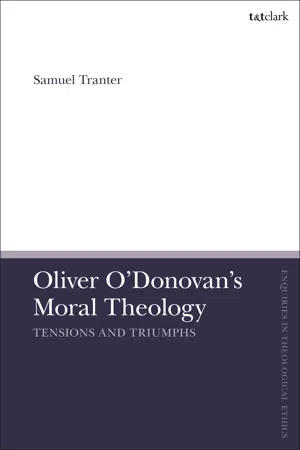
This book offers the first sustained, full-length treatment of the wide-ranging work of major Anglican theologian Oliver O'Donovan. Analyzing such key texts as Resurrection and Moral Order, The Desire of the Nations and Ethics as Theology, Samuel Tranter shows that the relationship between eschatology and ethics is an area of significant tension in O'Donovan's evolving vision of moral theology.
Tranter traces this tension as it relates to O'Donovan's writing and contemporary discussion around natural law, divine command and human flourishing, as well as to particular topics such as poverty, marriage and singleness and biotechnology. He also connects it with the broader doctrinal features of O'Donovan's project, such as his accounts of creation, sin and redemption, and his understanding of the relationships between the cross and the resurrection, on one hand, and Christology and pneumatology, on the other. Throughout, Tranter indicates the implications of these themes for our understanding of the Christian life.
This volume establishes and evaluates O'Donovan's influence on contemporary Christian ethicists and political theologians (such as Luke Bretherton, Gilbert Meilaender, Jean Porter and Brent Waters), and engages with critical readings of O'Donovan (such as those by Stanley Hauerwas and Gerald McKenny). In conversation with these and other voices from a range of perspectives, Tranter shows how O'Donovan's proposals may be appropriated and amended as a resource for theology and ethics going forward.
- 288 pages
- English
- ePUB (mobile friendly)
- Available on iOS & Android
eBook - ePub
About this book
Information
1
Groundwork
‘The Natural Ethic’
Introduction
I begin my exploration of O’Donovan’s writings with an early article entitled ‘The Natural Ethic’, which originated in a paper given at the 1978 National (UK) Evangelical Conference on Social Ethics. The piece might be regarded as juvenilia (O’Donovan was still in his early thirties when he wrote it), and it is true, as we shall see, that O’Donovan’s thought will gain a high degree of subtlety that is not especially evident here. But the argument of ‘The Natural Ethic’ is one possessed of a serious constructive ambition and prosecuted with confidence; it has been described with some credibility as ‘a manifesto for his later work’.1 On my reading, the way O’Donovan puts together an account of moral theology in this essay is essentially constitutive of the way he will continue to do so throughout his career – or at least until the partial recalibration of the late trilogy Ethics as Theology. Furthermore, ‘The Natural Ethic’ commends itself as a place to start because, among the constellation of ideas introduced as basic to O’Donovan’s thought, we find eschatology occupying an ambiguous position. The article captures a kind of ‘freeze-frame’ moment, then, which represents an initial stage in a decades-long wrestle with creation and redemption, their relation and the implications for morality.
This chapter examines O’Donovan’s assured early statement in some detail. First, it introduces his presentation of three rival traditions of moral theory, exploring his account of the decline of the third of these – the ‘natural ethic’ – and the results of that decline within Protestant thought. Protestant thought, O’Donovan claims, habitually confuses ontology and epistemology, imputing sinful disorder to nature where it ought not, and – relatedly – misapprehending the relationship between creation and redemption. This Protestant error is the backdrop against which he wishes to retrieve an ethic oriented to natural order. Next, I observe eschatology’s curious entry into O’Donovan’s argument. Caught up in a critique of historicism, eschatology appears at times to be tarred with the same brush, and portrayed as a cause of ethical irresponsibility. Nevertheless, O’Donovan does make a formal proposal that balance should be struck between nature and history, and just so between creation and eschatology. And notably, this proposal is designed to overcome the polarization of ‘creation ethics’ and ‘kingdom ethics’ that vexed evangelical moral and political discussion (and perhaps Protestant theology more widely).
I will argue, however, that ‘The Natural Ethic’ itself struggles to achieve that balance. The doctrine of creation seems to be afforded substantially more weight than eschatology; the article’s title suggests as much. This disparity may not, in itself, represent grounds for criticism. Despite the formal affirmation of balance, it seems that balance is not what O’Donovan ultimately wants to espouse. (Intriguingly, in the questions for discussion that accompany the paper in its published form, we will find what appears to be an acknowledgement of that fact.) Nonetheless, O’Donovan appears to place limits on the positive ethical import of eschatology as a result of this imbalance, and that seems to me a mistake.
Accordingly, I probe the reasons for the weighting of ‘The Natural Ethic’ and propose three contributing factors: first, O’Donovan’s sense of the priority of creation over redemption in Christian confession; second, his discernments regarding the pressures of the broader cultural milieu and the basis of a faithful Christian witness within it (a judgement similarly expressed, as we shall see, in O’Donovan’s slightly later Begotten or Made?); and, third, a notion of salvation as being principally the restoration of creation. Again, none of these features are necessarily problematic, intrinsically. But when they are understood in such a way as to diminish the moral significance of Christian teaching about eschatology, then a wrong implication has been drawn, and suspicion will wrongly be cast upon much that is theologically defensible – even upon that which, arguably, is imperative on the basis of the gospel.
Three rival traditions
O’Donovan begins the article with an account of three traditions of philosophical thought and their differing ways of conceiving moral disagreement.2 In the first place is one – we may call it rationalist, and O’Donovan gives as example the utilitarians – which ‘thought that moral judgement was essentially a matter of accurate prediction: ‘[I]f one could know exactly what consequences would follow from each of the alternative courses of action, one would be in no doubt as to which to follow.’3 But this perspective is found wanting: ‘[T]he most profound and terrifying moral controversies resist this kind of rationalization.’4 A second tradition – we may call it emotivist, though O’Donovan names no exemplar here – has by contrast ‘represented moral disagreement as a function of inscrutable personal commitment’.5 Again, this perspective misses crucial aspects of morality: ‘Moral judgements, unlike personal choices, belong to the public domain of reason.’6 It is, then, to neither of these traditions, but to a third, that O’Donovan invites us to turn in search of a more satisfying explanation:
The natural ethic offers us this account of moral disagreement: that when men look on the world as a whole they see different things. On the bare facts they may agree; but the structure of reality behind the facts they see quite differently, and this affects the way they describe and understand the facts. Is there such a thing as ‘food’, or only market produce? Is there rule and obedience, or only a social contract? Is there free gift, or only subtler forms of exchange? Are there natural ties, or only voluntary associations? At this metaphysical level many of the most profound and painful moral disagreements arise.7
Stated like this with its sequence of paired interpretations, the natural ethic seems to be attractive first of all because of its theoretical sensitivity to possibilities of divergence in the morally freighted interpretation of reality. But it will become clear that for O’Donovan, this tradition of moral reasoning is taken up because of its assistance in answering ethical questions coherently by supplying an encompassing metaphysics, besides explaining disagreement about them. Surely it is because he sees in ‘natural teleology’ the ability to illumine the structure of reality behind the facts and therefore to suggest an answer one way or the other – and in each of these cases we may guess the natural ethic would support the first of the two options given – that O’Donovan will seek ‘to make a case for’ it, in response to those ‘who have wished to deny it’.8
The neglect of the natural ethic
Though there are now those in both science and theology who would deny it, the natural ethic was ‘the accepted view of mediaeval Christianity, which got it from Platonic and Aristotelian philosophy’.9 But for the audience, O’Donovan thinks, it may be unfamiliar, even unpalatable, not least because this tradition ‘has had little favour in Protestant cultures’.10 That O’Donovan imagines his hearers might find the proposals disagreeable, though, is not simply because they are Protestants but more profoundly because they are people of modernity. As people of modernity, they inhabit a moral imaginary constructed after the collapse of the earlier consensus, and, on O’Donovan’s analysis, this collapse has had grave results for moral theory. If ethics formerly possessed a unified conception of nature, in which nature bears moral significance because it is conceived of as possessing kinds and ends replete with natural meaning, then that is now denied. His case thus rests on the claim that confidence in the inherent order and moral normativity of nature has been undermined, and ought to be urgently recovered.
The revolutionary movement that bequeathed the legacy of a disintegrating metaphysics, O’Donovan explains, consisted in a potent combination of two philosophical innovations: voluntarism and nominalism. Voluntarism suggested that moral value is ultimately decided by God’s will, not God’s intellect, contra the classical tradition: ‘Nature, as the expression of God’s mind, was value-free; questions of good and evil turned on what it was God’s will from time to time to command.’11 The sundering of fact and value followed. Nominalism, for its part, expressed the sceptical assessment that language of natural ‘kinds’ is creative rather than empirical, and introduced in its place a metaphysics of singulars.
Now, it is not O’Donovan’s gestural metanarrative as such that I want to draw attention to. It bears family resemblance to prominent approaches such as Charles Taylor’s and Alasdair MacIntyre’s – though note its early date.12 It is O’Donovan’s theological gloss on voluntarism that merits closer attention: ‘Another way of expressing it [voluntarism] would be that God’s purposes are to be known only in his providential work in directing history, not in his creational work which precedes history.’13 Here we already find in nuce O’Donovan’s acute sensitivity to the danger of neglecting the doctrine of creation, and his inclination to view that neglect as the root of many modern moral ills. (More complexly, we also find the insightful suggestion that it is possible for forgetfulness of creation to coexist with putative remembrance of providence.)
The besetting error of Protestant ethics
The philosophical innovations of voluntarism and nominalism fostered scientific thought – O’Donovan’s comments on this aspect of its heritage need not detain us14 – and they also inspired the Reformers, lending ‘tools’ with which ‘to attack the Thomist epistemology which allowed that in principle (and in fairness to St Thomas one should stress the phrase “in principle”), natural man might perceive natural values and natural meanings without the aid of revelation’.15 The Reformers responded with a ‘powerful and authentically Christian stress on the decisiveness of revelation’, encapsulated in their Christocentrism.16 Now for O’Donovan, it was apt for them to emphasize what might have been occluded: that ‘the bestowal of meaning is part of God’s saving work in history’.17 Erroneously, though, Protestantism took as corollary of this that ‘in nature man can discern no meaning’.18 It has therefore frequently focused solely upon ‘revelation in history’, which, while ‘certainly the lynchpin of Christian epistemology’, is not the only legitimate concern of ethics.19 In doing so, ‘making the epistemological issue supreme over the ontological’, Protestantism ‘has often tended to upset the balance that the Fathers struck’.20 And the imbalanced position, mistaking epistemological challenge for ontological deficiency, produced a misattribution of some consequence: ‘God’s creation should not be held responsible for a fragmentation which is really due to the problem of knowledge in fallen mankind.’21
Having identified these confusions, O’Donovan offers some semantic clarification. He argues that in Christian theology, ‘nature’ as a concept can properly be used to denote two things. Either it can be ‘contrasted with “revelation” as an epistemological programme, or contrasted with “history” to make an ontological distinction’.22 Clarifying this renders pellucid what Reformational instincts blurred:
The important epistemological points that the Reformation had to make must not be allowed to shelter a destructive and semi-Christian ontology. It is one thing to say that until the Word became incarnate, man could discern no meaning in nature; quite another to say that until the Word became incarnate nature had no meaning. Revelation is the answer to man’s blindness, not to nature’s emptiness. True, man’s blindness is itself part of a disruption with...
Table of contents
- Cover
- Half-Title
- Series
- Title
- Contents
- Acknowledgements
- Introduction
- 1 Groundwork: ‘The Natural Ethic’
- 2 Topography: Resurrection and Moral Order – ‘The Objective Reality’
- 3 Contour: Resurrection and Moral Order – ‘The Subjective Reality’ and ‘The Form of the Moral Life’
- 4 Territory: Desire of the Nations and Ways of Judgment
- 5 Remapping: Ethics as Theology
- Conclusion
- Postscript: The end of ethics
- Appendix: Cartography with O’Donovan and friends
- Bibliography
- General index
- Index of scripture references
- Copyright
Trusted by 375,005 students
Access to over 1.5 million titles for a fair monthly price.
Study more efficiently using our study tools.
Frequently asked questions
Yes, you can cancel anytime from the Subscription tab in your account settings on the Perlego website. Your subscription will stay active until the end of your current billing period. Learn how to cancel your subscription
No, books cannot be downloaded as external files, such as PDFs, for use outside of Perlego. However, you can download books within the Perlego app for offline reading on mobile or tablet. Learn how to download books offline
Perlego offers two plans: Essential and Complete
- Essential is ideal for learners and professionals who enjoy exploring a wide range of subjects. Access the Essential Library with 800,000+ trusted titles and best-sellers across business, personal growth, and the humanities. Includes unlimited reading time and Standard Read Aloud voice.
- Complete: Perfect for advanced learners and researchers needing full, unrestricted access. Unlock 1.5M+ books across hundreds of subjects, including academic and specialized titles. The Complete Plan also includes advanced features like Premium Read Aloud and Research Assistant.
We are an online textbook subscription service, where you can get access to an entire online library for less than the price of a single book per month. With over 1.5 million books across 990+ topics, we’ve got you covered! Learn about our mission
Look out for the read-aloud symbol on your next book to see if you can listen to it. The read-aloud tool reads text aloud for you, highlighting the text as it is being read. You can pause it, speed it up and slow it down. Learn more about Read Aloud
Yes! You can use the Perlego app on both iOS and Android devices to read anytime, anywhere — even offline. Perfect for commutes or when you’re on the go.
Please note we cannot support devices running on iOS 13 and Android 7 or earlier. Learn more about using the app
Please note we cannot support devices running on iOS 13 and Android 7 or earlier. Learn more about using the app
Yes, you can access Oliver O'Donovan's Moral Theology by Samuel Tranter in PDF and/or ePUB format, as well as other popular books in Theology & Religion & Christian Theology. We have over 1.5 million books available in our catalogue for you to explore.