This book examines the philosophies of nature of the early Greek thinkers and argues that a significant and thoroughgoing shift is required in our understanding of them. In contrast with the natural world of the earliest Greek literature, often the result of arbitrary divine causation, in the work of early Ionian philosophers we see the idea of a cosmos: ordered worlds where there is complete regularity. How was this order generated and maintained and what underpinned those regularities? What analogies or models were used for the order of the cosmos? What did they think about causation and explanatory structure? How did they frame natural laws?
Andrew Gregory draws on recent work on mechanistic philosophy and its history, on the historiography of the relation of science to art, religion and magic, and on the fragments and doxography of the early Greek thinkers to argue that there has been a tendency to overestimate the extent to which these early Greek philosophies of nature can be described as 'mechanistic'. We have underestimated how far they were committed to other modes of explanation and ontologies, and we have underestimated, underappreciated and indeed underexplored how plausible and good these philosophies would have been in context.
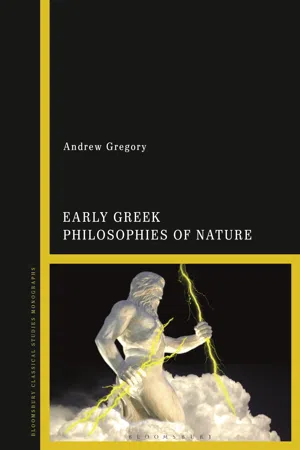
- 256 pages
- English
- ePUB (mobile friendly)
- Available on iOS & Android
eBook - ePub
Early Greek Philosophies of Nature
About this book
Information
1
Methodological Issues
As methodological issues will be crucial for this book, I want to discuss some of the key aspects in this first chapter. In particular I want to start with historiography, that is, how we approach doing the history of early Greek ideas on nature. As I will challenge the idea that any early Greek thinker was a mechanist, what assumptions are therefore in play and why have some scholars seen mechanism in early Greek thought? I also want to argue for some important intellectual space between what has direct affinity with modern science and what has been termed ‘the primitive’.1 I will look at how terms such as mechanist have been defined, and argue there is no one agreed definition; rather there is a wide range of views. Some Greek terms need examination as well, most notably the standard term for nature, phusis, but also kubernan, to steer, and kratein, to control. I will also question why scholars have taken supposed affinities between ancient science and seventeenth-century mechanical philosophy to be so important. Finally, I have something significant to say about Plato and early Greek thought. I argue that too stereotypical an approach to Plato in general and the Phaedo passage known as Socrates’ autobiography in particular gives an account of thought prior to Plato that is too binary and inflexible. A less rigid account of Plato’s reactions to his predecessors, which is supported by other passages in Plato, reveals interesting information about early Greek thought on nature.
Early Greek mechanistic thought?
One important argument of this book will be that there has been a tendency to overestimate the extent to which early Greek philosophies of nature can be described as ‘mechanistic’, along with an overestimate of how plausible and effective the ‘mechanistic’ interpretations would have been in context. I take ‘mechanistic’ quite broadly here, encompassing views on ontology, causation, explanation, analogies and natural laws. The corollary is that we have underestimated the extent to which these philosophies of nature were committed to other modes of explanation and ontologies, and that we have underestimated, and indeed underexplored, how plausible and good these philosophies would have been in context.
It is important here not to privilege mechanistic interpretations in three senses. First, one approach to early Greek philosophies of nature has been to seek affinities with modern science. The view, largely tacit, is that the deeper or more wide-ranging these affinities are, the higher our evaluation of early Greek science will be. Hence there has been a drive to find affinities between early Greek thinkers and either the mechanical philosophy of the seventeenth century and after, or modern mechanistic views. Second, some aspects of the mechanistic view, particularly relating to how we frame natural laws, have become widely and generally accepted. It is important that we do not treat key assumptions here as atemporally evident, or in some sense natural, and everything else as inferior to or as a deviation from these supposed atemporal truths. Third, we must recognize that the mechanistic view has undergone development and has had periodic crises of plausibility. So, in the eighteenth century the mechanical philosophy struggled for plausible explanations of biological phenomena recently discovered with the microscope until more sophisticated modelling techniques were developed. It is critical to recognize that ancient mechanistic views lacked sophisticated modelling, and opposition to them was not wholly based on issues of teleology or theology but could be based on issues of plausibility as well.
This book will argue that there is an important sense in which the early atomists, Leucippus and Democritus, often taken to be mechanists, were in fact not mechanists. Materialists, certainly, with an ontology of atoms and void, what is and what is not. However, there is a difference between materialism and a mechanical interpretation of materialism. If we look at the analogies the early atomists used, they did not use mechanical analogies, they did not liken the world to a machine, but used biological, human, agricultural and maritime analogues instead.
Two arguments against early mechanistic ideas do not interest me.2 One is that there was some form of disdain for the practical in the early Greek thought. Whether there was such a disdain or not, I would contend that a move to a mechanistic view of the world is not a simple, natural and straightforward consequence of a practical engagement with the world. The other argument is that the early Greeks saw mechanics as in some way contrary to nature or in some sense not part of what they conceived of as the investigation of nature. Recent work has debunked this view.3
Modernization?
I take this issue about affinities and mechanistic thought to be one within a broader phenomenon. In the history of science seeking affinities occurs more broadly, and one can see this process at work in the history of philosophy and in the history of literature too. The problem is not so much seeking affinities on their own but, as von Staden has argued, seeking affinities and eliding differences, or privileging any perceived affinities.4 There are several considerations to be balanced here. One is historical generosity towards the subject, which will lead us to look at possible affinities. On the other hand, we must be conscious of the fact that ideas do have a history and it is possible to attribute them anachronistically. Even if one is a strong realist about those ideas (so they always exist), human realization of them is a separate issue. I have argued elsewhere that the pursuit of scientific affinities can be misleading and indeed counterproductive.5 So with Anaximander, trying to make him ‘the first Darwinist’ conceals the interesting work he was doing in zoogony,6 recognition of which makes him a less ‘modern’ thinker, but paradoxically much more coherent and interesting, and one more in tune with the ideas of his time.
I bring up these issues because I have some things to say about Homer and Hesiod that may be controversial. I will argue that there is an important sense in which neither Homer nor Hesiod had philosophies of nature. By this I mean that they had no term for nature, nor did they have any conception of or any term for what is beyond or contrary to nature. Homer’s Circe has been hailed as the first witch in the Western literary tradition. However, neither narrator nor characters in the Odyssey treat her as a witch, and she does nothing different in kind to other gods and goddesses. This issue is important as it relates to Homer and nature. Is there a conception of beyond the natural to support the assertion of witchcraft? I argue there is not. The idea of Circe as a witch is an anachronistic imposition on Homer. There are other aspects of this phenomenon as well. I am concerned that translating moira (lot) as ‘fate’ can import inappropriate modern ideas to Homer. It is also unfortunate that debates about epistemology in Homer have centred on scepticism, a later idea for which Homer has no recognizable motivation, rather than looking at much more interesting issues of the Muses and the authority of the account given and what humans can know about the gods and moira. Finally, I argue that the idea of a historia, an investigation or enquiry, is alien to both Homer and Hesiod. If we are going to talk in terms of peri phuseōs historia, an ‘enquiry concerning nature’, we need to understand that later thinkers generated both the notion of phusis and the notion of historia. Less controversial will be my rejection of the idea that the self-moving equipment of Hephaestus’ workshop (Iliad XVIII, 414 ff.) and the self-steering ships of the Phaeacians (Odyssey VIII/ 555) were mechanical automata. This is a point worth mentioning to show that there can be interpretations of Homer that are too modern and too mechanistic, and a line needs to be drawn somewhere. The result of this process, applied to both poets and early philosophers and medical thinkers, is that we find an interesting engagement with the poets on issues of the generation and maintenance of order and on issues of epistemology as well.
Reflexivity
As I will point to some affinities between later developments and early Greek thought, there is an issue of reflexivity to account for. Indeed, if we think there is any continuity between the ancient investigation of nature and science, there must be such affinities and we need some affinities in order to be able to demarcate our subject matter from other ancient endeavours. It is not seeking affinities as such that is the problem, but doing so to the exclusion of dissimilarities, doing so within a Whiggish account of the history of philosophy or science, and doing so in a way which over-estimates the modernity of those affinities. I hope, being conscious of those pitfalls, to avoid them and to have a meta-level discussion of the nature and value of any supposed affinities, and as I have suggested above in relation to Anaximander, the depth of those affinities. It is also important to be conscious of attempting to be even-handed here. So one could produce an account that emphasiz...
Table of contents
- Cover
- Half-Title Page
- Dedication
- Series Page
- Title Page
- Contents
- Introduction
- 1 Methodological Issues
- 2 Order in Homer and Hesiod
- 3 Early Ideas on Knowledge and Enquiry
- 4 Anaximander and the Kubernan Tradition
- 5 New Explanations, New Philosophies of Nature
- 6 Anaximenes and the Kratein Tradition
- 7 Leucippus and Democritus
- 8 The Hippocratic Authors
- Conclusion
- Notes
- Bibliography
- Index
- Copyright
Trusted by 375,005 students
Access to over 1.5 million titles for a fair monthly price.
Study more efficiently using our study tools.
Frequently asked questions
Yes, you can cancel anytime from the Subscription tab in your account settings on the Perlego website. Your subscription will stay active until the end of your current billing period. Learn how to cancel your subscription
No, books cannot be downloaded as external files, such as PDFs, for use outside of Perlego. However, you can download books within the Perlego app for offline reading on mobile or tablet. Learn how to download books offline
Perlego offers two plans: Essential and Complete
- Essential is ideal for learners and professionals who enjoy exploring a wide range of subjects. Access the Essential Library with 800,000+ trusted titles and best-sellers across business, personal growth, and the humanities. Includes unlimited reading time and Standard Read Aloud voice.
- Complete: Perfect for advanced learners and researchers needing full, unrestricted access. Unlock 1.5M+ books across hundreds of subjects, including academic and specialized titles. The Complete Plan also includes advanced features like Premium Read Aloud and Research Assistant.
We are an online textbook subscription service, where you can get access to an entire online library for less than the price of a single book per month. With over 1.5 million books across 990+ topics, we’ve got you covered! Learn about our mission
Look out for the read-aloud symbol on your next book to see if you can listen to it. The read-aloud tool reads text aloud for you, highlighting the text as it is being read. You can pause it, speed it up and slow it down. Learn more about Read Aloud
Yes! You can use the Perlego app on both iOS and Android devices to read anytime, anywhere — even offline. Perfect for commutes or when you’re on the go.
Please note we cannot support devices running on iOS 13 and Android 7 or earlier. Learn more about using the app
Please note we cannot support devices running on iOS 13 and Android 7 or earlier. Learn more about using the app
Yes, you can access Early Greek Philosophies of Nature by Andrew Gregory in PDF and/or ePUB format, as well as other popular books in Philosophy & Ancient & Classical Philosophy. We have over 1.5 million books available in our catalogue for you to explore.