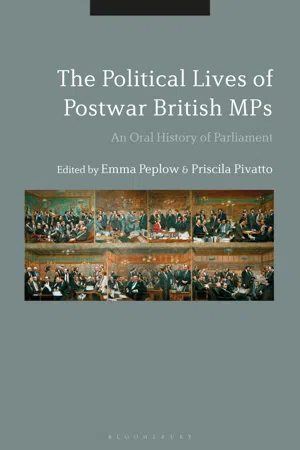
Parliament is Britain's most important political institution, yet its workings remain obscure to academics and the wider public alike. MPs are often seen as 'out of touch' or 'all the same' and their individual motivations, achievements and regrets remain in the background of party politics. In this book, Emma Peplow and Priscila Pivatto draw on the History of Parliament Trust's collection of oral history interviews with postwar British MPs to highlight their diverse political experiences in Parliament.
Featuring extracts from a collection of interviews with over 160 former MPs who sat from the 1950s until the 2000s, The Political Lives of Postwar British MPs gives a voice to those MPs' stories. It explores why they became interested in politics, how they found their seat and fought election campaigns, what it felt like to speak in the chamber and how their class or gender dictated their experiences at Westminster. In the process, readers will be given rare glimpse into the spaces inhabited by MPs, the political rivalries and friendships and the rising and falling of their careers.
With accounts from MPs of all political stripes, from the well-known like David Owen and Ann Taylor to those who sat for just a few years such as Denis Coe; from old political families like Douglas Hurd to those like Maria Fyfe who felt themselves outsiders, this book provides deep insight into the political lives of MPs in our age.
eBook - ePub
The Political Lives of Postwar British MPs
An Oral History of Parliament
- 288 pages
- English
- ePUB (mobile friendly)
- Available on iOS & Android
eBook - ePub
The Political Lives of Postwar British MPs
An Oral History of Parliament
About this book
Information
Part 1
Background
1
Discussions around the dining table
Politics at home
[My family] had quite strong opinions, all of us. It used to be quite a struggle to get the family together for Sunday lunch. […] We used to have tremendous discussions about politics and international affairs and a lot of fun. My father was a very good raconteur too. A lot of fun, a lot of laughter – but a lot of really serious hard talking and argument. I just got captivated by all this. So, really if you like to say, I am really a prisoner of my upbringing.
Frank Judd (Labour, 1966–79)1
What led our narrators to become interested, and later actively participate, in political life? For roughly half of the former MPs in the archive, this interest started in the homes and communities they grew up in. More often than not these experiences resulted in the political attitudes that you might expect – Mildred Gordon’s left-wing radicalism was shaped by the 1930s East End of London, her Labour councillor father and the Cable Street riots, for example – but this was not always the case.2 Labour MP Michael Barnes’s father was a Conservative agent.3
Many MPs interviewed attribute their basic values to their family, forming ideas of right and wrong that were later expressed politically. Some of those who grew up in the 1940s and 1950s, particularly those from a privileged or a religious background, talked about public service or giving something back. Not all came from religious homes or continued to hold religious beliefs, but for those who did, values from the church, chapel or synagogue (all our interviewees to date have Christian, Jewish or non-religious backgrounds) could influence them late into their lives. Derek Foster said he was ‘certain that it was being a Christian which drove me into politics in the end’.4
For the majority of our narrators, their families were political in the sense that at the very least politics was discussed in the home and their parents voted. In many cases it went further. A significant portion had parents or wider family who were MPs, ministers – in one case even prime minister.5 Political activism was, for these interviewees, ‘normal’. This covered all classes and parties. Olga Maitland’s home life was dominated by a daily household ritual of political conversation, drinks and dinner hosted by her father, an MP and later peer;6 Jim Sillars’s father danced for joy with his four-in-a-block council housing neighbours on hearing the 1945 Labour landslide result.7
This family involvement encouraged, in some, early activism themselves. Several remember helping in election campaigns as children. For the children of MPs this had a deep impact on their childhood. Emma Nicholson said that ‘the constituents came first’ for her father,8 and both she and Llin Golding discussed the hardships faced by their mothers raising families with fathers away in Parliament.9 Some felt inspired by their family’s activism. Hilton Dawson remembered feeling his grandmother’s presence when he sat in Parliament,10 and Ann Cryer ‘couldn’t imagine my life without a political aspect’, and traced her political commitment to her Independent Labour Party (ILP) grandmother.11
Several MPs were grateful for wide, direct, sometimes financial support and encouragement from their families. For some this was only after initial discouragement to test their resolve. This involvement was not always without conflict. Michael Irvine described his Labour MP father’s efforts to keep him in the Labour Party, and his disappointment when he decided to stand for the Conservatives.12
Some attributed their early political beliefs to family and community circumstances, such as poverty or periods of unemployment. A working-class background did not necessarily lead to left-wing politics. Elizabeth Peacock remembered her mother’s ire at her vote being taken for granted by Labour councillors just because they lived in a council house.13 Forming attitudes could be subtle: Members of all parties described socializing only with others who had similar views, but this was more often mentioned by Labour Members, who could believe that there was ‘something wrong’ with Conservative voters.
But not all came from political backgrounds, however. Some remembered their families only discussing politics on election day. Peter Jackson’s father actively discouraged his political interest as he believed it was a distraction from his studies.14 So a political home was not necessary to form a future MP, but in many cases it certainly helped.
* * *
My father insisted that we should always read a good newspaper, every day. [...] He would still insist that you’ve got to keep yourself informed in as broad-minded a way as possible. [...] How did liberalism permeate the household? It was something to do with tolerance, fairness and justice, and, not in any religious sense at all, but always considering others when you were considering yourself. Jenny Tonge (LD, 1997–2005) 15
During the war obviously floor coverings were scarce and expensive; it was quite common to put old newspapers on the floor, particularly in wet weather. My mother was always complaining that whatever she asked me to do, I’d sort of stop half way and started reading the newspaper [laughs]. So I sort of took an interest in current affairs, and was conscious of what politics was about. Roger Sims (Conservative, February 1974–97) 16
What I can remember, actually, is developing an interest in politics and starting to read the Guardian. [...] and I can also remember subscribing to left-wing journals. [...] So from a very, very early age I became political, to such an extent that I became very politically conscious, conscious of Britain’s role [after the Second World War] and not wanting to be conscripted [into the RAF]. I said to my father, ‘I’m going to volunteer to be a Bevin boy,’ and he said he would kick me out if I did.17 And I was a bit weak. Peter Jackson (Labour, 1966–70) 18
My father said to me one time, [I was] just a boy. ‘You’re on about the Germans, it’s not the Germans, it’s the Nazis. The Germans are like us, ordinary folk just like us. [...] The difference between the Nazis and our society is that they promote the thugs.’ [...] That was me getting taught the difference between an ‘ism’ [and a people]. Eric Clarke (Labour, 1992–2001) 19
My father had a great influence on the way I saw things. He was a socialist, but he wasn’t in any sense whatever a party man. He was a person of independent thought. He wasn’t a joiner, none of my family ever were joiners, they were all individualists. He certainly tended to see things from a socialist point of view. He was anti-Hitler, anti-Mussolini, anti-Stalin too, I’m pleased to say, a large number of socialists in those days weren’t. Not only did I as a child get interested in politics through him but I started off imbibing his attitudes and opinions [...] It was a good start. Bryan Magee (Labour/SDP, February 1974–83) 20
I think it was the public service element in [my parents’ lives] which I admired. I didn’t set out to emulate it, I just became involved. Kenneth Warren (Conservative, 1970–92) 21
My parents were at that stage school teachers, and my dad was on the local council. [...] So we grew up in a household where we always talked about what was going on in the world, where [...] we were always, we just were encouraged to think and be involved. I do remember once when I was probably a teenager he said [...] to my brother and I: ‘I don’t care what you do, but you’ve got some responsibilities for other people. You should be involved in public life in some way.’ It was just what we were brought up with. Hilary Armstrong (Labour, 1987–2010) 22
[My maternal grandmother] thought Jews from privileged families should give public service. When she heard I’d left the navy, aged seventeen, she took down a photograph of me from a mantelpiece beside one of Queen Mary, banded it and put in a drawer and never took it out again. And I heard about this, it upset me slightly, and when I failed to get into the Royal Academy of Music, I determined to get on with trying to do public service through politics. […] I didn’t grow up in a Tory atmosphere. I grew up in a British patriotic and public service atmosphere. Serve the country: queen and country. Royal Navy is better than the army and the air force. Churchill won the war. [...] Nothing about Conservative Party doctrine. Toby Jessel (Conservative, 1970–97) 23
My parents actually were Christian Scientists; it’s something I found a bit difficult to handle as I grew up. They were very staunch readers of the Bible. They would go to church twice on a Sunday, something called a testimony meeting on a Wednesday, so my childhood was surrounded by the church – church activities. I went to a church school, so religious, Christian values very much affected my thinking politically I think. David Hinchliffe (Labour, 1987–2005) 24
My father and mother were both practicing Christians without ramming it down our throats. [...] That was part of my life and it remains part, [...] it does [inform my politics]. It’s a difficult marriage, [...] you find yourself in contradictions. Take assisted dying [...] I will make up my mind, when [the issue is debated in the House of] Lords, [...] I will take into account the views expressed on behalf of the Church of England by the Bishops in the Lords. [...] It is just an illustration of how occasionally you do look for guidance on a matter which isn’t party political. Douglas Hurd (Conservative, 1974–97) 25
I took confirmation in time for my twenty-first birthday. [...] During that discussion [with the priest] on confirmation, he spoke about my life experiences and how I viewed things, the values that I thought were correct in life. He said, ‘What are you doing with those values? [...] So if there’s an opportunity to play a part, then it’s duty, your own sense of responsibility to play a part. Whether it’s in religion, in politics or in life [...] just take those responsibilities.’ [...] It was [...] because of what he was saying [...] I decided at the age of nineteen, twenty to join the Young Socialists, thinking to myself, ‘Well, he’s right, if you don’t do anything other people will make decisions for you.’ Frank White (Labour, October 1974–83) 26
* * *
I was very influenced by my father. [...] Ovington Square life was intensely political. In the evenings it was a complete tra dition, the ping of six o’clock [...] out would come the drinks for the evening, it was generally whisky, and then the conversation would start. They would argue and toss issues around – my parents and whoever else was around – before a rather late dinner. [...] Those evenings swapping of ideas over drinks were really a big factor in our lives. We as children, of course we couldn’t follow what was going on, but we heard about it, we could feel it, we could sense it. [...] You could sense all that buzz. My mother [...] was very good at cutting through the talk and getting to the essence. Olga Maitland (Conservative, 1992–7) 27
[My father was] a great believer in nationalisation, particularly in transport, because he’d seen what had happened in between the wars with the laissez-faire attitude to rail services. So I was brought up with that very strong sense of it matters who owns it. [...] There’s a better deal for working people when they do own it. [...] [Politics was discussed] all the time – the local candidates but obviously they loved Aneurin Bevan. He was worshipped in our household. Alice Mahon (Labour, 1987–2005) 28
[My earliest political memory] was the 1945 result. I knew, I was just a child, but I knew something significant had happened because my father who must have been listening to the wireless rushed down the stairs [...] to tell [our neighbours] and they were literally dancing up and down the path with great joy. So obviously for me this was very, very significant, my father saying we’re in at last, sort of thing. After that I didn’t really bother terribly much until the ’51 election when Labour were defeated. I just happened to be there in our kitchen with the old man, and he was in ...
Table of contents
- Cover
- Half-Title
- Title
- Contents
- Foreword
- Foreword
- Acknowledgements
- Note on the text
- Introduction
- Part I Background
- Part II Politics before Westminster
- Part III House of Commons
- Part IV Politics
- Part V Reflections
- Conclusion
- Notes
- Glossary of MPs
- Bibliography
- Index
- Copyright
Trusted by 375,005 students
Access to over 1.5 million titles for a fair monthly price.
Study more efficiently using our study tools.
Frequently asked questions
Yes, you can cancel anytime from the Subscription tab in your account settings on the Perlego website. Your subscription will stay active until the end of your current billing period. Learn how to cancel your subscription
No, books cannot be downloaded as external files, such as PDFs, for use outside of Perlego. However, you can download books within the Perlego app for offline reading on mobile or tablet. Learn how to download books offline
Perlego offers two plans: Essential and Complete
- Essential is ideal for learners and professionals who enjoy exploring a wide range of subjects. Access the Essential Library with 800,000+ trusted titles and best-sellers across business, personal growth, and the humanities. Includes unlimited reading time and Standard Read Aloud voice.
- Complete: Perfect for advanced learners and researchers needing full, unrestricted access. Unlock 1.5M+ books across hundreds of subjects, including academic and specialized titles. The Complete Plan also includes advanced features like Premium Read Aloud and Research Assistant.
We are an online textbook subscription service, where you can get access to an entire online library for less than the price of a single book per month. With over 1.5 million books across 990+ topics, we’ve got you covered! Learn about our mission
Look out for the read-aloud symbol on your next book to see if you can listen to it. The read-aloud tool reads text aloud for you, highlighting the text as it is being read. You can pause it, speed it up and slow it down. Learn more about Read Aloud
Yes! You can use the Perlego app on both iOS and Android devices to read anytime, anywhere — even offline. Perfect for commutes or when you’re on the go.
Please note we cannot support devices running on iOS 13 and Android 7 or earlier. Learn more about using the app
Please note we cannot support devices running on iOS 13 and Android 7 or earlier. Learn more about using the app
Yes, you can access The Political Lives of Postwar British MPs by Emma Peplow, Priscila Pivatto, Emma Peplow,Priscila Pivatto in PDF and/or ePUB format, as well as other popular books in History & Modern British History. We have over 1.5 million books available in our catalogue for you to explore.