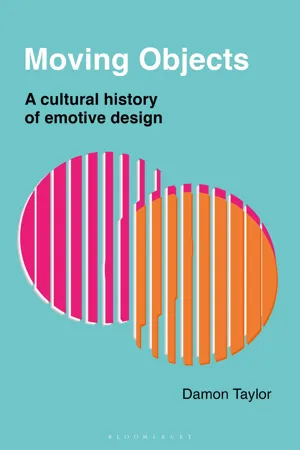
Moving Objects deals with emotive design: designed objects that demand to be engaged with rather than simply used. If postmodernism depended upon ironic distance, and Critical Design is all about questions, then emotive design runs hotter than this, confronting how designers are using feelings in what they make.
Damon Taylor's original study considers these emotionally laden, highly authored works, often produced in limited editions and sold like art – objects such as a chair made from cuddly toys, a leather sofa that resembles a cow, and a jewellery box fashioned from human hair.
Tracing the phenomenon back to the 'Dutch inflection' that began with Droog designers like Jurgen Bey and Hella Jongerius, Taylor conducts an analysis of the development of Design Art and looks for its origins in the uncanny explorations of surrealism. Offering a critique of Speculative Design, and an examination of the work of designers such as Mathias Bengtsson, whose work involves 'growing' furniture inside computers, Taylor asks what happens when the tangible melts into the datascape and design becomes a question of mobilities. In this way, Moving Objects examines contemporary issues of how we live with artefacts and what design can do.
- 248 pages
- English
- ePUB (mobile friendly)
- Available on iOS & Android
eBook - ePub
About this book
Information
1
Droog: The dry and the moist
Just before Christmas of 2010, Droog Design opened a new retail space in The Cosmopolitan, a $3.9 billion hotel and gambling complex in Las Vegas. The interior, designed by Marcel Schmalgemeijer, was modelled on the final sequences of the film 2001: A Space Odyssey and the underfloor lighting gave the strange and outlandish furniture presented an other-worldly glow. A few days before the opening of the store, John Unwin, CEO of The Cosmopolitan, gave a journalist from the publication Travel and Leisure a tour of the hotel site. Having pointed out the ‘casino cabanas’ and the lobby columns patterned with high-definition video screens, they reached the building’s eastern edge, where it opens onto the sidewalk of the Las Vegas Strip. Here, Unwin remarked, ‘We’re going to put a Droog in this corner.’ ‘A what?’ the journalist asked, bemused. ‘You know: Droog, the Dutch design store,’ replied his host, explaining, ‘slots [slot machines] would make more money, but I think Droog is cooler.’1 It is clear then what the hotel gained from this: prestige and the glamour of appearing cutting-edge. But what was Droog getting from the deal?
Nearly two decades before, in April 1993, in an old villa in the centre of Milan, Droog Design showed their first collection at the prestigious Salone del Mobile. Droog is a commercial collective established by the historian and critic Renny Ramakers and the designer and educator Gijs Bakker, which was formed to act as a vehicle for a new wave of Dutch design. At this point, Ramakers was one of the most important and well-known design commentators in the Netherlands. Bakker and his partner Emmy van Leersum had been central to the Dutch and German studio jewellery movement of the 1970s, and in the 1980s, his activities had broadened out to include furniture and product design, making him a leading figure in the Dutch design world at the time, allowing him to lend creative and academic weight to the project.2 At the Salone show, Droog presented a range of furniture and utilitarian domestic objects, which included ‘a bundle of second-hand drawers, a chair made of rags, piled up lamp shades, a coffee maker in which bicycle lamps were mounted, a bookcase made of paper’.3 Reviewing the show, the French newspaper Libération suggested that the ‘unknowns’ responsible for Droog should be ‘given a medal for spiritual savoir vivre’, saying that ‘they tell the most improbable of stories. Fairytales without fairies. Fleeting. They are brilliant in that they arouse the desire to revivify the quotidian in life. Design for them is not a question of taste but an ongoing issue. That makes you feel better. The way a stroll through the flea market does.’4
In the past, much has been made of the Dutch origins of this type of design. Gareth Williams, one of the main commentators on this kind of work and the former curator of contemporary furniture at the Victoria and Albert Museum, has observed that there are ‘common themes and shared concerns’ that are observable in this kind of design ‘which has led to what we might describe as a Dutch inflection in international design today’.5 Ramakers was certainly keen to promote the idea that there is something basically Dutch in such an approach, particularly in the idea that there is an essentially humorous quality to it. She states that ‘the Dutch tradition of simplicity and clarity links arms with the nose-thumbing element’ which is typified by a ‘“dry” (droog) humour’.6 Similarly, Paola Antonelli, the curator of design at the Museum of Modern Art in New York, has observed that Droog designs ‘did not necessarily have much in common but shared a similar sensitivity’ which was identified as ‘typically Dutch and thus exquisitely dry’.7 However, as the following history of this kind of work will show, though the origins of the Droog approach (and that of work that followed it) can certainly be attributed to a way of working developed in the Netherlands, not least at the Design Academy Eindhoven, there were broader influences at work. In many ways more than being typical of a particular national approach, what was special about Droog when it launched was the way it seemed to capture a certain attitude that was in the air at the time, one that was iconoclastic whilst also being sensitive to the growing importance of feeling in design.
Seventeen years later, they were a cool loss leader for a hotel and casino. Ramakers, her co-founder Bakker having departed by this point, stated that ‘Droog has always pioneered new directions for design, we see our role as a design company in creating new content and also in setting new boundaries in how and where our work is encountered. Las Vegas is a new context for us and we are excited about the opportunities it will bring.’8 Yet, this seemed a strange trajectory. How did an organization that began life challenging the design profession by presenting work that appeared to revitalize the everyday come to be selling its wares in the gaudy environs of the Las Vegas Strip?
It might be observed that it was a change in the way in which design was marketed that had primarily led to the development of this type of work. As Williams suggested some time later, it could be seen that ‘the mechanisms of the art world, specifically the art market’ had at this time ‘increasingly leeched into the practices of designers’.9 Though he acknowledges that the situation was much more complicated than this initial statement might suggest, such an assertion illustrates the way in which commentators have stressed the importance of the market in the appearance of emotionally laden, content-heavy design.10 Whilst it should be acknowledged that the commercial development of the market was crucial in shaping how we ascribe value to such objects (and this is discussed in detail in Chapter 4), the intention here is to place the artefacts into a context whereby they are understood as design, rather than being valued as a form of pseudo-art. This will then involve taking into account the way in which commercial concerns shaped them, but at the same time keeping in view the way that particular formal and functional considerations, associated with the discourse of design rather than art, have served to determine their nature.
Droog was established by Ramakers and Bakker as a way of showcasing the work of young designers from the Netherlands, both to raise the status of Dutch design and to market it on the international stage. Influenced by work such as Jasper Morrison’s Some New Items for the Home Part 1, shown at Milan in 1988, Ramakers detected what she described as a ‘back-to-basics’ approach that was more playful than the neo-modernist design that dominated at the time.11 Morrison’s show has the feel of an installation. A spartan room is populated by a few pieces of simple furniture. The bookcase is drawn onto the wall and three green bottles stand on the table. Here, therefore, something interesting is happening, in that the viewer is directed to examine the table and chairs, but a broader narrative is implied. The stage-set-like appearance of the show seems to suggest a domestic life interrupted. That is, the set-up seems to say something about use. This approach, if not co-opted by Ramakers, then at least was used as a form of compass as she selected works that were to exemplify the new Dutch tendency she wished to sell.
The following chapter is not a narrative history of Droog, but it does follow the path of the organization from the early works appropriated into the organization by Ramakers and Bakker through to its move to Las Vegas to discover how the form of highly expressive design they promote came to move from the margins of the design world to occupy a place at the top end of the market for designed goods. In the process, the intention is to ask what tools need be applied if we are to understand what happened to allow for these circumstances to pertain. To do this it will be necessary to consider what qualities this form of design possesses, what techniques have been applied in their creation and how our relationship to such objects has changed in the intervening years. Throughout, Droog products are examined, not to form a chronological account of the organization’s history or to catalogue their output but to allow a window onto practices that reveal how these marvellous things actually represent a darker and more interesting undercurrent in design than their reputation as quirky status symbols may suggest.
The presence of things
What makes Droog’s early output exciting is that the strange things they produced really were meant to be manufactured, sold and used. The central feature that makes design design, rather than art or something simply to be mused upon is use. Designed objects, no matter how absurd they are, by being presented as design, suggest that they will actually be employed by someone to do something. Yet, use is about much more than simply the application of the object as a tool. Tejo Remy’s Rag Chair of 1991, for example, which was a feature of Droog’s first show, has been made by wadding together rags which are held in the shape of a chair by being bound in metal tapes (Figure 6). As is discussed below, in a piece such as this, we have a strong sense of the creator of the object, its author. Its improvised feel gives the impression that another person has spent time putting this thing together. Crucially, however, upon encountering an object such as this, there is also a sense that this is a thing that has been made for somebody to use; its adoption of the formal chair archetype and its titling as a chair, all place it in the field of domestic use objects, even if it is a florid example.

Figure 6 Tejo Remy, Rag Chair for Droog, 1991. Photographer: Robaard/Theuwkens (Styling by Marjo Kranenborg, CMK)
Remy’s chair is made from the appropriated detritus of modern life. In this way, it seems to be a far cry from functionalist furniture. It has been put together from elements that have initially been created for a different purpose, suggesting some form of recycling or reuse. This might then appear to imply that Remy was in some way ‘upcycling’ the materials (though this word would not have been used at the time, of course), to effect a more ecologically sound form of design. Indeed, Ramakers was keen to promote this reading of the work.12 Yet, this was not the designer’s intention,13 and the effect of the piece is certainly not limited to a conscious recognition of such an agenda. Rags speak of change, of one thing turning into another. Consequently, Remy’s chair invokes a sense of the transience of manufactured goods and the way that modernity is as much about waste and decay as it is about the construction of a shiny new future. As the critic Walter Benjamin notes, Charles Baudelaire, the lyrical poet of high capitalism in the nineteenth century, was much concerned with the ragpicker as a feature of modernity. He observed:
Here we have a man who has to gather the day’s refuse of the capital city. Everything that the big city threw away, everything it lost, everything it despised, everything crushed under foot, he catalogues and collects. He collects the annals of intemperance, the capharnaüm (stockpile) of waste. He sorts things out and makes a wise choice; he collects like a miser guarding a treasure, the refuse which will assume the shape of useful or gratifying objects between the jaws of the goddess of Industry.14
In just this way, Remy’s chair appears to be the work of a designer who has sorted through the detritus of modern production to create a useful or gratifying object. In the process, we are offered a chair, one that can be sat on and used in the standard way, but it is also a thing that stimulates a certain reaction, one that is outside of the bounds of the normal functions of furniture.
Things such as Remy’s chair can certainly be regarded as functional pieces of design, in that they do what they were intended to in a practical sense. That they are also expressive objects, which demonstrate a poetic approach to how they operate, does not then disqualify them as functional, rather it exemplifies the way that, as the design historian John Heskett has argued, a more fully inclusive definition of function is nee...
Table of contents
- Cover
- Half-title Page
- Title Page
- Contents
- Figures
- Acknowledgements
- Introduction
- 1 Droog: The dry and the moist
- 2 Framing design art
- 3 Viscerealities
- 4 Valuing emotive design
- 5 Rhetorical devices and lyrical things
- 6 To the ends of the earth
- Notes
- Select Bibliography
- Index
- Copyright Page
Trusted by 375,005 students
Access to over 1.5 million titles for a fair monthly price.
Study more efficiently using our study tools.
Frequently asked questions
Yes, you can cancel anytime from the Subscription tab in your account settings on the Perlego website. Your subscription will stay active until the end of your current billing period. Learn how to cancel your subscription
No, books cannot be downloaded as external files, such as PDFs, for use outside of Perlego. However, you can download books within the Perlego app for offline reading on mobile or tablet. Learn how to download books offline
Perlego offers two plans: Essential and Complete
- Essential is ideal for learners and professionals who enjoy exploring a wide range of subjects. Access the Essential Library with 800,000+ trusted titles and best-sellers across business, personal growth, and the humanities. Includes unlimited reading time and Standard Read Aloud voice.
- Complete: Perfect for advanced learners and researchers needing full, unrestricted access. Unlock 1.5M+ books across hundreds of subjects, including academic and specialized titles. The Complete Plan also includes advanced features like Premium Read Aloud and Research Assistant.
We are an online textbook subscription service, where you can get access to an entire online library for less than the price of a single book per month. With over 1.5 million books across 990+ topics, we’ve got you covered! Learn about our mission
Look out for the read-aloud symbol on your next book to see if you can listen to it. The read-aloud tool reads text aloud for you, highlighting the text as it is being read. You can pause it, speed it up and slow it down. Learn more about Read Aloud
Yes! You can use the Perlego app on both iOS and Android devices to read anytime, anywhere — even offline. Perfect for commutes or when you’re on the go.
Please note we cannot support devices running on iOS 13 and Android 7 or earlier. Learn more about using the app
Please note we cannot support devices running on iOS 13 and Android 7 or earlier. Learn more about using the app
Yes, you can access Moving Objects by Damon Taylor in PDF and/or ePUB format, as well as other popular books in Design & Design General. We have over 1.5 million books available in our catalogue for you to explore.