The French Revolution brought momentous political, social, and cultural change. Life in Revolutionary France asks how these changes affected everyday lives, in urban and rural areas, and on an international scale.
An international cast of distinguished academics and emerging scholars present new research on how people experienced and survived the revolutionary decade, with a particular focus on individual and collective agency as discovered through the archival record, material culture, and the history of emotions. It combines innovative work with student-friendly essays to offer fresh perspectives on topics such as:
* Political identities and activism
* Gender, race, and sexuality
* Transatlantic responses to war and revolution
* Local and workplace surveillance and transparency
* Prison communities and culture
* Food, health, and radical medicine
* Revolutionary childhoods
With an easy-to-navigate, three-part structure, illustrations and primary source excerpts, Life in Revolutionary France is the essential text for approaching the experiences of those who lived through one of the most turbulent times in world history.
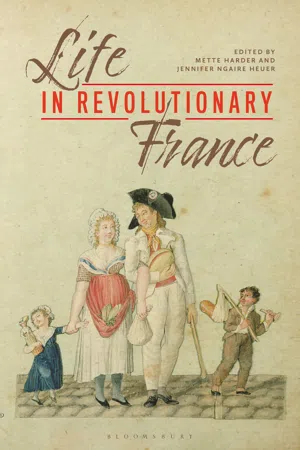
eBook - ePub
Life in Revolutionary France
- 424 pages
- English
- ePUB (mobile friendly)
- Available on iOS & Android
eBook - ePub
Life in Revolutionary France
About this book
Information
PART ONE
Revolutionary Identities and Spaces
1
Republicans and Royalists:
Seeking Authentic Rural Voices in the Sources of the French Revolution
Jill Maciak Walshaw
On a warm summer evening, Jeanne Floissac, known affectionately to locals as La Floissaquette, was serving customers at the inn she managed with her husband in the village of Casseneuil in the south-western department of Lot-et-Garonne (see map of France in Figure 0.1).1 It was July 1793, and France was in the fourth year of Revolution. The king was dead and the queen was in prison, awaiting trial. The new government, the National Convention, had been elected by near-universal male suffrage; Robespierre led the radical faction known as the Mountain, and the Terror had begun. France had been at war with Austria and Prussia for about a year, and just six months prior, the republic had announced that 300,000 young men would be conscripted to march under the tricolor banner.
In such turbulent times, inns like the one run by Jeanne and her husband were places where country people would gather, to relax and socialize, but also to hear the news and share their opinions. On this particular evening, some of la Floissaquette’s customers were talking, and some were playing a game of “sizette” (a card game played by two opposing teams of three players); all were drinking. When a rival innkeeper, Antoine Barroussel, came to pay his tab with two municipal vouchers worth 20 sous and 10 sous respectively, Jeanne refused them, saying that they were no longer legal tender. “No matter,” replied Barroussel; “I can use them to pay the taille,” referring to the main tax on land and wealth that had been assessed before the Revolution. Witness testimony was conflicted on what happened next: some, including two weavers, one tailor and two farmers, said that Jeanne retorted, “since we no longer have a king, we shouldn’t have to pay taxes,” while a third weaver, twenty-four-year-old Pierre Tonbat, added that she had said, “I don’t like the Republic; you people like it if you want.” Barroussel brought an accusation to local officials and Jeanne was arrested on the charge of provocation au rétablissement de la royauté—verbally attempting to bring about the return of the monarchy—the penalty for which was death by guillotine.
Jeanne Floissac successfully defended herself: in the interrogations that followed, she clarified that she had said “since we no longer have a king we don’t pay the taille, but we do pay the [Republican] property taxes,” and she produced three new witnesses who confirmed her version. When she was asked about her opinion on the Revolution—whether she had ever rejoiced at the setbacks of the French army or at resistance to the new regime—she responded evenly that “she had always been happy when the affairs of the Republic were going well.” In the end, all witnesses—even those who had initially supported Barroussel—agreed that Jeanne had spoken in a calm way, and that they hadn’t perceived any intention, in her words or body language, to inspire hatred of the republic or to discourage them from paying their taxes; they had left her establishment, they said, without having been scandalized by what she’d said. Not only was Jeanne acquitted, but Barroussel was fined 300 livres in damages for malicious intentions.2
What can this story—and the trial documents used in its telling—teach us about rural responses to the French Revolution? Clearly, political issues were front-of-mind not only for Parisian sans-culottes but also for citizens in the provinces. The Revolution affected everyone, both positively and negatively, and country dwellers were not shy about voicing their opinions. The latter was true from the earliest days of the Revolution, and arguably, before. What had changed by 1793 was that the republic was on shaky ground: threatened by external enemies and domestic ones, its elected body deeply divided, the government issued law after law prohibiting seditious actions or words that might shake people’s faith in the regime. Possibly, Barroussel’s denunciation was a complete fabrication, aimed at ousting his competition in Casseneuil. Or perhaps Jeanne Floissac had spoken carelessly, expressing what many were feeling: frustration with war, requisitions, and taxes, and a Revolution that seemed increasingly directed from Paris.
The Revolution did not come out of the blue, nor was it a completely modern event imposed on a backward society. True, the Third Estate delegates to the Estates-General and the later governments were largely members of an educated, wealthy, and more urban elite, but the peasants were not as unprepared for the Revolution—or as uninvolved in it—as we might imagine. It takes careful attention to tease their experience out of the mountains of revolutionary documents that remain of that decade.
The basic narrative of the rural response to the French Revolution is familiar. In broad terms, villagers initially supported the gains achieved in 1789 and 1790, such as the abolition of the feudal regime and the administrative revolution that gave more power to local municipalities, but they became a conservative and even counter-revolutionary force as the Revolution diverged from rural values and interests. The split in the Catholic Church resulting from the Civil Constitution of the Clergy in 1791 and the arrest and eventual execution of Louis XVI disrupted two key pillars of rural society, while the relentless demand for recruits and supplies after the declaration of war in 1792 and the radicalization of the political landscape in the spring and summer of 1793 aggravated the situation. Yet while these sweeping brushstrokes are accurate in a general sense, the picture does not allow for the many ways in which villagers engaged with the events and political culture of the Revolution, often enthusiastically and with originality.
In this chapter, we will tackle the thorny problem of how we, as students of history, can uncover the rural experience of Revolution, with little in the way of unfiltered source material. After a brief orientation to the historiography, we will look at a series of moments when the peasantry participated in political affairs on both the left and the right. “If there was a rural popular movement during the Revolution, then it was counter-revolutionary, Catholic and royalist,” one scholar has claimed,3 yet some peasants were decidedly pro-revolutionary. Villagers enthusiastically discussed new laws and announcements in municipal assemblies which had existed before 1789 and which the Revolution infused with new political importance. With a wave of anti-seigneurial uprisings in the summer of 1789, they pushed middle-class deputies to abolish not only the feudal regime but all unredeemed dues, changing forever the social fabric of the countryside.4 They formed National Guard units and political clubs modeled after the Jacobin Club in Paris, they wrote petitions to the National Assembly, and voted in elections. Villagers also made political statements—often, but not always, expressing apathy, disgust, or outright hostility—which have been recorded in hundreds of trials for sedition and seditious speech. Despite the barriers of language, culture, and more than 200 years that separate us from those who lived through the Revolution, engaging with these raw local sources brings us to a deeper, more nuanced understanding of how the Revolution was experienced in the countryside.
Describing Rural Experience: Approaches and Challenges
In 1993, Vivian Gruder asked the provocative question, “Can we hear the voices of peasants?” Her answer was yes: teasing out questions of local dialect, political awareness, and the divide between peasant spokespeople and literate intermediaries, Gruder argued that the rural views expressed in two 1788 pamphlets could be considered not only authentic but strikingly perceptive. ...
Table of contents
- Cover
- Half-Title Page
- Title Page
- Contents
- List of Figures
- List of Maps
- Acknowledgments
- Introduction: Rethinking the Revolutionary Everyday
- Part One Revolutionary Identities and Spaces
- 1 Republicans and Royalists: Seeking Authentic Rural Voices in the Sources of the French Revolution
- 2 Mapping Women’s Everyday Lives in Revolutionary Marseille
- 3 Emigration, Landlords, and Tenants in Revolutionary Paris
- 4 Home Fronts and Battlefields: The Army, Warfare, and the Revolutionary Experience
- 5 Race, Freedom, and Everyday Life: French Caribbean Prisoners of War in Britain
- Part Two The Right To?—Revolutionary Justice at Work
- 6 Crime, Law, and Justice
- 7 Surveillance at Work: A Theft on the Rue du Bac
- 8 Sex as Work: Public Women in Revolutionary Paris
- 9 Doctors, Radicalism, and the Right to Health: Three Visions from the French Revolution
- Part Three Revolutionary Experiences, Practices, Sensations
- 10 Tasting Liberty: Food and Revolution
- 11 Spectacles of French Revolutionary Violence in the Atlantic World
- 12 Practice and Belief: Religion in the Revolution
- 13 Facing the Unknown: The Private Lives of Miniatures in the French Revolutionary Prison
- 14 Revolutionary Parents and Children: Everyday Lives in Times of Stress
- Notes on Contributors
- Recommended Reading
- Index
- Copyright
Trusted by 375,005 students
Access to over 1.5 million titles for a fair monthly price.
Study more efficiently using our study tools.
Frequently asked questions
Yes, you can cancel anytime from the Subscription tab in your account settings on the Perlego website. Your subscription will stay active until the end of your current billing period. Learn how to cancel your subscription
No, books cannot be downloaded as external files, such as PDFs, for use outside of Perlego. However, you can download books within the Perlego app for offline reading on mobile or tablet. Learn how to download books offline
Perlego offers two plans: Essential and Complete
- Essential is ideal for learners and professionals who enjoy exploring a wide range of subjects. Access the Essential Library with 800,000+ trusted titles and best-sellers across business, personal growth, and the humanities. Includes unlimited reading time and Standard Read Aloud voice.
- Complete: Perfect for advanced learners and researchers needing full, unrestricted access. Unlock 1.5M+ books across hundreds of subjects, including academic and specialized titles. The Complete Plan also includes advanced features like Premium Read Aloud and Research Assistant.
We are an online textbook subscription service, where you can get access to an entire online library for less than the price of a single book per month. With over 1.5 million books across 990+ topics, we’ve got you covered! Learn about our mission
Look out for the read-aloud symbol on your next book to see if you can listen to it. The read-aloud tool reads text aloud for you, highlighting the text as it is being read. You can pause it, speed it up and slow it down. Learn more about Read Aloud
Yes! You can use the Perlego app on both iOS and Android devices to read anytime, anywhere — even offline. Perfect for commutes or when you’re on the go.
Please note we cannot support devices running on iOS 13 and Android 7 or earlier. Learn more about using the app
Please note we cannot support devices running on iOS 13 and Android 7 or earlier. Learn more about using the app
Yes, you can access Life in Revolutionary France by Mette Harder, Jennifer Ngaire Heuer, Mette Harder,Jennifer Ngaire Heuer in PDF and/or ePUB format, as well as other popular books in History & Early Modern History. We have over 1.5 million books available in our catalogue for you to explore.