eBook - ePub
Syria and Lebanon Under the French Mandate
Cultural Imperialism and the Workings of Empire
- 336 pages
- English
- ePUB (mobile friendly)
- Available on iOS & Android
eBook - ePub
Syria and Lebanon Under the French Mandate
Cultural Imperialism and the Workings of Empire
About this book
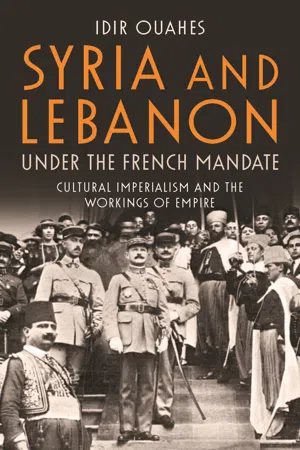
French rule over Syria and Lebanon was premised on a vision of a special French protectorate established through centuries of cultural activity: archaeological, educational and charitable. Initial French methods of organising and supervising cultural activity sought to embrace this vision and to implement it in the exploitation of antiquities, the management and promotion of cultural heritage, the organisation of education and the control of public opinion among the literate classes. However, an examination of the first five years of the League of Nations-assigned mandate, 1920-1925, reveals that French expectations of a protectorate were quickly dashed by widespread resistance to their cultural policies, not simply among Arabists but also among minority groups initially expected to be loyal to the French. The violence of imposing the mandate 'de facto', starting with a landing of French troops in the Lebanese and Syrian coast in 1919 - and followed by extension to the Syrian interior in 1920 - was met by consistent violent revolt. Examining the role of cultural institutions reveals less violent yet similarly consistent contestation of the French mandate. The political discourses emerging after World War I fostered expectations of European tutelages that prepared local peoples for autonomy and independence. Yet, even among the most Francophile of stakeholders, the unfolding of the first years of French rule brought forth entirely different events and methods. In this book, Idir Ouahes provides an in-depth analysis of the shifts in discourses, attitudes and activities unfolding in French and locally-organised institutions such as schools, museums and newspapers, revealing how local resistance put pressure on cultural activity in the early years of the French mandate.
Information
CHAPTER 1
ANTIQUITIES PROTECTION AND EXCAVATION
As a new era of mandatory rule began in 1920, the historical artefacts and fortifications covering the cities, tell mounds and deserts of Syria and Lebanon were the subject of renewed battles. The first five years of mandatory rule over Syria and Lebanon witnessed a casual and ultimately vague formulation of antiquities law. There was a deep-rooted orientalism present in French, and even international, scholarly and regulatory circles. This combined to impede effective encouragements of local concern for the conservation and promotion of antiquities.
Efforts were certainly made to protect archaeological resources by the newly organised Service des Antiquités. Yet, despite rhetorical aloofness, French administrators largely adopted Ottoman approaches to antiquities regulation. Although the League of Nations’ mandate charter had included a general stipulation requiring protection of antiquities, precise details remained undefined. The French therefore relied on continuing an Ottoman-era law that provided for a split allowing half of all items found at excavations to go to foreign, especially French, missions.
Widespread excavations had already occurred before World War I and the mandate encouraged (particularly French) archaeologists to undertake further digs. By affording the new mandatory authorities the ability to establish themselves as protectors of a forgotten ancient, and even Islamic, past, such activity conveniently buttressed claims to a civilising mission. Yet local opinion, in the local government apparatus and press, did not idly allow French dominance of these antiquities. This phenomenon of political use of malleable claims of culture was thus well established in the first five years of the mandate, before the later mandate period.1
French encouragement of archaeological activity for the consolidation of cultural claims bolstering the mandate was not unique in the region.2 Yet whereas the Iraqi and Palestine mandates’ archaeological past have been subjected to scrutiny, analytical accounts of mandate Lebanon and Syria’s antiquities service are few.3 The fate of antiquities was subject to cultural claims from the outset of the mandate. Newspapers in France covered developments in Syrian archaeology, though not with the verve shown in Anglophone reporting on British exploits in Egypt and Iraq.4 Finally, the local government bureaucracy of early mandate government, one of several facets of early French rule grounded on Ottoman foundations, provided a space for contesting exclusively French cultural claims.
Antiquities, Orientalism and Cultural Imperialism
A storied French engagement with the Levant’s antiquities certainly gave weight to claims of cultural affinity with the region. France’s engagement with the Orient was centuries old. Antiquities exploration during the French occupation of Egypt clearly served to underpin Napoleon’s political ambitions.5 His expedition to Syria sparked a flurry of European scholarly and governmental interest in the region. A key component of this Napoleonic orientalism was the assumption that local peoples had neither an interest in their ancient past, nor the capacity to preserve it. This was the result of orientalist prejudices rooted in a rationalist attempt to categorise, and thus control, the past for the purposes of present governance, an approach directly in opposition to the understanding of ancient relics expressed by Islamic philosophers and Egyptian governors.6
As the French cultural and economic presence in West Asia became firmly established over the course of the nineteenth century, orientalist presumptions crystallised. Central to Egyptian reformer Muhammad ‘Ali’s push for modernisation was his patronage of orientalists such as the Saint-Simonian Barthélemy Prosper Enfantin.7 Napoleon’s nephew Louis Bonaparte also gazed eastward, sending Ernest Renan on a mission alongside French troops during France’s intervention in the 1860 Lebanese civil war.8 Demonstrating burgeoning military-savant ties, Renan collaborated with the expeditionary army’s topographical brigade to secure maps of Lebanon for his ethnographic studies.9 French interest in Mediterranean antiquity resurged during the Third Republic (1870 – 1940), in the face of German and British competition for the strategic region.10
Such activity fit within the broadly described phenomenon of orientalism best outlined by Edward Said’s eponymous book, which evidences how the romantic-era European scholarly and governmental gaze eastward tended toward dispossession and control by creating an imagined division.11 The orientalism thesis has subsequently been critiqued and refined by historians who stressed Said’s lack of attention to particular empirical evidence from certain parts of the world and across historical periods.12 European cultural arrogation through a ‘resurrection’ of locally forgotten, formerly glorious, pasts was eminently possible in the nineteenth century. A range of contemporary archaeological bulletins demonstrated this cultural imperialism. In an article on Phoenicians, renowned British archaeologist Leonard Woolley suggested a revision to previous French accounts of Phoenician development. Woolley suggested race-based distinctions between Oriental (Asiatic) and Western (Greek) influences; an Aegean Phoenician civilisation had first developed in contact with Ancient Greece, before being ‘subject to an Asiatic influx’. Woolley finished by explaining that it was this confusion of Asiatic and Aegean Phoenicia that had led Greek histories to ‘falsely attribute to the Phoenicians, thanks to the Aegean base [. . .] the great roles [in fact] played by peoples of pure race’.13
By researching bygone glories that had seemingly been ignored by local peoples, Europeans and, from the mid-nineteenth century onwards, an increasing number of US scholars, laid claim to ownership of an ancient and foreign past. They were also delimiting what Said noted were the ‘pure’ and ‘impure’ ‘images of a privileged, genealogically useful past [. . .] in which we exclude unwanted elements’.14 This was neither dispassionate nor malevolent research. Despite the bias, archaeologists (often working in difficult circumstances and driven by researchers’ passions) made fundamental contributions to human knowledge. Despite France’s interest in making political gains from cultural claims and a rich archaeological tradition in the region, antiquities exploitation was constrained by structural limits to mandatory methods. These limits were imposed by dual pressure from domestic Syro-Lebanese organisations and the principles of tutelage and an ‘open door’ that the League of Nations oversight required.
The words of Talal Asad on anthropologists’ colonial encounters resonate with archaeological activity:
The basic reality which made pre-[Second World] war social anthropology a feasible and effective enterprise was the power relationship [. . .] the colonial power structure made the object of anthropological study accessible and safe [. . .] [yet it is too simplistic to view anthropology] as primarily an aid to colonial administration, or as the simple reflection of colonial ideology [. . .] bourgeois consciousness [. . .] has always contained within itself [. . .] the potentialities for transcending itself.’15
The deep imprint that orientalist narratives of the ancient world left upon the official, often classically trained, minds points to the dialogic relationship between imperial power-holders and researchers. The notion of ‘official minds’ has been discussed in various imperial contexts. Classic studies emphasised the political strategies, or their lacunae, among Whitehall and Quai d’Orsay decision makers. More recent commentary has absorbed the influence of cultural histories to consider the mentalities shaping the multiple views of imperial planners, regional administrators and local assimilators.16 Such ‘epistemic habits’, as Ann Laura Stoler terms them, can be recovered by reading the archives critically.17
To give one example of such orientalist mindsets, consider the comments made by high-placed US official Colonel Edward M. House, an influential member of Woodrow Wilson’s post-World War I Inquiry and an Ivy-League-educated Texan. He wrote that ‘while Europe was bleeding [. . .] in every mosque, in every market place there was a quiet exultation that Western Civilization seemed bent upon destroying itself [. . .] we of the West are prone to think of those of the East as inactive dreamers [. . .] we sometimes fail to reckon on that fierce courage which, when aroused, will dare death and destruction [. . .] there is one advantage the East has over the West, its people know how to wait. Time is as nothing to them. Their History stretches through the centuries.’18
Echoes of these orientalist and romantic mentalities were equally present among policy-makers in Paris and mandate executors in the Levant. In February 1919, the then foreign minister and future president of the Republic, Alexandre Millerand, spoke of a ‘centuries-old [French] Protectorate’ in Syria, originating in the Crusades, one which continued via protection of Christians, charitable works and the provision of relief and education.19 In another note, he added that: ‘[France] brought the benefits of civilisation [. . .] if France was able to achieve such a result, she owes it, it is true to say, to the activity of her national missionaries, professors and merchants who acted in conjunction to her political activity and in constant liaison with her’.20
Key military administrators in Beirut and Damascus evinced similar convictions. In 1920 General Mariano Goybet, fresh from the Maysalūn vic...
Table of contents
- Cover
- Title Page
- Dedication
- Contents
- Map and Figures
- Preface
- Notes on the Text
- List of Abbreviations
- Introduction: Cultural Institutions and the Struggle to Define the Mandate
- 1. Antiquities Protection and Excavation
- 2. Controlling Cultural Heritage: Museums, Tourism and Exhibitions
- 3. Classrooms, Curricula and Content
- 4. The Politics of Pedagogy
- 5. Surveillance, Subsidies and Censorship: The Domestic Arabic Press
- 6. Subservience and Sanction? The Francophone Press
- 7. Internationalism: The External Press
- 8. General Conclusion
- Notes
- Select Bibliography
- Index
- eCopyright
Trusted by 375,005 students
Access to over 1.5 million titles for a fair monthly price.
Study more efficiently using our study tools.
Frequently asked questions
Yes, you can cancel anytime from the Subscription tab in your account settings on the Perlego website. Your subscription will stay active until the end of your current billing period. Learn how to cancel your subscription
No, books cannot be downloaded as external files, such as PDFs, for use outside of Perlego. However, you can download books within the Perlego app for offline reading on mobile or tablet. Learn how to download books offline
We are an online textbook subscription service, where you can get access to an entire online library for less than the price of a single book per month. With over 1.5 million books across 990+ topics, we’ve got you covered! Learn about our mission
Look out for the read-aloud symbol on your next book to see if you can listen to it. The read-aloud tool reads text aloud for you, highlighting the text as it is being read. You can pause it, speed it up and slow it down. Learn more about Read Aloud
Yes! You can use the Perlego app on both iOS and Android devices to read anytime, anywhere — even offline. Perfect for commutes or when you’re on the go.
Please note we cannot support devices running on iOS 13 and Android 7 or earlier. Learn more about using the app
Please note we cannot support devices running on iOS 13 and Android 7 or earlier. Learn more about using the app
Yes, you can access Syria and Lebanon Under the French Mandate by Idir Ouahes in PDF and/or ePUB format, as well as other popular books in History & Middle Eastern History. We have over 1.5 million books available in our catalogue for you to explore.