Whilst historians often regard the Norman Kingdom of Sicily as centralised and administratively advanced, County and Nobility in Norman Italy counters this traditional interpretation; far from centralised and streamlined, this book reveals how the genesis and social structures of the kingdom were constantly fraught between the forces of royal power and local aristocracy authority. In doing so, Hervin Fernandez Aceves sheds important new light on medieval Italy.
This book is the result of thorough research conducted on the vast source material for the history of this fascinating 12th-century world. Starting with the activities of Norman counts and the configuration of the counties, it explores how social control operated in these nodes of regional authority, and argues that the Sicilian monarchy relied on the counties (and the counts' authority) to keep the realm united and exercise control.
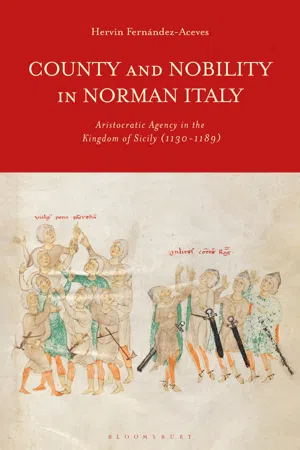
eBook - ePub
County and Nobility in Norman Italy
Aristocratic Agency in the Kingdom of Sicily, 1130-1189
- 296 pages
- English
- ePUB (mobile friendly)
- Available on iOS & Android
eBook - ePub
County and Nobility in Norman Italy
Aristocratic Agency in the Kingdom of Sicily, 1130-1189
About this book
Information
1
The counts of Norman Italy before Roger II
Sicily, though nominally attached to the duchy of Apulia, was practically ruled autonomously by Count Roger II during the 1120s. The Sicilian count was also the undisputed ruler of the whole of Calabria, after his cousin Duke William ceded him the shares he and his father had retained in Palermo, Messina and Calabria. By autumn 1124, Roger II had moved into Apulian territory, as he attempted to establish control over the lordship of Montescaglioso, which had been held by his sister Emma in the right of his son Roger, after her husband Rudolph Machabeus had died.1 While the Sicilian count claimed Montescaglioso, he was accompanied by Christodoulos, his chief minister, and George of Antioch, the Arab-speaking Greek official who, a couple of years later, succeeded Christodoulos and became the first Sicilian ‘Emir of Emirs’.2 These two administrators are an iconic example of the sort of Greek officials Count Roger II could rely on to exploit and manage his extensive resources in Sicily.
The expertise of such functionaries allowed Roger II to organize his income and develop an army and a fleet that enabled him to impose his authority over the peninsular lands. However, their social arrangement differed greatly from that of the county of Sicily, and the authority of the Norman overlords acted as one of the central sources of this arrangement. The counts and princes of southern Italy were the vanguard of a society accustomed not only to its political autonomy but also to the absence of a uniform system of government and social recognition.
The overlords’ power basis
After Roger II’s cousin died in 1127, the count of Sicily claimed the mainland territories as the rightful heir of the duke of Apulia. Duke William, as the last surviving direct heir of Robert Guiscard, was not only the nominal leader of the Normans who settled in Apulia following its conquest from the Greeks after 1042 but also the heir to the Lombard princes of Salerno – the Tyrrhenian city had become the dukes’ chief city after Guiscard took it in 1076. It took Roger II three years to bring all his insular and peninsular dominions together under a kingdom; after having subjected the most prominent lords in southern Italy by force, Count Roger of Sicily became the king of Sicily in 1130, ruling over all the Norman dominions in Italy. These lands, however, had not previously seen a widespread and univocal notion of nobility and government. What was once a constantly warring setting became the breeding ground for descendants of the original Norman mercenaries who had arrived in the Mediterranean 100 years earlier. The leaders of these northern mercenaries flourished and established their own rule, eventually becoming the princes of Capua and the dukes of Apulia.
Bringing all these units together into one single polity, under the same crown, might have heightened the expectation for autonomy of the territorial leaderships. The Sicilian king’s new subjects could have been prepared to acknowledge him as their nominal overlord, but they certainly did not expect to lose power in their own lands. Many of the counts in both Capua and Apulia were in practice independent of princely or ducal authority. In their documents, they did not formally acknowledge the authority of either the prince of Capua or the duke of Apulia. They appeared instead as counts, not by the grace of their overlord but by grace of God alone, with those in Apulia referring to the emperor in Constantinople. Robert of Loritello (modern Rotello) and his son, furthermore, styled themselves in the 1090s and 1110s with the title comes comitum, ‘count of counts’, and they also appear to have used their own cruciform monograph as the comital signature.3 The portions that were nominally subject to the duke of Apulia, like the Terra Beneventana and the dominions of the count of Loritello and his kin, threw off all obedience to any constituted authority, not to mention the actual independent lordships such as the Salento peninsula and the county of Sicily itself.4 Let us not forget that King Roger II had once been a count himself, a sovereign over his own dominions and without any effective lordship or authority exercised over him. The comital title was, hence, used to identify specific, prominent lords as leaders – or even potential leaders – among a community of other lords. In the eleventh century, a s Cuozzo highlighted, the Norman leaders’ power was based on two components: their economic power as landholders and their local authority as military warrantors of order and justice.5 In this sense, the ‘county’ that could have emerged from these eleventh century comites in Norman Italy should have referred more to the original and ancient voice of comitatus as a company or band of soldiers than to the political and territorial unit found in successive centuries.
The search for the original south Italian counties has led to an overflow of misguided and anachronistic readings across history and historiography. From forged charters to modern Italian scholarship, it has been assumed that the south Italian county existed continuously since the Norman conquest. A revealing example of this is the case of Richard the Seneschal, a Norman lord in the Terra d’Otranto at the end of the eleventh and beginning of the twelfth century. Since Prignano’s seventeenth-century Historia, Richard had been identified as count of Mottola. Until Cuozzo argued against his identification as a count, it was assumed that a county of Mottola existed. After careful examination of the documents on which Richard’s comital title had been attested, Cuozzo came to the conclusion that this dignity was ascribed to the lord of Mottola and Castellaneta around the thirteenth and fourteenth centuries, to provide diplomatic evidence for the litigations concerning the Castellaneta properties of the monasteries of the Most Holy Trinity of Cava dei Tirreni, St Mary of Pisticci, St Anastasius of Carbone and the Most Holy Trinity of Venosa.6 What was thought to be an early Norman county turned out to be a treacherous fiction, created by both monastic forgery and institutional preconceptions.
The social typology of territorial lordships adopted by the Normans in the eleventh century appears to have been oriented towards distinguishing the ultimate coercive role exercised by the leaders of military units of knights, acknowledging also their condition as prominent and prosperous lords, in that they held most of the land.7 The material resources that must have resulted from exploiting the land, and the miscellaneous local customs – which could have included plateaticum, porticum or incultum – exacted from the populations under their control, suggest that the early Norman counts could have amassed a substantial sum. Nevertheless, the counts’ revenues as overlords cannot be measured due to the lack of surviving evidence.
The scarcity of surviving documents at the beginning of the twelfth century makes it impossible to present a systematic treatment of comital prerogatives and competences; moreover, there is no clear or categorical usage of the title of comes before the creation of the Sicilian kingdom. At that time, the comital title did not carry any specific definitions of rights or responsibilities, which may reflect the absence of an effective central authority or a generalized notion of government. The authority these early Norman counts exercised over the local population must have been given by the fact that they were the only ultimate coercive force in the region.
The title of comes was also an honorific title employed during the Norman conquest to express social prestige – an ideological source of power – by alluding to either old noble Lombard families or the descendants of the ‘new nobility’ of conquerors. The latter group comprised of the handful of Norman kin-groups that provided both the upper aristocracy in southern Italy and the most influential lineages: the extended family of the princes of Capua; the Buonalbergo of Ariano; the Molise of Boiano; the descendants of Guiscard’s brother William of Principato; and the ‘sons of Amicus’ of Andria, Lesina and Molfetta.8 This expression of prestige, nonetheless, did not bear any special faculties that were not already enjoyed in the capacity of overlords. Some lords (domini) might have held their lands from some of these counts, such as the counts of Loritello. However, other lords did not acknowledge any overlordship at all.9 It was the actual coercive capacity of the dominus, and not necessarily the title, that granted additional judicial and financial rights over other lords.10
Once these territorial military leaders, the comites, were securely established, the hereditary claims of their own kin prevailed in successive generations. The vanishing central authority left after Guiscard’s death, together with the steady displacement of the older upper authorities, rendered the nominal endorsements superfluous. Hence, the power of these first Norman counts could go as far as their political abilities and military successes would allow. The northern regions, both in the principality of Capua and in the Adriatic lands north of the Capitanata, granted the greatest opportunity for these counts to extend their authority beyond their own chief cities. In the east, the counts in the north of Bari and in the east of Benevento occupied lands and considerably expanded their dominions in the previously unconquered northern Adriatic, thus enlarging their territorial and military resources. Contrastingly, in Capua, the older Lombard comital dignities provided the new ‘counts’ with a useful model of social prestige and political distinction that they could use to consolidate their authority over other lords and local communities, both urban and of tenant-farmers.
Regardless of their location, be that Apulia, Calabria or Terra di Lavoro, the counts’ lordships do not appear to have constituted a delimited territorial unit, and the toponyms ascribed to some of the comital titles indicated either an autochthonous dignity attached to a specific city or urban population (such as the count of the ‘Caiazzans’ or the count of Catanzaro) or the location of the count’s residence or main lordship (such as the count of Loritello). Since the title by itself did not define the border of the count’s holdings, these must have varied significantly because of territorial expansion and political quarrelling. Although the comital dignity provided an enhanced and recognized social status for its bearer, the actual geographical area of authority and influence depended on the count’s activities and operations, and not solely on the title.
In summary, the military and political ability of each Norman lord were the means through which they could acquire a place of prestige and enhanced social status, regardless of their origins and family, or however distinct their respected areas of influence.11 That prestigious position was confirmed by the usage of the title of comes, which was ambiguous enough to allow a varied array of prominent barons to confirm their superior status over other lesser lords, although it marked their inferiority to the duke of Apulia and the prince of Capua. This ambiguity echoes the usage that the comital dignity had in the Carolingian era. The title of comes was employed by Charles Martel and his son Pippin not only to appoint commanders who undertook special military and paramilitary missions but also to designate officers who commanded garrison units at forts and in cities.12 The comites then developed into the archetypal secular officials on which Charlemagne and Louis the Pious relied to carry out their will in the provinces. These Carolingian comites’ responsibilities included not only military duties – such as gathering those eligible to serve in the army – but also the collection of various types of imposts, presiding over cadres of other functionaries, and enforcing justice through a system of local courts. However, the power enjoyed by these comites varied significantly, mostly considering that there were probably around 400 counties north of the Alps which were not cleanly defined. Despite the new Carolingian administrative framework, local conditions ended up determining the actual duties carried out by these comites as agents of a distant imperial rule.13 The role of the first Norman counts in Italy also differed, and the individual’s status and prerogatives depended not on the comital title itself but on the web of ties with their inferiors, superiors and peers, and the specific relationship between the comites and their communities.
The usage of the comital title at this stage created thus a broad buffer zone of social recognition which simply distinguished the comites from less powerful barons. Unsurprisingly, this created asymmetric relationships between counts, as is illustrated in the following section. Furthermore, although the title was different and inferior to the dukedom in Apulia and the princedom in Capua, the social status of the early twelfth-century Norman counts seems not to have differed practically from those wh...
Table of contents
- Cover
- Half-Title
- Dedication
- Title
- Contents
- List of illustrations
- Preface
- Acknowledgements
- List of abbreviations
- Introduction: Documenting Italo-Norman agency
- 1 The counts of Norman Italy before Roger II
- 2 The new kingdom’s nobility and the creation of the south Italian counties
- 3 Leadership and opposition under the count of Loritello
- 4 Coalition and survival of the nobility
- 5 New spheres of comital action under Margaret’s regency
- 6 Consolidated counties during the reign of William II
- 7 Beyond the county: The counts’ new military and political role
- Conclusions
- Appendix 1: A note on the Duana Baronum
- Appendix 2: Figures
- Appendix 3: Maps
- Appendix 4: Tables and diagrams
- Notes
- Bibliography
- Index
- Copyright
Trusted by 375,005 students
Access to over 1.5 million titles for a fair monthly price.
Study more efficiently using our study tools.
Frequently asked questions
Yes, you can cancel anytime from the Subscription tab in your account settings on the Perlego website. Your subscription will stay active until the end of your current billing period. Learn how to cancel your subscription
No, books cannot be downloaded as external files, such as PDFs, for use outside of Perlego. However, you can download books within the Perlego app for offline reading on mobile or tablet. Learn how to download books offline
Perlego offers two plans: Essential and Complete
- Essential is ideal for learners and professionals who enjoy exploring a wide range of subjects. Access the Essential Library with 800,000+ trusted titles and best-sellers across business, personal growth, and the humanities. Includes unlimited reading time and Standard Read Aloud voice.
- Complete: Perfect for advanced learners and researchers needing full, unrestricted access. Unlock 1.5M+ books across hundreds of subjects, including academic and specialized titles. The Complete Plan also includes advanced features like Premium Read Aloud and Research Assistant.
We are an online textbook subscription service, where you can get access to an entire online library for less than the price of a single book per month. With over 1.5 million books across 990+ topics, we’ve got you covered! Learn about our mission
Look out for the read-aloud symbol on your next book to see if you can listen to it. The read-aloud tool reads text aloud for you, highlighting the text as it is being read. You can pause it, speed it up and slow it down. Learn more about Read Aloud
Yes! You can use the Perlego app on both iOS and Android devices to read anytime, anywhere — even offline. Perfect for commutes or when you’re on the go.
Please note we cannot support devices running on iOS 13 and Android 7 or earlier. Learn more about using the app
Please note we cannot support devices running on iOS 13 and Android 7 or earlier. Learn more about using the app
Yes, you can access County and Nobility in Norman Italy by Hervin Fernández-Aceves,Hervin Fernández Aceves in PDF and/or ePUB format, as well as other popular books in History & European Medieval History. We have over 1.5 million books available in our catalogue for you to explore.