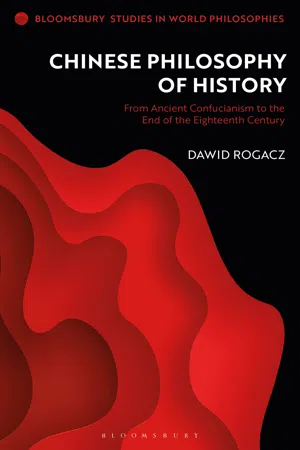
Challenging the Eurocentric misconception that the philosophy of history is a Western invention, this book reconstructs Chinese thought and offers the first systematic treatment of classical Chinese philosophy of history.
Dawid Rogacz charts the development from pre-imperial Confucian philosophy of history, the Warring States period and the Han dynasty through to the neo-Confucian philosophy of the Tang and Song era and finally to the Ming and Qing dynasties. Revealing underexplored areas of Chinese thought, he provides Western readers with new insight into original texts and the ideas of over 40 Chinese philosophers, including Mencius, Shang Yang, Dong Zhongshu, Wang Chong, Liu Zongyuan, Shao Yong, Li Zhi, Wang Fuzhi and Zhang Xuecheng. This vast interpretive body is compared with the main premises of Western philosophy of history in order to open new lines of inquiry and directions for comparative study.
Clarifying key ideas in the Chinese tradition that have been misrepresented or shoehorned to fit Western definitions, Rogacz offers an important reconsideration of how Chinese philosophers have understood history.
An attempt to define the subject matter of the philosophy of history is just as necessary as it is burdensome, in the face of fundamental disagreements over the scope of, issues associated with – and even the term for – philosophical reflection on history. To avoid an arbitrary or even normative definition, I will try to present the different ways of understanding this notion and outline a view of the philosophy of history that is closest to the Chinese conceptions under examination here. Since this is an explicitly interdisciplinary field, the relationship between the philosophy of history and other disciplines, both historical (such as theory of history and methodology of history) and philosophical, cannot be overlooked. The meaning of the term ‘philosophy of history’ is also highly ambiguous, especially in English, where the word ‘history’ can refer to both a process and a story. Awareness of this basic difference becomes much clearer, however, in contemporary philosophy, which some time ago divided itself into the analytic and continental (or substantial) branches of the philosophy of history. Taking all of this into consideration, I will try to delineate the issues associated with the philosophy of history in the most general manner, as they are reflected in a diversity of particular standpoints. One of those viewpoints, namely holism in the philosophy of history, plays a crucial role in the proposed interpretation of the Chinese philosophy of history.
Philosophy and the theory of history
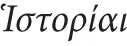
To explicate the difference between the philosophy of history and the theory/methodology of history, some larger fields to which they belong need to be clearly acknowledged: the philosophy of history has always been a part of philosophy, while the theory and methodology of history are assigned to be a part of science. This idea would not have been alien to the Greeks, those fathers of Western historiography, and it was not without reason that Herodotus titled his work
(Inquiry), for his studies involved travels to historical places and collecting reliable evidence of the past. Understandably, at the very outset questions were posed concerning which sources were reliable, and generally what kinds of sources are reliable, or what methods should be used to scrutinize these sources, and how to create a historical narrative that will not ‘lose’ its credibility. General reflection of this nature, originating from the practice of writing history, is quite different from proper historiography. In the face of the ambiguity of the concept of history, which means both history in the sense of past events (res gestae in Latin) and history in the sense of a narrative (historia rerum gestarum), a great deal of time was devoted to searching for a distinctive term that would encompass general scientific research on history. In 1815, the Polish historian Joachim Lelewel introduced the concept of ‘historica’ in his book Historyka, tudzież o łatwym i pożytecznym nauczaniu historii (Historica, or easy and useful teaching of history), which was popularized by Johann Gustav Droysen (Grundriss der Historik, 1868). Importantly, Lelewel distinguished historica from the philosophy of history:
Comments of a philosophical or political character and moral lessons are not allowed here, because they usually could become the motive, or at least give the writer the suspicion that he narrated the circumstances, distending them to his views.1
In the work Historica. The principles of the methodology and theory of historical knowledge, another Polish historian, Marceli Handelsman, defined ‘historica’ as a science devoted to: (1) the theory of historical knowledge, and (2) the creative process of writing about history, as well as (3) a method for historical research.2 In fact, under the pressure of time, the programme of ‘historica’ became further diversified, differentiated and divided. Contemporary scholars usually use the term ‘theory of history’ to name the first domain, and ‘methodology of history’ to denote the third domain, whereas reflection on the creative process of writing history (2) often goes by the name of ‘metahistory’, from the celebrated work of Hayden White, Metahistory: The Historical Imagination in Nineteenth-Century Europe (1973). Interestingly, as part of the reaction to this diversification, the term historica has returned to favour, for example in Jörn Rüsen’s Historische Vernunft: Grundzüge einer Historik from 1983.
The difference between the theory and the methodology of history is neither clear nor established. Generally speaking, the methodology of history is more concerned with the cognitive actions of historical research, while the theory of history addresses the results of these activities. Yet, when employing a programme of contemporary analytic philosophy of history, the boundary between the theory and philosophy of history gradually fades. For this reason, some researchers, such as Jerzy Topolski, have proposed a new definition of the methodology of history that also includes inquiry into the subject of history, which is usually treated as part of the philosophy of history.3
The discussion on the subject of the theory (or methodology) of history proves that professional historians are insistent that there should be a clear difference between even the theoretical part of historical research and philosophical reflection on history. This trend is an extension of the dissenting vote against the philosophy of history that was cast by the fathers of modern historical research: Leopold von Ranke and Jacob Burckhardt. The latter proclaimed a total divergence between philosophy and history, denying the existence of any general idea of history.4 Note, however, that regardless of these declarations, historians tend to make assessments of historical events in the light of the value systems rooted in their own (often unrealized) views of history. After the criticism of positivism, such ‘axiologically neutral’ procedures as selection of sources and explanation turned out to be deeply rooted in the preceding theories. Hayden White claims that even the form of emplotment has an affinity to the specific idea of history and its process.5 These arguments show that not only the theory of history, but also historiography, is entangled in the philosophy of history.
The philosophy of history and other philosophical disciplines
A similar ambiguity is found in the relation between the philosophy of history and other philosophical disciplines. The first point to stress is that the philosophy of history does not belong to the classical branches of philosophy. At first glance, the philosophy of history is closest to political philosophy, but the analytic philosophy of history falls within the scope of the philosophy of science (or the philosophy of language), whereas narrativism or the hermeneutic philosophy of history is closer to the aesthetics and philosophy of literature. The speculative philosophy of history is, on the other hand, often identified with the ‘metaphysics of history’. It is this polysemy of the term ‘history’ that ultimately makes the status of the philosophy of history so unclear. There is no doubt that the philosophy of history is essentially linked with each of the traditional branches of philosophy. Ontological concepts of time, change and development significantly shape our understanding of history. Issues in the domain of philosophical anthropology, such as views on human nature or man’s place in nature and society, influence the philosophy of history to no less a degree (and in the case of this book, perhaps have the greatest influence). The relationship between epistemology and the philosophy of history was already evident in the philosophy of Giambattista Vico, Georg W.F. Hegel and Wilhelm Dilthey. It then grew even stronger with analytic philosophy, which focused on the problems of historical explanation, historical narrative, representation of the past and the status of historical experience. Axiology is present in the philosophy of history primarily as a basis for the evaluation of the past. And in a special way, the philosophy of history is affected by political philosophy, as historiography deals mainly with the political history of states and nations. The most important systems of the philosophy of history, including Hegelianism and Marxism, interpret history through the prism of their own political project, whose implementation crowns the historical process. This association was so strong that many contemporary political philosophers (Karl R. Popper, Isaiah Berlin, François Lyotard) blamed the philosophy of history as such (or ‘historicism’6) for the twentieth-century totalitarianisms of Nazism and Communism.
This notwithstanding, it seems that the central position among determinants of the philosophy of history is occupied by historical factors themselves. This can be both the fall of empires (Rome in the case of St. Augustine, the Ming China for Wang Fuzhi and the Soviet Union for Francis Fukuyama), as well as the emergence of outstanding individuals initiating a new era (Liu Bang for Jia Yi, St. Francis for Joachim of Fiore, Napoleon for Hegel). The decisive impulse that gave rise to the Western philosophy of history is often considered to be the Lisbon earthquake of 1755, which shook people’s faith in divine providence: in 1765 Voltaire published La Philosophie de l’histoire, in which the term ‘philosophy of history’, as opposed to ‘theology of history’, was used for the first time.
The philosophy of (the) history, philosophy of (a) history, historiosophy
The ambiguity of the English term ‘philosophy of history’ is caused by the fact that there are no rival or alternative terms. In Polish, for instance, there are three different terms that denote the philosophy of history, and in two of them different words for ‘history’ are used: one for history as a process (dzieje) and another for history in the more general sense, including history as a narrative (historia). This is similar to German, in which Geschichte tends to mean history as the past, while Historie refers to scientific or literary accounts.7 Hence the term Geschichtsphilosophie might be identified with a speculative philosophy of history, claiming to have an insight into the nature of the historical process. In his Culture and History (1959), Phillip Bagby tries to coin the term ‘a history’ for the work of historians and ‘the history’ for the events of the past.8 Hence what there should be is ‘philosophy of a history’ and ‘philosophy of the history’. However, this division is not commonly accepted and probably seems odd to most proficient speakers of English. Accordingly, I will continue using the term ‘philosophy of history’ as the most general form, denoting both res gestae and historia rerum gestarum, since – especially in the case of pre-modern thinkers, Chinese included – it is hard to maintain a strict demarcation between these two areas. Should it become necessary to stress the systematic and independent character of this thought, I will opt for the term ‘speculative philosophy of history’. Although I treat this notion as identical with the German Geschichtsphilosophie, I shall not restrict its reference to Hegelianism and Marxism, as I hold it is theoretically acceptable to construct an independent philosophical view of historical processes, usually devoid of any ‘logic of history’ (putting aside the issue of a scientific character of such a view). As Emil Angehrn shows, there are at least three main periods in the development of the Western Geschitsphilosophie: from its beginnings and St. Augustine ...
Table of contents
Cover
Half-Title Page
Series Page
Title Page
Contents
Acknowledgements
Introduction
1 What is the Philosophy of History?
2 Following the Past: The Philosophy of History in Ancient Confucianism
3 Quest for the Trend of History: The Philosophy of History in Other Schools of Thought in the Warring States Period
4 Nature, People, and History: The Philosophy of History in the Han Dynasty
5 The Basis of History: The Philosophy of History from the Eighth to the Twelfth Century
6 Individual and History: The Philosophy of History from the Thirteenth to the Eighteenth Century
7 Encompassing History: The Distinctiveness of the Chinese Philosophy of History
Conclusion: The Past is Never Dead
Notes
Bibliography
Index
Copyright
Trusted by 375,005 students
Access to over 1.5 million titles for a fair monthly price.
Study more efficiently using our study tools.
Frequently asked questions
Yes, you can cancel anytime from the Subscription tab in your account settings on the Perlego website. Your subscription will stay active until the end of your current billing period. Learn how to cancel your subscription
No, books cannot be downloaded as external files, such as PDFs, for use outside of Perlego. However, you can download books within the Perlego app for offline reading on mobile or tablet. Learn how to download books offline
Perlego offers two plans: Essential and Complete
Essential is ideal for learners and professionals who enjoy exploring a wide range of subjects. Access the Essential Library with 800,000+ trusted titles and best-sellers across business, personal growth, and the humanities. Includes unlimited reading time and Standard Read Aloud voice.
Complete: Perfect for advanced learners and researchers needing full, unrestricted access. Unlock 1.5M+ books across hundreds of subjects, including academic and specialized titles. The Complete Plan also includes advanced features like Premium Read Aloud and Research Assistant.
Both plans are available with monthly, semester, or annual billing cycles.
We are an online textbook subscription service, where you can get access to an entire online library for less than the price of a single book per month. With over 1.5 million books across 990+ topics, we’ve got you covered! Learn about our mission
Look out for the read-aloud symbol on your next book to see if you can listen to it. The read-aloud tool reads text aloud for you, highlighting the text as it is being read. You can pause it, speed it up and slow it down. Learn more about Read Aloud
Yes! You can use the Perlego app on both iOS and Android devices to read anytime, anywhere — even offline. Perfect for commutes or when you’re on the go. Please note we cannot support devices running on iOS 13 and Android 7 or earlier. Learn more about using the app
Yes, you can access Chinese Philosophy of History by Dawid Rogacz in PDF and/or ePUB format, as well as other popular books in Philosophy & Chinese History. We have over 1.5 million books available in our catalogue for you to explore.