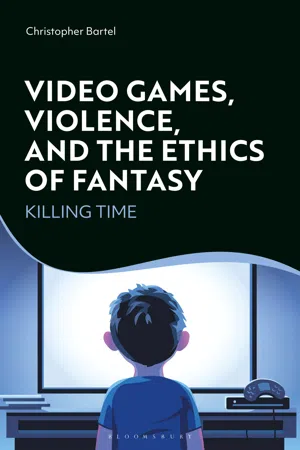
Is it ever morally wrong to enjoy fantasizing about immoral things? Many video games allow players to commit numerous violent and immoral acts. But, should players worry about the morality of their virtual actions? A common argument is that games offer merely the virtual representation of violence. No one is actually harmed by committing a violent act in a game. So, it cannot be morally wrong to perform such acts. While this is an intuitive argument, it does not resolve the issue.
Focusing on why individual players are motivated to entertain immoral and violent fantasies, Video Games, Violence, and the Ethics of Fantasy advances debates about the ethical criticism of art, not only by shining light on the interesting and under-examined case of virtual fantasies, but also by its novel application of a virtue ethical account. Video games are works of fiction that enable players to entertain a fantasy. So, a full understanding of the ethical criticism of video games must focus attention on why individual players are motivated to entertain immoral and violent fantasies.
Video Games, Violence, and the Ethics of Fantasy engages with debates and critical discussions of games in both the popular media and recent work in philosophy, psychology, media studies, and game studies.
- 224 pages
- English
- ePUB (mobile friendly)
- Available on iOS & Android
eBook - ePub
About this book
Information
1
Introduction
The Problem of Virtual Ethics
1.1 Crashing the Funeral
World of Warcraft 1 (or WoW for short) is a highly popular massively multiplayer online role-playing game (or MMORPG). WoW players build and embody avatars that go adventuring across the realm of Azeroth. Players can band together to form a guild, participate in traditional dungeon raiding and dragon slaying quests, and fight battles against other players. For their efforts, successful players are rewarded with loot and experience.
In 2006, a Horde guild suffered the unexpected death of one of their members in real life owing to a fatal stroke. Her character’s name was Fayejin. The guild decided to hold a ceremony within the game to memorialize their lost colleague. The organizers announced that the ceremony would take place near a lake in the wilderness, which is contested territory between the guild factions. They also announced that their members would be unarmed and asked the WoW community to respect their memorial service. Of course, that didn’t work out. One rival guild—called Serenity Now—saw the service as an opportunity. Serenity Now raided the ceremony, slaughtered the unarmed guests, and posted a video of their exploits online.
What is now infamously known as the “funeral raid” has been the focus of much passionate debate within the WoW community. And for good reason. The event raises fascinating and important questions about the scope of morality and its application in video games. Did Serenity Now do anything wrong? There are strong feelings on both sides of this question.
Imagine that something like this were to happen in real life. While it is a fair military tactic to ambush an enemy, ambushing an unarmed enemy at a memorial service where they have openly declared their unwillingness to fight is deeply underhanded, and it might even count as a war crime. But perhaps comparing this event to real life is unfair. Regardless of whether it would be right or wrong in real life, the WoW funeral raid was not real. It was a game. By focusing on WoW’s status as a game, supporters argue that Serenity Now did nothing wrong because their actions did not violate any of the game’s rules. After all, the memorial was held in a part of the game world where player-versus-player violence is permitted.
Opponents, however, claim that Serenity Now did do something wrong—something vile and inhumane. Serenity Now broke an unspoken moral rule, one that demands decency and respect even of opponent players. Sportsmanship is not a specific rule that is explicitly written into the rules of any game, yet it is a norm of game playing that is expected across all games.2 Of course, the problem with “unspoken rules” is that it is difficult to claim that any rule has been broken when no rule has ever been agreed upon.
The WoW funeral raid is interesting because it brings to light many deeply vexing questions about our moral engagement with video games. Is it ever morally wrong to do something vicious or violent or cruel in a video game? Can a player’s actions in a game, which are typically directed toward virtual characters, even count as “vicious,” “violent,” or “cruel”? Do video games set up their own internal moral systems that are independent from real-world morality? Or, can some real-world moral obligations seep into the fictional worlds of video games?
The difference in opinion between Serenity Now’s supporters and their opponents partially comes down to a difference in the way that players think about what is included within the “rules of the game.” Are moral concepts like “right” and “wrong” defined solely by the game’s internal rules, or are “right” and “wrong” external rules that players impose on the game? According to some gamers, the only way to do something “wrong” in a video game—whether morally or otherwise—is to tamper with the game code and thereby gain an unfair advantage. As long as the game code is not tampered with, any actions that happen within the affordances of the game are “fair play.”3 People who believe that there was nothing wrong with Serenity Now’s funeral raid take an internal or rule-based view of right and wrong. According to this group, World of Warcraft is governed by the game’s internal rules, which can only be found in the game code.
Alternatively, others believe that the game code is not the only rule of the game. While Serenity Now did not technically cheat, their actions were still wrong—their actions were insensitive, damaging, and unsporting. This sort of critical attitude toward Serenity Now would only make sense if there were rules of morality that we can impose on video games that go beyond the game code. We could think of this as an external or narrative-based view of right and wrong.4 On this view, we should think of the game code as something like the laws of physics of the virtual world. In reality, whether an action is morally right or wrong has nothing to do with whether that action is physically possible or not. The moral externalist might insist that the game code only describes what a player is able to do, not what they ought to do. Whether a player ought to do something in a game world is a matter that is external to the game’s code.
This distinction between the internalist view of game morality and the externalist view offers a helpful way of understanding why disagreements arise when considering cases like the WoW funeral raid. Now at least we have a way of thinking about the nature of the disagreement. But we still need an answer—which view is correct? Should we be internalists or externalists? This question cannot be answered simply by looking more closely at the game code or by playing more games. Ultimately, this is a philosophical question about the nature of morality in video games: Do the rules of our actual-world morality extend into video game spaces, or do video game worlds create their own contained moralities? It is conceivable that video games might create their own in-game moral rules. For instance, notice how the kinds of actions that are condoned by players vary from one game to the next. This suggests that morality within gamespaces is changeable and is dependent on the context of the game. In fact, it might be wrong to talk about “morality” at all—perhaps what we are really talking about is nothing more than etiquette. But there is some evidence that points in the other direction, thus complicating matters. These are the cases that will be the focus of this chapter, cases that suggest that video game worlds are not so irrevocably separate from the actual world. If this is correct, then there might be good reason to believe that at least some of our actual-world moral rules, obligations, and values extend into video game worlds.
1.2 The Dilemma of Virtual Ethics
The WoW funeral raid offers an example of the moral difficulties that arise in multiplayer video games, but similar questions can be asked about single-player games. In fact, focusing on single-player games offers a more interesting challenge. We might explain whatever real-world moral obligations players have in multiplayer games as instances of sportsmanship, which is a real-world obligation that players have to other players regardless of the virtual medium of the game.5 But when playing a single-player game by myself, can I ever be morally criticized for the things that I do in the game? I have committed numerous virtual crimes in video game worlds—brutal, unspeakable crimes. Most of the time, I felt no remorse. Most of the time. But in fact, some of the time, I did feel remorseful, sometimes deeply. But why should I? In single-player video games, my actions—however horrible they might seem—are perpetrated against non-player characters, bloodless virtual beings who do not exist outside of the gamespace and who feel no pain. My virtual actions carry no real-world consequences. So, why should I ever feel remorse? A common belief is this: video games are just games, the violence portrayed in them is merely the fictional representation of violence, and there is nothing morally wrong with the fictional representation of violence. We watch movies and read novels filled with imaginary violence and there is nothing wrong with that. So, why should we worry about violence in video games?
When thinking of questions like these, it is easy to treat them like abstract theoretical concerns. However, I suspect that when we treat these questions as mere theoretical abstractions, we have a tendency to overgeneralize and to dismiss genuine problems without sufficient thought. In general, it is true that video games are just fictional representations of violence; and, in general, there is nothing wrong with that. But these generalizations overlook the subtlety and nuance that is needed to address specific cases. When we look at specific cases, there is a lot more going on. Our overgeneralizations tend to lead us to adopt an all-or-nothing attitude to these problems, when what we really need is a subtle and nuanced attitude.
If you think that video games are just games, the violence portrayed in them is merely the fictional representation of violence, and there is nothing morally wrong with the fictional representation of violence, then I ask that you think about the following two examples.
Battle Raper 6 is a Japanese video game released by Illusion, a game-design company known for its adult video games, which is a video game genre called eroge. Battle Raper is a single-player game featuring hand-to-hand combat in the style of the Mortal Kombat games that belongs to a subgenre of games known in Japan as “eroge”—games that have some erotic content. The player can choose from four female characters or one male character. As the characters take damage, their clothes fall off. While the game features the standard kicking and punching moves, it also allows the player to perform sexually explicit grappling attacks and molestation attacks. Beating the game unlocks additional content where the player is able to freely molest and rape the four female characters.
Ethnic Cleansing 7 is a first-person-shooter published by Resistance Records in 2002. It is a white supremacist video game. The player controls a white nationalist who is fighting a “race war.” The player is required to fight their way through streets populated only by African-Americans and Latinos before descending to a subway to fight against Jews. The final battle pits the player against a fictionalized Ariel Sharon, former Prime Minister of Israel, who welds a rocket launcher.
Do we truly believe that there is nothing wrong with committing acts of violence in games ever? If so, then why not commit acts of rape or massacre racial minorities in games? Certainly one could criticize the games’ designers for producing games so morally repugnant. But it is more philosophically interesting, I suggest, to think about the position of the game player: Is it morally wrong for the player to play such games? An internalist conception of games would need to accept that the player does nothing morally wrong by enacting the sorts of violence that these games allow because it is part of the rules of the game that such acts can be performed and the player is just following the rules. But that defense seems pretty shallow.
The problem I present here is a modification of one that was first posed by Morgan Luck known as the “gamer’s dilemma,” which has become one of the central puzzles of virtual ethics.8 The dilemma goes like this: many players defend murder in video games as merely harmless fun because it causes no real-world harm; however, the exact same argument could be employed to defend pedophilia in video games with equal force. If there is nothing wrong with virtual murder because no one is harmed, then there ought to be nothing wrong with virtual pedophilia because no one is harmed. The dilemma is that players intuitively feel that virtual murder should be morally permissible while virtual pedophilia should not be; yet there seems to be no morally relevant difference between the two that would justify why we treat them differently, considering that both are fictional actions. Luck argues that we must therefore treat both in the same way: either virtual murder and virtual pedophilia are both morally impermissible and we should condemn them equally, or they are both morally permissible and we should tolerate them equally.
There has been much debate about this argument among philosophers recently.9 Many have sought to prove Luck wrong by arguing that there is a morally relevant difference between virtual murder and virtual pedophilia that justifies why we can defend the former but condemn the latter. Sadly, there is still no consensus on these issues. We will return to this dilemma and examine it in detail in Chapter 6, but for now it is worth noticing the broad scope of Luck’s dilemma. Many will insist that there is nothing wrong with violence in games, like those in the Grand Theft Auto series or the Call of Duty series, simply because the violence is fictional and no real-world individual is actually harmed by simulating fictional violence within such games. One might be uncomfortable with some of the violence, but mere discomfort does not amount to a moral criticism. However, the acts of violence that are represented in Battle Raper and Ethnic Cleansing are also purely fictional and no real-world individual is harmed by playing those games either. Yet, Battle Raper and Ethnic Cleansing seem to be morally disgusting in a way that Grand Theft Auto and Call of Duty are not. So, we find ourselves in Luck’s dilemma again.
To be clear, the problem described in the gamer’s dilemma is a problem for the players just as much as it is a problem for game designers, and perhaps even more so. It might be tempting to try to resolve the dilemma by pointing out morally relevant differences in the game designers’ intentions. One might argue, for instance, that it is unfair to compare Call of Duty to Ethnic Cleansing because the latter is clearly a case of propaganda. This might be right—I have no doubt that Ethnic Cleansing is intended as propaganda—but this suggestion is insufficient as a resolution to the dilemma. The problem is that, while the accusation of propaganda is a valid criticism of the designers and publishers of Ethnic Cleansing, this accusation says nothing about the moral responsibility of the players. We typically describe works of art or cultural products as pieces of “propaganda” because of something that the author of the work has done—namely, the author has created an object that is intended to communicate a political message to a targeted audience in a defective way.10 When we criticize works of propaganda, we naturally criticize the author of the work for producing something defective; but we do not thereby criticize the audience also. However, the gamer’s dilemma is not limited to the designers of games. The scope of the dilemma is just as much about players as it is about game designers. Ethnic Cleansing may be condemned as a piece of propaganda; but is it thereby also wrong for players to play it? The answer to this question has noth...
Table of contents
- Cover
- Half-Title
- Series
- Dedication
- Title
- Contents
- Preface
- Acknowledgments
- 1 Introduction: The Problem of Virtual Ethics
- 2 Amoralist Avoidance Strategies: Fiction and Games
- 3 Virtual Ethics and Virtue Ethics
- 4 Free Will, Motivation, and the Limits of Moral Criticism
- 5 Virtual Immoral Fantasies
- 6 Virtue Ethics on the Gamer’s Dilemma
- 7 Criticizing Games
- Notes
- References
- Index
- Copyright
Trusted by 375,005 students
Access to over 1.5 million titles for a fair monthly price.
Study more efficiently using our study tools.
Frequently asked questions
Yes, you can cancel anytime from the Subscription tab in your account settings on the Perlego website. Your subscription will stay active until the end of your current billing period. Learn how to cancel your subscription
No, books cannot be downloaded as external files, such as PDFs, for use outside of Perlego. However, you can download books within the Perlego app for offline reading on mobile or tablet. Learn how to download books offline
Perlego offers two plans: Essential and Complete
- Essential is ideal for learners and professionals who enjoy exploring a wide range of subjects. Access the Essential Library with 800,000+ trusted titles and best-sellers across business, personal growth, and the humanities. Includes unlimited reading time and Standard Read Aloud voice.
- Complete: Perfect for advanced learners and researchers needing full, unrestricted access. Unlock 1.5M+ books across hundreds of subjects, including academic and specialized titles. The Complete Plan also includes advanced features like Premium Read Aloud and Research Assistant.
We are an online textbook subscription service, where you can get access to an entire online library for less than the price of a single book per month. With over 1.5 million books across 990+ topics, we’ve got you covered! Learn about our mission
Look out for the read-aloud symbol on your next book to see if you can listen to it. The read-aloud tool reads text aloud for you, highlighting the text as it is being read. You can pause it, speed it up and slow it down. Learn more about Read Aloud
Yes! You can use the Perlego app on both iOS and Android devices to read anytime, anywhere — even offline. Perfect for commutes or when you’re on the go.
Please note we cannot support devices running on iOS 13 and Android 7 or earlier. Learn more about using the app
Please note we cannot support devices running on iOS 13 and Android 7 or earlier. Learn more about using the app
Yes, you can access Video Games, Violence, and the Ethics of Fantasy by Christopher Bartel in PDF and/or ePUB format, as well as other popular books in Philosophy & Aesthetics in Philosophy. We have over 1.5 million books available in our catalogue for you to explore.