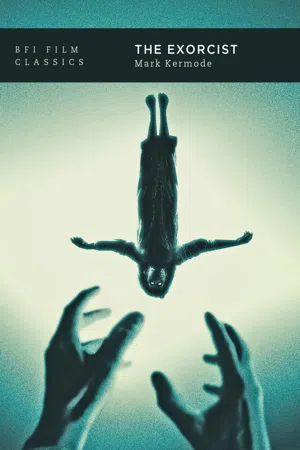
Inspired by an alleged real case of demonic possession in 1949, The Exorcist became an international phenomenon on its release in 1973. A blockbusting adaptation of a best-selling novel, it was praised as 'deeply spiritual' by some sections of the Catholic Church while being picketed by the Festival of Light and branded 'Satanic' by the evangelist Billy Graham. Banned on video in the UK for nearly fifteen years, the film still retains an extraordinary power to shock and startle.
Mark Kermode's compelling study of this horror classic was originally published in 1997, and then extensively updated and expanded in 2003 to incorporate the discovery of new material. This revised edition documents the deletion and reinstatement of key scenes that have now been integrated into the film to create The Exorcist: The Version You've Never Seen. Candid interviews with director William Friedkin and writer/producer William Peter Blatty reveal the behind the-scenes battles which took place during the production. In addition, exclusive stills reveal the truth about the legendary 'subliminal images' allegedly lurking within the celluloid.
- 104 pages
- English
- ePUB (mobile friendly)
- Available on iOS & Android
eBook - ePub
The Exorcist
About this book
Information
1 The Beginning
In 1993, writer Thomas B. Allen published a well-researched potboiler entitled Possessed. Recounting the supposed demonic infestation and subsequent exorcism of a fourteen-year-old boy in Mount Rainier, Maryland, in 1949, Possessed promised page-turning thrills in the form of a ‘chilling, factual reconstruction of the best-documented exorcism in history’. Allen’s version of these events, which had enjoyed brief notoriety in the 40s (and again, more sensationally, in the 70s) was largely based on the diaries of Father Raymond J. Bishop, who had assisted Father William S. Bowdern in the exorcism in question. Bishop’s diaries had been written as an official record of the proceedings for the use of the Jesuits and the doctors who had tended the boy. Allen had apparently gained access to the diaries through Father Walter Halloran, who had also assisted in the exorcism.4
In producing a work that quotes extensively from Bishop’s diaries, Allen succeeded where writer William Peter Blatty had failed nearly thirty years earlier. But had Blatty managed (as he had so strongly desired) to persuade those involved in the 1949 exorcism to sanction a non-fiction work based on the case, it is probable that neither the bestselling novel nor the blockbusting film of The Exorcist would ever have existed. In the event, Blatty’s failure in this venture became the starting point for one of America’s most notorious films.
In his behind-the-scenes book William Peter Blatty On The Exorcist: From Novel to Film, Blatty recounts how, as a junior at the Jesuitical Georgetown University in 1949, he came across an article in the Washington Post outlining the basic details of the Mount Rainier exorcism – that a young boy, who had been plagued by borderline supernatural phenomena, had undergone an extensive period of clerical attention after which his problems had reportedly ceased. ‘In what is perhaps one of the most remarkable experiences of its kind in recent religious history,’ the article began, ‘a fourteen-year-old Mount Rainier boy has been freed by a Catholic priest of possession by the devil.’ According to the Post story, the boy’s ‘symptoms’ had included the unassisted movement of his bed, mattress, a heavy armchair and assorted small objects, inexplicable scratching noises in his vicinity, and his own screaming, cursing and voicing of Latin phrases, a language he had never studied. The report made an indelible impression on the young Blatty, who saw in it ‘tangible evidence of transcendence... If there were demons, there were angels and probably a God and a life everlasting.’5
Encouraged by his tutors to present a paper on exorcism, Blatty became gripped by the notion that a credible, in-depth account of the case could serve as an uplifting document, reassuring the sceptical of the absolute existence of God. As Blatty later told Peter Travers and Stephanie Reiff for their book The Story Behind The Exorcist:
Like so many Catholics and people of belief, I thought it would be nice to put my fingers through the holes in Christ’s hands or have Christ appear on the Empire State Building to give me a private revelation. None of us has seen Lazarus or the Resurrection. So, if all the reports of the paranormal phenomena in the case were true, it would seem to me, although not a proof of everything that I had been taught, at least an absolutely riveting corroboration.6
The case as described by Allen is indeed intriguing. Events began on 15 January 1949, when the young boy (whom Allen renames ‘Robbie Mannheim’) and his grandmother were spending an evening together at 3210 Bunker Hill Road, Mount Rainier, Maryland.7 Untraceable dripping and scratching noises prompted a fruitless search of the upstairs rooms, with Robbie’s father concluding that rats were responsible. Eleven days later, Robbie’s ‘Aunt Harriet’ died in St Louis, profoundly affecting the boy, who had been close – perhaps unnaturally so – to his father’s unconventional sister. A self-professed medium, Harriet had spent much time with Robbie, teaching him how to use a Ouija board and explaining how the souls of the dead could make contact with the living. With Harriet’s death, the disturbances in the Mannheim household increased dramatically; Robbie’s mattress would shake at night, and his bedroom became infested with scratching and thumping sounds which, when questioned, seemed to respond to the name of Aunt Harriet.
On Thursday 17 February, with poltergeist phenomena now a regular occurrence at Bunker Hill Road, Robbie spent the night at the home of the Mannheims’ local Lutheran minister, Reverend Luther Miles Shulze. A non-believer in demonic possession, Shulze witnessed Robbie’s bed shaking and the movement of a heavy armchair and the mattress on which Robbie lay, leading him to tell the Mannheims: ‘You have to see a Catholic priest. The Catholics know about things like this.’ Sometime between Sunday 27 February and Friday 4 March, Robbie underwent an abortive exorcism under the control of Father Albert Hughes, at the Jesuit-run Georgetown Hospital, during which Robbie attacked Hughes with a piece of broken bedspring, slashing his arm from shoulder to wrist.
Things grew stranger still. Following instructions apparently scratched on Robbie’s body in red letters, reading ‘Louis’, ‘Saturday’ and ‘3½ weeks’, the Mannheims went to stay with relatives in St Louis (where Aunt Harriet had lived and died), who referred them to the Jesuit priests Father Raymond Bishop and Father William Bowdern. While Bowdern and Bishop investigated the possibility of demonic possession, Robbie’s relatives performed makeshift seances, concluding (bizarrely) that Aunt Harriet was indeed infesting Robbie, in an attempt to direct his father to a hidden stash of money intended for Harriet’s daughter.
On Wednesday 16 March, under instruction from Archbishop Joseph Ritter, Bowdern performed an exorcism at the home of Robbie’s aunt and uncle, assisted by Father Bishop and the young Father Walter Halloran. During the ceremony, Robbie spat into the faces of the priests, while welts and stripes appeared on his body, some forming the words ‘Hell’ and ‘Go’, the letter X, and an image of the Devil in which, according to Bishop, ‘The arms were held above his head, and seemed to be webbed, giving the hideous appearance of a bat.’ Subsequent home exorcisms followed, during which Robbie broke wind, mimed masturbation and urinated copiously while screaming that his penis was burning.
Although Robbie’s condition had not improved, Bowdern agreed to accompany the boy back to Mount Rainier, where further exorcisms took place, prompting the appearance on the boy’s skin of the words ‘Hell’ and ‘Spite’ and the numbers 4, 8, 10, and 16. These regular brandings continued, now often breaking the surface of the skin and drawing blood, while the boy taunted those around him in a guttural voice. ‘There was filthy talk and movements,’ records Bishop of one of Robbie’s more pronounced seizures, ‘and filthy attacks on those at the bedside concerning masturbation and contraceptives, sexual relations of Priests and Nuns.’
Finally, having failed to place Robbie in a Baltimore mental institution, Father Bowdern returned to St Louis with the boy who, on Palm Sunday, was placed in a secure mental ward at the Alexian Brothers Hospital. A further exorcism produced the word ‘Exit’ on his chest, with an arrow pointing to his penis (and resulted in a violent blow to the genitals for Bowdern). On Easter Sunday, Bishop recorded an increased authority in the ‘devil’s voice’ with which Robbie spoke during his attacks, while other witnesses reported a chilled air in the room, an unbearable stench and a grotesque distortion of the boy’s features. Finally, at around 11pm on Monday 18 April, Robbie announced ‘Satan! Satan! I am Saint Michael, and I command you, Satan, and the other evil spirits, to leave this body in the name of Dominus. Immediately! Now! Now! Now!’ At this, Robbie’s disturbances abruptly ceased.8
It is clearly possible to explain the case of ‘Robbie Mannheim’ as a text-book case of hysteria with mild, associated telekinetic side-effects.9 Moreover, viewing the events from a contemporary perspective it is hard not to imagine some form of repressed sexual trauma surrounding Robbie’s relationship with his Aunt Harriet. Thomas Allen notes that ‘Aunt Harriet seems to have treated Robbie more like a special friend than as a nephew,’10 and wonders in passing, ‘Did something happen between her and Robbie, something so darkly secret that it now haunted him?’11
As we know from Bishop’s diaries, many of the adolescent boy’s rantings were of a sexual nature, fixating violently on his genitals and on the sexual act. More strikingly still, even in the advanced stages of his disturbance, Robbie tended to manifest symptoms of ‘possession’ only at night, when he had changed from his dayclothes into his pyjamas and retired to bed. This one recurrent motif stands out in Allen’s tale, as does his account of Robbie’s violent reaction to a statue of Christ being stripped of his garments during the stations of the cross. Could this not be a manifestation of some guilty trauma involving nakedness? Indeed, when Archbishop Ritter, who personally authorized the exorcisms, later appointed a Jesuit examiner to review the case, the official conclusion was that Robbie was not afflicted by demons, but suffered from ‘a psychosomatic disorder with some kinesis action’.12
Bowdern felt differently, however, telling William Peter Blatty some twenty years later: ‘I can assure you of one thing – the case in which I was involved was the real thing. I had no doubt about it then and I have no doubts about it now.’13 A further twenty years on, Blatty would tell me of his conviction that the Mount Rainier case had been a genuine instance of demonic possession:
Yes, yes, absolutely. And it’s not a matter of this being one case among many others that I know of... Had I not come across this case I don’t think I would have written The Exorcist. My original intention for The Exorcist was not as a novel. I was going to write a case history of an authentic case of demonic possession. That for me was the excitement of the whole enterprise. And I was in touch with the exorcist involved, but he simply could not get permission from the Archbishop, because of the family.
Blatty suggests that the family’s reluctance to attract publicity was more evidence that this was a genuine case: ‘This family was not looking for any kind of notoriety, and indeed became very upset when it was suggested, on talk shows or whatever, that The Exorcist was based on this case.’
Ultimately, the relationship between the Mount Rainier case and the events depicted in The Exorcist would become the source of much public speculation. At this point, however, Blatty simply retained a fascination with the story, and a belief that it could somehow form the basis of a project which would lead him out of the comedic cul-de-sac into which he had written himself. Having gained an enviable reputation in the 60s as a comedy writer (he penned the screen romps What Did You Do in the War, Daddy?, Promise Her Anything and the Inspector Clouseau movie A Shot in the Dark), Blatty had begun to be frustrated by the lack of opportunity to write anything more serious. As he now ruefully notes, in the wake of The Exorcist, ‘a very promising career as a humorist was obliterated at a single stroke’.
Blatty’s first approach to Father Bowdern came after a friend in Los Angeles had supplied him with the exorcist’s name and address. During their initial encounters, Blatty reportedly asked Bowdern to help write an account of the Mount Rainier case which could ‘do more for the Church and for Christianity than eighty novels could.’14 Bowdern’s reply was complex: ‘My own thoughts were that much good might have come if the case had been reported, and people had come to realise that the presence and activity of the Devil is something very real. And possibly never more real than at the present time.’ However, his clerical superiors had strictly instructed him not to publicize the case on the grounds that ‘it would be most embarrassing, and possibly painfully disturbing to the young man, should he be in any way connected with a book detailing events that took place in his life some years ago. Since a case of possession is a very rare occurrence, he would certainly connect his own experience with any such account.’15 Undaunted, Blatty worked on a fictional tale which was inspired by the 1949 case but, crucially, not linked to it in any direct way. The result was The Exorcist.
Blatty’s fictional tale of possession centres on actress and single mother Chris MacNeil, whose daughter Regan develops serious behavioural problems while they are living in Georgetown, Washington DC. A barrage of medical and psychological tests fail to explain either the savage transformation of Regan’s personality, or the violent shaking of her bed. Further horrors ensue as Burke Dennings, the director of Chris’s current movie, is found dead near the MacNeil home, and a detective, Lieutenant Kinderman, surmises that Dennings was murdered, then thrown from Regan’s bedroom window. In a desperate bid to save her daughter, the avowedly atheist Chris turns to young Father Damien Karras, a local priest of faltering faith, who finally agrees to perform an exorcism. Karras is joined by ageing exorcist Father Lankester Merrin, who dies of heart failure during the ceremony. Devastated by Merrin’s death, and enraged by Regan’s taunts, Karras commands the ‘demon’ to leave her and enter his body, before throwing himself to his death through Regan’s window. His sacrifice is her salvation.
Clearly, if Thomas Allen’s account is to be believed, there is relatively little direct similarity between the events of 1949 and the phenomena described in The Exorcist. ‘Robbie Mannheim’’s supposed possession never obliterated his personality in the manner attributed to Regan MacNeil, who suffers so spectacularly in The Exorcist. Though there are many cryptic references to Robbie having no recollection of the events surrounding his exorcisms, he was said to be lucid for the greater part of the day throughout his three-month ordeal, falling prey to fits only by night. There are no such lulls in the personality disorder presented in The Exorcist, wherein a well-adjusted twelve-ye...
Table of contents
- Cover
- Series
- Title
- Contents
- Acknowledgments
- A Note About the Revised 2nd Edition
- Prologue
- 1 The Beginning
- 2 The Edge
- 3 The Abyss
- 4 And Let My Cry Come Unto Thee
- 5 Epilogue
- Appendix: Late Night Double Bill
- Notes
- Credits
- Bibliography
- Copyright
Trusted by 375,005 students
Access to over 1.5 million titles for a fair monthly price.
Study more efficiently using our study tools.
Frequently asked questions
Yes, you can cancel anytime from the Subscription tab in your account settings on the Perlego website. Your subscription will stay active until the end of your current billing period. Learn how to cancel your subscription
No, books cannot be downloaded as external files, such as PDFs, for use outside of Perlego. However, you can download books within the Perlego app for offline reading on mobile or tablet. Learn how to download books offline
Perlego offers two plans: Essential and Complete
- Essential is ideal for learners and professionals who enjoy exploring a wide range of subjects. Access the Essential Library with 800,000+ trusted titles and best-sellers across business, personal growth, and the humanities. Includes unlimited reading time and Standard Read Aloud voice.
- Complete: Perfect for advanced learners and researchers needing full, unrestricted access. Unlock 1.5M+ books across hundreds of subjects, including academic and specialized titles. The Complete Plan also includes advanced features like Premium Read Aloud and Research Assistant.
We are an online textbook subscription service, where you can get access to an entire online library for less than the price of a single book per month. With over 1.5 million books across 990+ topics, we’ve got you covered! Learn about our mission
Look out for the read-aloud symbol on your next book to see if you can listen to it. The read-aloud tool reads text aloud for you, highlighting the text as it is being read. You can pause it, speed it up and slow it down. Learn more about Read Aloud
Yes! You can use the Perlego app on both iOS and Android devices to read anytime, anywhere — even offline. Perfect for commutes or when you’re on the go.
Please note we cannot support devices running on iOS 13 and Android 7 or earlier. Learn more about using the app
Please note we cannot support devices running on iOS 13 and Android 7 or earlier. Learn more about using the app
Yes, you can access The Exorcist by Mark Kermode in PDF and/or ePUB format, as well as other popular books in Media & Performing Arts & Film History & Criticism. We have over 1.5 million books available in our catalogue for you to explore.