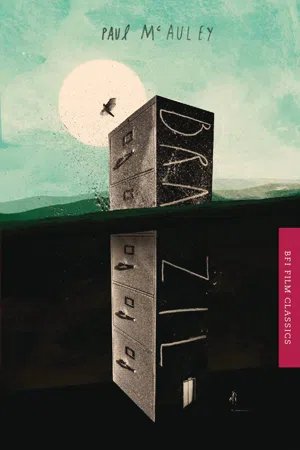
eBook - ePub
Brazil
About this book
Widely believed to be Terry Gilliam's best film, Brazil's brilliantly imaginative vision of a retro-futuristic bureaucracy has had a lasting influence on genre cinema. Exploring its complex history and relationship with other dystopias, Paul McAuley explains why this satire on the unchecked power of the state is more relevant than ever.
Information
‘Brazil’
Introduction
To begin with, it wasn’t always called Brazil. While writing early drafts of the screenplay, Terry Gilliam and his collaborators ran through a variety of working titles, some serious, some tongue-in-cheek, that reflected the multiplicity of the film’s influences and themes. The earliest, The Ministry and The Ministry of Torture, invoked the monolithic bureaucracy that governs its dystopia. Two more, So That’s Why the Bourgeoisie Sucks and How I Learned to Live with the System – So Far, referenced the mockery of mindless consumerism, the moral compromises of its protagonist, Sam Lowry, and Stanley Kubrick’s black comedy about nuclear brinkmanship and military bureaucracy, Dr Strangelove or: How I Learned to Stop Worrying and Love the Bomb (1964). And then there was 1984½, a nod to two acknowledged inspirations, George Orwell’s Nineteen Eighty-Four (1949) and Federico Fellini’s oneiric 8½ (1963), before Gilliam finally settled on a title borrowed from Geoff Muldaur’s jaunty and slightly kitsch version of Ary Barroso’s samba standard,1 the song that became Brazil’s leitmotif.
The title was one of the many things that Universal Studios executive Sid Sheinberg disliked about Brazil;2 he and Gilliam fought a famously gruelling battle over the final cut for the US market before Gilliam prevailed. The film was finally released in the US in December 1985,3 ten months after its release in Europe. It received a mixed critical reception. In The New York Times, Janet Maslin praised Brazil for its ‘jaunty, wittily observed vision of an extremely bleak future’;4 Time’s film critic Richard Corliss claimed that ‘There is not a more daft, more original or haunting vision to be seen on American movie screens this year … A terrific movie has escaped the asylum without a lobotomy.’5 But in The Chicago Sun-Times, Roger Ebert found it ‘very hard to follow’ and complained that ‘It’s as if Gilliam sat down and wrote out all of his fantasies, heedless of production difficulties, and then they were filmed – this time, heedless of sense’;6 and as far as Stanley Kauffmann was concerned, ‘Brazil doesn’t add up to much, not only because its cautionary tales are familiar, but because it has no real point of view, nothing urgent under its facile symbols. And the story winds on and on looking for a finish. Three or four times I reached for my coat prematurely.’7
Audiences more or less agreed with Ebert and Kauffmann. In the US, at least, it seemed that the studio had been right after all. Brazil was prodigiously inventive and visually stunning, but its wealth of unexplained detail, a complex narrative that blended reality and fantasy, and the bait and switch of its enigmatic ending, gave it the reputation of being an overwhelming spectacle wrapped around a story that alienated and confused many cinemagoers. Although Terry Gilliam had won the battle for control of his film, he had failed to win over the all-important American market. It would be years until video rentals and sales helped to earn out his film’s comparatively modest budget.
Despite this inauspicious beginning, Brazil’s reputation has steadily grown. It is now widely regarded as the most thoroughly realised example of the creative signature that indelibly watermarks all of Gilliam’s films: a compound of vivid imagery, gonzo humour, stories that combine allegorical elements and genre tropes with excursions across the border between the fantastic and the real, and investigations of the power and danger of the imagination. Gilliam’s final cut of Brazil is available in lavish DVD and Blu-ray packages; there’s a book dedicated to the film’s inception, and another to the tribulations of its making and marketing; it was voted the 54th best British film ever made in the British Film Institute’s pre-millennial survey, regularly features in lists of best science-fiction films and has received the pop-culture accolade of being parodied in The Simpsons.
I first saw Gilliam’s work in the BBC television show Monty Python’s Flying Circus (1969–74). Its absurdist sketches, ridiculing authority and overturning unexamined mores of what was then, despite the brief heyday of Swinging London, still pretty much a drably conformist society, were an indelible part of student culture in the 1970s, much as duffel coats and trad jazz were for an earlier generation. Like many of my university friends, I could (and did) recite chunks of dialogue from sketches which had been reissued on LPs, an essential surrogate for Python fans in the age before endless TV repeats, DVD box sets and YouTube.


Terry Gilliam (top right) and other Pythons; Monty Python’s Flying Circus (1969–74): stream-of-consciousness animation
Gilliam had worked as a cartoonist for the satirical magazine Help! and, briefly, Mad Magazine, before moving to London when he became disillusioned with the Vietnam War and the reactionary mores of American society and politics. He quickly developed a career as a TV animator, working for shows like Do Not Adjust Your Set (1967–9) and We Have Ways of Making You Laugh (1968) before, through a previous acquaintance with John Cleese, becoming part of the Python ensemble. His surrealistic stream-of-consciousness animations, crammed with layered detail and assembled from his own cartoons and cut-outs from artworks, photographs, magazines, and Victorian and Edwardian engravings, provided the show’s opening credits and visual trademarks, and formed the connective tissue between its open-ended sketches. He first transferred his signature style to live-action films8 when he co-directed Monty Python and the Holy Grail (1975) and acted as art director for Monty Python’s Life of Brian (1979).9 He also directed the sequence in Life of Brian in which a flying saucer crash-lands and briefly kidnaps the hapless hero, and wrote and directed the short film The Crimson Permanent Assurance, which opened Monty Python and the Meaning of Life (1983).
Fan that I was, I’d seen the three Python feature films and had also liked the gritty imagination of Gilliam’s first solo directorial effort, the medieval farce Jabberwocky (1977), although somehow (possibly because I thought, mistakenly, it was a children’s film, rather than a film for children of all ages) I missed his second, more successful film, Time Bandits (1981). And then there was Brazil, which I saw soon after it opened in Britain in February 1985, months before Gilliam’s battle with Universal (a controversy that at the time passed me by) and the film’s relative failure in the US (ditto).
I was a practising research scientist and a fledgling science-fiction author back then, trying to shape my own ideas about the various futures that might evolve from the present. Brazil’s mise en scène resembled a version of the future that had been filtered through the sensibilities of the authors and illustrators of pulp scientifiction magazines, or an alternative history that had evolved at right-angles to our own. A retro-future like nothing else in contemporary science fiction, where people dressed in 1940s clothing, drove three-wheeled bubble cars, and used phones with miniature plug-in switchboards and computers with typewriter keyboards and tiny screens magnified by plastic lenses. This densely detailed atemporal bricolage, in which the dreams and debris of the entire twentieth century were compacted into a single moment10 (and which won production designer Norman Garwood and set dressing designer Maggie Gray Academy Award nominations), chimed with my affinity for the crammed, hypercapitalist, noir-inflected futures of the nascent cyberpunk movement and earlier authors like Alfred Bester, John Brunner and Samuel R. Delany. And the film’s narrative not only mixed farce, black comedy and slapstick in the style of the Pythons, demonstrating that, as Peter Marks has contended, ‘surreal humour can operate as part of a satirical social critique’,11 but also interrogated the present at a slant, exemplifying the Martian viewpoint of the best science fiction.
Brazil’s narrative is woven from parallel threads of reality and fantasy. Sam Lowry, a clerk in a department of a monolithic bureaucracy, escapes from the routines of his life in dreams of being a winged knight. In the waking world, he glimpses a woman, Jill Layton, who looks exactly like the dream girl of his fantasies, and learns that she is suspected of terrorism. His attempts to find and save Jill are echoed in his dreams; eventually, his bumbling attempts to become an actual hero doom both Jill and himself, and he ends up in one of the bureaucracy’s torture chambers; a vivid sequence in which he’s rescued by freedom fighters and escapes with Jill to a rural paradise is suddenly revealed to be yet another fantasy, the only way of escaping his tormentors. ‘I wanted to make a film where a man goes mad,’ Gilliam has said, ‘and it’s a happy ending.’12

Telephone, Brazil-style
Although Gilliam claims not to have read Nineteen Eighty-Four – ‘whatever knowledge I had was just general knowledge that was in the atmosphere’13 – he admits that, even though he was thinking more of Kafka, Brazil echoed many elements of Orwell’s classic dystopia. The protagonists of Nineteen Eighty-Four and Brazil both work for the bureaucracies of police states, and both become involved in doomed love affairs that end with their arrest and torture by men they believe to be their friends. The government in Nineteen Eighty-Four is at war with other nation states, while the government in Brazil is engaged in a war against internal terrorists: the civilian populations of both are threatened by random explosions. Both films, as John Hutton has pointed out, ‘posit a world from which in a real sense there is no escape or refuge’,14 and both share the core message (also that of Yevgeny Zamyatin’s We [1921] and Aldous Huxley’s Brave New World [1931]) that, as Orwell scholar Sir Richard Rees has put it, ‘our industrial machine civilisation is tending to deracinate and debilitate us, and will finally destroy us’.15 Brazil’s narrative also shares some elements with Fritz Lang’s seminal dystopia Metropolis (1926): like Freder Fredersen, the hero of Metropolis, Sam Lowry was born into the social elite of a teeming city, and both Freder and Sam fall in love with a woman who is motivated by empathy for the oppressed working classes. Unlike Freder, however, Sam completely lacks any revolutionary ardour.
There are also significant differences between Brazil and Nineteen Eighty-Four. Michael Radford’s film adaptation of the novel was released in 1984, while Brazil was being completed. In a contemporary interview, Gilliam recalls,
I was scare...
Table of contents
- Cover Page
- Title Page
- Contents
- ‘Brazil’
- Conclusion
- Notes
- Credits
- Bibliography
- eCopyright
Trusted by 375,005 students
Access to over 1.5 million titles for a fair monthly price.
Study more efficiently using our study tools.
Frequently asked questions
Yes, you can cancel anytime from the Subscription tab in your account settings on the Perlego website. Your subscription will stay active until the end of your current billing period. Learn how to cancel your subscription
No, books cannot be downloaded as external files, such as PDFs, for use outside of Perlego. However, you can download books within the Perlego app for offline reading on mobile or tablet. Learn how to download books offline
Perlego offers two plans: Essential and Complete
- Essential is ideal for learners and professionals who enjoy exploring a wide range of subjects. Access the Essential Library with 800,000+ trusted titles and best-sellers across business, personal growth, and the humanities. Includes unlimited reading time and Standard Read Aloud voice.
- Complete: Perfect for advanced learners and researchers needing full, unrestricted access. Unlock 1.5M+ books across hundreds of subjects, including academic and specialized titles. The Complete Plan also includes advanced features like Premium Read Aloud and Research Assistant.
We are an online textbook subscription service, where you can get access to an entire online library for less than the price of a single book per month. With over 1.5 million books across 990+ topics, we’ve got you covered! Learn about our mission
Look out for the read-aloud symbol on your next book to see if you can listen to it. The read-aloud tool reads text aloud for you, highlighting the text as it is being read. You can pause it, speed it up and slow it down. Learn more about Read Aloud
Yes! You can use the Perlego app on both iOS and Android devices to read anytime, anywhere — even offline. Perfect for commutes or when you’re on the go.
Please note we cannot support devices running on iOS 13 and Android 7 or earlier. Learn more about using the app
Please note we cannot support devices running on iOS 13 and Android 7 or earlier. Learn more about using the app
Yes, you can access Brazil by Paul McAuley in PDF and/or ePUB format, as well as other popular books in Media & Performing Arts & Film & Video. We have over 1.5 million books available in our catalogue for you to explore.