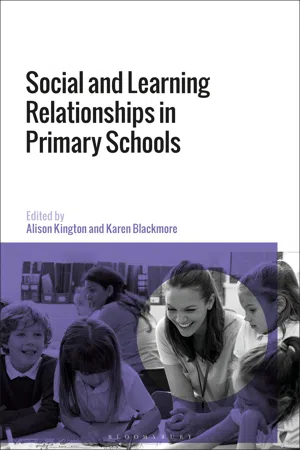
One of the most important factors in pupils' success in school are the relationships developed with teachers and other children. Not only are these relationships important in their own right, but they have considerable bearing on pupil motivation, achievement, and on their perceptions of themselves as learners. Social and Learning Relationships in Primary Schools is based upon, but not confined by, recent research projects focused on a range of relationships that exist within English primary schools. This text provides substantial evidence and rich insights into the development and ongoing influences on these social and learning relationships, relating to both the academic and affective outcomes of pupils.
The book is presented in four parts: i) social interaction and the curriculum; ii) classroom relationships and the impact on learning; iii) professional identity and professional development; and iv) individual differences and inclusion. Through these sections, the authors identify important features of primary schooling including, for example, delivery of the core subjects, learning environment, role of student teachers in schools, classroom technology, and the transition between phases of education. They examine a number of social psychological influences on these relationships in terms of career phase, professional identity, adult-child and peer relationships, and self-efficacy and provide powerful evidence of the complexities of primary school life.
Drawing together the perspectives of a number of authors, all of whom have served as practising teachers as well as gaining a wealth of experience in the higher education sector, Social and Learning Relationships in Primary Schools offers a detailed and holistic understanding of the influences that shape learning, policy and practice in this context.
eBook - ePub
Social and Learning Relationships in Primary Schools
- 256 pages
- English
- ePUB (mobile friendly)
- Available on iOS & Android
eBook - ePub
Social and Learning Relationships in Primary Schools
About this book
Information
Part Four
Individual Differences and Inclusion
10
Planning for Children’s Voice in Sociocultural Education: Findings from the We Are Europe Project
Branwen Bingle
Introduction
We Are Europe (WAE) was a two-year Erasmus+ project in the field of civic education. Underpinned by the motto ‘Know yourself and be open to the difference of others’, the project brought together a consortium of eight partners from six European Union (EU) countries: Austria, Estonia, Finland, Poland, Portugal and the UK. Led by members of the Institut für Jugendliteratur, a non-profit educational research and development organization based in Vienna, the project was founded on the principles of interdisciplinary cooperation and a wish to bring together diverse voices in order to raise social and cultural awareness across the EU. The project aimed to develop innovative teaching modules for pupils aged 9–14, primarily around specific themes such as the concept of ‘home’ as a part of national, regional and local identity, in order to provide a resource which celebrated the diversity of the EU.
A key rationale for the project was the perceived need to deepen students’ political and historical knowledge of Europe in general, and especially about those European countries that were partners in the project. Participants in the project were able to develop their interest in the EU as an inclusive space for lifelong learning and work. Previous liberal assimilationist policies focused on citizenship education as a means of encouraging integration into a single dominant culture (Banks 2008). However as Borgmann-Prebil and Ross (2013, p. 405) point out, Article 9 of the Treaty on European Union (TEU), supported by Article 20 of the Treaty on the Functioning of the European Union (TFEU), makes it clear that ‘Citizenship of the Union shall complement and not replace national citizenship.’ Thus, the project was founded on an intention to celebrate the unique social and cultural lives of citizens of the participating member states, while facilitating a sense of connectedness with their concurrent European identity.
Political context
The varied but overlapping political environment in each of the six countries involved provided a strong motivation for participation. In Austria, the lead institution was supported by Schule Anton-Sattler-Gasse, a local school that had developed a multicultural approach to its educational offer due to an influx of pupils from neighbouring countries such as Hungary, Slovakia and the Czech Republic. In addition, the school had rising numbers of children on roll whose families were economic migrants or refugees seeking asylum. The issues faced by the school, though concentrated due to its location in the capital city of Vienna, were not unusual. In Austria, ‘Immigrant population has grown during the past three decades, from 4 per cent in 1980 to 16 per cent in 2012’ (Pechar 2015, p. 21), meaning many more schools were needing to consider how to integrate pupils arriving with limited knowledge of the national language and culture. In this school, the staff felt that it was important to acknowledge the multiple civic and social identities experienced by the students. Their participation in WAE was underpinned by a wish to create learning that would help students feel a sense of belonging as citizens of Austria and of the EU, without sacrificing their home culture and heritage.
In contrast, for the participants from the University of Eastern Finland (Ita-Suomen Yliopisto), the context was more culturally homogeneous, though larger cities were becoming more multicultural (Rautiainen and Kostiainen, 2015). Thus, the project provided the potential to develop materials that would give an insight into other European cultures and lifestyles that could not necessarily be gleaned from the general population, in order to encourage a better understanding of the diversity of European experience. An added advantage was it provided the researchers from the university an opportunity to analyse the pedagogical tools and pupil outputs beyond their immediate environment. This was also the case for participants from Estonia and Poland who, as newer member states, had previously been influenced by the educational and political policies of the Soviet Union (Corner, 2015). The contributors from these countries were keen to share cultural resources and social practices that demonstrated their unique national identities within the context of EU membership.
Participation within Portugal and the UK was coordinated by institutes involved in Initial Teacher Education (ITE), namely the Instituto Politécnico de Castelo Branco and the University of Worcester. Similar to the Austrian context, in Portugal a representative from one of the school partners, Agrupamento de Escolas Nuno Álvares, was part of the consortium. Attitudes towards the EU were generally positive in Portugal, as the prerequisite of a democratic government for entry to the EU aided the move away from the more authoritarian regimes of much of the twentieth century (Royo, 2007). There was a consensus from the members of the project consortium that membership was socially, economically and culturally important for Portugal, particularly as a country that, historically, had been a key part of European globalization. In the UK, however, the situation was more complex, and during the course of the project the context changed dramatically in a way that related directly to the social and learning relationships being established. This was due to the ongoing political, commercial and social debate relating to the nature of the UK’s role within the EU.
Methodology
The initial project proposal was based on the idea that all outputs, including lesson plans, resources and examples of pupils’ work, were to be produced through team work, using an interdisciplinary approach based on a shared learning strategy, cooperative learning and learner-centred methods. This underpinned the development of the multinational project team: partners included school teachers and leaders, teacher-educators, academic researchers and librarians, with further support commissioned by some partners from C&T, a theatre and education group with expertise integrating drama and digital media. The intention was to create an interdisciplinary educational community of practice in order to address the project aims as comprehensively as possible. According to Wenger, McDermott and Snyder (2002, p. 4), ‘[c]ommunities of practice are groups of people who share a concern, a set of problems, or a passion about a topic, and who deepen their knowledge and expertise in this area by interacting on an ongoing basis.’ A community of practice, then, is primarily a social structure founded on an aggregated knowledge base; in other words, a group of individuals comes together around a shared set of interests and/or problems and collectively develops a body of common knowledge, skills or strategies to address these. In the case of this project, the diversity of roles represented within the community of practice was fundamental to ensuring the lesson plans and resources would be appropriate for a broad European audience.
Data collection
The project was implemented in seven stages:
1. Fact finding and the establishment of a local, national and international rationale for the project. This included a review of the national curriculum in each country to identify how and where aspects of culture were specifically alluded to in order to support the development of appropriate lessons. Pupils’ knowledge bases in relation to the EU and the project participant countries were examined by the use of a questionnaire. Finally, a (Knowledge, What, Learned) KWL1 grid (Ogle, 1986) was adapted to collect baseline information about what pupils already knew and what/how they wanted to learn during the project.
2. The identification of sources and resources to support teaching and learning in the planning phase (stage 5). This was linked to the curriculum review and intended to act as a starting point for planning rather than the production of a prescriptive list: participants were free to select resources not previously identified during the planning phase.
3. Production of ‘Tips for Teachers’ to support professionals in developing their pedagogical understanding. This was designed as a stand-alone booklet detailing key approaches and teaching strategies that the project consortium felt would facilitate lessons that explored cultural, social, economic and political issues within an European context and enabled greater understanding and tolerance.
4. The development of a set of professional learning modules for teacher trainers to use with school staff. Building on the ‘Tips for Teachers’, the modules provided a continuing professional development (CPD) programme totalling thirty hours of blended learning. The modules drew upon the results of the questionnaires to students and teachers, as well as the lists of resources, to address gaps in knowledge and understanding.
5. The development of lesson plans for piloting in schools. In the UK this was undertaken by teachers across two middle schools, one deemed primary and one deemed secondary, to ensure lesson plans were produced for the full age range of pupils aged 9–14 in order to meet the parameters of the project.
6. The collation of some of materials produced by the students as a result of the piloted lessons. These were then published on the project website (stage 7) and were intended to be used as exemplars as well as resources in their own right.
7. The development of the project website, www.we-are-europe.net, as an online open-access publication. This acted as a repository for the materials designed by the participants from all the previous activities.
A total of 37 teachers and 1,300 pupils were involved in the project across the six participant countries. For the purpose of this chapter, only specifi...
Table of contents
- Cover
- Half-title Page
- Also available from Bloomsbury
- Title Page
- Contents
- Illustrations
- Foreword
- Acknowledgements
- Notes on Contributors
- Introduction
- Part Two Classroom Relationships and Learning
- Part Three Professional Identity and Professional Development
- Part Four Individual Differences and Inclusion
- Index
- Copyright Page
Trusted by 375,005 students
Access to over 1.5 million titles for a fair monthly price.
Study more efficiently using our study tools.
Frequently asked questions
Yes, you can cancel anytime from the Subscription tab in your account settings on the Perlego website. Your subscription will stay active until the end of your current billing period. Learn how to cancel your subscription
No, books cannot be downloaded as external files, such as PDFs, for use outside of Perlego. However, you can download books within the Perlego app for offline reading on mobile or tablet. Learn how to download books offline
We are an online textbook subscription service, where you can get access to an entire online library for less than the price of a single book per month. With over 1.5 million books across 990+ topics, we’ve got you covered! Learn about our mission
Look out for the read-aloud symbol on your next book to see if you can listen to it. The read-aloud tool reads text aloud for you, highlighting the text as it is being read. You can pause it, speed it up and slow it down. Learn more about Read Aloud
Yes! You can use the Perlego app on both iOS and Android devices to read anytime, anywhere — even offline. Perfect for commutes or when you’re on the go.
Please note we cannot support devices running on iOS 13 and Android 7 or earlier. Learn more about using the app
Please note we cannot support devices running on iOS 13 and Android 7 or earlier. Learn more about using the app
Yes, you can access Social and Learning Relationships in Primary Schools by Alison Kington, Karen Blackmore, Alison Kington,Karen Blackmore in PDF and/or ePUB format, as well as other popular books in Education & Education Theory & Practice. We have over 1.5 million books available in our catalogue for you to explore.