- 208 pages
- English
- ePUB (mobile friendly)
- Available on iOS & Android
eBook - ePub
About this book
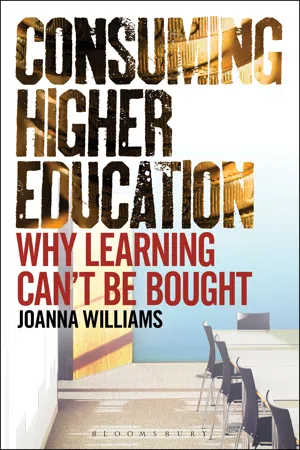
Consuming Higher Education explores the status of students within the university and society, and the funding and purpose of higher education, drawing on empirical data, UK and USA government policy documents, speeches by policy makers and media representations of students. Joanna Williams moves beyond the debates surrounding fees to consider the impact of the consumption model on universities, learning, knowledge, and student identity. While consumer status initially appears to empower students, Williams argues that it ultimately erodes students' autonomy and reduces learning to an instrumental focus on credit accumulation. At the same time, in giving students consumer status, lecturers are encouraged to avoid intellectually or emotionally challenging content so as not to upset student consumers, which could promote dissatisfaction. Williams draws these themes and arguments together to consider what it means to be a student and to explore alternative conceptions of higher education.
Information
1
Students within a changing university
Students have not always been considered consumers of higher education. Nor did the student-as-consumer arrive in the UK merely as a result of the 2011 legislation that raised individual tuition fee payments, as much of the recent media debate might suggest. This chapter explores the HE landscape in the USA and the UK before the vocabulary of markets, consumer choice and student satisfaction replaced the language of knowledge, learning and education. From this historical background it becomes possible to trace the social, economic and political conditions that gave birth to the student as consumer. This chapter considers key government policies that have shaped the HE sectors in both the USA and the UK up to the mid–1990s.
Many debates recur throughout the history of HE, the chief of which is the purpose of universities. Rhetorical battles between supporters of vocational education and liberal education echo across the generations. Likewise, discussion as to who should go to university began in earnest from the middle of the nineteenth century. Neither of these debates has been resolved. Without understating the political and cultural pressures that operated around universities in the past, or naively assuming a ‘golden age’ of higher education, we can trace a general shift away from a more liberal notion of higher education being important for its own sake, towards a more instrumental connection to the employment prospects of individuals. Over more recent years, HE has moved from being broadly viewed as a public good of benefit to society, to a private good of benefit mainly to the individual student.
Today, policy makers argue that higher education should primarily serve an economic purpose in ensuring individual employability and international competitiveness; or a social purpose in creating an inclusive society where individual social mobility, and national social justice, can be seen to occur. Before passing judgement upon either of these positions it is important to note that both locate the purpose of a university as external to education. British sociologist Frank Furedi notes that ‘an instrumental economic agenda has converged with an anti-elitist social engineering imperative, in a joint attack on academic, subject based education’ (Furedi, 2009: 40). It is assumed today that education must indeed have a stated purpose; that it is not just important in and of itself.
Education, and higher education in particular, represents the historical accumulation of society’s collective knowledge and understanding. The content, rather than the form, of higher education represents a nation’s intellectual heritage: the knowledge, skills and traditions that are considered worth passing from one generation to the next. Hannah Arendt suggests it is because children are ‘born into an already existing world’ that educators have a particular responsibility to play a role in passing on society’s knowledge, ‘even though they may, secretly or openly, wish it were other than it is’ (Arendt, 1954: 185–6). Through the passing on of this knowledge, ‘individuals gain an understanding of themselves through familiarity with the unfolding of the human world’ (Furedi, 2009: 47). It is for this reason that Michael Oakeshott refers to education as a ‘conversation between the generations’ (in Pring, 2004: 28).
Society’s attitude towards the institutions and people that comprise the higher education sector in many ways represents the regard in which this national intellectual heritage is held. A need to locate the purpose of HE as external to learning for its own sake is perhaps indicative of a broader crisis in relation to the knowledge that is considered sufficiently important to pass from one generation to the next. If the intellectual elite in society are no longer able to confidently assert a body of knowledge that future citizens should be able to master, interpret, add to, and make their own, then universities necessarily fall back upon instrumental purposes to justify their existence. Arendt notes: ‘the crisis of authority in education is most closely connected with the crisis of tradition, that is with the crisis in our attitude toward the realm of the past’ (Arendt, 1954: 190). The emergence of the student-as-consumer then represents not just a financial or even a political shift within the HE sector, but fundamentally an educational shift too.
When students are no longer perceived to be potential contributors to the public intellectual capital of the nation, there are perhaps few alternatives to the student-as-private-investor model. The brief historical sweep of two major national HE sectors provided here aims to show how, by the mid–1990s, the student consumer had become an established feature of the US HE sector; and how, even before the introduction of tuition fees paid directly by students in the UK, the scene had been set for the emergence of the student-as-consumer here too.
A brief history of higher education in Britain and America
The history of universities in England dates back as far as 1096, when a centre of teaching and learning is recorded as existing in Oxford. This was to become the first university in the English-speaking world (Robinson, 2010: xii). The University of Cambridge followed a little over 100 years later, when a group of scholars banished from Oxford set up an alternative home. These universities were founded by the Catholic Church as essentially monastic institutions, designed for young men to spend time dedicated to theological study before entering the Priesthood. The founders of these institutions were influenced by the work of St Augustine and, going back even further, Plato’s Academy, which aimed to keep men cloistered from the concerns of everyday life (in Carr, 2009: 5). Later years brought the founding of the ‘Ancient Universities’ in Scotland: institutions that developed during the Renaissance and Medieval periods, when King James II (1437–60) wanted Scottish universities to rival Oxford and Cambridge and established St Andrews (1413) and Glasgow University (1451).
These universities were exclusively religious institutions until the Reformation, when King Henry VIII ordered the dissolution of the Catholic Monasteries in 1534. One impact of the Reformation was to begin slowly to challenge the narrowly religious focus of universities. The reign of Queen Elizabeth I (1558–1603) marked the start of the Renaissance in England and the intellectual excitement of the era further served to loosen the religious grip on universities and broaden the range of subjects taught in them. By the middle of the seventeenth century John Locke graduated from Oxford University having studied medicine, ‘natural philosophy’ and philosophy (Smith, 2001: 45).
The first American universities had similar religious beginnings to those in Britain, but were founded by members of the Protestant faith rather than the Catholic Church. Harvard College was the first university to be established in 1636, followed by the College of William and Mary in Virginia in 1693, and the University of Pennsylvania in 1751. Despite religious affiliation, these privately funded institutions were proud to be free from the political control of the British colonial government (Heller, 2011: x).
For some students in the seventeenth and eighteenth centuries, entering university would have been a precursor to their becoming clergymen, their divinely determined ‘vocation’ in life. The purpose of a university could, then, perhaps be considered vocational, in the sense that it served as a form of training for a future life path. Today, as definitions of vocational education have shifted, we would probably consider the education received by students at this time as more broadly academic than narrowly practical. Indeed, it is only since 1987 that ‘training’ to join the Priesthood in Britain has moved away from a purely academic, philosophical and theological focus to include more practical aspects of delivering ministry.1 For other students in the seventeenth and eighteenth centuries, links to the Church were more of a formality and did not prevent them from studying a broad-based range of subjects.
From the mid-seventeenth century until the end of the nineteenth century, the Enlightenment marked a final cultural departure from the Middle Ages. With the Enlightenment came the possibility of a rationalist, scientific understanding of the world achieved through independent scholarship. New fields of study emerged in areas such as mathematics, astronomy, physics, politics and economics. Other subjects such as philosophy and medicine were radically updated and expanded. Huge leaps in understanding were made and much new knowledge was discovered. More of the population than ever before sought to engage in intellectual pursuits. For the most part, these intellectual developments took place outside of the universities and only latterly had an impact upon the academy.
The development of education in America at this time was greatly influenced by the work of the British Enlightenment philosopher John Locke (1632–1704), who described the human mind as a ‘tabula rasa’ [blank slate] – a concept that implied that the mind could be perfected through the formative influence of education. This was considered revolutionary because up to this point it had been believed that knowledge, and especially moral sense, was innate or ‘God-given’, and that therefore education was of strictly limited use. The notion of humans as being perfectible through knowledge gave new impetus to schools and universities. In America, the demand for the building of more universities was driven by Independence in 1776; Locke’s work had also been influential in the writing of the American Declaration of Independence. Citizens of an independent nation sought to determine their own intellectual future. In 1791 the Bill of Rights was passed by Congress, and education became a function of state rather than federal government. States then began to charter public universities to supplement the private, often church-funded institutions.
Only towards the end of the Enlightenment period did British universities come to be influenced by philosophies of what would now be termed ‘liberal education’: the promotion of learning for its own sake, to seek truth and to broaden knowledge as an end in itself, as opposed to serving a religious purpose. The liberal ideal is often considered to stand in opposition to education that has a vocational, practical utility. John Stewart Mill, in his 1867 Inaugural Address to the University of St Andrews, describes the role of a university as ‘not a place of professional education’, because he suggests subjects such as law and medicine are ‘no part of what every generation owes the next as that on which its civilisation and worth will principally depend’ (Mill, 1867). As with the Church Elders who founded the earliest universities, the Enligh...
Table of contents
- Also available from Bloomsbury
- Title
- Copyright
- Dedication
- Contents
- Foreword
- Acknowledgements
- Introduction: It's not about the money
- 1 Students within a changing university
- 2 The rise of the student consumer
- 3 Constructing consumption
- 4 Teaching consumption and consuming learning
- 5 A question of identity
- 6 Customer care
- 7 Beyond entitlement
- Bibliography
- Index
Trusted by 375,005 students
Access to over 1.5 million titles for a fair monthly price.
Study more efficiently using our study tools.
Frequently asked questions
Yes, you can cancel anytime from the Subscription tab in your account settings on the Perlego website. Your subscription will stay active until the end of your current billing period. Learn how to cancel your subscription
No, books cannot be downloaded as external files, such as PDFs, for use outside of Perlego. However, you can download books within the Perlego app for offline reading on mobile or tablet. Learn how to download books offline
Perlego offers two plans: Essential and Complete
- Essential is ideal for learners and professionals who enjoy exploring a wide range of subjects. Access the Essential Library with 800,000+ trusted titles and best-sellers across business, personal growth, and the humanities. Includes unlimited reading time and Standard Read Aloud voice.
- Complete: Perfect for advanced learners and researchers needing full, unrestricted access. Unlock 1.5M+ books across hundreds of subjects, including academic and specialized titles. The Complete Plan also includes advanced features like Premium Read Aloud and Research Assistant.
We are an online textbook subscription service, where you can get access to an entire online library for less than the price of a single book per month. With over 1.5 million books across 990+ topics, we’ve got you covered! Learn about our mission
Look out for the read-aloud symbol on your next book to see if you can listen to it. The read-aloud tool reads text aloud for you, highlighting the text as it is being read. You can pause it, speed it up and slow it down. Learn more about Read Aloud
Yes! You can use the Perlego app on both iOS and Android devices to read anytime, anywhere — even offline. Perfect for commutes or when you’re on the go.
Please note we cannot support devices running on iOS 13 and Android 7 or earlier. Learn more about using the app
Please note we cannot support devices running on iOS 13 and Android 7 or earlier. Learn more about using the app
Yes, you can access Consuming Higher Education by Joanna Williams in PDF and/or ePUB format, as well as other popular books in Éducation & Politique d'éducation. We have over 1.5 million books available in our catalogue for you to explore.