In October 1971 Mohammad Reza Pahlavi, Shah of Iran, held a celebration to commemorate the 2500th anniversary of the founding of the Persian Empire by Cyrus the Great. Dozens of heads of state descended on Persepolis for these Celebrations, where they were regaled to sumptuous banquets and entertainment. Critical journalists in Western Europe and North America lambasted the Shah for holding such a decadent event while many of his people lived in poverty. Due to the overwhelmingly negative press at the time, the event is still today widely remembered as a catastrophic failure.It is even said by many to have sparked the unrest that eventually led to the revolution and the Shah's downfall in 1979.
In this first comprehensive academic study of the 2500th Anniversary Celebrations, Robert Steele looks beyond the pomp and splendour to examine the events' origins, the goals the organisers set out to achieve with them and the extent to which these goals were accomplished. The book seeks to place the Celebrations in the context of the Shah's rise, rather than his fall, uncovering the unparalleled international cultural and scholarly operation that was spurred by the Iranian regime for the occasion, exploring the effects the event had on Iran's tourism industry and questioning narratives of the event's cost.
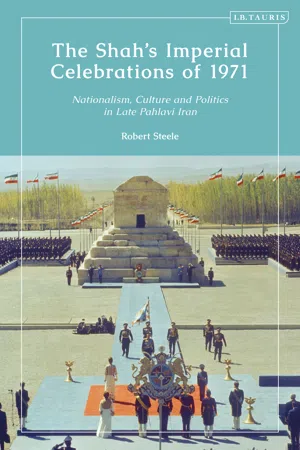
eBook - ePub
The Shah’s Imperial Celebrations of 1971
Nationalism, Culture and Politics in Late Pahlavi Iran
- 240 pages
- English
- ePUB (mobile friendly)
- Available on iOS & Android
eBook - ePub
The Shah’s Imperial Celebrations of 1971
Nationalism, Culture and Politics in Late Pahlavi Iran
About this book
Information
1
Ideology and historical background
Pierre Nora has argued that in the context of nationalism, there is no such thing as spontaneous memory; and that, therefore, once a historical narrative has been devised and described, a country’s leaders are faced with the need to stimulate continuously awareness of this constructed past among the population. Leaders do this by such means as creating archives, marking anniversaries, eulogizing, authenticating documents and organizing celebrations.1 The Shah was certainly not the first to use large-scale national celebrations for this purpose, as demonstrated by the 1913 tercentenary of the Romanov dynasty in Russia, the 1937–8 bimillennial celebration of the birth of Augustus in Italy and the 1940 celebration of the 2600th anniversary of the Japanese empire.2 Such celebrations help to create or enforce national identity, legitimize one’s rule or defend the established order, and to trumpet the leader’s power and authority.3 The purpose is not merely to commemorate past events but to present the current political status quo as the inevitable result of historical forces. As David Kertzer has written, ‘In rendering their political system sacred through the use of ritual, people end up legitimizing the power held by political leaders.’4
The use of ritual and performance to elicit public support for a ruler or regime has been an important strategy for creating legitimacy in Iranian history. The royal patronage and embellishment of the Ashura rituals in the Safavid period from the rule of Shāh ʿAbbās, and the taʿziyeh during the Qajar period, allowed the ruler to insert himself into pre-existing religious ceremonies, and in the process establish the state as the guarantor of religion.5 The Pahlavis also used ceremonies as a means to legitimize the authority of the state, though these were often secular rather than religious. One key strategy employed by the Pahlavi regime was the creation of lieux de mémoire, to borrow Pierre Nora’s phrase for physical sites designed or repurposed for the collective remembrance of a shared national history. This essentially became the government policy with the founding of the Society for the National Heritage of Iran (Anjoman-e Āsār-e Melli-ye Irān) in 1922. Events such as the celebration of the 1000th anniversary of the birth of Ferdowsi and the comparatively low-key inauguration of Nāder Shāh’s tomb in 1959, both of which were supported by the Society for the National Heritage, illustrate the Pahlavi regime’s strategy of both creating national heroes and establishing sites at which they could be honoured. Although steps had already been taken to glorify the image of Cyrus, the removal of Islamic-era additions to the site in the build up to the Celebrations, the sombre ceremony held at the tomb and the Shah’s moving dedication, bolstered the Cyrus narrative and firmly established the tomb as a place at which Cyrus could be honoured as an Iranian hero.
Works such as Reza Zia-Ebrahimi’s The Emergence of Iranian Nationalism have explained how intellectuals from the middle of the 19th century onwards recast the pre-Islamic period as a golden age in Iranian history, and equated the advent of Islam with the demise of Iranian grandeur.6 The purpose of this chapter is not to provide an overview of Iranian nationalism but to show how romantic perceptions of Ancient Persia informed the thinking of nationalist authors, and how this romantic nationalist discourse developed into state nationalism with the emergence of Reza Shah, forming a key component of the Pahlavi state ideology of the 1960s and 1970s. The chapter seeks to understand how Cyrus the Great became such an important figure to Mohammad Reza Pahlavi, why he derived legitimacy from such an ancient ruler, and why his regime ultimately held the Imperial Celebrations in 1971 to honour the Achaemenid king.
Nationalism and Ancient Persia
The nation is commonly understood as a distinctly modern form of political society, bound together by a collective consciousness.7 Although nationalism as a scholarly discipline is relatively modern, for centuries political theorists have been discussing the idea of nation and nationalism. Jean-Jacques Rousseau observed in his Constitutional Project for Corsica in 1765, for example, that ‘The first rule to be followed is the principle of national character; for each people has, or ought to have, a national character; if it did not, we should have to start by giving it one.’8 In his understanding, endowing the population with a binding identity is imperative for citizens to be able to understand their place in the community to which they belong. When Rousseau talks of ‘giving’ a national character, this suggests that national identities as we know them today did not appear entirely organically. Shared language, culture and territory can provide a foundation for a shared identity, but ‘for that consciousness to become nationalist in any true sense’, as Eley and Suny note, ‘something else normally has to happen in the form of political intervention’.9 The idea of a homeland, or a nation, therefore, is not natural per se, but is something chosen, constructed and ultimately politically motivated.
The term vatan had been used in Persian to denote a habitual place, or ordinary home, but its meaning was changed to denote a national homeland by intellectuals from the middle of the 19th century onwards.10 During this period, education was controlled by the Shiite clergy through the maktab system, which stifled any open political discussion of modernization.11 The translation and proliferation of the works of modern Western political philosophers and the increased interaction between Westerners and Iranians helped to change this situation. A number of prominent intellectuals, including Mirzā FathʿAli Ākhundzādeh, Mirzā Āqā Khān Kermāni and Mirzā Malkam Khān, criticized the role of Islam in public life and utilized the works of thinkers such as Voltaire, Renan and Montesquieu to attempt to construct a modern, secular identity for the Iranian homeland.12 Renan’s work in particular spoke about the usefulness of history in conceptualizing the nation. In a lecture in 1882, he said
The nation, like the individual, is the outcome of a long past of efforts, sacrifices, and devotions. Of all cults, that of the ancestors is the most legitimate: our ancestors have made us what we are. A heroic past with great men and glory (I mean true glory) is the social capital upon which the national idea rests. These are the essential conditions of being a people: having common glories in the past and a will to continue them in the present; having made great things together and wishing to make them again.13
The rich catalogue of Persian history and literature, in the words of Tavakoli-Targhi, ‘provided the pedagogical resources for the making of nationalist subjectivity and identity’.14
The intellectuals emphasized Ancient Persia for three reasons.15 First, by focusing on the ancient past, the movement naturally attained a level of authenticity. David Lowenthal noted this phenomenon in our understanding of history when he observed, ‘Being ancient makes things precious by their proximity to the dawn of time, to their earlier beginnings … the more ancient a lineage the more highly venerated it is.’16 Second, the lack of Persian material on the ancient period allowed for innovation and creativity, and the period served as a convenient template onto which the ideals and ideas of the modern world could be transplanted. As noted above, discussions of modernization had been suppressed by the conservative teaching of the maktab, but through exploration of history this dialogue could take place. And third, this innovation and creativity, in a sense the rearticulation of ancient history, allowed for effective comparison with the present. The high point of ancient Persian pre-eminence provided a sharp contrast to the dilapidated current state of affairs. It served, as Marashi observed, as a ‘political call to arms’.17
This contrast between the glorious past and the present reality inevitably led some to question who, or what, was to blame for the decline. One of the first intellectuals to tackle this question was Jalāl al-Din Mirzā (1827–1872), who was the forty-eighth son of Fath ʿAli Shāh. He spoke French and was educated at the Dār al-Fonun, where he was exposed to a number of important Western historical and philosophical texts, including John Malcolm’s History of Persia, George Rawlinson’s History of the Sassanian Kings of Persia and a number of works of Voltaire.18 His Nāmeh-ye Khosrovān (Book of Kings), which was written in simple Persian prose and intended as an elementary textbook for the Dār al-Fonun, marked a break from the Persian historiography of the Qajar period, in the sense that it stressed cultural and political continuity from the pre-Islamic to Islamic periods.19 Jalāl al-Din Mirzā presented a romanticized image of the pre-Islamic period and showed that the Arab invasions were, as Amanat writes, ‘a political catastrophe that pummelled the superior Iranian civilization under its hoof’.20
Mirzā FathʿAli Ākhundzādeh (1812–1878) was another important nationalist intellectual during this period. His romantic interpretation of Iranian history was ‘the closest a nineteenth-century Iranian expatriate could come to the Deist ideas of the French Enlightenment’.21 Like Jalāl al-Din Mirzā, with whom he was in contact, Ākhundzādeh contrasted the glory of Ancient Persia with the Islamic period, tracing Iran’s deprivation to the barbarous Arab invaders: ‘It has been 1,280 years now that the naked and starving Arabs have descended upon you and made your life miserable. Your land is in ruins, your people ignorant and innocent of civilization, deprived of prosperity and freedom, and your King is a despot.’22 For Ākhundzādeh, Ancient Persia represented modernity and authenticity, whereas the Islamic period was one of backwardness.23 While the Islamic period provided an example of deprivation, the West was held up as a model to which Persia should aspire. As Mohamad Tavakoli-Targhi has written, ‘Identification with heterotopic Europe served as an oppositional strategy for the disarticulation of the dominant Islamicate discourse and for the construction of a new pattern of self-identity grounded on pre-Islamic history and culture.’24 This shift towards the West and enlightenment ideas and away from Islam and the Islamite tradition was representative of a growing intellectual schism that developed during this period between the modernist intellectuals and the ulema.
An important aspect of Iranian nationalism that developed at this time was the Aryan myth, which championed the idea of Iranian exceptionalism, and which later came to have a significant influence on the Pahlavi state ideology under Mohammad Reza Pahlavi, expressed most explicitly through his adoption of the term Āryāmehr, Sun of the Aryans. Western scholars such as Friedrich Max Müller and Arthur de Gobineau popularized the idea of a superior Aryan race and at the beginning of the 20th century, the word Aryan was used in many scholarly circles to denote a higher race.25 While some scholars in Iran were certainly influenced by this racist doctrine, and the idea of a superior Iranian race perhaps had some allure, the Aryan myth in Iran reflected specific trends in Iranian nationalism and historiography. While the Aryan myth had distinctive anti-Jewish overtones in Europe – indeed, it was used by some to denote one who is an anti-Semite – in Iran, the ideology had its roots deep in Persian history and reflected, if anything, anti-Arab sentiment.
Ali Ansari has argued that although the Aryan discourse may have been attractive for some, it was by no means popular and some of the key nationalists of the period, including Mohammad ʿAli Forughi and Sayyed Hasan Taqizādeh, not only did not support the racist doctrine but also argued against it.26 Moreover, authors such as Ākhundzādeh did not use ideas related to race to make abstract scientific pronouncements but to legitimate their claims and to assert Iran, as Marashi writes, ‘as an equal and authentic member of a trans-European modernity’.27 Like Ākhundzādeh, Mirzā Āqā Khān Kermāni (1854–1896) sought to re-evaluate the ancient Iranian civilization as distinct from the period after the Arab conquests. The idea of an ancient Aryan heritage again helped to emphasize this distinction.
The modern Iranian nationalism that developed from the middle of the 19th century onwards and that was eventually embraced by the Pahlavi regime was stimulated by three factors: an increased awareness of European political phi...
Table of contents
- Cover
- Half-title Page
- Dedication Page
- Title Page
- Illustrations
- Note on transliteration
- Acknowledgements
- Introduction
- 1 Ideology and historical background
- 2 ‘The World’s Centre of Happiness’
- 3 International diplomacy at Persepolis
- 4 The Celebrations and cultural policy
- 5 International cultural activity
- 6 Criticizing the Celebrations
- 7 The cost of the Celebrations
- Conclusion
- Notes
- Bibliography
- Index
- Plates Section
- Copyright Page
Trusted by 375,005 students
Access to over 1.5 million titles for a fair monthly price.
Study more efficiently using our study tools.
Frequently asked questions
Yes, you can cancel anytime from the Subscription tab in your account settings on the Perlego website. Your subscription will stay active until the end of your current billing period. Learn how to cancel your subscription
No, books cannot be downloaded as external files, such as PDFs, for use outside of Perlego. However, you can download books within the Perlego app for offline reading on mobile or tablet. Learn how to download books offline
Perlego offers two plans: Essential and Complete
- Essential is ideal for learners and professionals who enjoy exploring a wide range of subjects. Access the Essential Library with 800,000+ trusted titles and best-sellers across business, personal growth, and the humanities. Includes unlimited reading time and Standard Read Aloud voice.
- Complete: Perfect for advanced learners and researchers needing full, unrestricted access. Unlock 1.5M+ books across hundreds of subjects, including academic and specialized titles. The Complete Plan also includes advanced features like Premium Read Aloud and Research Assistant.
We are an online textbook subscription service, where you can get access to an entire online library for less than the price of a single book per month. With over 1.5 million books across 990+ topics, we’ve got you covered! Learn about our mission
Look out for the read-aloud symbol on your next book to see if you can listen to it. The read-aloud tool reads text aloud for you, highlighting the text as it is being read. You can pause it, speed it up and slow it down. Learn more about Read Aloud
Yes! You can use the Perlego app on both iOS and Android devices to read anytime, anywhere — even offline. Perfect for commutes or when you’re on the go.
Please note we cannot support devices running on iOS 13 and Android 7 or earlier. Learn more about using the app
Please note we cannot support devices running on iOS 13 and Android 7 or earlier. Learn more about using the app
Yes, you can access The Shah’s Imperial Celebrations of 1971 by Robert Steele in PDF and/or ePUB format, as well as other popular books in History & 20th Century History. We have over 1.5 million books available in our catalogue for you to explore.