Over the past few decades, there has been a growing concern about the social and environmental risks which have come along with the progress achieved through a variety of mutually intertwined modernization processes. In recent years these concerns are transformed into a widely-shared sense of urgency, partly due to events such as the various pandemics threatening livestock, and increasing awareness of the risks and realities of climate change, and the energy and food crises. This sense of urgency includes an awareness that our entire social system is in need of fundamental transformation. But like the earlier transition between the 1750's and 1890's from a pre-modern to a modern industrial society, this second transition is also a contested one. Sustainable development is only one of many options. This book addresses the issue on how to understand the dynamics and governance of the second transition dynamics in order to ensure sustainable development. It will be necessary reading for students and scholars with an interest in sustainable development and long-term transformative change.
eBook - ePub
Transitions to Sustainable Development
New Directions in the Study of Long Term Transformative Change
- 398 pages
- English
- ePUB (mobile friendly)
- Available on iOS & Android
eBook - ePub
Transitions to Sustainable Development
New Directions in the Study of Long Term Transformative Change
Part I
The Dynamics of Transitions
A Socio-Technical Perspective
Frank W. Geels and Johan Schot
I.1
Introduction
Exploration of the Research Topic
The main research question we address is how to understand and influence long-term and complex socio-technical transitions. Our journey in this part of the book is geared to developing a socio-technical perspective on transitions, borrowing insights from disciplines such as science and technology studies, evolutionary economics and sociology. We define such transitions as shifts from one socio-technical system to another. These systems operate at the level of societal domains or functions such as transport, energy, housing, agriculture and food, communication, and health care. The study of transitions is a special kind of research topic, different from many other topics commonly dealt with in mainstream social science. We consider transitions as having the following characteristics:
1. Transitions are co-evolution processes that require multiple changes in socio-technical systems or configurations. Transitions involve both the development of technical innovations (generation of novelties through new knowledge, science, artifacts, and industries) and their use (selection, adoption) in societal application domains. This use includes the immediate adoption and selection by consumers (markets and integration into user practices), as well as the broader process of societal embedding of (new) technologies (e.g. regulations, markets, infrastructures, and cultural symbols).
2. Transitions are multi-actor processes, which entail interactions between social groups such as businesses or firms, different types of user groups, scientific communities, policymakers, social movements, and special interest groups.
3. Transitions are radical shifts from one system or configuration to another. The term “radical” refers to the scope of change, not to its speed. Radical innovations may be sudden and lead to creative destruction, but they can also be slow or proceed in a step-wise fashion.
4. Transitions are long-term processes (40 –50 years); while breakthroughs may be relatively fast (e.g. 10 years), the preceding innovation journeys through which new socio-technical systems gradually emerge usually take much longer (20–30 years).
5. Transitions are macroscopic. The level of analysis is that of “organizational fields”:
those organizations that, in the aggregate, constitute a recognized area of institutional life: key suppliers, resource and product consumers, regulatory agencies, and other organizations that produce similar services or products. The virtue of this unit of analysis is that it directs our attention not simply to competing firms … , or to networks of organizations that actually interact … , but to the totality of relevant actors.
(DiMaggio and Powell, 1983: 148)
Our analysis thus focuses on a particular level of organizational hierarchies, which are often thought to consist of the following levels: individual, organizational subsystem, organization, organizational population, organizational field, society, and world system. Our focus thus exceeds the level of businesses or firms and populations (e.g. industries), but it is more specific than the level of societies or world systems. Organizational fields, which consist of communities of interacting populations, receive increasing attention in organization studies and sociology (e.g. Leblebici et al., 1991; Davis and Marquis, 2005; Meyer et al., 2005). Our study of transitions contributes to this new stream of research, albeit with a stronger focus on socio-technical change and innovation.
Transition is not just an unusual research topic; our approach to it, marked by zooming in on technology, is also quite specific. This choice should not be confused with an approach that focuses on the material (hardware) aspects of transitions only. Our socio-technical perspective is based on a contextual understanding of technology. Building on science and technology studies (STS), we understand the development of technology as “heterogeneous engineering” (Latour, 1987; Law, 1987). This involves not only the development of knowledge and prototypes, but also the mobilization of resources, the creation of social networks (e.g. sponsors, potential users, firms), the development of visions which may attract attention, the construction of markets, and new regulatory frameworks. Technological development thus involves the creation of linkages between heterogeneous elements. In this respect, Hughes (1986) coined the useful metaphor of building a “seamless web,” indicating that technological change requires actors to combine physical artifacts, organizations (e.g. manufacturing firms, investment banks, and research and development laboratories), natural resources, scientific elements (e.g. books and articles), and legislative artifacts (e.g. laws). In a similar vein, Rip and Kemp (1998) have defined technology as “configuration that works.” While the term “configuration” refers to the alignment between a heterogeneous set of elements, the addition “that works” suggests the configuration should stabilize in “fulfilling a function.” These definitions of technology emphasize not only the inherent connections between technical and social aspects, but also the intrinsic orientation towards use and functional application domains. Technologies are always “technologies-in-context” (Rammert, 1997: 176). Our perspective, then, is decidedly socio-technical.
The focus on technology and innovation is important for a study of transitions because since the nineteenth century technology has been used by many actors as a way of advancing the modernization process (Schot, 2003). Technological change has assumed an incessant, endogenous, innovative dynamic in modern, capitalist societies. This does not mean, however, that new knowledge and artifact designs are prime movers in transition processes. We are obviously not technological determinists. Rather, our argument is that actors in transition processes give technology a prominent role in their change strategy (see for example Giddens, 2009; Chapter 6). Technology is a site for organizing change. This tendency is also clearly visible in the present discussion on transitions towards sustainability. Some claim that the emphasis on technological solutions is part of the problem, arguing that real solutions for sustainable development should come from social or cultural change. In our socio-technical approach, however, we study how material, social and cultural changes interact in transitions towards sustainable development.
Another important characteristic of our research question is its deeply historical nature. Therefore, it is useful to explore the specific characteristics of historical change and its explanations, which may differ from other types of explanations current in the social sciences. In Chapter 6 we will elaborate on this issue in depth. In this part our focus is only on the identification of relevant heuristics or criteria for theory development regarding long-term change processes. To this end, we first delve into theories of history. Specifically, we present three types of heuristics.
First, historians underscore the importance of co-evolution between ongoing processes and lateral thinking. They share a conviction that a sense of the whole must inform the understanding of the parts:
Specialist expertise … compartmentalizes human experience into boxes marked “economics,” “social policy” and so on, each with its own technical lore, whereas what is really required is openness to the way in which human experience constantly breaks out of these categories. These lateral links with different aspects of society are much easier to discern with the benefit of hindsight… . Historians can claim with some justice to be specialists in lateral thinking.
(Tosh, 2002: 35)
In the context of this lateral competence, Freeman (2004: 548) quotes Schumpeter about the importance of history for theory development on technological innovation:
It is absurd to think that we can derive the contour lines of our phenomena from our statistical material only. All we could ever prove from it is that no regular contour lines exist… . We cannot stress this point sufficiently. General history (social, political and cultural), economic history and industrial history are not only indispensable, but really the most important contributors to the understanding of our problem. All other materials and methods, statistical and theoretical, are only subservient to them and worthless without them.
(Freeman, 2004: 548)
A second cluster of heuristics relates to issues of explanation and causality, for instance, notions about multi-causality, anti-reductionism, search for patterns, and the importance of context:
Most historians will go to some lengths to avoid a “monocausal explanation.” Almost all historians are used to the idea that historical events are frequently over-determined, that is they may have several sufficient as well as necessary causes, any one of which might have been enough to trigger the event on its own. Generally, however, they see it as their task to establish a hierarchy of causes and to explain, if relevant, the relationship of one cause to another… . Historical explanation commonly proceeds by relating an event or a process or a structure to a broader historical context.
(Evans, 2000: 158)
In trying to decide what “causes” something to happen, historians can draw on a number of different theories, and fall back into a variety of positions. Most would admit that, except at the most simple level, everything has a plurality of causes. And what then happens on account of those causes becomes, in turn, the cause of something further still. Historians try to make patterns from these intricate series of events; sometimes very simple patterns, such as a narrative of “important” men, and sometimes very complex patterns, of ideologies, economics, and cultures.
(Arnold, 2000: 92)
Third, historians have learned to distinguish between different types of chronologies. Braudel (1958; 1976) identified three types based on different time scales and different speeds: a) structural history, associated with the study of geological, geographic, social, and mental structures that change only glacially; b) conjunctural history, associated with the study of economic and demographic cycles with durations of decades rather than centuries; and c) eventful history, associated with the ephemera of politics and events reported in newspapers (Figure I.1.1).
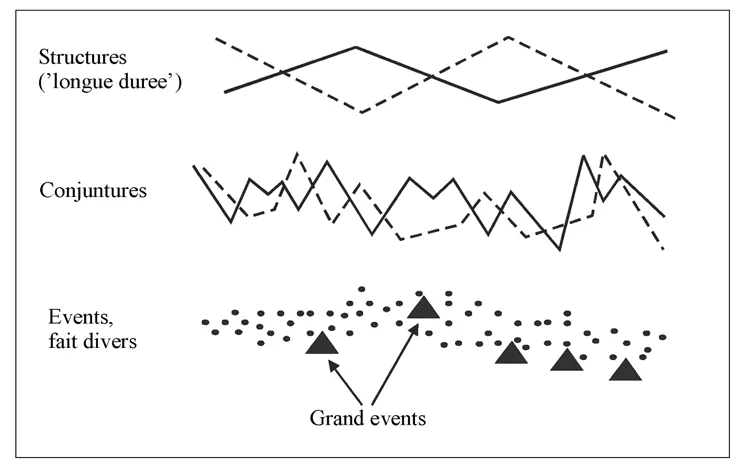
Figure I.1.1 Different historical time-developments (Bertels, 1973: 123).
We believe any theory of transition should incorporate Braudel’s ideas of multiple time scales, while acknowledging that his perspective was topdown and structuralist by conceptualizing agency (events) as superficial disturbance of structural changes. Furthermore, Braudel never explicitly theorized the relationships between his levels.
In sum, theories of history offer the following useful general heuristics for studying long-term processes: multi-causality, co-evolution, lateral thinking, anti-reductionism, patterns, context and the use of different time scales. In the following chapters, these heuristics inform our conceptual work on long-term socio-technical transitions.
History is also important for transitions research in another way, however. We will not only develop a socio-technical perspective on transitions, but also test the plausibility of the proposed perspective with historical case studies. In our argument we rely on historical case studies for three reasons. First, studies of future transitions cannot be tested as of yet (because the future still lies ahead), while studies of present or ongoing transitions are also limited, because they cannot cover entire transitions from beginning to end. Second, as we will argue in Chapter I.6, testing requires the tracing and analysis of processes, event sequences, and agency; the historical case-study method is well suited for this. Third, history is important as a treasure trove of empirical case studies that enable what Yin (1994) has called analytical generalization towards conceptual perspectives and theories. This is exactly how we will use our case studies, especially in Chapter I.4 where multiple cases are used to replicate the basic perspective, as well as to further refine it (we will distinguish different analytical transition pathways).
We develop our argument as follows. Chapter I.2 introduces the so-called multilevel perspective (MLP) on transition. Subsequently, in Chapter I.3 we elaborate on the theoretical foundations of this perspective. We position it as a specific crossover between science and technology studies (STS), evolutionary economics, and sociology. In Chapter 4 we further differentiate the MLP, and show how particular types and sequences of interactions lead to different transition pathways. We propose four transition paths, provide empirical illustrations (which are necessarily short), and provide a future research agenda. Chapter I.5 discusses empirical findings and conceptual elaborations of Strategic Niche Management (SNM). This is a specific management approach embedded not only in new ways of thinking about governance (for this argument see Part III), but also in the MLP as it is grounded in a combination of STS, evolutionary economics, and sociology. Finally, in Chapter I.6 we reflect on the nature of the explanations provided by the MLP.
Our choice to focus on MLP excludes a number of other socio-technical approaches which could be mobilized to advance our understanding of transitions. In particular we would like to point to the so-called functional perspective on technological innovation systems (TIS approach) which emphasizes how innovation systems work, instead of how they are structured, as is the case for original innovation systems literatures (for this point and a comparison between MLP and TIS, see Markard and Truffer, 2008; see also Geels et al., 2008). In the TIS approach the overall system function is the generation, diffusion and use of innovations. Subsequently, several sub-functions can be recognized, ...
Table of contents
- Routledge Studies in Sustainability Transitions
- Contents
- Figures
- Tables
- Textboxes
- Foreword
- Preface
- Introduction
- Part I The Dynamics of Transitions
- Part II Towards a Better Understanding of Transitions and Their Governance
- Part III Understanding Transitions from a Governance Perspective
- Notes
- References
- About the Authors
- Index
Trusted by 375,005 students
Access to over 1.5 million titles for a fair monthly price.
Study more efficiently using our study tools.
Frequently asked questions
Yes, you can cancel anytime from the Subscription tab in your account settings on the Perlego website. Your subscription will stay active until the end of your current billing period. Learn how to cancel your subscription
No, books cannot be downloaded as external files, such as PDFs, for use outside of Perlego. However, you can download books within the Perlego app for offline reading on mobile or tablet. Learn how to download books offline
Perlego offers two plans: Essential and Complete
- Essential is ideal for learners and professionals who enjoy exploring a wide range of subjects. Access the Essential Library with 800,000+ trusted titles and best-sellers across business, personal growth, and the humanities. Includes unlimited reading time and Standard Read Aloud voice.
- Complete: Perfect for advanced learners and researchers needing full, unrestricted access. Unlock 1.5M+ books across hundreds of subjects, including academic and specialized titles. The Complete Plan also includes advanced features like Premium Read Aloud and Research Assistant.
We are an online textbook subscription service, where you can get access to an entire online library for less than the price of a single book per month. With over 1.5 million books across 990+ topics, we’ve got you covered! Learn about our mission
Look out for the read-aloud symbol on your next book to see if you can listen to it. The read-aloud tool reads text aloud for you, highlighting the text as it is being read. You can pause it, speed it up and slow it down. Learn more about Read Aloud
Yes! You can use the Perlego app on both iOS and Android devices to read anytime, anywhere — even offline. Perfect for commutes or when you’re on the go.
Please note we cannot support devices running on iOS 13 and Android 7 or earlier. Learn more about using the app
Please note we cannot support devices running on iOS 13 and Android 7 or earlier. Learn more about using the app
Yes, you can access Transitions to Sustainable Development by John Grin,Jan Rotmans,Johan Schot in PDF and/or ePUB format, as well as other popular books in Economics & Development Economics. We have over 1.5 million books available in our catalogue for you to explore.