Perversion and Modern Japan
eBook - ePub

Perversion and Modern Japan

Psychoanalysis, Literature, Culture

  1. 352 pages
  2. English
  3. ePUB (mobile friendly)
  4. Available on iOS & Android
eBook - ePub

Perversion and Modern Japan

Psychoanalysis, Literature, Culture

About this book

How did nerves and neuroses take the place of ghosts and spirits in Meiji Japan? How does Natsume Soseki's canonical novel Kokoro pervert the Freudian teleology of sexual development? What do we make of Jacques Lacan's infamous claim that because of the nature of their language the Japanese people were unanalyzable? And how are we to understand the re-awakening of collective memory occasioned by the sudden appearance of a Japanese Imperial soldier stumbling out of the jungle in Guam in 1972?

In addressing these and other questions, the essays collected here theorize the relation of unconscious fantasy and perversion to discourses of nation, identity, and history in Japan. Against a tradition that claims that Freud's method, as a Western discourse, makes a bad 'fit'with Japan, this volume argues that psychoanalytic reading offers valuable insights into the ways in which 'Japan' itself continues to function as a psychic object.

By reading a variety of cultural productions as symptomatic elaborations of unconscious and symbolic processes rather than as indexes to cultural truths, the authors combat the truisms of modernization theory and the seductive pull of culturalism. This volume also offers a much needed psychoanalytic alternative to the area studies convention that reads narratives of all sorts as "windows" offering insights into a fetishized Japanese culture. As such, it will be of huge interest to students and scholars of Japanese literature, history, culture, and psychoanalysis more generally.

Frequently asked questions

Yes, you can cancel anytime from the Subscription tab in your account settings on the Perlego website. Your subscription will stay active until the end of your current billing period. Learn how to cancel your subscription.
At the moment all of our mobile-responsive ePub books are available to download via the app. Most of our PDFs are also available to download and we're working on making the final remaining ones downloadable now. Learn more here.
Perlego offers two plans: Essential and Complete
  • Essential is ideal for learners and professionals who enjoy exploring a wide range of subjects. Access the Essential Library with 800,000+ trusted titles and best-sellers across business, personal growth, and the humanities. Includes unlimited reading time and Standard Read Aloud voice.
  • Complete: Perfect for advanced learners and researchers needing full, unrestricted access. Unlock 1.4M+ books across hundreds of subjects, including academic and specialized titles. The Complete Plan also includes advanced features like Premium Read Aloud and Research Assistant.
Both plans are available with monthly, semester, or annual billing cycles.
We are an online textbook subscription service, where you can get access to an entire online library for less than the price of a single book per month. With over 1 million books across 1000+ topics, we’ve got you covered! Learn more here.
Look out for the read-aloud symbol on your next book to see if you can listen to it. The read-aloud tool reads text aloud for you, highlighting the text as it is being read. You can pause it, speed it up and slow it down. Learn more here.
Yes! You can use the Perlego app on both iOS or Android devices to read anytime, anywhere — even offline. Perfect for commutes or when you’re on the go.
Please note we cannot support devices running on iOS 13 and Android 7 or earlier. Learn more about using the app.
Yes, you can access Perversion and Modern Japan by Nina Cornyetz, J. Keith Vincent, Nina Cornyetz,J. Keith Vincent in PDF and/or ePUB format, as well as other popular books in History & Asian History. We have over one million books available in our catalogue for you to explore.

Information

Publisher
Routledge
Year
2010
Print ISBN
9780415691437
eBook ISBN
9781134031535
Edition
1
Topic
History
Index
History

1
Introduction

Bruce Suttmeier: Speculations of murder …
When Freud set out, in Moses and Monotheism, to argue that Moses was not a Jew but an Egyptian and that the Jewish people themselves had murdered him, he was not being provocative, nor was he unaware of the likely response. “To deny a people,” he wrote, “the man whom it praises as the greatest of its sons is not a deed to be undertaken lightheartedly – especially by one belonging to that people. But,” he continued, “No consideration, however, will move me to set aside truth in favor of supposed national interests.”1 While the historical accuracy of what Freud called his “historical novel” has been largely discounted, his goal in writing it, described by one critic as the introduction of “impurity and secondariness into the heart of Jewish cultural identity”2 still stands as a superb example of how the psychoanalytic method can be used to combat nationalist historiography. Indeed it is not just Jewish cultural identity, but the very notion of “cultural identity” itself, along with “supposed national interests” that are Freud’s real targets in Moses and Monotheism. And, paradoxically, in his attempts to uncover the rotten truth behind them, Freud may have been acting as an exemplary son.
Bruce Suttmeier’s account of the case of Yokoi Sh
ichi, a Japanese soldier straggler from the Second World War, who emerged from the jungles of Guam in 1972, performs a similar operation on the myths of postwar Japanese identity. Yokoi was first greeted as a hero whose extraordinary survival skills and tenacity in the jungle supplemented popular narratives of the Japanese people’s resilience in wartime. But there was also something uncanny about his habit of referring to “his Majesty the Emperor” that served as an uncomfortable reminder of a past the nation would rather have forgotten. When stories began to circulate about his possible murder of two fellow soldiers, they brought with them a flood of unwanted memories.
If the Japanese people were just getting comfortable thinking of themselves primarily as victims of the war, Yokoi’s return forced them to remember not only the atrocities committed by the Emperor’s army, but also their own eagerness to forget. His astonishing ability to survive and face hardship reminded them how spoiled and complacent they had become. And at the same time Yokoi’s repeated revisions and retractions of his own memories of life in the jungle played out as an acute spectacle of the same protracted struggle the whole country had long been engaged in to reconcile wartime experience with a postwar world. Suttmeier’s analysis of this “unsettling, symptomatic eruption of the past into the present” in the early 1970s is all the more relevant in today’s Japan where a resurgent nationalism threatens to repress the past in the interest of an emperor-centered “monotheism” of its own.

Notes

1. Sigmund Freud (1939) Moses and Monotheism, Katherine Jones (trans.), New York: Vintage.
2. Eric Santner (Spring 1999) “Freud’s ‘Moses’ and the Ethics of Nomotropic Desire,” October 88: 7.

1
Speculations of murder

Ghostly dreams, poisonous frogs and the case of Yokoi Sh
ichi
Bruce Suttmeier
[A]lmost every part [of the text] came to include obvious gaps, awkward repetitions, and tangible contradictions – signs that tell us things we were never meant to know. The corruption of a text is not unlike a murder. The problem lies not in doing the deed but in removing the traces of it.
Sigmund Freud, Moses and Monotheism
The dead heroes and ghosts he sees are probably illusions.
(from a January 30, 1972 report on Yokoi Sh
ichi by Dr Koyama, Guam Memorial Hospital)1

Yokoi a murderer

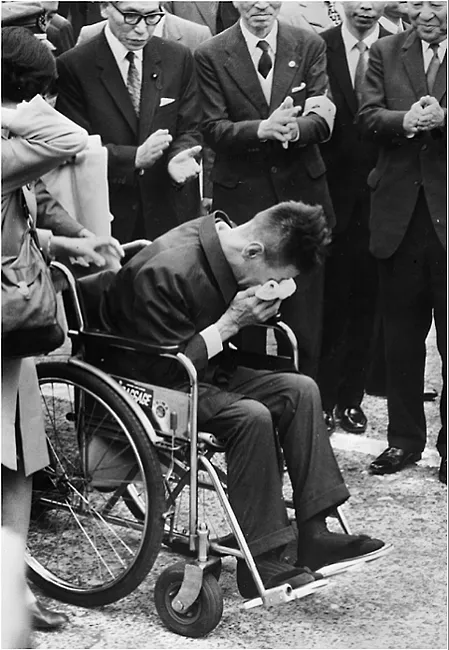
On February 2, 1972, thousands of people stood on the viewing decks of the Tokyo International Airport, holding small Japanese flags, watching as a DC8 plane from Guam touched down and taxied toward them. Tens of millions more reportedly watched the scene on TV.2 As the door to the plane opened, the excited crowd roared with deafening cheers, waving their flags and shouting for its inhabitants to emerge. But when the first figures emerged onto the gangway, reporters at the scene noted, the “shouting abruptly ceased.” The first two men out of the plane, black-suited and grim-faced, carried two boxes wrapped in white cloth, the remains of two soldiers who had died in the Guam jungle eight years earlier. A moment later, a frail-looking man in a dark suit leaned forward and gingerly stepped onto the gangway. “The shouting broke out again as if in one huge voice,” the reporters wrote, growing louder as the man, waving and bowing, his hands trembling, his voice cracking, passed just yards away from the assembled onlookers (Figure 1.1).3
The frail figure, the object of this thunderous reception, was Yokoi Sh
ichi, the Japanese soldier found in the jungles of Guam nine days earlier, an army straggler who after hiding for 28 years, living in a 13-foot hole dug among the roots of a bamboo grove, had emerged as an odd, intriguing remnant of Japan’s imperial past. Consular officials in Guam had marveled at his initial appearance, the long straggly beard and unkempt hair, the tattered clothes fashioned out of pago-tree bark, the anachronistic speech filled with the idioms and ideas of imperial Japan. The next day, his hair cut and his face shaven, he had the first of two press conferences,
Figure 1.1 “Homecoming,” February 2, 1972: Yokoi Sh
ichi, a former sergeant in the Imperial Japanese Army, weeping with emotion as he is applauded on his arrival in Tokyo after hiding in the jungle of Guam for 28 years, 31 years after he had left Japan to do his military service. (Photograph by Keystone/Getty Images.)
detailing his unit’s utter defeat in 1944, his retreat, with several other soldiers, into the jungle, his struggle to procure food and shelter, his leaving of the larger group in 1946 with his comrades Shichi Mikio and Nakahata Satoshi, his final separation, after discord and temporary splits, from these two in 1960, and their death in 1964, the beginning of his eight years of complete isolation.4
This chapter examines the return of Yokoi, exploring, in particular, the speculation that his comrades Shichi and Nakahata, whose remains returned in those cloth-covered boxes, did not die in 1964 of accidental food poisoning but instead were murdered by Yokoi himself. This speculation was but a small aspect of the enormous, frenzied media attention that followed Yokoi’s discovery in 1972, but it offers an intriguing entry into the story of his uncanny return, a narrative of obsession and suspicion, of uneasy celebrity and unwelcome memories, a narrative where dreams of dead comrades and displaced confessions unsettled the public’s fascination with this former soldier in the emperor’s army.
Throughout this chapter, my interest in these speculations lies less in the factual, verifiable circumstances of the two men’s demise and more in the psychical ground upon which speculation of their death flourished; or, to use the psychoanalytic terms that will inform my study, less in the “material truth” of their death and more in the “historical truth” enabled by such an investigation. As defined by Freud in Moses and Monotheism, “historical truth” is a form of truth that “brings a return of the past,” a “distorted,” “delusional” truth that is “spectral, fantasmatic,” it references an event that may never have happened, but that is, nevertheless “more real than reality.”5 It is a form of truth that finds in both specters and speculation, in both Yokoi’s intrusive dreams and the nation’s obsessive fascination with his return, a revelatory mode of truth-telling. The lineaments of this speculation – an imperial soldier perpetrating murderous violence – were not completely unprecedented in the postwar period, of course, but what the Yokoi case so incisively illustrates is how violence by Japanese soldiers during the war, so long unacknowledged and denied, so long resisted and repressed, so long displaced b...
Table of contents

  1. Perversion and Modern Japan: Psychoanalysis, Literature, Culture
  2. Contents
  3. Figures
  4. Contributors
  5. Introduction
  6. 1 Introduction
  7. 1 Speculations of murder
  8. 2 Introduction
  9. 2 Japan’s lost decade and its two recoveries
  10. 3 Introduction
  11. 3 The corporeal principles of the national polity
  12. 4 Introduction
  13. 4 Pelluses/phani
  14. 5 Introduction
  15. 5 Penisular cartography
  16. 6 Introduction
  17. 6 Two ways to play fort-da
  18. 7 Introduction
  19. 7 The double scission of Mishima Yukio
  20. 8 Introduction
  21. 8 Navigating the inner sea
  22. 9 Introduction
  23. 9 In the flesh
  24. 10 Introduction
  25. 10 Sexuality and narrative in Sōseki’s Kokoro
  26. 11 Introduction
  27. 11 Exhausted by their battles with the world
  28. 12 Introduction
  29. 12 Freud, Lacan and Japan1
  30. 13 Introduction
  31. 13 Packaging desires
  32. References
  33. Index