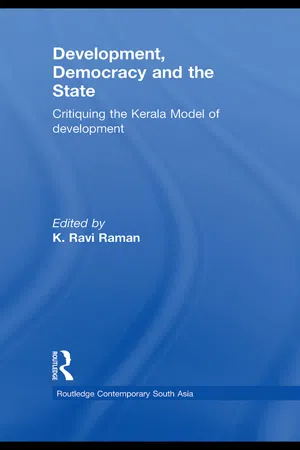
The Indian state of Kerala is known for its high social model of development and social democratic governance. This book presents the most comprehensive analysis of the Kerala Model of Social Development to date. The model has often been identified as one worth emulating because it is seen to have taken the state to the zenith of human development and democratic governance. Using an interdisciplinary approach, the book sheds new light on the paradoxes of the Indian state and its model of economic development. The book provides a consolidated exploration and critique of the Kerala model, which usually has been portrayed as linear with the grand narrative of progress, development and democracy. Chapters discuss the past and present dimensions of the Kerala experience from a historical and political-economic perspective, thus providing a fresh understanding of the emerging concerns in the state and the construction of an ethically viable development agenda, eschewing the scourge of social inequity. A significant contribution to the literature on development, democracy and the state, it analyses the complex interconnectedness of the various political-economic and socio-cultural domains involved in these experiences.
eBook - ePub
Development, Democracy and the State
Critiquing the Kerala Model of Development
- 272 pages
- English
- ePUB (mobile friendly)
- Available on iOS & Android
eBook - ePub
About this book
Information
1
The Kerala Model
Situating the critique
K. Ravi Raman
Introduction
In his lecture ‘What is Critique?’ 1 Foucault argued that critique does not exist in isolation but is, rather, multi-faceted – it is meaning qualified by the objects that it sets out to analyse. Critique always denotes a dissection of something such as an authority, a practice, an institution or a discourse, without which it loses its relevance. For Foucault, critique tries to question, challenge and resist the established norms, the authoritative regime, in an effort to generate a ‘critical attitude’ – an ethically loaded ‘virtue’ – on ‘how not to be governed’. While his constant probing and devaluing of the system may appear excessive to some, the entire framework could in fact be turned around to give interrogation and investigation a true meaning. This volume of essays attempts to offer such a critique of the manner in which the discourse of the Kerala Model 2 has been orchestrated and how the various social sections have experienced the process of development and democracy in this Indian state.
Notwithstanding the fact that India in the global south is accepted to be the single largest formal democracy in the world, its performance as a substantive and deliberative democracy in terms of civil liberties, equity and social justice has often been called into question (Kohli 1989, 2009; Jalal 1995; Kaviraj 1995; Bagchi 1995; Harriss-White 2003; Hewitt 2008). Yet, some states in the country like Kerala and West Bengal are viewed as exceptions to this rule (Franke and Chasin 1989, 2000; Kohli 1989; Heller 2000; Varshney 2000). Kerala in the deep south has always been singled out for two reasons: its highly successful model of social development and a social democratic governance hinged on its ‘communist’ experiments. Having achieved high levels of human development despite a comparatively low income, the state is often considered on par with the economically advanced West.
However, while the success stories with regard to Kerala have been told and retold, little has been mentioned of the subliminal negative trajectories therein. The Kerala Model (KM) remains almost unchallenged, veiled by a shroud of academic opacity. The discourse surrounding the KM with its attendant invitations of power has hardly been looked into, leaving room for a fresh enquiry into the dominant discourse on the Kerala body-polity as such. This is especially relevant at a time when the new forces of globalisation and neoliberalism work to reinforce existing power relations. An attempt at such an exercise is possible only through a cross-disciplinary approach which derives insights from varying intellectual traditions and multiple conceptual practices. The primary aim of this volume is thus to supplement the scholarship on development, democracy and the state by engaging with as well as challenging the dominant discourse on the otherwise glorified KM and it opens with these introductory remarks. This is followed by 14 chapters in four sections, with new generation scholars critiquing the KM from a historical as well as contemporary perspective. 3
Kerala Model: economic variant of orientalism?
Neither the Kerala Model nor the mass democratic consciousness that helped fashion it evolved naturally; rather it was a protracted journey in the face of tenacious negotiation/resistance/consensus from among both dominant and subaltern social forces, with a constellation of movement-initiatives that emerged from within and outside the region, culminating in the creation of the modern state of Kerala. The formation of the state in 1956 was largely the outcome of a self-assertion of social identities over the decades down to the early nineteenth century, and the gradual awakening of a region-bound linguistic and cultural identity that led to a call for an aikya keralam (united Kerala). In sharp contrast to the renaissance in, say, West Bengal, where it had originated in a move to further empower the Brahmanical Hindus, the renaissance in Kerala began among the subaltern castes with a clear mission: a rejuvenation of the particular caste/ community which cut across ideological boundaries to encompass all humanity. Rooted in egalitarian ideals, these movements fought to overcome the immediate oppressive systems, and worked towards achieving a universal brotherhood, with the early missionaries, saints, radicals and reformers from the different castes and religions playing a decisive role in generating their own versions of modernity. 4
Significant political developments occurred in parallel to these social reform movements as well: the social democrats, who had broken away from the Indian National Congress in the mid-1930s to form the Congress Socialist Party, and who later joined the Communist Party of India, lobbied for the abolition of the princely states, and the creation of a United Kerala. In yet another political milestone, the communists themselves came into power through parliamentary democracy, for the first time in the world. Within a week of assuming power, the Namboodiripad-led Communist Ministry of 1957 initiated a series of state interventions which included the prevention of eviction of tenants – a long-standing demand raised by the agrarian movements in the state since the mid-30s. But the government’s intervention in the education sector, which was yet another landmark achievement, met with stiff resistance from the orthodox hegemonic forces – particularly, the Christian church, the conservative Nair Service Society and the Congress-led opposition. 5 Though the ministry was pulled down by the Nehru-led federal government in July 1959, the communist alliances did subsequently come into power and various reforms in Kerala did become a reality; changes in land relations and improvements in education, health, labour welfare and public distribution were brought into force bringing into being a state which displayed, over the years, a marked change in almost all the developmental indicators. Kerala thus came to be designated progressive and democratic with social justice its developmental agenda, the latter being attributed to the aforementioned late-nineteenth century subaltern movements, trade union formations, peasant struggles and the social policy regime of the communist/social democratic government.
The state has been continuously ranked first in the country in terms of its human development indices and in this it has outperformed even the more economically advanced states in India. While its infant mortality and life expectancy rates compare well with the advanced nations and often betters the figures of South Korea, Malaysia, China and Indonesia, Kerala’s sex ratio – female-to-male ratio – is 1.058 which is almost identical to that of advanced Europe and North America and much higher in comparison with the rest of India (0.93). The state also has a near universal level of literacy and high levels of health and nutrition among its women and children. Most of these factors, independently and jointly, contribute to the composite human development index which gives the state an edge over the remaining Indian states. With respect to human poverty reduction too, Kerala remains far ahead of many other states.
The ‘Kerala model’, or broadly the unique Kerala experience, was the outcome of what has been referred to as ‘public action’/‘public politics’ (Franke and Chasin 1989; Jeffrey 1992, 1994; Dreze and Sen 1995; Kannan 1995, 2000; Ramachandran 1997; Heller 1999, 2000; Lieten 2002a, b; also see UN-CDS 1975, Ratcliffe 1978; Raj and Tharakan 1983; George 1999; Parayil 2000; Tornquist 2002; Tharamangalam 2006). However, Herring (1983, 1989) argues that the leftist coalitions in the state established a ‘public moral economy’ valuing labour over profits. Contrasting Kerala with the rest of India, Heller (2000) locates a process of deepening democracy, a ‘process under which the formal, effective, and substantive dimensions of democracy become mutually reinforcing’. The advance of democracy is further highlighted by the New Democratic Initiatives and the associated Peoples’ Campaign for Democratic Planning and Development, which, according to Franke and Chasin (1997) point towards a new direction within the left in the state and one which could challenge the forces of globalisation. For Heller, Kerala is a state ‘in which democratic practices have spread throughout society, governing not only relations between states and citizens but also public relations between citizens’ (Heller 2000: 488).
Though the Kerala experience is largely portrayed as a linear experiment within the grand narrative of progress, development and deliberative democracy, 6 concerns have simultaneously been raised as to whether KM as an economic system could be sustained in the absence of further growth and whether it has reached its limits. It is often argued that as a redistributive state, it is no longer sustainable unless it is capable of generating growth and re-prioritising its social allocation patterns aiming at a disciplinary cut in social sector expenditures, particularly on health and education, the two pillars of KM. It is suggested that a stagnation in growth has led to a crisis in the state mandating increased capital investment, market reforms, extension of market rationalities into social services and so on. The role played by the economists in Kerala in yoking the state to market rationality, often due to the emergent crisis, is significant; whether it was pursued as a conscious project or was a matter of mere coincidence is something we do not intend to address in this chapter. 7
While the Kerala experience has been a reasonably successful experiment, the general academic tendency to portray it as a model worth emulating has thus turned out to be just another regime of truth for two reasons. The model is often paraded as one which has benefited most social sections of Kerala society in a quiet negation of the class/caste plurality that truly exists in the state, and the larger unequal power relations that have been reproduced over the years and reified within its sociopolitical construct. Second, the real truth about the various social sections remains camouflaged by official discourse, and the complacency generated by this regime of truth forecloses all possibilities of a counter-discourse, thus lending ever greater power to this regime. The Kerala Model as taught, explained and researched, remains trapped within the recycled paradigm of progress and development for all, an equation first highlighted by the United Nations in the mid-1970s. However, the dominant narrative, which has often assumed the status of an economic variant of orientalism, has also been critiqued sporadically from varying standpoints, broadly, from the point of view of a prolonged exposure to the neo-colonial world economy, the growth of a speculative economy and surplus drain, the plight of the outliers and depressed castes and the failure of policies and planning (see Rammohan and Raman 1990; Rammohan 1991, 2000; Kunhaman 1994; Kurien 1995; Omvedt 1998; Tharamangalam 1998, 2006; Bijoy and Raman 2003; Sreekumar and Sanjeev 2003; Sreekumar and Parayil 2006; Jacob and Bandhu 2009; Raman 2009).
Subsequent exploration of this sanctified model has failed to generate any critical understanding of the other side of the Kerala experience as enjoyed by its communities and its people in general. The dominant discourse on KM continues to miss the major concerns of the minorities and the marginalised; and through this silence, the unheard and the unsaid is further marginalised, in terms of both material and non-material concerns. Moreover, it fails to address the three major challenges that the state faces – the widening inequality among social sections, an increasing asymmetry of power relations with respect to its historically evolved marginalised communities, and the challenges (and the possibilities) they encounter in this contemporary era of globalisation. There is hardly any discussion on how people, as distinct and collective identities, experience their daily lives, and how they negotiate and engage with the structure authorities – the state, the local hegemonic social classes and global capital. Moreover, the status of women remains unaddressed, particularly their subordination in terms of work participation, gender equality, freedom of expression and so on – all in turn rendering them victims of unequal power relations.
The contributors in this volume advance this critique further, discussing some of the claims and issues within the dominant narratives, and engaging directly/ indirectly with the past and the present dimensions of the Kerala experience; each chapter is thus a step towards both a fresh understanding of the emerging concerns in the state and the construction of an ethically viab...
Table of contents
- Routledge Contemporary South Asia Series
- Contents
- Contributors
- Acknowledgements
- 1 The Kerala Model
- Part 1 Historical perspectives
- Part 2 Contemporary political economy
- Part 3 Gender, space and identities
- Part 4 New social movements
- Index
Trusted by 375,005 students
Access to over 1.5 million titles for a fair monthly price.
Study more efficiently using our study tools.
Frequently asked questions
Yes, you can cancel anytime from the Subscription tab in your account settings on the Perlego website. Your subscription will stay active until the end of your current billing period. Learn how to cancel your subscription
No, books cannot be downloaded as external files, such as PDFs, for use outside of Perlego. However, you can download books within the Perlego app for offline reading on mobile or tablet. Learn how to download books offline
Perlego offers two plans: Essential and Complete
- Essential is ideal for learners and professionals who enjoy exploring a wide range of subjects. Access the Essential Library with 800,000+ trusted titles and best-sellers across business, personal growth, and the humanities. Includes unlimited reading time and Standard Read Aloud voice.
- Complete: Perfect for advanced learners and researchers needing full, unrestricted access. Unlock 1.5M+ books across hundreds of subjects, including academic and specialized titles. The Complete Plan also includes advanced features like Premium Read Aloud and Research Assistant.
We are an online textbook subscription service, where you can get access to an entire online library for less than the price of a single book per month. With over 1.5 million books across 990+ topics, we’ve got you covered! Learn about our mission
Look out for the read-aloud symbol on your next book to see if you can listen to it. The read-aloud tool reads text aloud for you, highlighting the text as it is being read. You can pause it, speed it up and slow it down. Learn more about Read Aloud
Yes! You can use the Perlego app on both iOS and Android devices to read anytime, anywhere — even offline. Perfect for commutes or when you’re on the go.
Please note we cannot support devices running on iOS 13 and Android 7 or earlier. Learn more about using the app
Please note we cannot support devices running on iOS 13 and Android 7 or earlier. Learn more about using the app
Yes, you can access Development, Democracy and the State by K. Ravi Raman in PDF and/or ePUB format, as well as other popular books in Politics & International Relations & Politics. We have over 1.5 million books available in our catalogue for you to explore.