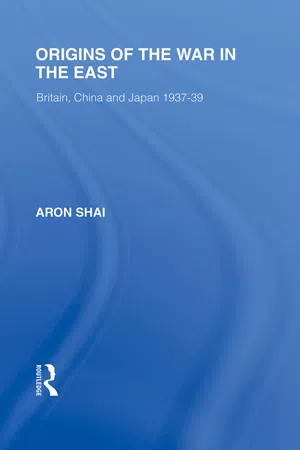
This study describes the British government's policy towards China during the first phases of the undeclared Sino-Japanese war, starting in July 1937 when the conflict in North China culminated in all-out hostilities; and ending in September 1939 when the outbreak of the war over Poland forced the British government to turn almost all its attention to Europe. The dilemmas confronting British policy-makers in the Far East are analysed together with the implementation of their subsequent solutions. Attention is focused on the question of British interests in China and on the decisive factors and considerations which determined British policy and Britain's role in the Sino-Japanese war. Questions concerning the safety of the British subjects and the commercial community in China and their influence on the decision making process, the attitude towards Soviet influence in China and prospects of Communist take-over are also discussed. In the final analysis the book examines the widely debated subject of appeasement in its Asian context. It is argued that Britain pursued a policy towards Japan which gained strength without producing a Far Eastern Munich
- 258 pages
- English
- ePUB (mobile friendly)
- Available on iOS & Android
eBook - ePub
Origins of the War in the East
1
FROM AN INCIDENT TO THE UNDECLARED SINO-JAPANESE WAR
The First Stage
The first shots that were heard near Lukouchia (Marco Polo Bridge), in Wangpinghsien near Peking at 11.40 p.m. on 7 July 1937 opened a new era in the history of the Far East. As has already been noted, those shots, though unexpected at the time, were not without precedent in the recent history of China’s northern territories.1 For the preceding period of nearly six years Japan had been encroaching on Chinese sovereignty.2 The process had started with the ‘Mukden Incident’ of 18 September 1931, which had paved the way for Japanese domination in Manchuria, the establishment of the puppet state of Manchukuo, and a growing Japanese influence over the northern provinces of China proper which were meant to serve as a buffer state between Manchukuo and the Nanking government.3 Yet the consequences of the Lukouchiao incident proved to be still graver than those of the clash at Mukden—they jeopardised the very existence of the Nanking régime.4
Hitherto there had been divisions of opinion in the Nanking government and in Chinese public opinion on the necessity for an effective reaction to the Japanese aggression and their creeping penetration.5 Henceforth, however, all were agreed that the Japanese had to be halted; the debate was over the desirability of doing so in the present circumstances. This undoubtedly was a turning-point which marked not only a further change in Chinese internal politics, but also a new course of interest taken by the international community towards the Far East and China.6
As is often the case in such instances, it was not clear exactly what had happened.7 The British Foreign Office received contradictory reports which made it difficult to paint an objective picture. Yet it was soon realised that the first shots and the immediate local developments which followed them were of only secondary significance. Developments took place so rapidly and extensively, exceeding all anticipations, that despatches from the Far East flooding the Foreign Office became almost at once immaterial and irrelevant, not to mention the lengthy reports which were sent by ordinary mail. The important issues turned out to be the consequent measures and counter-measures taken by the belligerents after the incident.8 However, the local character which the dispute initially assumed, and the lack of efficient communications in North China, contributed a great deal to the obscurity of events and to the embarrassment they caused.
Less than a week after the incident Quo Tai-chi, the Chinese Ambassador in London, drew a dark picture of the situation in North China for Anthony Eden and blamed the Japanese for its initiation and the hostilities that followed.9 He remarked that Japan tended to believe that she could not be restrained by the Soviet Union owing to the recent executions in the military ranks there, which allegedly enormously weakened the Soviet military potential. He stressed that this had been proved when the Soviet Union had given way to Japan in the dispute over islands in the Amur River, earlier that year.10 The Japanese were engaged in strengthening their forces in Manchuria and Korea and in making naval and military preparations for additional operations. The Ambassador believed that the only way out of an impending conflict could be achieved through mediation by disinterested governments or by an offer of their good offices. He urged the British government to take immediate action before it was too late and added that the United States, France and the Soviet Union were being approached similarly. Eden, relying on reports from Tokyo and Peking,11 thought that Japan did not desire any military venture on a large scale in China and told the Chinese Ambassador that he had been assured of this in a conversation he had had with the Japanese Ambassador the previous day. He warned that a rigid position taken by either side, on a basis of prestige, might lead to dangerous consequences. He promised to consult the French, American and Soviet governments and do his best to achieve a peaceful solution.
The civil war in Spain, piracy in the Mediterranean, Mussolini’s empire in Africa, and Britain’s shaky position in the Middle East seemed, at this time, to preoccupy Whitehall and to leave it with no time to deal with another skirmish in North China. Yet it was soon realised that Far Eastern affairs had to be treated quite seriously.
Soon after the new outburst in North China James Dodds, the British Chargé d’Affaires in Tokyo, asked for authorisation to make representations to Koki Hirota, the Japanese Minister for Foreign Affairs. He wrote:
It is too soon for me to express an opinion on the acuteness of this latest Sino-Japanese clash, but I think it might be well if I were authorized to speak to the Minister for Foreign Affairs on certain eventualities [italics added] that you know…how genuinely anxious he is for an understanding with Great Britain and that nothing could defer such an understanding…as an attempt…by the Japanese to turn North China into a second Manchukuo.12
Eden approved this suggestion and authorised Dodds to take the earliest possible opportunity of making such a communication.13 Unaware of the significance of Dodd’s reservation, Eden himself expressed his distress to S.Yoshida, the Japanese Ambassador to the United Kingdom. He mentioned that the Anglo-Japanese conversations which were due to start ‘would hardly be possible if existing conditions near Peking persisted or grew worse’. The Ambassador in his reply stressed that Japan had no intention of fighting in China and expressed hopes that Britain would make some communication to the Chinese government so that if the Japanese military became more reasonable and willing to reach a compromise, the Chinese would not seek to profit by this fact.14
Britain’s first diplomatic reaction to the new Sino-Japanese clash seemed to have been conditioned by past experience of the Japanese aggressive policy in China and by the increased mistrust felt by the British public towards Japanese intentions.15 The British decision-makers could not ignore the undeniable fact that the hostilities were taking place on Chinese, not Manchurian, soil. The possible cancellation of the Anglo-Japanese talks, which were dear to the Japanese as a guarantee of British neutrality in their standing dispute with China, put real pressure on Japan. Yet soon the course which seemed to have been adopted by Britain was to be mildly altered. Dodds observed that there were some indications that Japan had not entertained the idea that the Lukouchiao incident, now referred to as the ‘North China incident’, would develop on so large a scale, but added that unless the Chinese ‘withdrew or some face-saving formula is discovered’, Japan would have no alternative but to send more reinforcements to the area. Dodds also hinted at a possible solution by which the Nanking government would be made to recognise the fact that ‘North China is Japan’s special field of economic exploitation’.16 Later he communicated his impression, with which his American colleague agreed, that Japan ‘did not want this incident, does not want to push it through, and is not being provocative’. A peaceful solution, he felt, depended on the ability of the Chinese Government to restrain their nationals. He disclosed that, on account of this belief, in talking to the Japanese Foreign Minister, he had not used the strong language he had originally contemplated. Instead he had merely reminded Hirota that it was ‘very unfortunate that the North China affair had broken out just as Anglo-Japanese talks were about to begin’, as Britain might not find it an ‘opportune moment’ to carry on such talks.
Eden realised that he had acted too hastily and accepted the need for a milder tone in approaching the Japanese Government. He therefore instructed Dodds to explain in the ‘friendliest possible way’ that the reason for Britain’s communication was her attempt to do all she could to ensure the maintenance of peace between Japan and China with whom Britain was always anxious to remain on the best of terms.17 Meanwhile, Lieutenant-General Homma, who had just returned to Tokyo from London, expressed the anxiety of the Imperial Family and the Japanese Government over Britain’s reaction to the hostilities in North China.18 Suspicions that Britain was encouraging China, the General pointed out, could cause Japanese reluctance to pursue talks with Britain. He also felt that Japan had to protect her subjects in North China. He implied that it was necessary to resist the pressure exerted on the Japanese Government by extreme elements who might agitate for the use of the ‘golden opportunity’ of the dispute for a ‘final’ solution of the ‘North China problem’.
In retrospect this seems a calculated attempt on the part of the ...
Table of contents
- CONTENTS
- ABBREVIATIONS
- PREFACE
- INTRODUCTION
- 1 FROM AN INCIDENT TO THE UNDECLARED SINO-JAPANESE WAR
- 2 THE LEAGUE OF NATIONS AND THE BRUSSELS CONFERENCE OF 1937
- 3 IN QUEST OF A POLICY: CHINA AND THE ANGLO-SAXON POWERS
- 4 THE WAR AND STRATEGIC AID
- 5 THE WAR AND FINANCIAL AID: THE CUSTOMS AND CREDITS TO CHINA
- 6 THE TIENTSIN DISPUTE OF 1939— A FAR EASTERN MUNICH?
- 7 CONCLUSION
- BIBLIOGRAPHY
- INDEX
Trusted by 375,005 students
Access to over 1.5 million titles for a fair monthly price.
Study more efficiently using our study tools.
Frequently asked questions
Yes, you can cancel anytime from the Subscription tab in your account settings on the Perlego website. Your subscription will stay active until the end of your current billing period. Learn how to cancel your subscription
No, books cannot be downloaded as external files, such as PDFs, for use outside of Perlego. However, you can download books within the Perlego app for offline reading on mobile or tablet. Learn how to download books offline
Perlego offers two plans: Essential and Complete
- Essential is ideal for learners and professionals who enjoy exploring a wide range of subjects. Access the Essential Library with 800,000+ trusted titles and best-sellers across business, personal growth, and the humanities. Includes unlimited reading time and Standard Read Aloud voice.
- Complete: Perfect for advanced learners and researchers needing full, unrestricted access. Unlock 1.5M+ books across hundreds of subjects, including academic and specialized titles. The Complete Plan also includes advanced features like Premium Read Aloud and Research Assistant.
We are an online textbook subscription service, where you can get access to an entire online library for less than the price of a single book per month. With over 1.5 million books across 990+ topics, we’ve got you covered! Learn about our mission
Look out for the read-aloud symbol on your next book to see if you can listen to it. The read-aloud tool reads text aloud for you, highlighting the text as it is being read. You can pause it, speed it up and slow it down. Learn more about Read Aloud
Yes! You can use the Perlego app on both iOS and Android devices to read anytime, anywhere — even offline. Perfect for commutes or when you’re on the go.
Please note we cannot support devices running on iOS 13 and Android 7 or earlier. Learn more about using the app
Please note we cannot support devices running on iOS 13 and Android 7 or earlier. Learn more about using the app
Yes, you can access Origins of the War in the East by Aron Shai in PDF and/or ePUB format, as well as other popular books in Business & International Business. We have over 1.5 million books available in our catalogue for you to explore.