This volume presents the Japanese version of the history of Japan from its origins, through the subjection of Korea, the introduction of Chinese culture, rebellion in Korea, Buddhism, Taika reforms, Ainu insurrection, the founding of Kyoto as the capital, the power of Fujiwara, the founding of the Kamakura Shogunate, Hojo family, Ashikaga Shogunate, Oda & Toyotomi families, Tokugawa Shogunate, the beginning of the Meiji, relations with Korea, Russia and the Chino-Japanese war of 1894, ending with the Russo-Japanese war of 1904.
PART I FROM THE BEGINNING OF THE EMPIRE TO THE SUBJECTION OF KOREA.
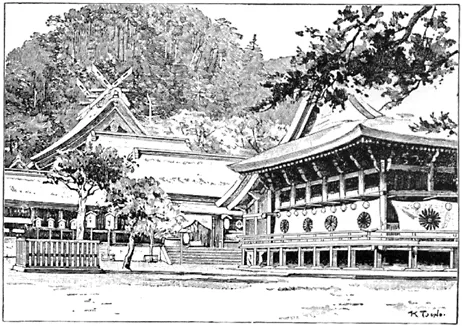
THE TEMPLE OF IZUMO-NO-OYASHIRO
Face p. 7]
CHAPTER I FOUNDATION OF THE JAPANESE EMPIRE. THE FIRST EMPEROR
ACCORDING to the legend, the Japanese islands were created by the god Izanagi-no-Mikoto and his wife Izanami-no-Mikoto. Their daughter, Amaterasu-Omikami,1 the sun goddess, was charitable, virtuous and clever; she taught men to cultivate the earth, to obtain silk and weave it in the loom. Her brother, Susa-noo-no-Mikoto, in contrast to her, was cruel and fierce. Therefore he was banished from Heaven to Izumo, a province on the island of Honto.2 He built a house there, and married a beautiful girl who bore him a son named Okuninushi-no-Mikoto. He was kind, clever and brave; he defeated all the frontier tribes and encouraged agriculture. When Amaterasu-Omikami sent an ambassador to demand the whole of his kingdom, he obeyed, and at once delivered up the land. He withdrew to the village of Kizuki in the province of Izumo and dwelt there till the end of his days, There is a large temple, Izumo-no-
yashiro, in which he is still worshipped as a god.
Amaterasu-Omikami, so the Nihongi relates, caused her grandson, Ninigi-no-Mikoto, to come down from heaven and spoke to him in these words: “Go to Japan where the meadows are green and fertile. Broad Japan shall be ruled by our descendants to all eternity, and our posterity shall endure forever like heaven and earth.” She gave him Yada-no-Kagami, a mirror, Yasakani-no-Magatema, a precious stone, and Murakumo-no-Tsurugi, a sword with the words: “These insignia shall be symbols of the Imperial power, and the worthy palladia of our Empire. The mirror, especially, shall remind you of me.”
Ninigi-no-Mikoto took the insignia and accompanied by many gods came down from Heaven to Hi
ga, a province on the island of Ki
si
, and ruled there. After Ninigi-no-Mikoto came in succession: his son Hikohohodemi-no-Mikoto, his grandson Ugayafukiaezu-no-Mikoto and his great-grandson Jimmu-Tenn
.1 Jimmu-Tenn
is the actual founder of the Japanese Empire.
The Emperor Jimmu lived in the province of Hi
ga on the island of Ki
si
. One day he gathered together his family and his faithful adherents and said to them; “Many traitors and evil-doers live in the east, and they oppress, rob, and plunder our good people. Therefore we must conquer them, and protect the good people.” And he set out to do so with a powerful army and with his whole family. They went through the straits of Hayasui, and the inland sea of Seto to Naniwa1 and landed there, in order to pursue their march into the province of Yamato, which Nagasunehiko, the leader of the rebellion, was plundering. When Nagasunehiko heard of the approach of Jimmu-Tenn
, he marched out to meet him, and a battle ensued on the mountain of Ikoma. In spite of great courage, the imperial army was defeated by the enemy.
The Emperor’s eldest brother was mortally wounded and soon died. Jimmu-Tenn
therefore abandoned the plan of reaching Yamato by land, marched back to Naniwa, and took ship to Kii, the nearest province on the sea coast to Yamato. He landed there on the shores of Kuma-no-Ura. Michinoomi-no-Mikoto, a native of the place who was a faithful servant of the Emperor, showed him the way across the mountains thought to be impassable. The imperial army conquered and brought into subjection all the rebels met on the way. When they reached Yamato, Nagasunehiko was murdered by his brother-in-law, Nigihayahi-no-Mikoto, a relative of the Emperor, who then put himself at the head of the army, and delivered it and the province of Yamato to the Emperor Jimmu. The neighbouring people of Tsuchikumo1 were also soon brought into subjection.
After the defeat of his enemies, Jimmu-Tenn
built a large palace at the foot of the mountain Unebi, and ascended the throne, 11th February, 660 B.C.
Such is the legendary account of the origin of the Imperial dynasty, and the foundation of the Japanese Empire by Jimmu-Tenn
. Jimmu’s personality is equally legendary. But it is certain that from the earliest times about which we possess any historical information until the present day, only one dynasty has ruled over Japan, and that the Japanese Imperial family2 is regarded as the oldest of all reigning families.
Japanese chronology begins with 11th February, 660 B.C.,3 the day of Jimmu-Tenn
’s accession.
Footnotes
1i.e. the divinity that shines down from Heaven.
2 The principal island of Japan.
1Tenn
is a Chinese word, Ten=heaven, O=king; other epithets for the Japanese Emperor are e.g. Tenshi=son of heaven and Mikado (Mi=sublime, Kado gate, portal).
1 Now Osaka.
1 Tsuchi=earth, Kumo Spider. They were so named because they lived in caves.
2Through the great importance attached to the family in Japan, family tradition plays a prominent part An interruption of the Imperial dynasty would have been an event of such importance that not even the vaguest tradition could have ignored it.
3 The late Professor Naka believes that this date of the Nihongi should be put back about 660 years.
CHAPTER II RELATIONS WITH K...
Table of contents
CONTENTS
INTRODUCTION.
FIRST PERIOD
PART I FROM THE BEGINNING OF THE EMPIRE TO THE SUBJECTION OF KOREA.
PART II FROM THE INTRODUCTION OF CHINESE CULTURE TO THE FALL OF THE SOGA FAMILY.
SECOND PERIOD
PART I FROM THE TAIKA REFORMS TO THE FOUNDATION OF THE CAPITAL, KIOTO.
PART II THE AGE OF THE FUJIWARA
PART III THE TAIRA AND MINAMOTO
THIRD PERIOD
PART I THE KAMAKURA SHOGUNATE
PART II RESTORATION, DIVISION, AND RECONCILIATION OF THE IMPERIAL DYNASTY
PART III THE MUROMACHI OR ASHIKAGA SHOGUNATE
PART IV THE ODA AND TOYOTOMI FAMILIES [1573– 1598]
PART V THE TOKUGAWA SHOGUNATE
FOURTH PERIOD
INDEX
Trusted by 375,005 students
Access to over 1.5 million titles for a fair monthly price.
Study more efficiently using our study tools.
Frequently asked questions
Yes, you can cancel anytime from the Subscription tab in your account settings on the Perlego website. Your subscription will stay active until the end of your current billing period. Learn how to cancel your subscription
No, books cannot be downloaded as external files, such as PDFs, for use outside of Perlego. However, you can download books within the Perlego app for offline reading on mobile or tablet. Learn how to download books offline
Perlego offers two plans: Essential and Complete
Essential is ideal for learners and professionals who enjoy exploring a wide range of subjects. Access the Essential Library with 800,000+ trusted titles and best-sellers across business, personal growth, and the humanities. Includes unlimited reading time and Standard Read Aloud voice.
Complete: Perfect for advanced learners and researchers needing full, unrestricted access. Unlock 1.5M+ books across hundreds of subjects, including academic and specialized titles. The Complete Plan also includes advanced features like Premium Read Aloud and Research Assistant.
Both plans are available with monthly, semester, or annual billing cycles.
We are an online textbook subscription service, where you can get access to an entire online library for less than the price of a single book per month. With over 1.5 million books across 990+ topics, we’ve got you covered! Learn about our mission
Look out for the read-aloud symbol on your next book to see if you can listen to it. The read-aloud tool reads text aloud for you, highlighting the text as it is being read. You can pause it, speed it up and slow it down. Learn more about Read Aloud
Yes! You can use the Perlego app on both iOS and Android devices to read anytime, anywhere — even offline. Perfect for commutes or when you’re on the go. Please note we cannot support devices running on iOS 13 and Android 7 or earlier. Learn more about using the app
Yes, you can access A History of Japan by Hisho Saito, Elizabeth Lee in PDF and/or ePUB format, as well as other popular books in History & Japanese History. We have over 1.5 million books available in our catalogue for you to explore.