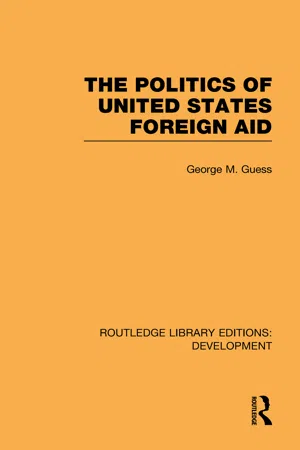
First published in 1987, this reissue explores contemporary United States foreign aid policies and thinking in the Reagan era. The author argues that aid policy is often confused as a result of bureaucratic decision-making processes. The book contrasts the experience of the many countries where aid-giving has produced unwished-for effects with the few countries where the desired results have occurred. The author concludes by arguing for a new approach to aid-giving by the United States.
- 316 pages
- English
- ePUB (mobile friendly)
- Available on iOS & Android
eBook - ePub
The Politics of United States Foreign Aid
Chapter One
THE POLITICAL ECONOMY OF US FOREIGN AID: PAST AND PRESENT
Introduction
As the US struggles for influence in the world power arena, its foreign assistance program follows along as a willing and important appendage. In a precarious context, characterized increasingly by desperation policy responses to coups, counter-coups, terrorism and religious fanaticism, the lines between US foreign policy, foreign aid and trade activities become blurred. That foreign aid lacks autonomy among American public policies is harmful in several ways to US interests abroad and to the needs of the developing world. First, foreign aid may be erroneously credited for foreign policy power successes though development projects fail and underdevelopment may be increasing. Second, and more commonly, foreign aid is unjustly blamed for foreign policy failures. The rantings of a Khadafy are viewed by many as another failed foreign aid attempt, the cut-off of which penalizes the Libyan people and not their officialdom. Consistent with this, some believe that foreign aid is not criticized enough. “Who could be against aid to the less fortunate?” ask Bauer and Yamey (Thompson, 1983:119). “When aid advocates talk of the disappointing record of aid, they mean not that aid has been ineffective or damaging but that the amounts of aid have been insufficient.”
Foreign aid consists of five programs: (1) Economic Support Fund (ESF), (2) Development Assistance (DA), (3) Food Aid or PL 480, (4) Security Assistance, and (5) multilateral Development Banks. These interrelated programs have separate constituencies and are proposed for funding by bureaucratic actors that are, in turn, controlled for efficiency and effectiveness by Congress working in conjunction with them. But these “checks and balances” have produced paralysis instead of healthy competition. Task definition is imprecise and institutional distrust among key actors tend to inhibit the proper functioning of checks and balances.
Further, that US foreign aid is a “microprogram” evaluated as a “macropolicy” creates false expectation and the likelihood of unfair judgment. Over the five major phases of foreign aid, the programs have been billed as dramatic macropolicies: spreading democracy, containing communism, and getting the poor ready for developmental “take off”. Tangled up with foreign policy events and the personal agendas of congressional “experts” and high-level amateur appointees in USAID, it can be stated without great risk that the bulk of foreign aid programs have been largely “unsuccessful” (or successful in a trivial sense). Perhaps the most successful program was also the shortest and most uncomplicated: the Marshall Plan. But since that program, the goals of foreign aid have broadened in almost inverse proportion to useful knowledge on the causes of poverty and underdevelopment. As the “fall guy” of foreign policy, the foreign aid program has been blamed by the left for neo-imperialism and by the right for generating exaggerated expectations among the poor which destabilizes political systems.
Foreign aid is a product of the American political system, a highly bureaucraticised network of actors that clash over resources and the authority (or turf) to influence policy. To the extent that we can analyze foreign aid through the Bureaucratic Politics lens, we may be able to point the way to a more autonomous policy that will be more likely to achieve realistic objectives. This book seeks to describe the evaluative dilemma of US foreign aid as part of foreign policy and to explain how and why the program is often ill-designed and poorly executed. The goal is constructive: to enhance the capacity of foreign aid to benefit the Third World which indirectly can enhance US influence in world affairs.
The making and execution of foreign aid policy has been characterized by intense confusion over both objectives and evaluative criteria since its initiation in the early 1940s. Foreign aid is not really “foreign” policy or a “domestic” program; yet it is planned, executed and evaluated as if it were both. Hence, despite its marginal budgetary expense in US terms, it is nearly always a controversial policy (Montgomery, 1986:94) In FY 1985, the Presidential foreign aid request amounted to less than 2% of the budget ($15.2 billion out of $925 billion or 1.6%), In FY 1978, US aid amounted to only 0.23% of GNP or about the same level provided by Austria, Japan, Switzerland, or Germany (Congressional Budget Office, 1980:9). Nevertheless, Congressional Quarterly (1985:2688) suggests that foreign aid “one of the most unpopular issues that Congress faces each year..”
Many have written of US foreign aid; many have written it off. But few have provided other than general frameworks for analysis. Critics of foreign aid tend to provide the more rigorous policy-oriented frameworks. Still, they tend to be simplistic, ignoring the real world of interest-driven bureaucratic policy-making which constrains both the US and its recipient countries. It is suggested that a Bureaucratic Politics model emphasizing “role conflict”, largely over budgetary resources, can be useful in explaining past failures and successes as well as providing a more solid foundation for foreign aid reform.
The Blurred Lines of Foreign Aid Policy
Many definitions of foreign aid and its purposes have been provided. Let us examine some of them before describing the current US foreign aid program in detail. Many observers agree that US foreign aid is a feeble effort to transmit the contradictory values of American political culture abroad with largely uneven results. Operationally, foreign aid consists of loans and grants of funding or technical assistance for security, developmental and humanitarian objectives. Montgomery (1967:1) notes that American foreign aid is a disappointment to both those who think we ought to run the world and those who think we ought to let the world alone. He suggests that Americans want to tinker with the world and improve it, without really changing it much (1967:2). Foreign aid then, is one expression of national impulse by which the US tries to “buy time” in a fast-changing world (1967:5). That foreign aid is frequently pressed into service of American foreign policy for “diplomatic” (establish a presence by earthquake or food aid), “compensatory” (military base rights in exchange for aid) and “strategic” purposes (improve world order via economic and military aid) (1967:10–19), opens it to controversy on a variety of different levels. The distinctive purpose of foreign aid is to assist other countries attain conditions (political, economic, social) that will serve world order and freedom (Montgomery, 1967:23). This purpose was reaffirmed in the 1983 Carlucci Commission Report which suggested that US assistance programs “make an indispensable contribution to achieving foreign policy objectives” (Schultz, 1984:1). This rather tall order means that a small expenditure of US aid can produce economic stability and political democracy under a variety of cultural conditions. Given the porousness of such objectives, it should be of little surprise that foreign aid often fails at one or more levels, or succeeds at one level and fails at another.
At least four levels of results may be distinguished: (1) regional-international, (2) country program results, (3) project results, and (4) individual technician performance (Montgomery, 1967:74). For example, security assistance is often evaluated on a regional-international plane: deterrence, conflicts managed, alliances preserved, and access for US forces preserved (DOD, 1986:23). The success of US arms sales via Foreign Military Sales (FMS) is measured by its contribution to strengthening the professional military establishment, as well as providing jobs in the US and reducing unit costs for items purchased by the US military (DOD, 1986:14). The Economic Support Fund (ESF) is often evaluated by its capability to provide resources to prevent financial chaos and encourage economic reform (DOD, 1986:28). For Development Assistance projects (DA) of USAID, measures include, farmers trained, and land titles distributed. So, if a project for land titling succeeds in a country plagued by political instability that eventually turns into a totalitarian state, foreign aid shares the blame in the public and even official mind. More commonly, project results often produce unintended consequences for country programs. Montgomery notes the irrigation project that produced both increased agricultural production and malaria (1967:80). More recently, the Sudanese “Freedom From Thirst” projects financed by multilateral development banks (MDBs) and non-US donors, proposed 4000 wells per year to increase water for cattle. Failure to control surrounding land use (colonial governments had restricted the number of wells dug to limit pressure on the carrying capacity of the land) resulted in over-grazing around the wells with widening “circles of death”. Though the project attained its objective—more water, the wider effects have been environmental degradation and famine (Albright, 1985).
Other writers have focused on the paradoxical domestic context of foreign aid policy-making. For example, O’Leary (1967:5) suggests that aid policy is supposed to please US public opinion, the host country, and the technicians who work in it. It must also please Congress and the President. At the same time, foreign aid policy is made in a “schizophrenic” fashion by one set of actors that favors bilateral military security (White House staff, State and DOD) another led by Treasury that seeks economic security through multilateral development banks (Rowen, 1986), and another led by USAID that seeks bilateral development. The larger, also paradoxical, objective of Congress seems to be to “micromanage” the program with many restrictions but to keep away from an unpopular issue.
But aid policy itself is often a hodgepodge of grants, loans and trade favors. Where economic and trade policies end and foreign aid begin is often unclear in the minds of many decision-makers and this contributes to the continuing malaise about aid. O’Leary notes that while the level of public support and perceived understanding of foreign policy and defense postures are usually high, they are minimal for foreign aid (1967:125). Asher (1961:4) suggests that part of the problem may be semantic: “aid” connotes action “for” rather than “with” others; “recipient” or “host” are terms often used instead of “participating” countries. So when the US spends to achieve the grandiose and almost indefinable objectives of “strengthening” military defenses in the” free world”, and promotion of “political development”, predictable failure brings out the plaintive cry of wounded gratitude at best, sell-outs and conspiracies at worst. At the other end of the scale are strict constructionists, who exclude from their definitions of aid anything that results from donor self-interest. For example, to McNeil (1981:45) a military base would not be aid; Montgomery, as noted, would view this as “compensatory” aid (1967:10–19). Since some suggest that donor self-interest is always the prevalent motive, by this view pure aid would not exist.
The problem of defining an autonomous foreign aid policy is complicated by the continuing inability to define developmental objectives in other than subjective ways and the close relationship between defense-security programs and foreign aid. As noted by Morley (1961:1), foreign aid was supposed to be temporary after World War II and not a “continuing liability”. But foreign aid programs “have been continuously retooled to meet various military and diplomatic cold war crises”. Put another way, unlike domestic policies that are usually evaluated on their own terms, such as capital and operating subsidies from the federal government to improve local government transit performance (which have not been very successful but are not very controversial either), foreign aid is evaluated by the success of such vague foreign policy doctrines as “containment” or “frontiersmanship”. Conversely, when a President such as Ronald Reagan wants to make an impact on trade, defense and anti-terrorism, foreign aid benefits from a larger budget request and stronger political support. For example, the FY 1987 request of $16.3 billion for foreign assistance is about $1.8 billion higher than the current year level. According to Nowels (1986:3) “Much of the program is closely linked to US defense strategy and is viewed as a cost-effective means of providing the maximum security benefits to the US without direct US involvement.”
Many have noted the foreign aid-foreign policy linkage, but few have suggested practical means or even rationale for separation. For instance, anticipating current US foreign aid dilemmas in Central America and the Middle East and past ones in Southeast Asia, Morley laments that “.. in extending the policy of containment and the system of anti-communist military alliances around the world, Washington in effect undertook to support indefinitely the economies and military forces of certain less developed countries” (1961:1). So foreign aid remains obscurely defined, now a “permanent postwar innovation” but still “the most controversial aspect of foreign policy” (Montgomery, 1967:6).
Whatever the deficiencies of a rationale for foreign aid, they pale in significance to field problems of implementation. The frequent hiatus between theory and practice in foreign aid is often explained by the political necessity of tying it to the vicissitudes of foreign policy. Expenditures unaccompanied by firm political support usually do not achieve intended results. In noting the lack of rhyme or reason in the pattern of US aid expenditures, Kaplan (1967:251) suggests that the most ‘festering criticism” of aid is that it is used by recipients for purposes inconsistent with US foreign policy and national security interests. He noted in 1967 what is still true, that allocation of defense support and military assistance is frequently unrelated to the eventual usefulness of recipient military forces (South Vietnam) and allocation of development aid doesn’t usually correspond to recipient growth rates (1967:252). Many technical reasons can be and have been advanced for the absence of a direct relationship between foreign aid and results. But the main problem is that of translating broad, shifting and often contradictory goals into specific programs and projects to be executed in highly volatile political cultures.
Morgenthau (Liska, 1960:vii) notes that even the notion of foreign aid as “instrument of foreign policy” is controversial since many believe that “foreign aid is an end in itself”. Controversy is often functional to public policy in that a scandalous political revelation, a good cost overrun, or a demoted whistle-blower can fasten public attention onto a problem, from which remedies can be applied and evaluated. So, in the intergovernmental transit grant program mentioned, perverse incentives have been generated in local transit agencies contrary to grantor intentions, such as overcapitalization and deferred maintenance. These conclusions became part of the public agenda and program revisions followed accordingly. The US domestic political system produces such programs; the transit program is a product of powerful conflicting interest groups such as labor unions, highways, local governments and mass transit advocates. Both qualitative and quantitative evidence on program results can be presented during annual appropriations hearings. Hence, the level of controversy is quite low (standards are fairly clear; debate is ongoing) except during periods of crisis (system breakdowns) and scandalous revelations (overruns and contractor fraud). This is the normal pattern of policy-making and revision in the US.
But foreign aid is a hybrid of foreign-domestic policy, meaning a clamorous reauthorization process with little attention to practicality and substance in most fiscal years. The FY 86 authorization was the first time in three years that Congress passed a regular foreign aid authorization. But its continued unpopularity is evident from the fact that foreign aid appropriations are higher if the bill doesn’t reach the floor of Congress for debate, i.e. when foreign aid is folded into the “continuing appropriations resolutions” of the last several fiscal years. Legislative management and oversight of foreign assistance has been irregular because the program itself is a product of larger foreign policy themes such as “containment” of Communism and new initiatives, as well as the electoral need to “micromanage” a program viewed largely as porkbarrel and waste by Congress. For example, this year Congress is considering authorization (required before “budget authority”, and appropriation) of aid to Northern Ireland, Haiti, the Philippines, the Howard Baker plan to expand World Bank activities, and security assistance to trouble spots such as the Middle East. Relative shares of the foreign aid program budget (development, security, economic support) are determined, in other words, by the balance of power within the US policy-making process. Domestically, its political support is weak and diffuse except among special groups like expatriates of affected countries, and farmers. Where foreign aid ties into security, it is supported by the same interests (contractors, related defense industries, powerful congressional defense advocates) that contribute to growth of the defense budget.
Logically then, the pattern of power politics within government reproduces itself for the US in the balance of power tradition of “realistic” international politics. The yardstick is power and foreign aid becomes a concomitant of legitimate power-seeking by the US. In contrast with the combined “liberal” 19th century British utilitarian notion of a world of nations, linked through trade and ruled by the power of enlightened public opinion (a visionary concept), and the moral-legalistic notion of Kantian categorical imperatives, realists such as Hans Morgenthau define “interest” in terms of power (Hoffman, 1985). Thus, foreign aid becomes part of the apparatus for advancing US world power objectives abroad.
Whether or not this is true (many AID technicians would certainly deny this because they are evaluated on less abstract criteria in the field than contribution to US power), the foreign aid program is treated by Congress and the public as if it were. Controversy surrounds its ends (“develop” Central America), while its programmatic means often pass scrutiny unless they involve political monuments, such as roads or dams. Since foreign aid is attached to foreign policy, and lacks conceptual and methodological precision in generating “development”, this means that controversy tends to be endless. It cannot be resolved by a hearing, a scandal, a quick stroke from a committee, by reorganization, or even a revised expenditure pattern. Clearly improvements can be made. But in a previously unrealized sense, all foreign aid solutions under these conditions, lead to new problems.
Before passing to a description of the current US program and criticism of it, let us examine several examples of th...
Table of contents
- CONTENTS
- TABLES AND FIGURES
- PREFACE
- Chapter One THE POLITICAL ECONOMY OF US FOREIGN AID: PAST AND PRESENT
- Chapter Two CRITICAL PERSPECTIVES ON FOREIGN AID
- Chapter Three THE BUREAUCRATIC ROLE CONFLICT MODEL
- Chapter Four US AID TO LATIN AMERICA
- Chapter Five US AID TO ASIA
- Chapter Six US AID TO THE MIDDLE EAST
- Chapter Seven CONCLUSION
- BIBLIOGRAPHY
- INDEX
Trusted by 375,005 students
Access to over 1.5 million titles for a fair monthly price.
Study more efficiently using our study tools.
Frequently asked questions
Yes, you can cancel anytime from the Subscription tab in your account settings on the Perlego website. Your subscription will stay active until the end of your current billing period. Learn how to cancel your subscription
No, books cannot be downloaded as external files, such as PDFs, for use outside of Perlego. However, you can download books within the Perlego app for offline reading on mobile or tablet. Learn how to download books offline
Perlego offers two plans: Essential and Complete
- Essential is ideal for learners and professionals who enjoy exploring a wide range of subjects. Access the Essential Library with 800,000+ trusted titles and best-sellers across business, personal growth, and the humanities. Includes unlimited reading time and Standard Read Aloud voice.
- Complete: Perfect for advanced learners and researchers needing full, unrestricted access. Unlock 1.5M+ books across hundreds of subjects, including academic and specialized titles. The Complete Plan also includes advanced features like Premium Read Aloud and Research Assistant.
We are an online textbook subscription service, where you can get access to an entire online library for less than the price of a single book per month. With over 1.5 million books across 990+ topics, we’ve got you covered! Learn about our mission
Look out for the read-aloud symbol on your next book to see if you can listen to it. The read-aloud tool reads text aloud for you, highlighting the text as it is being read. You can pause it, speed it up and slow it down. Learn more about Read Aloud
Yes! You can use the Perlego app on both iOS and Android devices to read anytime, anywhere — even offline. Perfect for commutes or when you’re on the go.
Please note we cannot support devices running on iOS 13 and Android 7 or earlier. Learn more about using the app
Please note we cannot support devices running on iOS 13 and Android 7 or earlier. Learn more about using the app
Yes, you can access The Politics of United States Foreign Aid by George M. Guess in PDF and/or ePUB format, as well as other popular books in Business & Business General. We have over 1.5 million books available in our catalogue for you to explore.