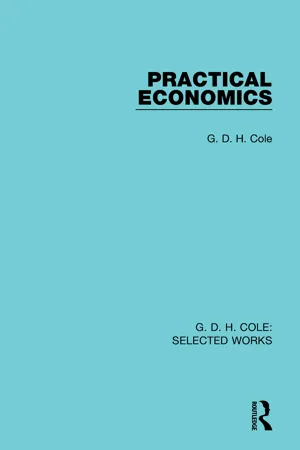
This volume compares the planning of economic conditions under the very different political systems of Soviet Russia, Fascist Germany and Italy and Democratic America, with some discussion of partial economic planning in Great Britain. It includes a broad survey of the successive phases of the Five Year Plans in the Soviet Union, the "New Deal" in the United States, and the diversion of the German economic activity to war preparation under the Nazi Four Year Plan. The author discusses the essential conditions for successful economic planning.
- 260 pages
- English
- ePUB (mobile friendly)
- Available on iOS & Android
eBook - ePub
Practical Economics
About this book
Information
PRACTICAL ECONOMICS
CHAPTER I
THE ESSENTIALS OF PLANNING
OUR grandfathers believed, with the unquestioning certainty of a religious faith, in laissez-faire. They held that, in economic matters, the State had only to keep out of the ring in order to ensure the best results. ‘Private enterprise’ would do all that was needed. Competition would ensure that consumers would be able to buy goods and services at the cheapest possible rates, and that full advantage would be taken of improving technical methods of production. The employer who charged more than the minimum price, or tried to carry on with obsolete methods, would go speedily to the wall. Only the fittest would survive. Moreover, competition would set the inventors and scientists busily to work devising new methods, so that science would flourish most greatly under the stimulus of the profit motive. Each person, in seeking his own economic interest, would be providentially furthering the interest of all. The search for profit would result in maximum production, because competition would keep profit down to the minimum needed to encourage enterprise, and would compel every profit-seeker to make himself as efficient a servant of the consumers as he possibly could.
In these days, that simple faith has been eclipsed. Our fathers were much less certain of it than our grandfathers; and in our own day it is held at all only by way of obstinate reaction against the prevailing conditions. Some economists continue to preach the theoretical soundness of the older doctrine; but even they have to admit that the chance of seeing it applied in the modern world, as it was largely applied in Victorian England, has become very small indeed.
The laissez-faire doctrine was always essentially capitalist in its outlook. It was conceived in terms of a number of private employers, each possessing certain instruments of production and a certain capacity to employ labour. It took the private ownership of capital for granted. Indeed, while it demanded that the State should as far as possible abstain from all interference in economic matters, there was one form of State intervention which it regarded as so axiomatic as not to constitute any interference at all. It looked to the State to uphold the ‘rights of property’; for on the inviolability of these rights the power of ‘private enterprise’ to do its beneficent work was believed to depend.
This form of State intervention was held, under laissez-faire principles, to involve that the right to acquire property should be open to all. Capital—that is, property in the means of production—was represented as the result of ‘abstinence.’ The capitalist was simply the individual who had refrained in the past from living up to his income—or of course, his heir, for inheritance was also taken for granted. The man without property, the wage-earner, was simply the person who had been improvident enough not to save, or, when it was admitted that his earnings were too low for saving to be possible, the person whose productive capacity was too small to make him worthy to join the capitalist class. Moral or economic shortcomings kept him where he was; and the fact of his exclusion from the class of property-owners was therefore no detriment to the justice of the economic system, which rewarded all men perfectly according to their deeds. The system handed out rewards for productive service in the form of wages and the profits of the active employers; and it handed out rewards for the moral service of ‘abstinence’—the second great economic virtue—in the form of interest on invested capital. Rent, indeed, was always rather difficult to fit into this scheme of things; for land, unlike capital, could hardly be regarded as the product of abstinence. The earlier classical economists had on this ground something of a prejudice against the landlord. But their successors sloughed it off by regarding land more and more as a form of capital, interchangeable by purchase and sale with other forms, and by dwelling more and more on the part played by capital, and therefore by abstinence, in improving the value of land.
In the early days of modern industrialism, this view of the capitalist as the ‘abstinent man’ had far more plausibility than it has to-day. Many of the early industrialists did rise from almost nothing, making good by their own enterprise and gradually increasing the scale of their operations by ploughing back their profits into the business instead of expanding their own consumption at an equal rate with their incomes. Some men do rise from the ranks in this way even to-day, far enough to become capitalists on a petty scale. But in these days of joint stock enterprise, no man, however talented or abstinent, gets far merely by saving out of his income. In order to ‘go big,’ he must get persons already in possession of large capital to back his schemes. Our self-made millionaires have been made, not by personal abstinence, but by their ability to get command of capital owned by others.
Early machine capitalism, in the rising industries of the first half of the nineteenth century, was highly competitive. There were many rival firms, each producing only a small fraction of the total output, and each trying to capture as much of the market as it could. Prices were determined by competition; and each manufacturer had to make himself efficient enough to compete with his rivals, on penalty of losing his market. Prices did tend to fall as productive efficiency increased; and restriction of output in order to maintain prices was in most cases out of the question. To this extent, the consumers did benefit, and the system did promote maximum production. It was under these conditions, applying to the most important and rapidly growing industries, that the doctrine of laissez-faire came to be widely accepted as embodying a universal economic truth.
But as the scale of production increased, until in many industries it became impossible for an employer to start business economically in a small way, and then gradually expand his scale of operations, conditions became very different. In one industry after another, the situation of perfect competition between a large number of rival firms ceased to exist. In certain new industries, of which railways are an outstanding example, it never could exist. For it was manifestly wasteful to build several competing railways to carry goods and passengers between two neighbouring towns when one railway could do all that was needed at less capital cost and with smaller running expenses. The supply of gas and that of water were other early instances in which monopoly, and not competition, seemed clearly to make possible the provision of services at the lowest cost.
Monopoly, however, while it might reduce the cost of supplying a service, gave no guarantee that the consumers would benefit by the lower cost. The monopolist, if he was let alone, could charge what he liked; and his price policy would be settled, not by competitive necessity, but by the elasticity of demand for his particular product in conjunction with the variations of his costs at different levels of output. It might pay him, in exceptional cases, where demand was very elastic and his commodity was produced under conditions of diminishing cost as output increased, to sell at the lowest possible price. But this would not necessarily, or even commonly, be the case. In most instances, the price that would give the monopolist the highest profit would be a higher price than the minimum at which it would pay him to produce.
This being evident, the case for laissez-faire in these particular instances, went by the board. Hesitantly, because it seemed dangerous to admit exceptions to the general freedom of ‘private enterprise,’ the necessity for some form of public regulation was admitted in the case of monopolies. But the exceptions were kept within the narrowest possible limits; and even within these limits as little regulation as possible was actually enforced.
But next, with the further growth of technique, there arose a situation in which, short of actual monopoly, the necessary scale of production became so large that there was room in the market for only a very few firms, and the entry of fresh competitors became very difficult, because the new entrant could not begin in a small scale and work his way up, but must from the start invest a huge capital in order to produce at all. Where such conditions exist, it becomes easy for the few competitors, if they so desire, to confer together, and to establish what is in effect a monopoly by agreeing upon the prices at which they will sell, and perhaps also about the quantities and varieties of goods that they will place on the market. The cartel, with more or less developed common selling agreements, is the most systematic form of this secondary type of monopoly; but, short of the cartel, it can be found in less formal price-fixing and similar arrangements in many branches of modern industry, and on both a national and an international scale.
The advocates of laissez-faire, faced with this type of monopoly, hesitated what to do. In the United States, the attempt was made, with singular lack of success, to outlaw it by prohibiting all arrangements for price-fixing between businesses, and by ordering the actual dissolution of trusts and combines held to be contrary to the public interest. In Germany, on the other hand, where the notions of economic individualism were never so strongly held, the State sought to control this type of monopoly by regulating the prices which it was allowed to charge, and by establishing some degree of public supervision. Finally, in Great Britain, it was allowed to grow practically unchecked, but did, in fact, grow less rapidly than in either Germany or America until recent years, probably because British industry was producing more extensively for a diversified world market, and free trade seemed in part to protect the home consumers against restrictive policies or high prices enforced by the combines.
It became, however, increasingly apparent that, under conditions of large-scale production, the capitalist system was very far from guaranteeing to the consumers maximum production at minimum prices. It also became apparent that another assumption of the laissez-faire doctrine was not being fulfilled. It had been assumed that, just as employers would all have to sell their goods at the lowest price, so would labourers, competing for jobs, be compelled to sell their labour cheap enough to make it worth while for the employers to employ them all. It was assumed, in fact, that unemployment, save as a comparatively unimportant effect of unavoidable friction in changing over from job to job, would not exist.
But it became plain that in reality unemployment, on a much more serious scale than this, could and did exist. Economists often took refuge in blaming the Trade Unions for maintaining wages at an uneconomic height—that is, at too high a level to make it profitable for employers to engage all the available labour. For a time this explanation was widely accepted; but it was gradually realised that there might in truth be no wage-level at which employers would be prepared to engage all those who were ready to work. This might be the case because the lowering of wages would at the same time lower purchasing power, and so narrow the market for consumers’ goods. It was attempted to argue that any such decline would be offset by an increased demand for capital goods, arising out of the higher profits made possible by the lower wages. But the answer to this is that, as capital goods are, in the last resort, useful only for making consumers’ goods, the demand for capital goods must depend on the prospective demand for consumers’ goods. It was then argued that the lower wages would not, in fact, decrease purchasing power, because prices would fall to a corresponding extent. But, if prices did fall to this extent, there could be no inducement to the employer to engage more labour; for this inducement depends, not on the level of costs alone, but on the relation between costs and selling prices. Finally, it was argued that, as more workers would be employed, as much or more would be paid out in wages as before, despite the lower wage-rates. This, however, is to assume the very thing that is to be proved—that more workers would actually find employment.
In truth, wherever competition is so limited that firms are able to choose their own level of output or price—the two of course going together—there can be no assurance of either maximum production or minimum price, or of full employment of the available supply of labour. Laissez-faire no longer offers, even in theory, the prospect of maximum economic advantage.
Nor is this all. As technique advances, the differentiation of products, as well as the necessary scale of production, increases. But each producer of a differentiated product—an Austin car as against a Morris for example, or one patent breakfast food as against another—is in a position of partial, though still competitive, monopoly. Indeed, competition among the rival monopolists can be exceedingly keen; for, in face of a limited total market, each wants to sell as much as he can in order to get the full advantages of the economy of mass-production. But whereas, when products are relatively undifferentiated, this competition can be carried on only in terms of price, it is conducted under conditions of monopolistic competition largely by means of advertisement of the rival branded and patented products. Thus advertisement comes, in many cases, to involve a substantial addition to the costs of production; and yet no firm can afford to dispense with it because, in face of the advertising tactics of its rivals, it will not be able to make the existence or merits of its wares known to the consumers, even if it is offering goods of equal quality at a lower price.
When a number of rival monopolists are competing in this way, the costs of production are artificially inflated; for each firm is prevented by its rivals from taking full advantage of the economies of mass-production, and the costs of advertisement have to be added on to the unnecessarily high costs of manufacture. Moreover, the patent laws, whereby each firm acquires a monopoly for certain gadgets or processes against its rivals, prevent the consumer from getting the best possible article, as this would involve the pooling of the various patents. Where, in order to remedy these defects, the rival producers do combine, the consumer is merely faced with a complete monopoly, and it is not by any means assured that the benefits of cheaper production will be passed on to him in lower prices.
Side by side with these developments of monopoly in its various forms in the field of manufacture, there appears a strong tendency towards the increase of distributive costs. This takes two main forms. In retail distribution, the principal defect is that costs tend to be inflated by excess of competition. For, whereas in the field of manufacture it becomes increasingly difficult for the small-scale business to exist at all, in many branches of retail trade it continues to be relatively easy to make a start with very little capital. This induces a very large number of persons to enter retail trade, attracted by the possibility of working ‘on their own’ and escaping from the discipline of wage-earning employment. The rate of mortality among these small-scale traders is high; but there are always plenty of new entrants ready to take the places of those who fail. Inevitably, the existence of a large number of redundant retailers raises the level of costs; for each has to accept less trade than he could economically handle. The resulting wastes are very considerable indeed; and for these the consumer has mainly to pay, though a part falls on the unsuccessful retailers, who either lose their small capital and fail, or carry on at a very low level of remuneration for themselves and their invested capital.
But why, it may be asked, are not these highcost small retailers destroyed by the competition of the larger capitalist firms? Partly because the small retailer offers forms of service—credit to poor purchasers, immediate delivery, the nearness of his little shop to the purchasers’ house; and so on—which the large store in many cases does not supply; and partly because the costs of the large stores, which are in active competition with one another, are inflated by the expenses of advertisement. Moreover, the small retailer, having sunk his savings in his shop, is often prepared to carry on at a very low rate of return until his scanty capital and credit are exhausted.
Retail trade, then, is very wastefully conducted from the standpoint of the consumer. But wholesale trade is no more immune from criticism. Goods, on their way from the producer to the consumer, often pass through an unnecessary number of hands. In addition, wholesaling, which demands a relatively large capital, lends itself easily to monopolistic arrangements among the firms engaged in a particular branch of trade. By restricting sales through high prices, the wholesaler can often in...
Table of contents
- CONTENTS
- LIST OF CHARTS AND TABLES
- CHAPTER I THE ESSENTIALS OF PLANNING
- CHAPTER II SOCIALIST PLANNING—THE U.S.S.R.
- CHAPTER III FASCIST ‘PLANNING’—GERMANY AND ITALY
- CHAPTER IV AMERICAN ‘PLANNING’—THE NEW DEAL
- CHAPTER V CAPITALIST ‘PLANNING’ IN GREAT BRITAIN
- CHAPTER VI CONCLUSION
Trusted by 375,005 students
Access to over 1.5 million titles for a fair monthly price.
Study more efficiently using our study tools.
Frequently asked questions
Yes, you can cancel anytime from the Subscription tab in your account settings on the Perlego website. Your subscription will stay active until the end of your current billing period. Learn how to cancel your subscription
No, books cannot be downloaded as external files, such as PDFs, for use outside of Perlego. However, you can download books within the Perlego app for offline reading on mobile or tablet. Learn how to download books offline
Perlego offers two plans: Essential and Complete
- Essential is ideal for learners and professionals who enjoy exploring a wide range of subjects. Access the Essential Library with 800,000+ trusted titles and best-sellers across business, personal growth, and the humanities. Includes unlimited reading time and Standard Read Aloud voice.
- Complete: Perfect for advanced learners and researchers needing full, unrestricted access. Unlock 1.5M+ books across hundreds of subjects, including academic and specialized titles. The Complete Plan also includes advanced features like Premium Read Aloud and Research Assistant.
We are an online textbook subscription service, where you can get access to an entire online library for less than the price of a single book per month. With over 1.5 million books across 990+ topics, we’ve got you covered! Learn about our mission
Look out for the read-aloud symbol on your next book to see if you can listen to it. The read-aloud tool reads text aloud for you, highlighting the text as it is being read. You can pause it, speed it up and slow it down. Learn more about Read Aloud
Yes! You can use the Perlego app on both iOS and Android devices to read anytime, anywhere — even offline. Perfect for commutes or when you’re on the go.
Please note we cannot support devices running on iOS 13 and Android 7 or earlier. Learn more about using the app
Please note we cannot support devices running on iOS 13 and Android 7 or earlier. Learn more about using the app
Yes, you can access Practical Economics by G Cole in PDF and/or ePUB format, as well as other popular books in Politics & International Relations & Political History & Theory. We have over 1.5 million books available in our catalogue for you to explore.