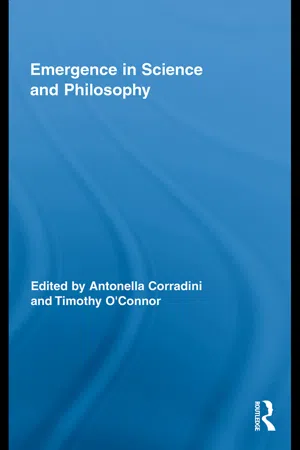
The concept of emergence has seen a significant resurgence in philosophy and the sciences, yet debates regarding emergentist and reductionist visions of the natural world continue to be hampered by imprecision or ambiguity. Emergent phenomena are said to arise out of and be sustained by more basic phenomena, while at the same time exerting a "top-down" control upon those very sustaining processes. To some critics, this has the air of magic, as it seems to suggest a kind of circular causality. Other critics deem the concept of emergence to be objectionably anti-naturalistic. Objections such as these have led many thinkers to construe emergent phenomena instead as coarse-grained patterns in the world that, while calling for distinctive concepts, do not "disrupt" the ordinary dynamics of the finer-grained (more fundamental) levels. Yet, reconciling emergence with a (presumed) pervasive causal continuity at the fundamental level can seem to deflate emergence of its initially profound significance. This basic problematic is mirrored by similar controversy over how best to characterize the opposite systematizing impulse, most commonly given an equally evocative but vague term, "reductionism." The original essays in this volume help to clarify the alternatives: inadequacies in some older formulations and arguments are exposed and new lines of argument on behalf the two visions are advanced.
Philosophical and scientific writing about the concept of emergence is animated by the widespread though not universal conviction that wherever the natural world manifests patterns of organized behavior whose description seems to require distinctive descriptive and causal/explanatory concepts, there may be found distinctive natural properties and processes—ones that operate independently of more fundamental processes. But the nature of their distinctive character and causal/explanatory autonomy from more basic phenomena is sharply debated. One of the most fundamental divides arises from the following question: do emergent phenomena entail that theories of basic physics must necessarily be ‘incomplete’, insofar as these theories are developed by studying small-scale microscopic systems exclusively when they are not embedded within organized emergent systems, and so not being subjected to the distinctive forces or constraints of such systems? The chapters in this first part address general questions of this sort, and each proposes a different account of how emergence is best understood for reasons of either conceptual coherence or explanatory fruitfulness.
Hong Yu Wong’s contribution explores the coherence of the classical supervenience model of emergence that was first articulated by C. D. Broad and recently resurrected by Kim and others in discussions of non-reductive physicalism. Using Kim’s arguments against emergence in his “Making Sense of Emergence” as a foil, Wong defends the internal consistency of the classical emergentist position. He challenges Kim’s downward causation and causal exclusion arguments as applied to emergent properties. In the second half of his chapter, having set aside causal exclusion worries deriving from Kim’s work, he examines whether there might still be a tension at the heart of the classical emergentist position that comes out of not entirely unrelated considerations. He approaches the issue not through the usual route of what the prospects for a claim about the causal closure of the physical are, but through considering the sense in which emergent properties supervene on basal properties on the classical ontology and whether this is consistent with emergent properties having novel downward causal influence. He attempts to describe a (putative) minimal classical emergentist world where emergents have novel causal powers, but appear to fail to supervene on basal properties. Consideration of why emergentists must reject this world as an emergentist world brings out why emergent properties supervene on the classical picture. He argues that supervenience in the case of emergent properties must be sui generis—grounded solely on fundamental, non-derivative emergent laws. This sets certain constraints on the explanatory potential of the classical emergentist position, since any causal influence by emergent properties must be consistent with patterns of co-variation between emergents and bases permitted by the fundamental emergent laws. The overarching aim of his chapter is to provide a more accurate picture of the classical emergentist position and its strengths and weaknesses.
Carl Gillett’s point of departure is debates not in general metaphysics but among contemporary scientific theorists. He suggests that the battle between reductionism and emergentism is a crucial case where a ‘metaphysics of science’ promises greater illumination than traditional metaphysics carried out in complete abstraction from and disregard of ongoing scientific theorizing. Both reductionism and emergentism, Gillett suggests, are well represented among prominent scientists, while neither label is embraced by an equally large share of philosophers. Perhaps this difference, then, reflects a fundamental difference in understanding how these terms are to be understood. Using the example of the mechanisms involved in potassium ion channels, Gillett tries to show how ‘compositional reductionism’ is a viable approach to special science entities, able to withstand traditional philosophical arguments against reductionism. He further holds that ‘strong emergentism’, as he characterizes it, is a similarly viable option, one that does not suffer from the charges of conceptual or metaphysical ‘spookiness’ often lodged against emergentist hypotheses. Strong emergentism is a form of non-reductive physicalism, accepting that all emergent properties are wholly realized by physical properties and relations, while rejecting usual formulations of the causal completeness of physics.
Mark Bedau advocates that philosophers cease arguing about which account of emergence is correct and instead embrace pluralism about emergence. He identifies three distinct kinds of emergence—nominal, weak, and strong—and contends that it is a simple empirical matter which of these may have application. Nominal emergence occurs where there is a macro-level property that logically or conceptually cannot have application to the micro-level. It is plain that there are such properties (e.g., liquidity). Weak emergence is a more ambitious, dynamical concept, on which the macro-level phenomena are ontologically and causally reducible to micro-phenomena, but only through an especially complex explanation. Thus, the hallmark of weak emergence is what he terms “explanatory incompressibility”—something which admits of degrees (and hence, weak emergence does as well). Offering several illustrative examples, Bedau argues that weak emergence is widespread in nature and scientifically very important. Finally, strong emergence requires irreducible “downward’ causal powers. Contrary to some, he contends that this concept is fully intelligible, but “all the evidence today suggests that strong emergence is scientifically irrelevant” (51).
Like Bedau, Michele Di Francesco holds that we should recognize a variety of emergence relations, since, he argues, there is no single notion of emergence that plausibly can do all the explanatory work that is foisted upon it by various thinkers motivated by distinct philosophical concerns. His point of departure in thinking about emergence are the platitudes that emergence is not reductionism and emergence is not dualism. He seeks to elucidate two varieties of emergence: moderate emergentism, which shades into non-reductive physicalism of standard sorts, and radical emergentism, which comes close to being an outright form of dualism and is the weakest form of naturalism we may conceive.
Finally, Georg Theiner and Timothy O’Connor take as their point of departure the working assumption of a moderate form of non-reductive physicalism. They show how this broad framework may admit three distinct varieties of emergence: emergence as organization dependence, as rooted in the absence of intentional design, and as multiple realizability. They then turn to the central focus of their chapter, which is the controversial thesis of group cognition. They propose that one who endorses a non-reductive physicalist view ought to endorse a “big tent” approach to cognition, one admitting of at least seven component capacities: adaptability, information processing, heed (of one’s environment), intentionality, extension, self-reflexivity, and consciousness. They then argue at length that contemporary work in several scientific domains provides strong evidence for forms of group cognition that exhibit several combinations of these characteristics (except for phenomenal consciousness). Different phenomena score differently on each of the three varieties of emergence identified previously. As with Bedau and Di Francesco, a moral of their discussion is that we may think of emergence in a plurality of ways, each admitting of degrees.
1 The Secret Lives of Emergents*
Hong Yu Wong
1.INTRODUCTION
In “Making Sense of Emergence”, Jaegwon Kim argues that ontological emergence does more wrong than just ‘betting against physics’; it is incoherent.1 Ontological emergence is the thesis that when aggregates of microphysical properties attain a requisite level of complexity, they generate and (perhaps) sustain emergent natural properties. What is constitutive of ontological emergence is the novel causal influence of emergent natural properties. One significant question is how to understand the notion of novel causal influence. An intuitive gloss is that an emergent property provides a causal contribution that goes beyond causal contributions made by any of the lower level properties had by the system and its parts taken either in isolation or in combination. One way to capture this is to claim that the behavior of an emergent property over time is characterized by a fundamental law. A further, but natural commitment of the emergentist is that once these distinctive properties emerge from basal properties, they can exercise causal influence on properties at the basal levels. The emergence of these new properties is taken to affect the dynamics of properties at the basal level. (This is commonly known as ‘downward causation’.) Kim contends that such a picture cannot be sustained. Kim argues that unless emergence is given a deflationary, epistemological interpretation, it is unworkable, because we cannot make sense of emergent properties having downward causal influence. He considers two varieties of emergent downward causation: synchronic reflexive downward causation and diachronic reflexive downward causation. (Reflexive because emergent properties have causal influence on events involving their own micro-constituents.) Kim defines the two varieties thus:
Synchronic reflexive downward causation. At a certain time t, a whole, W, has emergent property M, where M emerges from the following configuration of conditions: W has a complete decomposition into parts a1, … , an; each ai has property Pi; and relation R holds for the sequence a1, … , an. For some aj, W’s having M at t causes aj to have Pj at t. (28)
Diachronic reflexive downward causation. As before, W has emergent property M at t, and aj has Pj at t. We now consider the causal effect of W’s having M at t on aj at a later time t +
t. Suppose, then, that W’s having M at t causes aj to have Q at t +
t. (29)
Kim thinks the synchronic reflexive variety absurd, for it seemingly involves causal circularity (modulo worries about simultaneous causation). The diachronic variety, however, escapes the circularity worries because of the time delay between the putative cause and effect. Kim surmises that diachronic reflexive downward causation is all that emergentists need. But he argues that diachronic reflexive downward causation is open to his causal exclusion argument:
… I earlier argued that any upward causation or same-level causation of effect M2 by cause M1 presupposes M1’s causation of M2’s lower level base, P2 (it is supposed that M2 is a higher-level property with a lower-level base; M2 may or may no...
Table of contents
Routledge Studies in the Philosophy of Science
Contents
Figures
Introduction
Part I Emergence
Part II Self, Agency, and Free Will
Part III Physics, Mathematics, and the Special Sciences
Contributors
Index
Trusted by 375,005 students
Access to over 1.5 million titles for a fair monthly price.
Study more efficiently using our study tools.
Frequently asked questions
Yes, you can cancel anytime from the Subscription tab in your account settings on the Perlego website. Your subscription will stay active until the end of your current billing period. Learn how to cancel your subscription
No, books cannot be downloaded as external files, such as PDFs, for use outside of Perlego. However, you can download books within the Perlego app for offline reading on mobile or tablet. Learn how to download books offline
Perlego offers two plans: Essential and Complete
Essential is ideal for learners and professionals who enjoy exploring a wide range of subjects. Access the Essential Library with 800,000+ trusted titles and best-sellers across business, personal growth, and the humanities. Includes unlimited reading time and Standard Read Aloud voice.
Complete: Perfect for advanced learners and researchers needing full, unrestricted access. Unlock 1.5M+ books across hundreds of subjects, including academic and specialized titles. The Complete Plan also includes advanced features like Premium Read Aloud and Research Assistant.
Both plans are available with monthly, semester, or annual billing cycles.
We are an online textbook subscription service, where you can get access to an entire online library for less than the price of a single book per month. With over 1.5 million books across 990+ topics, we’ve got you covered! Learn about our mission
Look out for the read-aloud symbol on your next book to see if you can listen to it. The read-aloud tool reads text aloud for you, highlighting the text as it is being read. You can pause it, speed it up and slow it down. Learn more about Read Aloud
Yes! You can use the Perlego app on both iOS and Android devices to read anytime, anywhere — even offline. Perfect for commutes or when you’re on the go. Please note we cannot support devices running on iOS 13 and Android 7 or earlier. Learn more about using the app
Yes, you can access Emergence in Science and Philosophy by Antonella Corradini, Timothy O'Connor, Antonella Corradini,Timothy O'Connor in PDF and/or ePUB format, as well as other popular books in Philosophy & Mind & Body in Philosophy. We have over 1.5 million books available in our catalogue for you to explore.