eBook - ePub
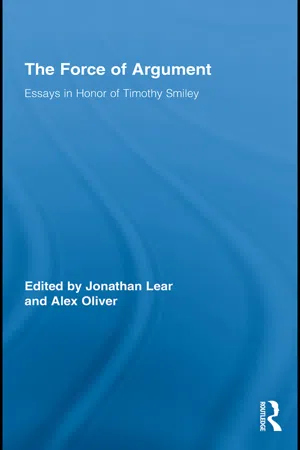
The Force of Argument
Essays in Honor of Timothy Smiley
- 286 pages
- English
- ePUB (mobile friendly)
- Available on iOS & Android
eBook - ePub
The Force of Argument
Essays in Honor of Timothy Smiley
About this book
Timothy Smiley has made ground-breaking contributions to modal logic, free logic, multiple-conclusion logic, and plural logic; he has illuminated Aristotle's syllogistic, the ideas of logical form and consequence, and the distinction between assertion and rejection; and his debunking work on the theory of descriptions is a tour de force. In this volume, an international roster of contributors discuss Smiley's work to date; their essays will be of significant interest to those working across the logical spectrum—in philosophy of language, philosophical logic and mathematical logic.
Information
1
Philosophy In and Out of the Armchair
Kwame Anthony Appiah
1 CONCEPTUAL ANALYSIS
One thing philosophers claim to do is: analyze concepts. We do this in language, so our analyses appear as sentences that we claim are conceptual truths. We utter sentences containing a word that expresses a certain concept: ‘green’, say, which expresses the concept green. But a conceptual truth is not just a true sentence that uses a concept: ‘The concept green applies to my shirt’ is a truth but not a conceptual truth. Rather, a conceptual truth is a truth that anyone who has the necessary concepts is in a position to know: e.g. ‘Green is a color’. Nothing more than knowledge of concepts is required to know that this is true. And, surely, knowledge of the concepts expressible in our language is just what all of us have with us wherever we go. As a result, as Tim Williamson once put it, ‘If anything can be pursued in an armchair, philosophy can’ (Williamson 2005: 1).
Now, if knowledge of concepts led immediately to knowledge of all conceptual truths, conceptual analysis would be trivially easy. But there are conceptual truths that people understand, but do not know to be true: e.g. ‘You cannot trisect an arbitrary angle with straight edge and compass’. How can this be, if possession of concepts is all that is required? This question raises a version of the paradox of analysis, which asks how an analysis can both be informative and correct. If it is informative, after all, then its truth doesn’t follow from conceptual knowledge alone.
Perhaps it is obvious to you what has gone wrong here. If it is, you can stop now. I aim to assemble the materials for an understanding of why—on almost any plausible semantic view—conceptual truths can indeed be hard to find, even though there is a sense in which the materials for finding them are, indeed, often available to anyone who understands the sentences we use to express them. I aim, too, to show that there are many conceptual truths that are most easily found by doing experiments, even if we could, in principle, have hit upon them in other ways. And I also want to show that there are conceptual truths that are inaccessible from an armchair (unless the armchair comes with a good supply of empirical information). So my first reason for being interested in these issues is that we need to get clear about them if we’re to decide what sorts of question we should, in fact, aim to work out in the armchair.
But another thing philosophers do is: try to keep clear about what we are doing. And any philosophically satisfying account of conceptual analysis will have, as a result, to be consistent with a philosophically satisfying account of concepts. In the last century or so, this has usually been taken to involve explaining linguistic meaning: in large measure because older approaches, which treated concepts as mental seemed not to have advanced very much, in part out of a general tendency (of which behaviorism in philosophical psychology is one symptom) to favor analyses that focus on things—like utterances and inscriptions—that, unlike ideas and thoughts, inhabit the public world.1 And so we must start with accounts of assertoric meaning, even if, as I shall suggest, this is not where we should end up.
2 FOUR THEORIES OF MEANING
In the analytic tradition there are four deep traditions of thought about assertoric meaning. In one—broadly pragmatist—tradition, the content of an assertion is identified with what assenting to it would lead us to do. Frank Ramsey, a student of pragmatism, put the idea this way in ‘Facts and Propositions’:
The essence of pragmatism I take to be this, the meaning of a sentence is to be defined by reference to the actions to which asserting it would lead …2 (Ramsey 1927: 51)
In a second—verificationist—tradition, the content of an assertion is identified with the experiences that would (and would not) warrant its utterance, its verification conditions (along with its falsification conditions, although from now on I’ll not refer explicitly to them).3 And in the third—realist—tradition, the content of an assertion is identified with its truth– conditions, with the states of the world that would make it true.4
These three lines of thought can be woven together. We could say, with the realist, that knowledge of meaning is knowledge of truth conditions, and still think that such knowledge would issue in knowledge of the verification conditions. Someone who knows when a sentence would be true might indeed be expected to recognize evidence for and against its truth. We could add, following another of Ramsey’s ideas, that someone who knows what a sentence means and believes it to be true will be led to act in those ways that would be utility-maximizing if the sentence were true.
Still, if the realist is right, the verificationist is probably wrong, because there will be more to meaning than verification conditions, unless it turns out that two sentences supported by exactly the same evidence must have the same truth conditions, in which case realism and verificationism will be equivalent. The pragmatist theory might be thought to be the combination of realism about the content of sentences with the view that assertions express beliefs and beliefs are states that lead us to act in ways that would be rational if the sentences expressing them were true.
The fourth tradition, which is Wittgensteinian, identifies meaning with use (Wittgenstein 1967). To understand a sentence, on this view, is to know how to use it properly. The use-theory is well placed to treat language that is not assertoric, since imperatives (including questions) and optatives and exclamations can be used appropriately or inappropriately as much as assertions. But for assertions the use-theory could turn out to be consistent with all the others, since to know how to use an assertoric sentence it might be both necessary and sufficient to know its truth-conditions, its verification conditions, or which acts the belief it expressed made apt.
Each of these traditions would need more careful articulation if we were to assess its plausibility. But there is something they largely share, an assumption made explicit in this passage from Michael Dummett:
What a theory of meaning has to give an account of is what it is that someone knows when he knows a language; that is, when he knows the meaning of the expressions and sentences of the language. (Dummett 1975: 99)
Even Wittgensteinians could agree with this. They could hold that knowledge of meaning is knowing how to use a sentence, so meaning is what a competent speaker knows. But they could also claim that it is irreducibly a form of know-how, and so not analyzable in terms of knowing any theory, since (they might claim) know-how need not be underwritten by propositional knowledge. But the other views develop most naturally as theories in which knowledge of meaning is propositional: knowing the truth conditions of a sentence is knowing that it would be true under such-and-such circumstances; knowing the verification conditions is knowing that it would be reasonable to assert it when such-and-such evidence was available; knowing the pragmatic meaning is knowing that it would be appropriate to act in such-and-such ways if one believed it true.5
So it is a deeply embedded assumption of much of the semantic theorizing of the last century or so that the capacities that underlie the competence of speakers of a language are underwritten by propositional knowledge about the sentences they utter. Granted that this is so, it is likely that you can generate some version of the paradox of analysis for most of these views. Consider, by way of example, some sentence that is offered in the course of a philosophical analysis as ‘true in virtue of its meaning’. Let it be, say,
K: | You can only know that something is so if it is, in fact, so. |
If this sentence is true in virtue of its meaning then, the proponent of the paradox of analysis says, anyone who knows what it means—anyone, then, who understands it—will know that it is true. So such an analysis, if correct, cannot be informative.
This line of argument has always struck me as oddly unconvincing. On an account of meaning in which grasp of meaning is propositional knowledge, there will be some proposition, M(K), which states the meaning of K:
Understanding K is knowing that M(K).
To say that it follows from the meaning of K that K is true is presumably to say that
E: | That M(K) entails that K is true. |
Now, as we saw, on a propositional theory anyone who understands K will know that M(K). But we can deny that it follows from the truth of E that someone who knows that M(K) also knows that K is true, provided we accept
N: | You need not know all the propositions entailed by what you know. |
And, while there have no doubt been people who were tempted to deny N, it is, absent a counterargument, something that it is very natural to accept.
There are puzzles that remain about how we can be said to know something without knowing something that follows pretty directly from it, and I shall return to those puzzles later. For the moment, though, I want to go back and trace a different trajectory in the history of modern philosophical semantics, which leads not to the problem of the paradox of analysis but to a rejection of the very idea of meaning.
3 QUINEAN EXCEPTIONALISM
Willard Van Orman Quine is not easy to fit into one of the four traditions I have identified, but that, I think, is because he did not have, in the sense I have sketched, a theory of meaning at all. What he had instead was an account of how language worked that was meant to allow us to do without the idea of meaning. In ‘Two Dogmas of Empiricism’ he proposed we should give up both the analytic-synthetic distinction and the doctrine he called ‘reductionism’, which he glossed as ‘the belief that each meaningful statement is equivalent to some logical construct upon terms which refer to immediate experience’ (Quine 1951: 20). Reductionism of that sort has gone the way of the dodo. But, whatever their official positions when faced directly with the question whether Quine was right about analyticity, many philosophers still practice conceptual analysis in a way that seems to suppose the very distinction between a kind of truth that obtains, as Quine put it, ‘independently of fact’, and a kind of truth that depends on the way the world actually is.
I am not alone in finding Quine’s arguments against analyticity unconvincing (see e.g. Grice and Strawson 1956; Putnam 1962). Sometimes in ‘Two Dogmas’ he argu...
Table of contents
- Routledge Studies in Contemporary Philosophy
- Contents
- Preface
- Acknowledgments
- 1 Philosophy In and Out of the Armchair
- 2 Restricted Quantifiers and Logical Theory
- 3 Logical Form
- 4 The Socratic Elenchus
- 5 What Makes Mathematics Mathematics?
- 6 Smiley’s Distinction Between Rules of Inference and Rules of Proof
- 7 Relative Validity and Vagueness
- 8 The Force of Irony
- 9 The Matter of Form
- 10 Abstractionist Class Theory
- 11 A Case of Mistaken Identity?
- 12 Inferential Semantics for First-Order Logic
- Bibliography of Works by Timothy Smiley
- Contributors
- Index
Trusted by 375,005 students
Access to over 1.5 million titles for a fair monthly price.
Study more efficiently using our study tools.
Frequently asked questions
Yes, you can cancel anytime from the Subscription tab in your account settings on the Perlego website. Your subscription will stay active until the end of your current billing period. Learn how to cancel your subscription
No, books cannot be downloaded as external files, such as PDFs, for use outside of Perlego. However, you can download books within the Perlego app for offline reading on mobile or tablet. Learn how to download books offline
Perlego offers two plans: Essential and Complete
- Essential is ideal for learners and professionals who enjoy exploring a wide range of subjects. Access the Essential Library with 800,000+ trusted titles and best-sellers across business, personal growth, and the humanities. Includes unlimited reading time and Standard Read Aloud voice.
- Complete: Perfect for advanced learners and researchers needing full, unrestricted access. Unlock 1.5M+ books across hundreds of subjects, including academic and specialized titles. The Complete Plan also includes advanced features like Premium Read Aloud and Research Assistant.
We are an online textbook subscription service, where you can get access to an entire online library for less than the price of a single book per month. With over 1.5 million books across 990+ topics, we’ve got you covered! Learn about our mission
Look out for the read-aloud symbol on your next book to see if you can listen to it. The read-aloud tool reads text aloud for you, highlighting the text as it is being read. You can pause it, speed it up and slow it down. Learn more about Read Aloud
Yes! You can use the Perlego app on both iOS and Android devices to read anytime, anywhere — even offline. Perfect for commutes or when you’re on the go.
Please note we cannot support devices running on iOS 13 and Android 7 or earlier. Learn more about using the app
Please note we cannot support devices running on iOS 13 and Android 7 or earlier. Learn more about using the app
Yes, you can access The Force of Argument by Jonathan Lear, Alex Oliver, Jonathan Lear,Alex Oliver in PDF and/or ePUB format, as well as other popular books in Philosophy & Logic in Philosophy. We have over 1.5 million books available in our catalogue for you to explore.