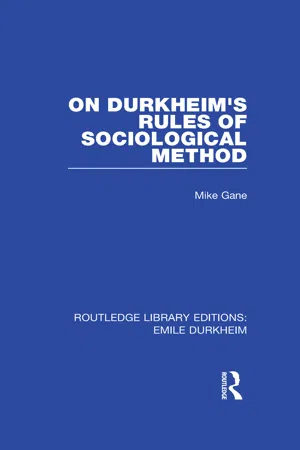
This radical appraisal of Durkheim's method, first published in 1988, argues that fundamental errors have been made in interpreting Durkheim. Mike Gane argues that to understand The Rules it is necessary also to understand the context of the French society in which the book was written. He explores the cultural and philosophical debates which raged in France during the period when Durkheim prepared the book and establishes the real and unsuspected complexity of Durkheim's position: its formal complexity, its epistemological complexity, and its historical complexity.
- 212 pages
- English
- ePUB (mobile friendly)
- Available on iOS & Android
eBook - ePub
On Durkheim's Rules of Sociological Method
About this book
Information
PART ONE
Man is excentric to himself
(Merleau-Ponty)
1
Durkheim, the Rules and the Problem
(i)
Emile Durkheim was born into an eminent Jewish family in eastern France in 1858. His adult life spans the period between the Franco-Prussian War and the First World War. He died in November 1917 at the age of 59.
After studying at the Ecole Normale Supérieure (1879–82), Durkheim taught at a number of Lycées between 1882 and 1887, a period broken by a term’s study in Germany, Berlin and Leipzig (1886) before taking up his first University position at Bordeaux where he worked from 1887–1902 (holding the ‘Chaire de Science Sociale’ from 1896). A second period of fifteen years was then spent at the Sorbonne in Paris 1902–17 (holding the ‘Chaire de Science de l’Education’ from 1902, and the ‘Chaire de Science de l’Education et Sociologie’ from 1913). Founder of the famous sociological yearbook, the Année Sociologique, and the school of sociology known as the Année school, or more simply the Durkheimian school, his stature has grown rather than diminished in sociology in the period since his death, at least outside of France. Today the ‘founding fathers’ of modern sociology are generally regarded as the trinity: Marx, Weber and Durkheim. Although it would be a gross error to think these are the only influences of any significance on modern sociology, or even its direct progenitors, they are without doubt its most brilliant formative influences. Translations and commentaries of Durkheim’s writings, at first only a trickle, have become an inundation.
Many more collections are promised: letters, essays and so on; the flood is not likely suddenly to stop. It must be noted that many of the translations are rather poor, even the more recent ones, and although the recent second translations are more readable than the earlier ones, they are by no means free of error.
This judgment also applies to the work under consideration here, The Rules of Sociological Method first published in 1894. Close analysis of the text therefore can only adequately be achieved by checking against the French, especially in key passages, since errors such as the substitution of ‘normal’ for ‘abnormal’ (Durkheim, 1982:98, line 14 up), ‘induction’ for ‘deduction’ (p. 150, line 20), ‘observations’ for ‘sensations’ (p. 81, line 15 up), can clearly sink any unwary reader.
But it may come as a different kind of surprise for some readers to learn that although this work features prominently on sociology courses very few sociologists outside Durkheim’s immediate circles have ever explicitly attempted to use them. Perhaps even this formulation involves a misunderstanding. Anthony Giddens (1976:8), is right to insist that method here should not be confused with techniques of recording and analysing empirical materials, often taught in sociology as sociological ‘method’. The book is much broader than any discussion of, say, survey techniques might suggest. It deals with questions concerning the conceptualisation of social structures and relations between them in the context of the classification of societies, as well as how to engage in sociological analysis of a whole range of social phenomena from family structure to religious ritual. In this context it is significant that a work such as Steve Fenton’s Durkheim and Modern Sociology (1984) contains virtually no discussion of method or the influence of the Rules, and W.S.F.Pickering’s Durkheim’s Sociology of Religion does not directly relate the project of the Rules to Durkheim’s development of the sociology of religion—and is content to assert that the Rules is ‘full of serious defects in many people’s eyes and shows a very limited knowledge of scientific procedure’ (Pickering, 1984:288). R.A.Jones, in his recent Emile Durkheim, again reiterates Lukes’s criticisms, adding that the Rules ‘is Durkheim at his worst’ (Jones, 1986:77). If the Rules seems to have become an embarrassment one might ask why it still occupies such a privileged place in the sociological pantheon: should not sociologists simply remove this text and forget about it rather than denounce this apparently meretricious work annually in introductory courses?
(ii)
What may be a suitable way of avoiding the obvious pitfalls of such a negative response? I suggest it is possible and productive to maintain that in some cases an author’s way of writing may be compared to his or her way of reading. To understand one is often a helpful step in attempting to illuminate and understand the other. And if, as here, we are aiming to understand the project of which the Rules is a part, it is logical that we should pose the question of how Durkheim himself expected and insisted his readers read his own works.
Let us for a moment briefly examine speculatively what this method of reading texts would involve. It would certainly be holistic in the sense that it would aim to move from the whole to the part—impossible of course unless the reader install certain suspensions; this would also imply the proper contextualisation of argument on the one hand, but also the recognition of the reality of the part vis-à-vis the context on the other. That this is without doubt Durkheim’s position can be seen in the following comment which comes from the first page of the Rules:
If the search for paradox is the mark of the sophist, to flee from it when the facts demand it is that of a mind that possesses neither courage nor faith in science.
Unfortunately it is easier to accept this rule in principle or theory than to apply it consistently. We are still too used to deciding all such questions according to the promptings of common sense to exclude the latter easily from sociological discussion. Whilst we believe ourselves to be emancipated from it, it imposes its judgments upon us unawares. Only a sustained and special practice can prevent such shortcomings. We would ask the reader not to lose sight of this. (trans mod.)
The reader:
should always be conscious that the modes of thought with which he is most familiar are adverse rather than favourable, to the scientific study of social phenomena, so that he must consequently be on his guard against first impressions. If he yields to these without resistance he may well have judged our work without having understood us. (Durkheim, 1982:31–2)
But what should happen if the reader encounters apparent contradiction? One writer has expressed it thus: ‘Durkheim might have said “I contradict myself? Very well, I contradict myself!”’ (Nisbet, 1965:28). Another, more recently:
It would not be difficult to quote passages from Durkheim which seem to contradict each other. When one finds such apparent contradictions in a thinker of Durkheim’s magnitude, however, more often than not it indicates that one has not understood him. (Schmaus, 1985:26–7)
This comment brings into the open what might be called a specifically Durkheimian problem: the moral and intellectual status of the author and ritual attitudes which accompany reading (see the discussion in Goffman, 1981:187). If other writers conclude easily that Durkheim’s efforts are to be rejected because of ambiguity, inconsistency and contradiction, this no doubt in part reflects the character of their opinion of him as a thinker. (A similar point is raised in review of the work of Durkheim’s nephew, Mauss, where the reviewer is content to identify apparently opposing lines of thought and immediately concludes that Mauss is simply a rather odd writer housing blatantly inconsistent opinions (Wood, 1978). Such a view comes very close to suggesting that the work is less than sane.) Here, I think it necessary to raise the question more directly as to what Durkheim’s own view was. There seems to be little doubt that he regarded reality as inherently complex and therefore any adequate thought, especially in the social sciences, had to reflect that complexity. This could give rise to the notion that any adequate reflection is ‘eclectic’ or a series of ‘mutually exclusive’ oppositions. This is illusory, he said, because it is purely abstract. If the elements are understood as part of a complex reality, that is ‘in their various places’ in that reality, such apparent contradiction evaporates (Durkheim, 1953:62).
It is essential, in order to follow this kind of complex thinking as a reader, to note qualifications and caveats, some of which may be presented in an extremely modest way. For example, in the Preface to the Rules Durkheim counters the suggestion that his position is materialist by stressing that: ‘Our method is in part only an application of (the spiritualist) principle to social facts’ (Durkheim, 1982:32). Here the important words are ‘in part’. One writer, Bouglé, completely overlooked the qualification and hence easily reached the conclusion that Durkheim was a spiritualist: he cited a passage from Durkheim as follows: ‘Society is not a system of organs and functions…it is the centre of a moral life’ (Durkheim, 1953:xl). The actual passage is: ‘Society was presented as a system of organs and functions… Society however, is more than this, for it is the centre of a moral life’ (1953:90–1).
So two conjoint rules must be applied: each argument must be located in an adequate contextualisation, and each caveat, however small, must be given its due. No doubt these observations are only a beginning; but they do suggest that Durkheim’s work is written in such a way that we may have to alter the way we normally read if we are to succeed in grasping it.
(iii)
Many of the most serious difficulties in understanding Durkheim stem, it seems to me, from a failure to take this requirement seriously, but even those who have noticed this remarkable aspect of his work do not realise its scope or its consequences. For example, Ernest Wallwork, citing the judgment of Henri Peyre, certainly seemed to have seen this element, which he called Durkheim’s dialectic and which he thought ‘intense and vital, ambiguous and adventurous, characteristics which make his position on any issue difficult to grasp’ (Wallwork, 1972:6). All Wallwork seems to mean by this, however, is that Durkheim was both a conservative (‘in the best sense’) and a radical at the same time. This assessment, however inadequate as we shall see, is far superior of course to those which have castigated Durkheim as an arch conservative, or as a naive liberal. Even Giddens’s comment that ‘in political temper and in sociological conviction Durkheim was an opponent of revolutionary thought’ (in Durkheim, 1986:24), fails to grasp the fact that within his work it is possible to find not only justifications for revolutions but a theory which makes vast collective effervescences the decisive formative moments in social development—further, for Durkheim, society did not simply ‘evolve’ into existence, it was born in such revolutionary effervescences. Many argue that Durkheim was a political moderate whose limited political horizon was the mediocre French Third Republic; but this overlooks the fact that Durkheim called not only for greater equality but argued that ‘so long as there are rich and poor from birth, there can exist no just contract, nor any just distribution of social status’ (Durkheim, 1984:lv). And at the end of the Elementary Forms he reiterated the judgment that European societies were in a critical moral state and that:
the state of incertitude…cannot last forever. A day will come when our societies will know again those hours of creative effervescence…though the work of (the French Revolution) may have miscarried, it enables us to imagine what might have happened in other conditions; and everything leads us to believe that it will be taken up sooner or later (Durkheim, 1961:475–6).
In other words it is possible to identify in Durkheim’s work revolutionary egalitarian themes, and it is perhaps surprising that a coherent left-wing Durkheimianism was not developed in France or elsewhere.
The main problem in trying to place Durkheim in any conventional category is that he combined a number of positions in an unusual way: he opposed anarchism and communism while supporting democratic socialism but refused to subordinate the independence of sociology as a science to any political organisation. While arguing that the continuing function of the state was to assist in the development of individual liberties, these liberties were not unconditional, for socialism demanded its own moral discipline. And socialism was for him not something dreamt up as a new utopia, it ‘appears part and parcel of the very nature of higher societies’ (Durkheim, 1986:120). Here lies the peculiarity of Durkheim’s political thought: his main therapeutic conclusion for modern societies, the restoration of occupational guilds in a new form, suggests in effect that there are in fact only two basic social forms: primal communism and higher socialism, all the other forms are deviations. The structural problems of the advanced societies arise because necessary occupational institutions have been destroyed, so that, from a morphological point of view, these societies are seriously imbalanced—hence they lurch from crisis to crisis, from war to war. Thus his socialism is tinged with the idea of restoration (for guild socialism, significantly described at more than one point as the norm of the bourgeoisie (e.g. Durkheim, 1957:33–4; 1984:xlviii), had been lost).
The complexity of this kind of theoretical and political social analysis should make us hesitate a little before reaching a judgment, but as Wallwork says, understating the situation, ‘caution has not always been exercised’ (Wallwork, 1972:6). Evidently caution alone is not sufficient; what is required is an examination of this type of complex strategic thought and how it is reflected upon by its author. It is not simply Durkheim’s ‘method’ for it is also applied to his method, as we shall see. For the moment it might be conceived as the deeper lying logic of Durkheim’s practice, operating behind the formulation of rules of procedure and sociological analysis. But it is not akin to any formal logic. It seems in fact more like a quasi-political element within the processes which orient the sociological enterprise, in the sense that it appears to be the framework which governs the way choices of analytical policies are made and followed through; it appears as dialectic when Durkheim begins a critique of former positions or available definitions; it appears as policy formation when Durkheim describes the reasons for undertaking a series of tasks in a certain order. The two sides of this practice could be called technique and strategy, and as such form the deeper framework for considerations of projects in epistemology and method. My view is that it is essential to grasp the nature of this strategic element in Durkheim’s work as it is the key to understanding its dynamic, its apparent inconsistencies, and is the only way in which its truly original elements can be recognised and assessed.
(iv)
Another way, perhaps, of conceiving this ‘dynamic’ element is to treat it as some kind of devil in the works: it manoeuvres, calculates, but in highly unexpected and seemingly perverse ways. It is not difficult even to imagine it as emanating from a kind of special organ. Certainly one writer saw Durkheim: ‘as a sort of automaton of super-human creation, destined endlessly to preach a new Reform, and who concealed within some vital organ, perhaps the brain…a perpetual system of unanswerable arguments’ (Maire, cited by Lukes, 1973:371).
But if I try to track down the nature of this devil (it is rather more like an imp), it is in order to grasp not a particular ‘theory’ but the nature of the realignments of a project. It is to place particular analyses in the context of a larger quest and to see them not as summations but as stepping stones of a necessarily sinuous pathway. I do not doubt the validity of sometimes harsh critical assessments of certain analyses as individual finished works, but I suggest that there is another level of criticism which needs to be undertaken, criticism of the larger strategic dimension of programmes of research. And Durkheim’s works are eminently suited for a consideration of this problem, indeed as I will attempt to argue, sociologists, by and large, have missed an opportunity to grasp certain of Durkheim’s texts, notably the Rules, because they have been unable to identify the dynamic unity between its propositions and the growing points of Durkheim’s larger project. At best they have seen this text as ‘transitional’. But what is not in some sense transitional?
In this perspective I also inquire into the difficult relation between theory, method and programme. My thesis here is that it is in the consideration of ‘method’ in the widest sense that we encounter elements of the strategic calculations arising from the programme. Sociology co...
Table of contents
- Contents
- Preface
- Acknowledgments
- Abbreviations of Titles
- PART ONE
- PART TWO
- PART THREE
- Bibliography
- Name Index
- Subject Index
Trusted by 375,005 students
Access to over 1.5 million titles for a fair monthly price.
Study more efficiently using our study tools.
Frequently asked questions
Yes, you can cancel anytime from the Subscription tab in your account settings on the Perlego website. Your subscription will stay active until the end of your current billing period. Learn how to cancel your subscription
No, books cannot be downloaded as external files, such as PDFs, for use outside of Perlego. However, you can download books within the Perlego app for offline reading on mobile or tablet. Learn how to download books offline
Perlego offers two plans: Essential and Complete
- Essential is ideal for learners and professionals who enjoy exploring a wide range of subjects. Access the Essential Library with 800,000+ trusted titles and best-sellers across business, personal growth, and the humanities. Includes unlimited reading time and Standard Read Aloud voice.
- Complete: Perfect for advanced learners and researchers needing full, unrestricted access. Unlock 1.5M+ books across hundreds of subjects, including academic and specialized titles. The Complete Plan also includes advanced features like Premium Read Aloud and Research Assistant.
We are an online textbook subscription service, where you can get access to an entire online library for less than the price of a single book per month. With over 1.5 million books across 990+ topics, we’ve got you covered! Learn about our mission
Look out for the read-aloud symbol on your next book to see if you can listen to it. The read-aloud tool reads text aloud for you, highlighting the text as it is being read. You can pause it, speed it up and slow it down. Learn more about Read Aloud
Yes! You can use the Perlego app on both iOS and Android devices to read anytime, anywhere — even offline. Perfect for commutes or when you’re on the go.
Please note we cannot support devices running on iOS 13 and Android 7 or earlier. Learn more about using the app
Please note we cannot support devices running on iOS 13 and Android 7 or earlier. Learn more about using the app
Yes, you can access On Durkheim's Rules of Sociological Method by Mike Gane in PDF and/or ePUB format, as well as other popular books in Social Sciences & Sociology. We have over 1.5 million books available in our catalogue for you to explore.