Foreign Workers and Law Enforcement in Japan
eBook - ePub

Foreign Workers and Law Enforcement in Japan

  1. 400 pages
  2. English
  3. ePUB (mobile friendly)
  4. Available on iOS & Android
eBook - ePub

Foreign Workers and Law Enforcement in Japan

About this book

This is a detailed study of the extent to which an increased influx of foreign workers is a threat to law and order in the context of the data-generating process of police statistics and the media coverage of "crimes" committed by foreigners. It shows that a general mood in which foreign workers are viewed as potential danger to Japanese society "protects" the criminalization of foreign "illegal" migrant workers.

The work begins by tracing the upsurge of "illegal" foreign workers in Japan. It builds a social profile of these "illegals" showing that because of fear of expulsion, lack of knowledge of the law and over-dependence on employer and workplace, their ability to avail themselves off the protection of the law is neglible, and they are always at risk of becoming victims to multiple exploitation.

Frequently asked questions

Yes, you can cancel anytime from the Subscription tab in your account settings on the Perlego website. Your subscription will stay active until the end of your current billing period. Learn how to cancel your subscription.
No, books cannot be downloaded as external files, such as PDFs, for use outside of Perlego. However, you can download books within the Perlego app for offline reading on mobile or tablet. Learn more here.
Perlego offers two plans: Essential and Complete
  • Essential is ideal for learners and professionals who enjoy exploring a wide range of subjects. Access the Essential Library with 800,000+ trusted titles and best-sellers across business, personal growth, and the humanities. Includes unlimited reading time and Standard Read Aloud voice.
  • Complete: Perfect for advanced learners and researchers needing full, unrestricted access. Unlock 1.4M+ books across hundreds of subjects, including academic and specialized titles. The Complete Plan also includes advanced features like Premium Read Aloud and Research Assistant.
Both plans are available with monthly, semester, or annual billing cycles.
We are an online textbook subscription service, where you can get access to an entire online library for less than the price of a single book per month. With over 1 million books across 1000+ topics, we’ve got you covered! Learn more here.
Look out for the read-aloud symbol on your next book to see if you can listen to it. The read-aloud tool reads text aloud for you, highlighting the text as it is being read. You can pause it, speed it up and slow it down. Learn more here.
Yes! You can use the Perlego app on both iOS or Android devices to read anytime, anywhere — even offline. Perfect for commutes or when you’re on the go.
Please note we cannot support devices running on iOS 13 and Android 7 or earlier. Learn more about using the app.
Yes, you can access Foreign Workers and Law Enforcement in Japan by Wolfgang Herbert in PDF and/or ePUB format, as well as other popular books in Business & International Business. We have over one million books available in our catalogue for you to explore.

Information

Year
2010
Print ISBN
9780415585170
eBook ISBN
9781136929076

1
Preliminary Remarks

This study is an analysis ex post facto. However, the period under study (1981–90) is not wholly an arbitrary one of a neat ten-year span, for it was the period in which the ‘problem’ of foreign migrant workers surfaced to public awareness and led to political discussion, and it was in its closing year that this process was brought to a climax with the introduction of a new Immigration Control Act on 1 June 1990. No doubt some other time-slice could be equally well justified but in no case is socio-surgical precision possible. I therefore transgress this time-frame when it is necessary or heuristically useful to do so. The ex post facto nature of every thorough sociological analysis has the consequence that new developments cannot—or can only exceptionally, and with ad hoc interpretation—be taken into consideration.
The time-frame pertains mainly to my sources, since with the exception of several important later studies (for example, the extensive collection of treatises edited by Tezuka A.O. (1992) although this collection also chiefly covers the time up to 1990) I took into account only the literature published up to the end of 1990. An (admittedly superficial) examination of the post-1990 literature dealing with foreign workers, when I returned to Japan in the spring of 1992, revealed some two dozen new publications. Most of these were journalistic (except for the clearly scientific studies of Tezuka, A.O., 1992) and repeated the catch-phrases ky
son
(coexistence) or ky
sei
(living together), the keywords of the ‘second round’ in the debate on foreign workers. The ‘first round’ was dominated by arguments related to ‘policy concerning whether to open or to close the country’ (cf. Tezuka, 1992b:7), and I did not expect to find on my return any substantially new insights concerning the purpose of my inquiry.
With regard to my sources I shall make a brief global comment: characteristic of most of them is a usually uncritical presentation of official statistics and data pertaining to the situation of foreign migrants to Japan, illustrated by concrete examples from field studies or the press. This approach is found not only in the journal istic works, but also in the publications claiming to be scientific. The latter alone (but unfortunately not always) are careful to cite their sources. For longer quotations, I have noted the profession of the author (journalist, lawyer, scientist) at the first passage quoted, in order to identify the literary genre. However, a professorship at a university, for example, does not necessarily guarantee the scientific character of statements published ex cathedra.
Independent empirical research is the exception among the Japanese literature. This might be explained by the high credibility attributed to the official ‘holy transcripts’ of data, for example, those released by the Ministry of Justice. These data are ‘recycled’ in most of the publications. The cited cases (as a rule extreme ones) from the daily press are more indicative of standards of newsworthiness and of popular themes than of reality itself. The cases I have used for illustration are mostly drawn from the literature; in some passages original newspaper articles are quoted. I tried to collect all of the circulating (and sometimes discordant) data and to evaluate their reliability with something approaching pyrrhonic scepticism. The following section dealing with the phenomenology of ‘illegal’ migration of labour to Japan, therefore, is a descriptio post festum, a description primarily of, and also conditioned by, the Japanese discourse. This discourse, after all, generates what becomes visible as ‘reality’, which is then describable in a second-order construction.

2
Phenomenology of the ‘Illegal’ Labour Migration to Japan

2.1 Theories of ‘Illegal’ Migration of Labour

To begin, I want to propose a theoretical framework within which some explanations may be offered for the ‘illegal’ migration of workers to Japan. I do not intend to propound a new sociological theory of migration; instead I want to present the models discussed in Japan. I will then attempt to carefully assess the relevance of these approaches and to identify universal characteristics of labour migration. This discussion will serve to introduce the theoretical concepts and to outline the (surface-)structure of migratory movement directed to Japan. It will provide a background for the Japanese discourse regarding the ‘problem’ of foreign workers.
Since the second half of the 1980s (at latest) there has been an ‘irregular’ migration of labour to Japan—mainly from Asian countries. This gained public attention through coverage by the mass media and political discussion as to whether an official ‘guest worker policy’ should be implemented or not. The term ‘irregular’ indicates that no official recruiting or dispatching of workers was involved, taken, and points to the circumvention of administrative rulings concerning stay and labour. Legally speaking, offences against regulations of the administrative law are committed, thus making applicable such legal descriptions as ‘illegal entrance’ (fuh
ny
koku),
‘illegal stay’ (fuh
zanry
),
or ‘illegal work’ (fuh
sh
r
)
. However, by use of the term ‘irregular’, the criminal and stigmatizing connotations of ‘illegal’ are avoided. Nevertheless, the ascription of the term ‘illegal’ to the activities and existence of Asian migrant workers is ubiquitous in the Japanese discourse. For that reason, I adopt that label (without meaning to stigmatize cases to which it is applied) when quoting from the literature.
In contrast to European countries, the percentage of foreigners in Japan is very small—only 0.8 per cent in a population of approximately 122 million. Koreans constitute 69.3 percent of (registered) foreigners (681,838 of the 984,455 non-Japanese residents). This group is comprised partly of second- and thirdgeneration descendants of those who, after the annexation of Korea as a de facto colony in 1910, immigrated or were deported to Japan as forced labour. The Chinese minority (whose presence dates from the annexation of Taiwan in 1895) comprises roughly 14 per cent of foreigners. Only an estimated 5 per cent of foreigners originate from Western countries (data for 1989 from Yamazaki, 1991:138 and 151). Since Japan first opened itself to foreigners after a period of self-imposed isolation (around 1641 to 1854) it has always pursued a rigid and restrictive ‘foreigner-policy’, with its focus on control still symbolized in the obligation of every foreigner residing for more than three months to carry a ‘certificate of alien registration’.
After Japan was able to conclude treaties with the foreign powers following that with England in July 1894, by which extraterritoriality was abolished, foreigners in Japan got the opportunity to move freely in the whole country in 1899 pursuant to an emperor’s ordinance. Herewith a new regulation of the foreigner law became necessary. The newly promulgated regulations were to again provide far-reaching opportunities for control. Japanese accommodating foreigners were bound by another ordinance released at the same time to inform the local police thereof, and foreigners who stayed at least 90 days in Japan also had to notify the authorities. At first, mainly diplomatic delegations and students came into the country, attracted by Tokyo, the cultural center of East Asia of the time. Manual labourers as a rule did not get entry permission, because the Japanese authorities wanted to protect the domestic labour market from an invasion by cheap Chinese manpower. Therefore on principle only those foreigners were allowed to settle for a length of time, who were qualified for specified services. (Gohl, 1984:331f.)
Except in the case of temporary (coerced) migration from the colonies until the end of the Second World War, the latter regulation —preventing admission of manual labour, and allowing only restricted admission of ‘qualified’ foreigners into clearly circumscribed fields of activity—has remained in force. Since the 1970s, there has been a migration of South East Asian women who are illegally employed in the so-called ‘services’ (that is, in the sex industry). This has been justly described as a traffic in women. The bulk of this immigration is arranged by organized traffickers.
In addition to this influx, there has been since the mid-1980s, larger scale, irregular migration of male ‘working tourists’, although not in the same pattern as recent ‘tourism for work’ (Arbeitstourismus) occurring in such countries as Austria since the opening of borders to former Eastern-bloc countries. In Japan, ‘working tourists’ are forced underground, since distance and financial burden prevent them from re-legalizing their residential status as tourists by first returning to their home country and then re-entering Japan. They therefore remain illegally. This ‘unexpected’ immigration of migrant workers jeopardizes a widely-accepted, semi-ideological view of Japan’s ‘identity’ as a ‘homogeneous island people with little experience in dealing with foreigners’ (see, for example, Komai’s (1992b) speculations as to whether Japan could become a ‘multi-ethnic’ country) and led to an over-heated debate about whether ‘guest workers’ should be welcome, and what sort of legislation would adequately control increasing migration from Asian countries.

2.1.1. The push-pull model

In the literature and public discussion dealing with ‘illegal’ Asian migrant workers, the question was repeatedly posed as to how and why Japan ‘suddenly’ became the target country of an irregular migration of labour. Neo-classical economic explanations gained particular popularity. According to this theoretical approach, labour is seen as a resource which ‘freely’ becomes mobile (or can be mobilized) depending on the supply-demand constellation. Existing disparities are assumed to be balanced through the ‘flow’ of labour. Push- and pull-factors are differentiated, and the attractiveness of labour migration is assessed according to their respective strength. The pull-factors are a cumulative combination of economic, demographic and social developments. For example, they could include falling birth rates, an increasing percentage of elderly (hence a decrease in the working population), and movement of indigenous workers into pleasant, better-paying (that is, white-collar) jobs. The push-factors which cause migrants to leave their countries of origin are overpopulation, pauperism, under-development and unemployment (cf. Castles and Kosack,
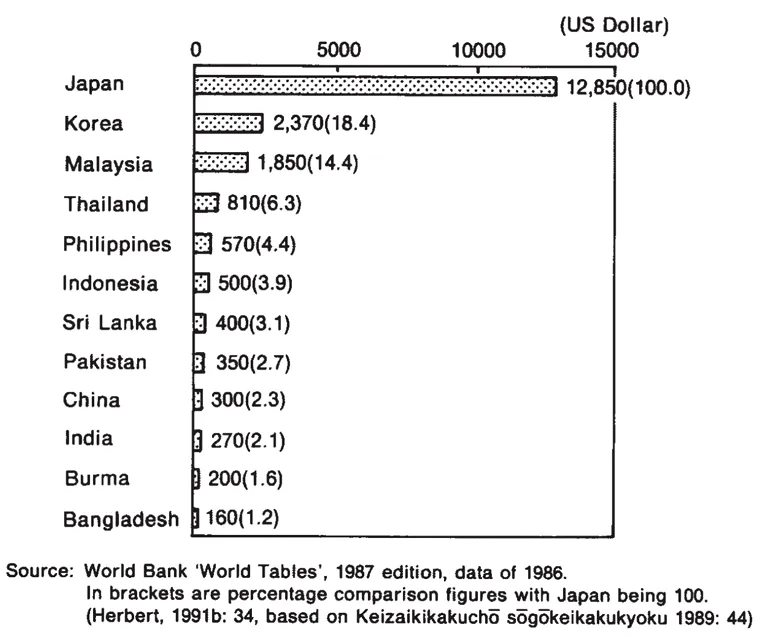
Figure 1.1 International comparison of per capita GNP
1985:26f.). At the macro-level, exorbitant economic disparities between Japan and its neighbours are evident. Gross national product (GNP) per capita serves as one indicator of disproportion in economic power, as shown in Figure 1. This economic imbalance is regularly mentioned, although not always with such force as here: ‘The premise of international labour migration is always the existence of smaller or bigger economic disparities’ (Miyajima, 1989:10).
At the micro-level, the opportunity to earn a high income in Japan—the result of the enormous wage gap between Japan and its neighbours—lures ‘illegal’ migrants and makes work in Japan attractive for them despite the risk of being repatriated. The prospect of earning money and the expectation of higher wages than at home are the manifest motives most often expressed by migrant workers. However, one should not overlook the possibility that this might be regarded as a legitimatory ascription (from a profit orientation) justifying toleration or shutting of one’s eyes, and for the employers it can help to aid and abet use of ‘illegal’ labour. Moreover, migrant workers are not just ‘profiteers’ who can be portrayed with ‘gold-digger’ metaphors. The decision to migrate is very often made out of the necessity to secure mere survival, and as a last choice, to escape a wretched situation of extreme poverty and unemployment. It can also be claimed that ‘cultural’ motives such as wanting to get to know the ‘success-country’ Japan, or to acquire knowledge and skills, may have been influential in the decision to migrate as is noted in Komai’s (1992a:285) analysis of 115 interviews of migrant workers in Japan.
The push-pull model is the dominant theory in Japan. A representative of the Ministry of Justice borrowed from this theory in enumerating several causes of migration, as he outlined and explained new legal measures and the position of his Ministry at a symposium. The causes mentioned were: economic imbalance (measured by per-capita GNP); revaluation of the yen, which makes migration of labour to Japan more profitable; economic depression in former target-countries of labour migration in the Middle East; worsening labour market conditions in the respective home countries; links between Japan and source countries organized by professional labour agents; and high demand fo...
Table of contents

  1. Contents
  2. Figures
  3. Tables
  4. Preface
  5. 1 Preliminary Remarks
  6. 2 Phenomenology of the ‘Illegal’ Labour Migration to Japan
  7. 3 Some Historical Preliminaries
  8. 4 Prelude: The Japayuki Question
  9. 5 The Early Stage of a Process of Irregular Migration: The Increase in Male ‘Illegal’ Workers
  10. 6 The Debate Concerning a Formal Policy on Guest-Workers
  11. 7 Migrant Workers and Criminality
  12. 8 The Media and Criminality
  13. Appendix All the Titles of Articles Evaluated for Media Analysis
  14. Notes
  15. Bibliography
  16. Glossary and Index of Japanese Terms