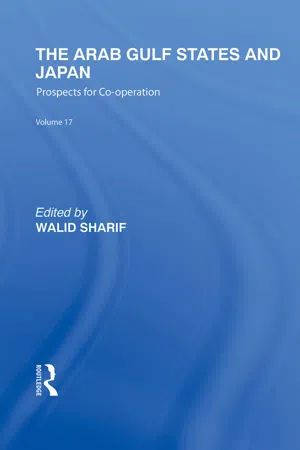
During the 1970s and '80s economic relations between the Arab Gulf States and Japan grew enormously. Approximately 65% of Japan's oil requirements were met from Arab Gulf resources. However, although Japanese imports of Arab oil comprise the major component of trade, Arab imports of Japanese goods are also increasing sharply. The seven Arab Gulf countries, represented by the Petroleum Information Committee accounted for 8% of Japan's total exports. This book explores the various avenues of economic co-operation that have developed between Japan and the Gulf States both in energy and other areas. It considers the measures that have been taken to protect the security of oil supply. It reports Japan's co-operation in the development of the petroleum industry in the Arab Gulf States. The book also examines the future prospects for economic, technological and political co-operation between Japan and the Arab Gulf States.
- 240 pages
- English
- ePUB (mobile friendly)
- Available on iOS & Android
eBook - ePub
The Arab Gulf States and Japan
PART I:
SECURITY OF OIL SUPPLY
1
SHORT-TERM AND MEDIUM-TERM OIL PRICE MOVEMENTS
Abdullah El-Kuwaiz*
Introduction
Before venturing predictions on oil prices, it may be useful to examine developments in supply and demand which, to a large extent, are responsible for the observed behaviour of oil prices. The interaction of supply and demand does not by itself provide a total justification for oil price trends, but it does elucidate the reality of the market-place.
Recent Market Developments
During the first two quarters of 1984, free world production was at an average level of 39.8 million barrels per day (b/d), while non-OPEC production attained a high of 21.6 million b/d; but OPEC production fell somewhat to an average of 18.2 million b/d during the same period. In the third quarter, total free world output increased to over 42 million b/d and reached a high of 42.7 million b/d in October.
Since June of 1984, total non-OPEC production increased marginally until it reached 24.5 million b/d in October, whereas OPEC production declined steadily through August (see Table 1.1).
The rise in non-OPEC production slowed during August, mainly because of summer maintenance work in the North Sea, but picked up again as fields became fully operational by September and October. After the low production level of August at 16.3 million b/d, OPEC production recovered in September and October. The rise was not enough to allow production to exceed 17.5 million b/d; data for September give OPEC an output
*Views presented in this paper are solely those of the author. They do not represent those of the GCC or any of its member states.
**By Abdullah El-Kuwaiz, Associate Secretary General for Economic Affairs, Co-operation Council of the Arab Gulf States.
Table 1.1: Free World Oil Supply (in thousand b/d)
of 16.6 million b/d, for a third-quarter average of 16.8 million b/d. Preliminary data for October show OPEC output at over 17 million b/d at the beginning of the month, but the sudden drop in light crude prices included a halt in the loadings of many countries and caused production to drop back to an average of 17 million b/d.
From a demand perspective (Table 1.2), total free world oil consumption, after being approximately 3 per cent above the level of the previous year during the first and second quarters of 1984,
Table 1.2: Free World Oil Demand (in million b/d)
declined somewhat in the third quarter, especially in the United States. Third-quarter world oil demand is thus put at 44.4 million b/d, which is 300,000 b/d above the third quarter of a year ago and 2.7 million b/d below the first quarter of 1984. Japan’s consumption continued to stay 5 per cent above the previous year for the third quarter, whilst the EEC registered the same rate of increase because of high residual oil demand in the UK and bad weather in September in Western Europe, which strengthened petroleum deliveries. US demand during the third quarter was only about 2 per cent higher than last year and showed no increase over the second quarter. Slackening residual oil sales contributed to the stagnation in US markets.
In sum, free world oil production increased by 2.3 million b/d between the first and third quarters of 1984, while consumption declined by 2.7 million b/d. From the third quarter of 1983 to the third quarter of 1984, production increased by 2.1 million b/d, while consumption increased by only 300,000 b/d. From these gross production and consumption figures alone, a decline in prices would have been predicted.
Short-term Predictions
1. Why has there been a general decline in oil consumption in the second half of 1984?
2. What are the implications of this decline upon the short-term reaction of oil prices, and, more importantly, what can be the expected path of oil prices?
The first question can be addressed by pointing out that one of the major causes for a decline in demand has been the recently observed draw-down in stocks in OECD countries (see Tables 1.3 and 1.4). Preliminary data for September show a general stock draw-down. The Japanese stock decline was quite distinct −0.6 million b/d, mostly resulting from a September 1 deadline for a higher petroleum tax. Elsewhere, stock-draws were moderate as oil imports met most of the increased demand. US companies, in particular, felt in September that the world oil situation lent itself to further stock-draws. September is usually an OECD stock-building month, but in 1984 it followed an unusual stock build-up of gasoline in the US, in addition to the Japanese stock manipulations.
Table 1.3: Monthly Stock Change in OECD Countries (million b/d)
Table 1.4: Stocks in OECD Countries (as of end of period, in million barrels)
Furthermore, stock levels, in general, were being maintained near the observed minimum levels averaged over the last few years. Thus, in the third quarter of 1984, there was a slight draw-down in stock, whereas in the third quarter of 1983 there was a stock buildup of 1.3 million b/d. Preliminary data for October show a decrease in stock figures as the month’s weather pattern was much warmer than usual (the warmest October in twelve years in North America), precluding any significant increase in residual fuel oil demand. This circumstance is, however, expected to change significantly once the winter months for the European and North American continents approach. If a normal winter develops, the demand for fuel oil should rise and a general increase in stocks is expected to proceed at a modest, yet consistent, rate.
A second factor, besides weather, which has affected overall demand has been the expectation of an economic slowdown in the OECD countries; the recent decline in oil demand (stockbuilding) has had the appearance of being administered shaped by the rhetoric of ‘expected’ economic contraction. This is evident from Table 1.4, which presents the days of forward consumption held in stocks in OECD countries. Since June of 1984, the measure dropped steadily and as of September 1984 represented only 89.3 days of forward consumption, as compared to 93.4 days a year earlier. Company-owned stocks declined about 10 per cent and now account for only 72 per cent of total stocks, compared with 76 per cent in 1983.
In view of the above, what can be expected of oil price behaviour and what will be the implication upon the major OPEC oil producers?
Looking at the short-term horizon, say the next six months, it is likely that oil prices will remain unchanged in nominal terms and could even increase slightly. With the approach of the high heating oil demand of the winter months, demand should pick up if normal weather patterns prevail. Furthermore, if normal inventory buildup also occurs, this will again strengthen demand and firm up the price structure. Intrinsic in this assumption, of course, is the expectation that OPEC production quotas will be maintained. If October is an indication of what is to be expected (see Table 1.5), then it would seem that quota restrictions will be observed by most members. However, beginning next summer the market for oil could again soften as projected winter demand subsides significantly.
This outlook need not have severe implications for GCC member states. Revenue contraction resulting from decreased oil exports, or reduced prices, will not significantly affect production decisions as stocks of financial assets of the GCC member states are adequate to meet short-term financial strains. The increased role of the private sector has added a security element when government revenues from oil decline. Moreover, most of the large development projects have either been completed, or are in the final stages of completion, thus reducing expenditure requirements. The slowdown in economic activity provides the region with the opportunity to consolidate economic gains and to lay the foundation for increased industrial and agricultural production to provide non-oil income for the future.
The short-term OPEC issue which, however, does merit some discussion, is the potential problem presented by crude price
Table 1.5: OPEC Production August 1984 (in thousand b/d)
differentials. As recently as October of 1984, the differential between Arabian light and Arabian heavy was officially $3.0, but in the spot market it registered a monthly average differential of $0.85. As a result of many modernisation and upgrading programmes that have been carried out by main refinery centres, notably those on the US Gulf coast, heavy crudes once shunned by refiners who were captive buyers of the light, sweet crudes, can now realise the same product yields from the poorer grades. This has greatly widened the supply base, enabling US refiners, for example, to use all the heavy North Slope crude and large volumes of Mexican Maya.
Although the emergence of heavy crude as a major feedstock has been in progress for some time, OPEC has only recently begun to approach the issue which many see as an important factor behind the price collapse of the lighter grades. Any meaningful resolution of the precarious situation in the world oil market will have to involve the heavy crudes which up to date have effectively been exempt from any official pricing decisions.
The question now becomes, what should OPEC do to alleviate the present disparity? Two potential alternatives come to focus. First, OPEC could officially alter the differential in the official price structure by raising the price of heavy crude, and thus bring into force market factors (that is, supply-demand). Although this is a direct and rather prompt alternative, one should be cautioned and must realise that major refinery upgradings have been de facto implemented, therefore precluding an immediate response by refiners who have immense capital costs to amortise.
A second alternative available to OPEC is a supply-oriented decision. By changing the mix of crudes available to the market, that is, offering more heavy crudes, the price of heavy crude could effectively be lowered to reflect the official price differential. Saudi Arabia, to some extent, has relied on this alternative. As a result of a change in the Saudi mix of crudes from a predominantly light blend (60 per cent, 20 per cent, 20 per cent) to that of rough equivalent proportions (40 per cent, 25 per cent, 35 per cent) the spot price of Arabian heavy declined by $0.15 from September to October. Unfortunately, due to overall slack demand conditions, the price of Arabian light also declined, therefore negating any effect on the differential. Nevertheless, if maintained, an altered mix will widen the difference between light and heavy crude spot prices, without reaching the actual difference between light and heavy crudes’ official price.
Medium-term Expectations
In the short run, movements in stocks and price differential disparities have dominated price movements. For the medium term, although price differential will continue to be important, oil prices depend on underlying or economic demand for oil, which in turn depends on world economic growth, income elasticity of demand for oil, and price elasticity of demand for oil; and on the supply of oil in OPEC and in non-OPEC countries. One can do a ‘back of the envelope’ calculation to arrive at some projections.
Projected world economic growth from the IMF and other sources would indicate optimistically an annual figure of less than 4 per cent. Estimates for average income and price elasticities of demand for oil are given in Table 1.6.
Table 1.6
The other element is oil production. As an extreme case scenario, one can assume zero increase in production outside of OPEC. OPEC has roughly an additional 16 million b/d to produce. Of this, it is estimated that an additional 2 million b/d would go to domestic consumption by 1990, leaving 14 to 16 million b/d (16 in 1985 and going down to 14 in 1990) for exports; this is roughly sufficient to meet projected world demand. The question, therefore, becomes—how much will OPEC, in fact, produce for exports? To answer this, one can examine some alternatives for OPEC behaviour.
Table 1.7 gives the necessary background information to assess OPEC behaviour and, in turn, prices. If one assumes an average income growth of 4 per cent in the world economy over the next six years, what would this mean in terms of increased oil demand at constant prices? Using an average long-term income elasticity of roughly 1 and an average price elasticity of −0.35, some interesting results can be derived.
In the second row of Table 1.7, the increase in world demand for oil, over 1983, has been calculated. As an extreme case scenario (that is, with high annual world growth of 4 per cent, no reduction in elasticities and no extra output outside of OPEC) it can be assumed that all of this increased demand would come from OPEC sources. If an equivalent output of oil was forthcoming, prices would stay roughly constant. In the third row, the implied extra revenues to OPEC are calculated, assuming a constant price of $30/barrel. In row 4, a very different calculation is done. That is, what if OPEC did not increase output but let prices rise as dictated by the increased demand; using a price elasticity of −0.35, this addition to revenue is calculated in row 4. The question is, therefore, how will OPEC behave, closer to the scenario of row 3 or row 4?
Clearly up to and through 1986, OPEC revenues would be higher if output was increased as opposed to letting prices rise. After 1986, the path of prices would depend on whether certain members of OPEC would benefit more by increasing output as opposed to letting prices rise. Given the high levels of excess capacity in some OPEC countries, the future of oil prices depends on the relative benefits of the two scenarios for these countries. Taking rough production figures available for 1984, one can see that roughly 15 million b/d or over 90 per cent of the extra capacity is in seven OPEC countries—Iran, Iraq, Kuwait, Libya,
Table 1.7: Oil Production and Revenues, 1984-90
Nigeria, Saudi Arabia, and the United Arab Emirates, while a little over 60 per cent of current OPEC exports is in these same countries. The issue then becomes, is it to the advantage of these countries to get 90 per cent of row 3 or 60 per cent of row 4? Clearly, prior to 1987, row 3 is bigger than row 4, so that they are better off with exporting more oil, as opposed to letting prices go up, even if the percentages were 50–50. However, given their low level of exports (resulting in a total share of only 60 per cent of OPEC exports), they would be better off in every year by getting 90 per cent of row 3, as opposed to 60 per cent of row 4. In the 1979–81 period, the reverse of this situation existed, that is the financial incentive was to let prices increase.
It is, therefore, difficult to imagine how oil prices can start increasing prior to 1989/90 given ‘normal’ market conditions. Clearly, unfor...
Table of contents
- CONTENTS
- ACKNOWLEDGEMENT
- INTRODUCTION
- OPENING ADDRESS
- PART I: SECURITY OF OIL SUPPLY
- PART II: OIL PRICE, MARKETING AND OTHER RELATED ISSUES
- PART III: RESEARCH AND DEVELOPMENT, TRAINING
- PART IV: THE ECONOMICS OF PETROCHEMICAL INDUSTRIES
- PART V: ALTERNATIVE ENERGY SOURCES
- PART VI: CO-OPERATION BETWEEN ARAB GULF STATES AND JAPAN
- LIST OF PARTICIPANTS
- LIST OF PARTICIPANTS
- INDEX
Trusted by 375,005 students
Access to over 1.5 million titles for a fair monthly price.
Study more efficiently using our study tools.
Frequently asked questions
Yes, you can cancel anytime from the Subscription tab in your account settings on the Perlego website. Your subscription will stay active until the end of your current billing period. Learn how to cancel your subscription
No, books cannot be downloaded as external files, such as PDFs, for use outside of Perlego. However, you can download books within the Perlego app for offline reading on mobile or tablet. Learn how to download books offline
Perlego offers two plans: Essential and Complete
- Essential is ideal for learners and professionals who enjoy exploring a wide range of subjects. Access the Essential Library with 800,000+ trusted titles and best-sellers across business, personal growth, and the humanities. Includes unlimited reading time and Standard Read Aloud voice.
- Complete: Perfect for advanced learners and researchers needing full, unrestricted access. Unlock 1.5M+ books across hundreds of subjects, including academic and specialized titles. The Complete Plan also includes advanced features like Premium Read Aloud and Research Assistant.
We are an online textbook subscription service, where you can get access to an entire online library for less than the price of a single book per month. With over 1.5 million books across 990+ topics, we’ve got you covered! Learn about our mission
Look out for the read-aloud symbol on your next book to see if you can listen to it. The read-aloud tool reads text aloud for you, highlighting the text as it is being read. You can pause it, speed it up and slow it down. Learn more about Read Aloud
Yes! You can use the Perlego app on both iOS and Android devices to read anytime, anywhere — even offline. Perfect for commutes or when you’re on the go.
Please note we cannot support devices running on iOS 13 and Android 7 or earlier. Learn more about using the app
Please note we cannot support devices running on iOS 13 and Android 7 or earlier. Learn more about using the app
Yes, you can access The Arab Gulf States and Japan by Walid Sharif in PDF and/or ePUB format, as well as other popular books in Business & International Business. We have over 1.5 million books available in our catalogue for you to explore.