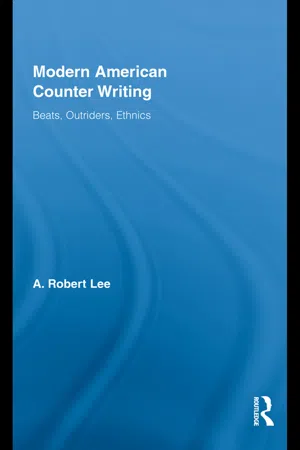
The dissident voice in US culture might almost be said to have been born with the territory. Its span runs from Roger Williams to Thoreau, Anne Bradstreet to Gertrude Stein, Ambrose Bierce to the New Journalism, The Beats to the recent Bad Subjects cyber-crowd. This new study analyses three recent literary tranches in the tradition: a re-envisioning of the whole Beat web or circuit; a consortium of postwar "outrider" voices – Hunter Thompson to Frank Chin, Joan Didion to Kathy Acker; and a latest purview of what, all too casually, has been designated "ethnic" writing. The aim is to set up and explore these different counter-seams of modern American writing, those which sit outside, or at least awkwardly within, agreed literary canons.
- 296 pages
- English
- ePUB (mobile friendly)
- Available on iOS & Android
eBook - ePub
About this book
Trusted by 375,005 students
Access to over 1.5 million titles for a fair monthly price.
Study more efficiently using our study tools.
Information
Subtopic
Literary CriticismIndex
LiteraturePart I
Beats
1
Beat Canon, Beat Shadow Canon
The beat generation can be seen as an aspect of the worldwide trend for intellectuals to reconsider the nature of the human individual existence, personal motives, the qualities of love and hatred, and the means of achieving wisdom. Existentialism, the modern pacifist-anarchist movement, the current interest of Occidentals in Zen Buddhism, are all a part of that trend. The beat generation is particularly interesting because it is not an intellectual movement, but a creative one: people who have cut their ties with respectable society in order to live an independent way of life writing poems and painting pictures, making mistakes and taking chances—but finding no reason for apathy or discouragement. They are going somewhere …
—Gary Snyder, “Notes on The Beat Generation” (1960)1
The stakes are too great—an America gone mad with materialism, a police-state America, a sexless and soulless America prepared to battle the world in defense of a false image of its Authority. Not the wild and beautiful America of the comrades of Whitman, nor the historic America of Blake and Thoreau where the spiritual independence of each individual was an America, a universe, more huge and awesome than all the abstract bureaucracies and Authoritative Officialdoms of the World combined. Only those who have entered the world of Spirit know what a vast laugh there is in the illusory appearance of worldly authority. And all men at one time or another enter that spirit, whether in life or death.
Allen Ginsberg, “Poetry, Violence, and The Trembling Lambs,” (1959)2
Beats. The Beat Movement. How best to re-engage with its one and several measures? How to give fresh eye and ear to a postwar repertoire of verse, fiction and performance that in its time and place stirred headlines as another America? Admirers, then and still, contend not only for a luminous gathering of literary-cultural energies but life-style in kind, the self unfettered, the spirit freed. To the un-persuaded the Beats will for ever smack of the easy shot, antics more than art, not to say a careerist shrewd regard for the market. Either way, and well over a half-century on from the bow first made in the late 1940, continued into the 1950s, and with an apogee in the 1960s, Beat remains un-erased, nothing if not unfinished business.
First has to be the founding circuit of texts, all long installed as canonical Beat fare—Ginsberg’s Howl and Other Poems (1956), Kerouac’s On The Road (1957), Corso’s The Vestal Lady on Brattle (1955) and Gasoline (1958), Burroughs’s The Naked Lunch (1959, 1962), and Ferlinghetti’s Pictures of the gone world (1955) and A Coney Island of The Mind (1958).3 Each, from a current vantage-point, has filters to be negotiated, notably the encrustations of fame, even notoriety, and for all their one-time generational shock of the new, the danger of having eased into familiar writ. A yet further complication, moreover, arises. Beat’s core players, its strike-force, have long tended to exert the pre-emptive effect. The upshot has been to relegate whole tiers of Beat-related authorship into a species of nether or shadow canon. Selective names in this regard, and for all that they can exert claims on other than Beat grounds, look to John Clellon Holmes, LeRoi Jones/Imamu Amiri Baraka, Barbara Probst Solomon, Michael McClure, Diane di Prima, Irving Rosenthal, Bonnie Bremser/Brenda Frazer, Harold Norse, Herbert Huncke and Joyce Johnson.4 Each bespeaks singularity, a discrete power of imagination, yet each in their own degree a liveliest crosspath into Beat’s literary orbit.
Even so, an iconic status attaches to Ginsberg’s Howl and Kerouac’s On The Road as Beat’s respective first and best celebrated calling-cards. The one offers “holy litany,” the would-be visionary hymn to life in the face of corporation and dollar appetite, Cold War and atomic bomb. The other, with Sal Paradise as chronicler and Dean Moriarty as re-configured Neal Cassady, relays the serial male companionship of road, jazz and sex within the novel’s itineraries from New York and New Jersey into Denver, California, New Orleans, The South and Mexico. Both serve as legendary countercultural anthems, whether the Eisenhower years defied for the sense of life as gridlock—the politics of McCarthyism, Wall Street as all-encompassing ethos, the Cold War—or, as each took on its own kind of notoriety, the 1950s into the 1960s as a generational change-era in social culture.
Beats, beatniks, hippies. The transition is long familiar. The GinsbergKerouac inaugural years were creative, literary, “Howl” in City Lights format, On The Road as Viking Press bestseller. In their wake came Beat as style, “liberated” youth, drop-out, the Village and Berkeley as key locations, diffuse ventures across the highways and into communes. The legacy would then move on to the drug-flower children of Haight-Ashbury, the Summer of Love in 1967, and Woodstock in 1969 with Jimi Hendrix and Janis Joplin, the both of them Beat-influenced. Beat’s trace, or overlap, at the same time was said to have been seen in the Free Speech Movement, the sexual revolution—not that Beat and feminism made for a nexus, the Chicago Democratic Convention protests of 1968, and the various Vietnam and Cambodia protests.
Yet Beat into Beatnik and beyond, along with the drugs heritage of pot, LSD and the heavier regimens, did not always sit easily in all original Beat quarters. Kerouac notably inveighed again the morphing into flower-power hippiedom (in his “Letter to Myself,” written in November 1960, he speaks disparagingly of having become the media’s “bloody King of the Beatniks”).5 The still subsequent transition, Beat as emerging media and market commodity, could prompt Burroughs in the 1980s to some vintage drollery (“Kerouac opened a million coffee bars and sold a million pairs of Levi’s to both sexes. Woodstock rises from his pages”).6
As America’s more public history evolved, Nixon and Watergate, the Carter and Reagan-Bush eras, the Clinton and Bush Jr. presidencies, through to the Obama White House, the 1960s and with it Beat and related counter- culture, could hardly avoid becoming part of period myth. The upshot has been both a sense of distance, and yet, paradoxically, an augmentation of interest. However construed, true or fake liberation, new American Renaissance or passing parade, the sheer spiritedness of both players and texts clearly has remained a draw. Both separately and compositely each writer-figure, each historic poem, novel, play, film or act of life-writing, together with work not so historic, wins latest reader-listeners. To say that Beat has found a historical place in modern American cultural formation is far from saying it has gone out of fashion, become moribund, or devolved into anachronism. The 1955 San Francisco Six Gallery readings under the orchestration of Kenneth Rexroth, especially Ginsberg delivering “Howl,” remain legend, as does City Lights as bookstore- publishing anchor, cinema like Pull My Daisy (1959) and Easy Rider (1959), and a Beat journal history stretching from City Lights Journal (1963–66) to The Beat Review (2007–).
The writings themselves manage the unusual feat of inspiring both huge popular followings and dedicated rolls of scholarship. It would be impossible to ignore the ever lengthening bibliography of monographs, essay-collections, reference-books, journal special issues, film, screen and print documentaries, bio-pics, web-sites, translations, DVDs and CDs. Archives, at Boulder’s Naropa and Stanford, or at the New York Public Library and the Library of Congress, continue to expand. Beat literature regularly enters the curriculum, High School to college. Beat conferences and panels convene with regularity, whether MLA, City Lights and Berkeley, or as in 1994 the NYU Beat conference under the co-chairing of Allen Ginsberg and Anne Waldman. Among international capitals London, Paris, Amsterdam, Rome and Tokyo, each with their Beat heritage, play host to ongoing commemorative festivals. Interest may well take different focus and shape, but the momentum clearly remains un-slowed.7
Enthusiasm continues to vie with reservation. In his insider-participant flourish, Tales of Beatnik Glory (1975), Ed Sanders, classicist, verse historian and founder-composer of the Fugs, mooted the Beat phenomenon as nothing short of a break-through in American consciousness, the very dawn of the New Aquarius.8 He affirms the mantra to have been one of liberation, the awakening of self through Zen, drugs, and however male-privileging, un-cosseted sexuality. Where once a consensual America in the wake of World War II had found its best-known symptomatic expression in the gray flannelled suit, suburban nuclear family, home-making and the cocktail hour, along with bobbysoxers as precursors to teenagers, the ethos had become the self of free space and, with the 1960s, the exhilarations coded in sex, drugs and rock and roll. The Beats would point not only to road and commune, but open relationship, ubiquitous pot, and a sound wrap to graduate from jazz to pop, Afro-America’s Charlie Parker, say, to California’s The Doors. Dress likewise moved on—button-down shirts and tweed jackets for men or all-black female attire yielded to bell-bottoms, shades, long hair as statement. As to literary texts they were no longer to be met with in silent library sessions or college-course classroom intimacy. The call had gone up for performance, the festival, campus, or coffee-house reading as participatory theatre.
At the opposite reach were the gate-keepers, the guardian sentinels warning of an America at risk of cheap-thrill surrender of mind. In “The Know-Nothing Barbarians,” written for Partisan Review in 1958 with due echoes of Matthew Arnold’s Culture and Anarchy, Norman Podhoretz, Allen Ginsberg’s one-time classmate, would indict “a movement of brute stupidity and anarchy know-nothingness.”9 For Robert Brustein, likewise, Beat and its wave-effects amounted to nothing short of “the cult of unthink.”10 As to the America of postwar Main Street, the small-town and rural hinterlands of the Midwest or South, Beat could hardly not seem other than aberrant, a fringe, especially in sexual behavior, and to be warned against by conservative parent and church or school authority.11
Whichever the bearing, and as an encyclopedic history like David Halberstam’s The Fifties (1993) confirms, Beat’s standing as totem and taboo assumed near mythic status.12 For true believers Ginsberg’s “Howl” still signifies break-through illumination, a transcendental spirituality fused of Whitman and Manhattan, Zen, Veda and Torah. At the same time it still faces dismissal as mere incantation, even dirty-word graffiti. On the Road, for its part, is still greeted as a pathway into America’s untapped existential wellsprings, life taken at speed and in spontaneous narrative to match. But the slaps it once received also still sting, notably from Truman Capote in 1959 on David Susskind’s show, Open End: “None of them can write. Not even Mr. Kerouac… [It] isn’t writing at all—it’s typing.”13 In common with Beat’s other ranking texts, both poem and novel so continue to stir contention, either a rebirth or decline of America’s postwar authorship.
Other mixed responses come into play. It has not gone un-noted that if Beat’s call was to creative-spiritual new heights a no doubt wry postscript arises in two notable recent manuscript sales. Kerouac’s original 120-foot taped scroll of On The Road, un-paragraphed, and with its true-named characters and edgier sexual material, was sold at Christie’s Manhattan auction for $1.9 million in 2001 to Jim Irsay, the present-day owner of the Indianapolis Colts, a display-item shown across the US with a 50-year anniversary exhibition during 2007. Ginsberg’s papers went to Stanford University for $1million, recognition, though many thought it opportunism as much on the part of the academy as by the poet and his estate, towards a Beat movement whose best-known writings and its usual suspects it had once viewed with little disguised condescension.
With the deaths of Ginsberg and Burroughs in 1997, and Corso in 2001, a number of quarters decided Beat had pretty much reached its close, memorial silhouette more than live substance. Yet on almost every showing such has proved anything but to hold. The 50th anniversaries of “Howl” and On the Road have been widespread, a line of read-ins, media documentaries and bookstore displays. In Kerouac’s case there has been not just the reprint of On the Road but his other fiction in the Library of America, typical laudings like that in Newsweek in 2007—“The novel that launched the Beats, the hippies and designer jeans turns 50,” and a promised screen adaptation with script by Roman Coppola and directed by Walter Salles of the screen documentary The Motorcycle Diaries with its 2004 portrait of Che Guevara.14
Beat canon. Beat shadow canon. This greatly diverse archive of voice and writing serves to remind that Ginsberg, Kerouac, Corso, Burroughs and Ferlinghetti, with Neal Cassady as “gone” poster boy and Gary Snyder as Buddhist and ecological spirit, together with their fellow literary makers, were never less than a genuinely wide, more inclusive gallery. If the presiding names and texts invite their respective re-evaluation, so in kind, do Beat’s fellow writers, the recognition of connecting other imaginative contours—Diane di Prima and women Beat figures, an African American tradition, early contemporaries like Holmes and Solomon. This is also to be reminded that for all Beat’s challenge to American cultural politics, Beat as way of life and being, it was also and at all times a literary efflorescence, its main impulses those of the fashioning imagination—word, voice, image, narrative, style, the text spoken and written.
* * *
Despite the intensely demanding fame he’d had to deal with for more than forty years, he’d kept the world both intimate and transcendent.
—Robert Creeley, Foreword, Allen Ginsberg (1997), Death & Fame: Poems 1993–199515
The one-time taboo accorded Ginsberg’s “Howl,” the controversies of language, un-abashed homoeroticism and drug reference, has infinitely contributed to keeping the poem in view. But that hardly plays true to the whole achievement. No serious anthology, or history, of postwar US verse would now consign “Howl” to some literary exclusion zone simply on the grounds of notoriety. Detractors go on insisting upon dishevelment, the upshot of a mind fatally shrill or divided. But those who hold the poem in altogether higher regard look to a stunningly spoken mantra, the dispelling of America perceived as corporation dollar greed, consumerism or bomb, and th...
Table of contents
- Literary Criticism and Cultural Theory
- Contents
- Acknowledgments
- Introduction
- Part I Beats
- Part II Outriders
- Part III Ethnics
- Notes
- Index
Frequently asked questions
Yes, you can cancel anytime from the Subscription tab in your account settings on the Perlego website. Your subscription will stay active until the end of your current billing period. Learn how to cancel your subscription
No, books cannot be downloaded as external files, such as PDFs, for use outside of Perlego. However, you can download books within the Perlego app for offline reading on mobile or tablet. Learn how to download books offline
Perlego offers two plans: Essential and Complete
- Essential is ideal for learners and professionals who enjoy exploring a wide range of subjects. Access the Essential Library with 800,000+ trusted titles and best-sellers across business, personal growth, and the humanities. Includes unlimited reading time and Standard Read Aloud voice.
- Complete: Perfect for advanced learners and researchers needing full, unrestricted access. Unlock 1.5M+ books across hundreds of subjects, including academic and specialized titles. The Complete Plan also includes advanced features like Premium Read Aloud and Research Assistant.
We are an online textbook subscription service, where you can get access to an entire online library for less than the price of a single book per month. With over 1.5 million books across 990+ topics, we’ve got you covered! Learn about our mission
Look out for the read-aloud symbol on your next book to see if you can listen to it. The read-aloud tool reads text aloud for you, highlighting the text as it is being read. You can pause it, speed it up and slow it down. Learn more about Read Aloud
Yes! You can use the Perlego app on both iOS and Android devices to read anytime, anywhere — even offline. Perfect for commutes or when you’re on the go.
Please note we cannot support devices running on iOS 13 and Android 7 or earlier. Learn more about using the app
Please note we cannot support devices running on iOS 13 and Android 7 or earlier. Learn more about using the app
Yes, you can access Modern American Counter Writing by A. Robert Lee in PDF and/or ePUB format, as well as other popular books in Literature & Literary Criticism. We have over 1.5 million books available in our catalogue for you to explore.