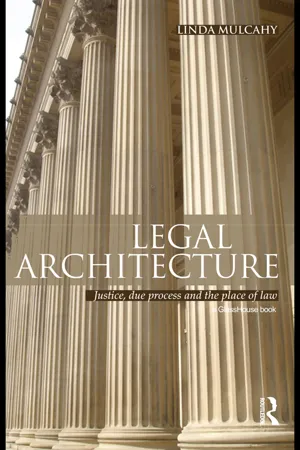
Legal Architecture addresses how the environment of the trial can be seen as a physical expression of our relationship with ideals of justice. It provides an alternative account of the trial, which charts the troubled history of notions of due process and participation. In contrast to visions of judicial space as neutral, Linda Mulcahy argues that understanding the factors that determine the internal design of the courthouse and courtroom are crucial to a broader and more nuanced understanding of the trial. Partitioning of the courtroom into zones and the restriction of movement within it are the result of turf wars about who can legitimately participate in the legal arena and call the judiciary to account. The gradual containment of the public, the increasing amount of space allocated to advocates, and the creation of dedicated space for journalists and the jury, all have complex histories that deserve attention. But these issues are not only of historical significance. Across jurisdictions, questions are now being asked about the internal configurations of the courthouse and courtroom, and whether standard designs meet the needs of modern participatory democracies: including questions about the presence and design of the modern dock; the ways in which new technologies threaten to change the dynamics of the trial and lead to the dematerialization of our primary site of adversarial practice; and the extent to which courthouses are designed in ways which realise their professed status as public spaces. This fascinating and original reflection on legal architecture will be of interest to socio-legal or critical scholars working in the field of legal geography, legal history, criminology, legal systems, legal method, evidence, human rights and architecture.
- 208 pages
- English
- ePUB (mobile friendly)
- Available on iOS & Android
eBook - ePub
About this book
Information
Table of contents
- Contents
- List of figures and sources
- Cases
- Legislation
- Acknowledgements
- Chapter 1 Architects of justice
- Chapter 2 An ideal type? Visions of the courthouse over time
- Chapter 3 Segmentation and segregation
- Chapter 4 Presumed innocent?
- Chapter 5 Open justice, the dirty public and the press
- Chapter 6 The heyday of court design?
- Chapter 7 Back to the future: Is there such a thing as a just court?
- Chapter 8 The dematerialisation of the courthouse1
- Bibliography
- Index
Trusted by 375,005 students
Access to over 1.5 million titles for a fair monthly price.
Study more efficiently using our study tools.
Frequently asked questions
Yes, you can cancel anytime from the Subscription tab in your account settings on the Perlego website. Your subscription will stay active until the end of your current billing period. Learn how to cancel your subscription
No, books cannot be downloaded as external files, such as PDFs, for use outside of Perlego. However, you can download books within the Perlego app for offline reading on mobile or tablet. Learn how to download books offline
Perlego offers two plans: Essential and Complete
- Essential is ideal for learners and professionals who enjoy exploring a wide range of subjects. Access the Essential Library with 800,000+ trusted titles and best-sellers across business, personal growth, and the humanities. Includes unlimited reading time and Standard Read Aloud voice.
- Complete: Perfect for advanced learners and researchers needing full, unrestricted access. Unlock 1.5M+ books across hundreds of subjects, including academic and specialized titles. The Complete Plan also includes advanced features like Premium Read Aloud and Research Assistant.
We are an online textbook subscription service, where you can get access to an entire online library for less than the price of a single book per month. With over 1.5 million books across 990+ topics, we’ve got you covered! Learn about our mission
Look out for the read-aloud symbol on your next book to see if you can listen to it. The read-aloud tool reads text aloud for you, highlighting the text as it is being read. You can pause it, speed it up and slow it down. Learn more about Read Aloud
Yes! You can use the Perlego app on both iOS and Android devices to read anytime, anywhere — even offline. Perfect for commutes or when you’re on the go.
Please note we cannot support devices running on iOS 13 and Android 7 or earlier. Learn more about using the app
Please note we cannot support devices running on iOS 13 and Android 7 or earlier. Learn more about using the app
Yes, you can access Legal Architecture by Linda Mulcahy in PDF and/or ePUB format, as well as other popular books in Architecture & Architecture General. We have over 1.5 million books available in our catalogue for you to explore.