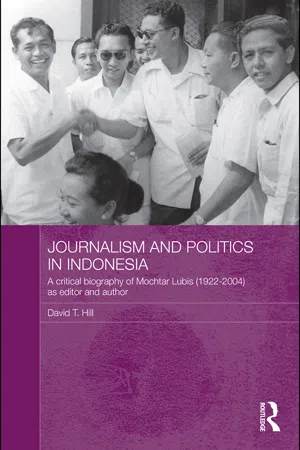
Mochtar Lubis was one of Indonesia's best-known newspaper editors, authors and cultural figures, with a national, regional and international prominence that he retained from the early 1950s until his recent death in 2004. This book traces the major events in the life of Mochtar Lubis, which is also a prism through which much of Indonesia's post-independence history can be interpreted. This book is also the story of Indonesia in the second half of the twentieth century, when the people of the archipelago became an independent nation, and when print media and the influential figures who controlled and produced newspapers, played a pivotal role in national political, educational and cultural life, defining Indonesia. Editors with strong personalities dominated the industry and sparred with the nation's leadership; Lubis was a vocal critic of the abuse of power and a thorn in the side of the country's first two presidents, becoming synonymous with combative journalism. Under both Sukarno and Suharto, Lubis had his newspaper closed down and was imprisoned. As the only comprehensive biography of this towering figure, the book provides a unique insight into the history and development of media, literature and the political system in Indonesia.
eBook - ePub
Journalism and Politics in Indonesia
A Critical Biography of Mochtar Lubis (1922-2004) as Editor and Author
- 288 pages
- English
- ePUB (mobile friendly)
- Available on iOS & Android
eBook - ePub
Journalism and Politics in Indonesia
A Critical Biography of Mochtar Lubis (1922-2004) as Editor and Author
About this book
Trusted by 375,005 students
Access to over 1.5 million titles for a fair monthly price.
Study more efficiently using our study tools.
Information
Part I
Early life
1
Introduction
Since Indonesia unilaterally declared Independence in 1945, the nation has experienced an – as yet unresolved – struggle between competing ideologies over the form and content of its political system, over the very idea of what Indonesia will become. Although on occasion marked by horrendous physical violence and military force, it has been most consistently a battle in the realm of ideas. Within this struggle to formulate the foundations of nationhood, the role of public intellectuals, artists, authors and cultural figures has been both highly critical and far more influential than may have been the case in much of the contemporaneous West. Since the 1950s, national politics in Indonesia has often been under the heel of the military, and political parties have been highly fluid, frequently unstable, and commonly dominated by a relatively narrow clutch of functionaries. Yet, cultural figures and public intellectuals, often at arm’s length from, or at most on the fringes of, formal party politics and outside the corridors of academe, have articulated both dominant and oppositional ideologies in vibrant and sustained debate down through the decades. This clash of ideas is nowhere more evident than in the media, where such contestations are played out between concepts of nationalism and communalism, secularism and sectarianism, traditionalism and modernity, liberal democracy and authoritarianism.
This book examines the development of a secular modernising tradition within Indonesian journalism and media practice since 1945, through a critical evaluation of the life of one of its most significant and controversial exponents, Mochtar Lubis (1922–2004). This exploration of Mochtar Lubis’s life and work – his social context, political base, those interests aligned with, and opposed to, him – tracks the transmission of democratic, secular and modernising values through the media and society during Indonesia’s turbulent post-Independence history. Mochtar Lubis was not a party politician, power broker, or ideologue. Nor was he an academic or scholar. Yet, as an articulate cultural broker, award-winning author and internationally renown journalist – a ‘man of letters’ in the broadest sense – he was one of the most influential spokespeople in the country, sustaining such public prominence for most of his adult life. He was one of only a handful of Indonesians of his generation whose ideas, sustained over decades, contributed to the identity of his nation, the character and practice of its media and the heights of its literature.
As editor of the feisty Indonesia Raya daily newspaper, he established his reputation as a symbol of press freedom in Indonesia, as the country’s best-known and most opinionated editor, unflinching in his combative style and preparedness to criticise anyone from the president down. For nearly half a century, he was a vocal critic of the abuse of power. During both the presidencies of Sukarno and Suharto, his paper was closed down, and he was detained, under house arrest or in jail, on three separate occasions. This fate of being incarcerated by both governments in power during his active public life he shared with but a tiny handful of political figures. His preparedness to endure long detention for his principles elevated him to hero status amongst younger generations of journalists who regarded him as the embodiment of the crusade for ‘freedom of the press’. As author of more than ten novels and short story collections, available in at least six world languages, Mochtar Lubis was Indonesia’s most translated litterateur for over 15 years. His first major novel, A Road with no End, was widely regarded, by both Indonesian and foreign literary critics, as one of the high-points of Indonesian creative fiction of the time, establishing his reputation as one of the nation’s great writers of fiction. His indictment of political corruption, the acclaimed Twilight in Jakarta, written during detention, was the first Indonesian novel published in English translation.
He was, however, a bundle of contradictions. A passionate, self-confessed ‘democrat’, his antagonism towards the Left made him a reluctant opponent of Suharto’s incarceration of members of the Indonesian Communist Party. A committed nationalist, his outspoken manner and embrace of democratic liberalism was seen by many as more fitting in the West than in Indonesia. Critics interpreted his editorial bravado and public ‘grand-standing’ as ultimately exacerbating rather than reversing the erosion of press freedoms. Yet, he remained a passionate advocate for a free and democratic media – even while the very definition of what this might mean in the Indonesian context was hotly debated, as much by its supporters as by those who opposed it. During Indonesia’s first half century, it was through such debates that the form of the Indonesian state, with its particular political system and institutions (like the media), was envisioned. Thus, Mochtar Lubis contributed significantly to the development of civil society and to the shaping of Indonesia’s (still malleable) political system.1
The tour de force
When Mochtar Lubis rose to the podium in the prestigious Jakarta Cultural Centre on 6 April 1977, few realised the impact his address would have on the national psyche. Standing over six feet tall, the fifty-five-year-old author, newspaper editor and former political prisoner towered over most of his compatriots literally as well as figuratively. He was ruggedly handsome and exuded a lithe sensuality. His audience was here to listen to one of the country’s leading dissidents at the zenith of his career and public influence. It was a little over three years since his outspoken daily newspaper had been banned, and two years to the month after his release from subsequent political detention without trial. His public profile was undiminished, as the large crowd, exceeding capacity, attested. The audience, which spilled out of the seating across the floor of the Arena Theatre, listened intently for more than two hours before responding with a battery of questions. That it was less than one month before the May 1977 General Elections only enhanced the frisson between the dissident critic and his audience.
Despite the rather subdued title – ‘The State of Present-day Indonesians, viewed from the Perspective of Culture and Human Values’ – the talk provoked a boisterous polemic both in the theatre that night and for weeks in the national press. As a measure of its impact, three decades later, it was still being cited in Indonesian weblogs and Internet sites – and by foreign observers – as the landmark analysis of the national character.2 Couched in the provocative style that was Mochtar Lubis’s trademark, it was the opening fusillade in a debate, not a guarded academic study. When published as an 80-page monograph, it quickly became a best seller, with four reprints within three years.3 A quarter of a century later, it was still in print.
In his address, Mochtar Lubis relentlessly dissected the traits of the Indonesian national character. He identified rare positive qualities, describing Indonesians as artistic, gentle, peace-loving, quick to learn, dexterous, endowed with a sense of humour and patient to a fault. Nevertheless, such praise was submerged in a barrage of criticism. Pulling no punches, he slammed his fellow Indonesians as hypocritical, feudalistic, superstitious, weak-willed, indecisive and always evading responsibility. They had been made lazy and impecunious by their lush environment. He decried Indonesians’ ‘intellectual prostitution’, and the media’s submissiveness. Even rational, highly educated Indonesians, he claimed, often surrendered to mysticism at times of crises. Traditional beliefs in talisman and mantera had their modern equivalent in symbolic political slogans, which encouraged people to place faith in the oft-repeated ‘new magic formulae and slogans’ of the Suharto government rather than any tangible achievements. Mochtar Lubis was scathing of those in power who claimed to be servants of the people, defenders of justice and the rule of law; in practice, they were egotistical, malicious, power-hungry and avaricious. ‘As the years go by we allow this elite of ours to enrich itself exponentially by corruption and theft of the rights and property of the people’, he argued, stressing Gandhi’s dictum, ‘Earth provides enough for everyone’s need, but not for everyman’s greed’.4
To maximise the benefits from Indonesia’s natural resources, ‘we must control science and technology. But we must be careful’, he warned his audience, for ‘Science is power, and power is never neutral’.5 While attacking piecemeal approaches to the problems created by ‘economic development’, he lambasted the West (particularly America) for seeking ever-greater opulence without thought for the developing world. Common goals should be the alleviation of hunger, the provision of adequate clothing, housing, equal educational opportunities and the guarantee that neither life nor death would be too expensive, he urged. This was achievable if wealthy countries adopted a simpler lifestyle and within Indonesia if development shifted to small-scale appropriate technology and agricultural industries, producing food, the most vital commodity for the future. ‘The more we are drawn along in the currents of consumerism of the rich countries’, he exhorted, ‘the more we make ourselves dependent upon their aid, whether in the form of their capital or technology, the more we make our safety dependent upon their weaponry, the more we weaken our ability to protect our individuality as a nation and as people and the more we fall further and further into dependence upon them’. It was an impassioned call for his compatriots to strive for an Indonesia that was democratically based, rationally governed, environmentally responsible, internationally independent and proudly egalitarian.
The lecture, which became known simply as ‘The Indonesian Character’ [Manusia Indonesia] (or by the title of the English translation, ‘The Indonesian Dilemma’), was Mochtar Lubis’s intellectual tour de force, delivered with characteristic brashness and encapsulating his particular analysis of his society and its politics. Even more than in a newspaper editorial or a literary work, in this lecture he distilled for his audience in a single presentation the breadth of his concerns about the direction he saw society heading and the struggle that would be necessary to rectify it.
The polemic
Public lectures in the Jakarta Cultural Centre rarely generated much press coverage. Occasionally reported in the literary or cultural columns of the inner pages, few made the headlines or opinion pages. Yet, Mochtar Lubis’s talk triggered a wave of front-page reports, detailed summaries and a polemic that peppered the prestigious ‘features’ pages and ‘letters to the editor’ for weeks.6
Most respondents praised his frankness, recognising Mochtar7 for the iconoclast he was. Others sought to correct his assumptions. There were many critics. One aging Javanese aristocrat was offended by Mochtar’s criticisms of feudalism, his ‘misunderstanding’ of noblesse oblige and his representation of Javanese culture.8 Another chided Mochtar for blaming the nation as a whole for the shameful behaviour of those who had exploited their powerful bureaucratic and military positions for financial gain. Mochtar’s approach was likened to foreign ‘Orientalists’ whose depreciatory assessments of local people supported the colonial power. There was no justification, the correspondent argued, in thinking that ‘the attributes of the Indonesian character are different from the attributes of people anywhere else in the world’.9
Subservient behaviour in the community does not mean Indonesians are characteristically feudalistic, a respected social psychologist argued, for such behaviour arises from the pattern of power relations into which people are pressured, responding to structural causes. He argued that Mochtar had not looked beyond ‘those who, in their daily lives, had the opportunity to come directly face to face with influences coming in from outside, in relation to development and modernisation. They live in the large cities and consist of government officials, wealthy businesspeople, intellectuals and others of the elite, as well as their families’. Mochtar had also failed to recognise that the ‘vast majority of Indonesians are farmers, and workers who are industrious, persevering, resolute in the face of the challenges of nature, appreciating moral values, upholding religious values and respecting honesty and courage’.10 Other respondents recognised that ‘the common people could not possibly be corrupt, laze about, not take any responsibility and the like’, arguing instead the political system was the root cause of the characteristics Mochtar described.11
Mochtar’s propensity for overstatement appeared partly intended to provoke debate, but to a degree public responses exposed biases inherent in Mochtar’s perceptions of his society. He was a middle-class, urban, cosmopolitan professional, whose experience as an investigative journalist and editor had earned him considerable social capital and prestige, while also laying bare for him the excesses of the Indonesian political elite. A secular humanist, he believed in the power of the individual, striving for a common good, to bring about social change. Despite the strength of the criticisms he directed at his fellow Indonesians, his was a fundamentally positivist and individualist analysis of his nation’s challenges. Not known for his subtlety or restraint, Mochtar’s composite ‘national character’ was largely devoid of such variables as class, religion, ethnicity and gender.
Such an analysis – and its unproblematised assumptions about the character of Indonesians – contrasted starkly with more inquiring contemporaneous academic critiques of dominant Western perspectives on Asian societies.12 While Mochtar was attacking the Indonesian ‘straw man’ in Jakarta, across the Straits of Malacca Indonesian-born Malaysian scholar Syed Hussein Alatas was critically dismantling the prejudices upon which Europeans had based their colonial ‘myth of the lazy native’ in Southeast Asia. The following year such ideas would be at the centre of intellectual debate globally with the publication in 1978 of Edward Said’s seminal dissection of Orientalism. As is now well known, Said identified key elements in the view of ‘the Orient’ held by non-‘Orientals’, which propounded fun...
Table of contents
- Routledge studies in the modern history of Asia
- Contents
- Acknowledgements
- Notes
- List of illustrations
- Part I Early life
- Part II The Sukarno period
- Part III The Suharto period
- Part IV Denouement
- Notes
- Glossary
- Bibliography
- Index
Frequently asked questions
Yes, you can cancel anytime from the Subscription tab in your account settings on the Perlego website. Your subscription will stay active until the end of your current billing period. Learn how to cancel your subscription
No, books cannot be downloaded as external files, such as PDFs, for use outside of Perlego. However, you can download books within the Perlego app for offline reading on mobile or tablet. Learn how to download books offline
Perlego offers two plans: Essential and Complete
- Essential is ideal for learners and professionals who enjoy exploring a wide range of subjects. Access the Essential Library with 800,000+ trusted titles and best-sellers across business, personal growth, and the humanities. Includes unlimited reading time and Standard Read Aloud voice.
- Complete: Perfect for advanced learners and researchers needing full, unrestricted access. Unlock 1.5M+ books across hundreds of subjects, including academic and specialized titles. The Complete Plan also includes advanced features like Premium Read Aloud and Research Assistant.
We are an online textbook subscription service, where you can get access to an entire online library for less than the price of a single book per month. With over 1.5 million books across 990+ topics, we’ve got you covered! Learn about our mission
Look out for the read-aloud symbol on your next book to see if you can listen to it. The read-aloud tool reads text aloud for you, highlighting the text as it is being read. You can pause it, speed it up and slow it down. Learn more about Read Aloud
Yes! You can use the Perlego app on both iOS and Android devices to read anytime, anywhere — even offline. Perfect for commutes or when you’re on the go.
Please note we cannot support devices running on iOS 13 and Android 7 or earlier. Learn more about using the app
Please note we cannot support devices running on iOS 13 and Android 7 or earlier. Learn more about using the app
Yes, you can access Journalism and Politics in Indonesia by David T. Hill in PDF and/or ePUB format, as well as other popular books in Social Sciences & Ethnic Studies. We have over 1.5 million books available in our catalogue for you to explore.