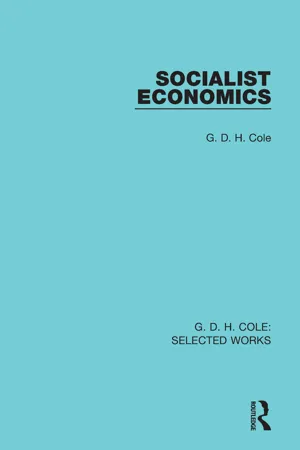
This volume sets forth as simply as possible the theoretical foundations which underlie the practical policies of democratic Socialism. This involves both a repudiation and a refutation of the assumptions of the older classical economists who believed in laissez-faire, and a careful differentiation of the economics of democratic Socialism from the neo-classical doctrines associated with the name of Maynard Keynes.
- 156 pages
- English
- ePUB (mobile friendly)
- Available on iOS & Android
eBook - ePub
Socialist Economics
About this book
Information
CHAPTER I
WHAT ARE SOCIALIST ECONOMICS?
SOCIALIST Economics are not a peculiar kind of Economics devised to bolster up the socialist case: they are simply a commonsense re-statement of economic laws and principles in terms appropriate to the world of to-day and to-morrow. On a great many matters of fundamental economic doctrine there is no difference between Socialists and other people; for where men of different opinions are studying the same facts in a spirit of honest enquiry there is plenty of room for agreement about them, however wide the differences about the policies that should be adopted in dealing with them may be. Thus, no one in his senses doubts that if the price of an article is increased without an equal rise in the prices of other articles, in most cases the demand for it will tend to fall off— especially if other things can be substituted for it. Again, no one in his senses denies that all production involves some using up of scarce resources, so that what is used in making one thing is not available for making others. This means that human wants can be satisfied only within limits set by the supply of scarce resources that can be employed in meeting them; that getting some things accordingly involves forgoing others; and that the purpose of good economic organisation is to ensure that the wants which deserve to be given preference shall be met before those which are less deserving.
Already, however, this second agreed statement begins to show where the divergences come in. For what wants do deserve to be given preference over others? The Socialist will set out unhesitatingly from the presumption that the most deserving claim on the social product is the provision for every person of a tolerable minimum standard of civilised living, and that claims to receive more than this minimum can be justified only where either the total product yields a surplus beyond what is needed to ensure the minimum for all, or where the concession of more to some than to others is an indispensable means to increasing the total product—that is, an incentive to produce. The practical Socialist may indeed be prepared to modify this presumption of unequal basic claims in its immediate application to the society in which he lives; for hardly any Socialist believes that it is practicable to leap directly from a capitalistic to a fully socialist society. But the Socialist will always be trying to apply his principle of fair shares for all to the fullest extent to which he thinks it can be applied to the society with which he is concerned; and he will always set out to study Economics with this principle firmly in mind as his objective.
This, however, is not the principle on which in any hitherto existing society the priority of claims has actually been settled. It would have staggered an eighteenth-century landowner to be told that anyone supposed that every other person had as good a claim as he to enjoy the means to civilised living, and that no claim of his to more than was enjoyed by labourers and other riff-raff could be considered except on the basis of its necessity for increasing total production and thus helping to raise the general standard of life. Even to-day most considerable owners of property and recipients of large incomes believe that they have a claim to be allowed to consume more than other people, not only because they believe they give the community superior service, but also, and in some cases exclusively, because they are ‘gentlemen’ or because they claim to enjoy their ‘rights of property’ or of superior education or culture irrespective of the service which they render to the community as a whole.
Economics, as a study of the economic aspects of the life of society and of the laws and principles which govern the production and distribution of goods and services which use up scarce resources, inevitably takes its colour from the social environment in which the economist lives. Economics, or rather Political Economy, as the subject used to be named, grew up in an environment in which most educated persons (and probably most uneducated persons too, as far as they had any opinions on the matter) took it for granted that ‘rights’ to property and income existed apart from claims based on productive or other social service, and that some men had ‘rights’ which overrode the claims of the unprivileged majority. Moreover, even those who challenged ‘rights’ based on hereditary or other forms of privilege commonly believed that a man who, within the law, could make a fortune had a right to enjoy it even if other men were being allowed to fall far short of a tolerable standard of living. The very men who attacked hereditary privileges were often, as in the great French Revolution, among the foremost in defending the ‘rights of property’ based on personal acquisition. The notion of a prior claim, valid for every individual, to a decent standard of civilised living either had not entered their heads at all, or had been rejected out of hand as inconsistent with the whole basis of the society in which they had grown up.
Accordingly, the classical economists were simply taking for granted what was taken for granted by most of their articulate contemporaries when they adopted as an assumption of their studies the inequality of property claims and of earning powers, and tacitly assumed that the State and the law would protect such claims and punish offenders against them. They drew up their economic laws governing the receipt of rent, interest, profits and wages on the assumption that the State would guarantee the ‘rights of property,’ including the right of a man to dispose freely of his ‘property’ in his own labour as well as in other things. On these assumptions they proceeded to frame a set of ‘laws’ governing the operation of economic affairs—laws which for the most part could not have been operative unless the ‘rights of property’ had been first assumed. They thus devised a ‘science’ of Political Economy which reflected the social valuations of their time and place; and in their ‘science,’ the ‘rights of property’ were taken as a postulate, whereas the ‘rights of men’ to a minimum standard of civilised living were not.
It must not, however, be forgotten that the new ‘science’ of Political Economy was in its day, in certain respects, a notably radical force. The first great school of eighteenth-century economists—the French Physiocrats— writing in the environment of the French court before the Revolution—had accepted without question the right of the landlord to what they called the ‘net product’ of the land, merely insisting that the taxes for the upkeep of government should be levied upon this product. The English economists who followed Adam Smith, writing in the environment of the Industrial Revolution, were critical of the landlord’s claims, because they regarded him as an unproductive levier of tribute which grew continually greater as a result of other men’s efforts; and they also, in the name of freedom of enterprise, set themselves against all claims to income resting on exclusive privileges or monopoly supported by law. The insistence of the English economists that the truly valid title to wealth and income rested on productive ability made classical economics a powerful force against both landlordism and trading monopoly; but it never occurred to most of its exponents to question the title to earned incomes, however large, or to a return on savings invested in productive enterprise, or the right to transmit property by inheritance and to receive the support of the law for all these things, quite irrespective of the claims of all men, simply as men, to enjoy a reasonable standard of life out of the total product of the collective effort of society. Their ideal was that, as far as possible, rewards should correspond to productive services, and not to human needs; and they tacitly took it for granted that owning a thing was fully equivalent to performing personally the service which the thing performed, so as to entitle the recognised owner of a mine or a factory to receive as income the value of the ‘utility’ of such a means of production, even if he himself did not manage as well as own and, in practice, did nothing except draw tribute from the labours of other men. The classical economists, even when they were Radicals in politics, would have nothing to say to any economic postulate resting on a belief in the equal ‘rights of man.’ Drawing their notions from the current practice of the economic world of the Industrial Revolution, they stressed the claims of production against those of landlordism and monopolistic privilege, but were quite unconscious that the private ownership of capital, fully as much as of land or of formal monopoly privilege, was a ‘right’ dependent on state-recognition and police enforcement, and therefore had in it an element of monopoly-revenue which failed to square with their insistence that rewards should be proportionate to services rendered in production.
The classical economists were able to take this line with an appearance of rationality because they wrote and thought of capital, as distinct from unimproved land, as something created by human effort and ‘saved’ by abstinence from consumption, instead of being used up In meeting immediate wants or desires. No doubt, much of the new wealth of the Industrial Revolution did arise in this way, and was based on the savings made out of profits by rising capitalists who denied themselves as high a living standard as they could have afforded if they had spent on consumption all they were able to earn. But no student of the period will suggest nowadays that abstinence, in any legitimate sense of the word, was the sole, or even the chief, source of capital. Much of the new capital came, not from the savings of active capitalists, but from rising land-rents and mine-rents, and from the proceeds of old fortunes profitably invested in industrial and commercial development. The classical economists simply took one form of capital accumulation which was prevalent in their day, and which they admired, treated it as the essential type of such accumulation, and rested on it a justification of the return to owners of capital in general as necessary agents in the creation of wealth.
In effect, the classical economists made use of an argument which related to one kind of capital accumulation to justify the return on all forms of capital, however accumulated. All capital applied to industry in a sensible way was capable of yielding an increase in production and was therefore fulfilling a desirable economic function; and accordingly all such capital was entitled to a return. This return accrued to the owner of the capital in question, whether he had saved it out of his earnings, or had inherited it, or had acquired it in any other way. If it was asked why the return on the capital should accrue to capital-owners who were performing no service beyond the loan of their money or the investment of it with some active entrepreneur, the answer usually made was ambiguous. In the forefront was put the active capitalist, who managed his own business and thus performed a direct productive service which was enhanced by his willingness to invest his earnings instead of spending them on personal consumption. Behind this protagonist loomed the inactive capital-owner, who was regarded as performing a similar service of ‘abstinence’ from consumption in order to apply his capital to industry even if he was not in fact abstaining from any consumption that he desired, but was on the contrary using his returns from the investment to expand his consumption as fast as he wished. Finally, behind the figures of the active capitalist entrepreneur and the ‘abstinent’ capital-owner loomed a great cloud—the risk which both undertook in embarking their capital in production instead of either consuming it or investing it quietly in land or in the public funds. The return on capital had thus three aspects—a return for enterprise, a return for ‘abstinence,’ and a return for risk-taking; but usually these three aspects were presented, not separately but all mixed up and in such a way as to put in the foreground the active entrepreneur who financed his business out of his own savings and thus performed all three services at once.
This was a convenient way of arguing because it obscured the essential differences between the three kinds of service. For in fact only one of the three—that of the active entrepreneur—had to be performed by the man himself, whereas the other two were attached to the capital itself, irrespective of its ownership. It was easy enough for the classical economists to show that capital constituted a real cost of production, because production meant employing and using up over time scarce resources which needed to be replaced. But it did not follow from this that the return on capital, any more than the rent of land, should accrue of right to any particular person. It only seemed to follow when one considered the case of the active entrepreneur who had himself created, saved and invested the capital which he used in conjunction with his personal labour of control and management. The question of the right to own capital which had not been saved by the owner out of his own personal earnings was either not raised at all, being taken for granted despite the criticism directed at the landlord, or was defended with arguments which would have looked much less convincing had they not been supported by the obviously productive figure of the active, saving, investing entrepreneur.
These arguments came down from an older tradition than that of classical economics. John Locke stands somewhere in a long line of writers who have rested the rights of property on the notion that a man, by ‘mingling his labour’ with the gifts of nature—e.g. by tilling hitherto untilled soil—makes the things he works on a part of himself, and thus ‘fixes his property in them.’ This process is generally described as taking place at an unspecified early stage of social development, when there is land for all and to spare, so that a man by cultivating it is not taking away anything that anyone else needs for himself. But the right of property thus acquired is regarded as persisting permanently and as transmissible by inheritance; and it is also further extended (as in Locke) by treating whatever labour is performed by ‘servants’ as the labour of their masters, so that all natural limits on the acquisition of property rights by the exercise of labour are removed—a conception which totally alters the character of the doctrine and, as Rousseau for one saw, knocks away its valid foundations.
On the basis of this notion, capital, other than land, was regarded as a stored-up product of labour, which belonged to the person who had caused it to be brought into existence. Land itself was regarded as partly a gift of nature—unimproved land—and partly capital, to the extent to which it had been improved by labour. This definition of capital as ‘stored labour’ was clearly inapplicable not only to coal and other raw materials given by nature, but also to capital values derived from the operations of social forces, such as the growth of populations, towns, markets, and other factors mainly beyond the capital-owners’ control. The classical economists half saw this in the case of land and minerals; but they entirely failed to see it, or at any rate to take account of it, in connection with other kinds of capital, except in the special case of legally buttressed monopolies, such as the privileged corporations on which they made war in the name of free economic opportunity. It seemed plausible to regard the active entrepreneur who applied his savings to the extension of production under his own management and control as entitled to a return which was partly earnings of management and enterprise and partly interest on his personal savings—how much of the one and how much of the other no one could possibly say. They failed to see that it was quite another matter when this argument in favour of the active, capital-providing entrepreneur as a necessary agent of economic progress was extended to cover the claims of capitalists who had neither saved a penny out of their personal earnings nor contributed any sort of personal service to the production of useful things.
This extension was, however, habitually made with almost no consciousness of the transition. Therewith, the classical economists habitually assumed that what some men were actually doing around them in growing wealthy by enterprise and abstinence could be done by any man, if he would behave as he should; and on this basis they concluded that the poor were poor by their own fault, and the rich rich by merit. Thus they arrived at a doctrine which, nominally exalting the right of every man to become wealthy by thrift and enterprise, in practice condemned the great majority to the poverty of wages held inexorably at ‘subsistence level.’
They did this, not out of sheer inhumanity, but partly at least because they believed that the human race, through too rapid increase of its numbers, was in perpetual danger of outrunning the means of subsistence, and that every rise in real wages threatened to defeat itself by causing more babies to survive and thus adding to the number of competitors in the labour market, so that real wages were bound to be forced down again in the course of the struggle for jobs. This Malthusian dogma, asserted as an absolute finding of economic law, helped them, even when they had decent human instincts, to repress them in the belief that no attempt to raise the labourer’s standard of living could in fact do the labourer any good; and it also enabled them to uphold, without qualms, the claim of the business man to enjoy the full protection of the law in getting as rich as he could by any means that would increase the total product and favour the accumulation of capital. The richer the business men could get, the more would they set aside by saving to increase the community’s productive resources; and such increase was the only way to employ and feed the people and thus to enable population to grow within bounds without an actual fall in the standard of life. Thus the enterprising, saving business man came to be the hero of the classical economists, and in employing more and more workers at subsistence wages he was regarded as a human benefactor, well worthy of his reward.
There was of course a large element of sense in this, in relation to the conditions in which it was said. In face of the immensely high infant death-rate, any rise in real family wages did tend to bring about a rapid rise in population by enabling more infants to survive. Moreover, advancing medical knowledge was of itself leading to a higher rate of survival, and thus calling for more employment and more food. Had it not been possible to open up fresh sources of food supply and to pay for what they yielded by larger exports of manufactures, there would have been in all the developed countries a growing pressure of population on the means of subsistence, such as Malthus feared. The situation did call, as the economists urged, both for emigration to open up new sources of food supply and for very rapid accumulation of capital in order to provide the means of paying for additional imports. The easiest, if not the only, way in the circumstances of promoting this accumulation was to let the owners of capital and the men of business enterprise have their heads with the least possible hindrance from the State or from anyone else; and, if it could be shown that as a result the poor could not be damaged and would in fact be benefited, as the classical economists thought it could, the conclusion was clear. There should be a legal system of property rights and employment relations that would weight the scales on the side of capitalist enterprise, as against both old forms of hereditary privilege and monopoly and new claims advanced by impracticable idealists such as Robert Owen and the early socialist economists. Such a system, being clearly for the best, could legitimately be taken as a postulate of Political Economy; and it was so taken, and under its influence economic studies acquired the shape which, in established educational institutions, they have to a great extent kept ever since.
Even when the successors of the classical economists had for the most part discarded the Malthusian argument and come to believe that wages depended rather on labour productivity than on any ‘iron law’ which held them down to subsistence level, there was not much modification in the other arguments used to uphold the rights of property. The valid concept of the real cost of capital as a factor of production continued to be translated unquestioningly into a claim of the capital-owner to receive a return on his capital. To a remarkable ex...
Table of contents
- CONTENTS
- PREFACE
- CHAPTER I WHAT ARE SOCIALIST ECONOMICS?
- CHAPTER II THE SOCIALISTS AND THE KEYNESIANS
- CHAPTER III THE POSTULATES OF SOCIALIST ECONOMICS
- CHAPTER IV PLANNING, EMPLOYMENT AND PRODUCTION
- CHAPTER V ECONOMIC DEMOCRACY
- CHAPTER VI INTERNATIONAL ECONOMICS
- CHAPTER VII SOCIALIST ECONOMIC VALUES
- INDEX
Trusted by 375,005 students
Access to over 1.5 million titles for a fair monthly price.
Study more efficiently using our study tools.
Frequently asked questions
Yes, you can cancel anytime from the Subscription tab in your account settings on the Perlego website. Your subscription will stay active until the end of your current billing period. Learn how to cancel your subscription
No, books cannot be downloaded as external files, such as PDFs, for use outside of Perlego. However, you can download books within the Perlego app for offline reading on mobile or tablet. Learn how to download books offline
Perlego offers two plans: Essential and Complete
- Essential is ideal for learners and professionals who enjoy exploring a wide range of subjects. Access the Essential Library with 800,000+ trusted titles and best-sellers across business, personal growth, and the humanities. Includes unlimited reading time and Standard Read Aloud voice.
- Complete: Perfect for advanced learners and researchers needing full, unrestricted access. Unlock 1.5M+ books across hundreds of subjects, including academic and specialized titles. The Complete Plan also includes advanced features like Premium Read Aloud and Research Assistant.
We are an online textbook subscription service, where you can get access to an entire online library for less than the price of a single book per month. With over 1.5 million books across 990+ topics, we’ve got you covered! Learn about our mission
Look out for the read-aloud symbol on your next book to see if you can listen to it. The read-aloud tool reads text aloud for you, highlighting the text as it is being read. You can pause it, speed it up and slow it down. Learn more about Read Aloud
Yes! You can use the Perlego app on both iOS and Android devices to read anytime, anywhere — even offline. Perfect for commutes or when you’re on the go.
Please note we cannot support devices running on iOS 13 and Android 7 or earlier. Learn more about using the app
Please note we cannot support devices running on iOS 13 and Android 7 or earlier. Learn more about using the app
Yes, you can access Socialist Economics by G. Cole in PDF and/or ePUB format, as well as other popular books in Politics & International Relations & Political History & Theory. We have over 1.5 million books available in our catalogue for you to explore.