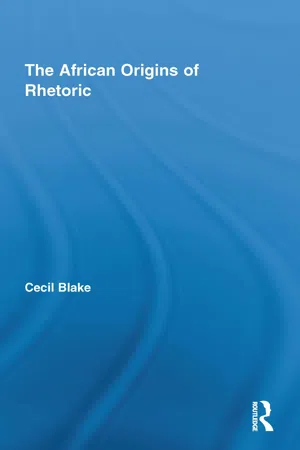
Through a critical analysis of ancient African texts that predate Greco-Roman treatises Cecil Blake revisits the roots of rhetorical theory and challenges what is often advanced as the "darkness metaphor" -- the rhetorical construction of Africa and Africans. Blake offers a thorough examination of Ptah-hotep and core African ethical principles (Maat) and engages rhetorical scholarship within the wider discourse of African development. In so doing, he establishes a direct relationship between rhetoric and development studies in non-western societies and highlights the prospect for applying such principles to ameliorating the development malaise of the continent.
- 140 pages
- English
- ePUB (mobile friendly)
- Available on iOS & Android
eBook - ePub
The African Origins of Rhetoric
1
Prologue
If thou obey these things that I have said unto thee, all thy demeanour shall be of the best; for, verily, the quality of truth is among their excellences. Set the memory of them in the mouths of the people; for their proverbs are good. Nor shall any word [come] out of this land forever, but shall be made a pattern whereby princes shall speak well. They (my words) shall instruct a man how he shall speak, after heard them; yea, he shall become as one skilful in obeying, excellent in speaking, after he hath heard them.
Ptah-Hotep
Verse 37c
Instruction
Fair speech is more rare than the emerald that is found by slave maidens on the pebbles.
Ptah-Hotep
Verse 1
Instruction
I start this work with a brief autobiographical statement in the hope of establishing up front a raison d’être for the task upon which I embark. The work I present on the origins of African rhetoric is deeply rooted in the traditions of Africans, notably in the moral and ethical foundations of African societies. It is upon those foundations that Africans from their formative years to their coming of age are expected to assume responsibilities in society.
The responsibilities range from preparations for leadership roles to family and vocational duties. The preparation takes the form of instructions from elders in society as well as traditional institutions (at times referred to as “secret societies” in some African states such as the Poro and Bondo institutions in Sierra Leone), designed to carry out such instructions and socialization. With the advent of evangelization and colonialism, there were interruptions in the process of socialization. The interruptions created confusion and the dislocation of indigenous normative systems because of the differences and contrasts between traditional African values and morality, and those represented by the intruding powers from outside the continent. As Kesteloot (1972) posits, “From the first moment, colonization always provokes an acculturation: men who had previously lived in the milieu of stable social and moral structures find themselves in a brutal confrontation with other men who are stronger than they are, who profess nothing but contempt for their ancient traditions, and who plan to substitute a new organizational structure” (p.17). The contact was not only brutal in terms of physical violence, but also in terms of the violent nature of the representations, perhaps more appropriately, misrepresentations of Africans by outsiders.
The degree of impact on African traditional beliefs, values and mores varied, depending upon the amount of exposure to the alien value orientations, belief systems and mores. The brief autobiographical account that follows contextualizes the dialectic, and sets the stage for a major theme that runs throughout the work: the abdication by Africans notably in the leadership structure in postcolonial Africa, from a rich African value system and mores, articulated brilliantly, for instance, in the ancient text on African rhetoric titled The Instructions of Ptah-Hotep, and a contemporary resultant troubled African governance structure.
I was born and raised in Sierra Leone during the colonial period and grew up at the dawn of the postcolonial era. My entire primary and secondary education was obtained at Catholic institutions. My family is deeply Catholic, and at least thirty percent of my teachers were Irish. My first exposure to school was at a kindergarten operated by Irish nuns of the order of the Sisters of Clooney. Irish priests belonging to the order of the Holy Ghost Fathers were among my teachers at both the primary and secondary school levels. Our upbringing at home, school and church was strict with a heavy stress on morality and felicitous adherence to conflicting value systems and mores, rooted in Catholicism and traditional African beliefs and practices.
The contradictions I experienced between the two value systems led to the writing of my first short story when I was eighteen years old, in retrospect aptly titled: “The Corkoh Mystery.” The basic story line was on a mysterious and catastrophic disaster that befell an African village as a result of questionable allegiances by a resident family, to an African traditional religious practice against the background of their Christian/Catholic beliefs and practice. The poems I wrote as a child also were shrouded in “mystery” largely due to the contradictions of Catholicism and African traditional beliefs. Living in a home that practiced both African and Catholic belief systems was indeed not easy. Going to confessions as a child was in some instances very difficult, particularly after family ceremonies on the occasion of births, deaths, marriages, and commemorative events on anniversaries of the passing of loved ones.
Among the major African traditional practices we faithfully performed were the awujohs–elaborate feasts of typically African dishes, followed by invocation and communication with the dead, our ancestors. The medium of communication was verbal, but kola nuts were and still are used as the medium to receive feedback from the dead. Two kola nuts are split open into four pieces and dropped on the ground at the site of the ritual or at the gravesite of the departed. The manner in which they lay on the ground leads to an interpretation as to whether or not the dead agrees with our supplications. The ritual is repeated until the family is satisfied that indeed there was a positive response from the dead.
Thus Saturdays, following awujohs were difficult days for me, since I had to go to confession, and had to determine whether our communicating with our ancestors and the rituals involved contravened the First Commandment that prohibits the worshipping of any other God than the Christian God. There were other major contradictions I had to consistently work on to resolve. The anecdote above relates to the conflict in values grounded in religious beliefs.
Other conflicts were based on socially accepted and/or preferred vocations or professions. An example of this conflict was my decision immediately after graduating from secondary school to establish a band with friends to play popular music. The band was called “The Golden Strings.” I was leader of the band and its creation was a devastating contradiction for my family. I belonged to a conservative family that looked down on people who played popular music. My decision created dissension between the family and me. The family eventually accommodated my bold venture.
Besides the religious and social experiences mentioned above, I started my political socialization by becoming an active member and debater at a debating club called Rodania. Through debating sessions on Sundays, I became aware and subsequently very conversant with the evils of colonialism and oppression and the need to work towards the total freedom from the grips of the colonial powers. Among the topics we debated was the issue of ideology, given the rivalry that existed between the West and the East–between capitalism/democracy and socialism/communism. We did not debate to any significant degree traditional African systems of governance, because we did not receive “formal” instructions on the subject while attending primary and secondary schools or during story-telling sessions in the evenings at home, at which time we were taught African morals and ethical principles in the form of folk tales.
My socialization was a continuous process of handling and negotiating what I saw as contradictions. There was an appreciation of both aspects of belief systems until I travelled to the United States to live in a western Christian country, with a history I never fully became exposed to firsthand while in Sierra Leone. The contradiction became even more perplexing, resulting in my resistance against the denigration of Africa and African belief systems during class discussions and deliberations in social organizations. The deliberations continue to date, particularly as one discovers more and more, the richness of Africa’s resources–its deep moral/ethical values that guided ancient African societies found in the treatise on African rhetoric–The Instruction of Ptah-Hotep, some of which continue to influence the day-to-day life of many Africans at the periphery, and not incorporated into the wider body politic.
My discovery of the text on African rhetoric written circa 3100 BCE and translated by Battiscombe Gunn (1918), The Instruction of Ptah-Hotep and the Instruction of Keg’emni: The Oldest Books in the World, reaffirmed my belief in the strengths of the African ethos. The text is on rhetoric (as a discipline) and governance. I find it the very antithesis of Machiavellis The Prince, in the sense that both Machiavelli and Ptah-Hotep are providing instructions for governance.
Upon reading Ptah-Hotep’s Instruction to his son on how to speak well, and the relationship of “good speech”–grounded in a commitment to African moral principles Maat–and governance, I became fully persuaded about the need for the African leadership structure to look more into the cultural and ethical/moral resources of the continent as they seek to fashion desirable societies. Some of them may have read Machiavelli, which may probably explain the tyranny they inflict upon their citizens. I doubt, however, how many among the African leadership structure have read The Instruction of Ptah-Hotep. This lacuna may explain the existing relationship between Africa and the rest of the world: that of a continent which on the whole has failed to use pertinent aspects of its traditional beliefs, values and mores in designing successful systems of governance, and allowed itself to be told by the West how to go about achieving that goal. It is a picture of the gravest contradictions of all, at least in my experiences and my exposure to both African and Western norms: a continent with a rich moral and ethical tradition upon which governance was fashioned and implemented, at a loss for governing models necessary for its regeneration after damaging years of the European and Arabian slave trade, as well as colonialism.
The development environment in the continent is characterized by major political and social problems manifested in conflicts in varying degrees of magnitude: internecine wars; endemic corruption, and a propensity towards dependence on others (the West and increasingly East Asia–China and Japan) to define and even provide support for a vision of desirable futures, since decolonization.
The present work introduces the African origins of rhetoric to communication, development studies and related disciplines. There is a lacuna, especially in scholarship on rhetorical theory that needs to be addressed in so far as Africas contribution to the early development of rhetorical theory is concerned. The work also locates African core principles found in its rhetorical tradition within the global debate on African national development and models of governance as the moral and ethical foundation upon which Africans could stand as they discuss among themselves and others, the issue of fashioning their model of governance. It is done against the historical background of a dastardly rhetorical onslaught on the nature and character of Africa and Africans, by the West. Furthermore, I seek to locate Africa’s contribution towards rhetorical theory with an emphasis on its moral principles in approaches to governance issues within the wider framework of the development imperatives facing the continent. In essence, one could not write about the African origins of rhetorical theory without engaging the African national development studies problematic.
I attempt, therefore, to redress the lacuna mentioned above, and engage the African development problematic. I do so by making a case for the inclusion of The Instruction of Ptah-Hotep, that was written in ancient Egypt three thousand years before Corax (circa 478 BCE), and much more before Plato, Isocrates, Aristotle, Cicero, Quintillian and others, into the annals of rhetorical theory. In the process, I expound on ancient Africa’s contribution to rhetorical theory, shedding some light on how its main tenet–a moral theory on rhetoric–could provide possible answers to extant problems faced by the continent. The problems range from governance and leadership issues within the African leadership structure in tackling development imperatives, to the characterological damage that resulted from abuses suffered by Africans through outside invasions of the continent, slavery, evangelization, colonialism and the current neo-colonial stranglehold on the continent.
The present work, therefore, engages the African development problematic like no other text in rhetorical theory has done to date. Traditional texts in rhetorical theory have not attempted to explain or to provide any perspective on the relationship between rhetorical theory and imperatives of African national development. The work is thus influenced by Instruction of Ptah-Hotep and the Instruction of Kegemni: The Oldest Books in the World grounded in core African ethical principles–Maatian principles. Its central thrust is on instructions on rhetoric and governance, with particular emphasis on the moral/ethical aspects, articulated by a Vizier in Kemet (ancient Egypt). Some may argue, and perhaps correctly so, that a text on rhetorical theory has no bearing on African national development. But this is precisely what makes the text unique.
Thus, I argue that there is an inextricable linkage between rhetoric and development studies, a linkage that had not received the attention it deserves in postcolonial studies with an emphasis on the African development problematic. From the perspective of rhetorical theory and its moral principles, the dominant ethos prevalent in rhetorical communication strategies and messages found in African governance settings at the national and regional levels is decidedly Western, notwithstanding the existence of a clearly articulated set of ethical principles found in ancient writings on rhetoric from Africa. I provide five speeches by African heads of state in this work as a means of adumbrating the apparent absence or lack of recognition and possible use of the core principles found in Ptah-Hotep’s Instruction.
The spatial nature of the work poses a key challenge in terms of its theoretical rationale paradigmatically, and discipline specific imperatives. Africa as a region has a long and glorious past prior to the following horrific epochs: slavery, evangelization and its negative impact, colonialism and of course neo-colonialism, which is still an albatross on the shoulders of Africans. Post-independent Africa, with its multifarious problems as well as prospects depending on how African leaders handle the latter, has a natural niche within postcolonial studies, an emerging paradigm that provides theoretical and analytical tools. Some may question my characterization of postcolonial studies as an “emerging paradigm.” I discuss this issue later.
Initially, my fascination was with the apparent lacuna that is readily discernible–the absence of any aspect of Africa’s contribution–in the study of the evolution of rhetorical theory. As the draft expanded, it became clear that a mere presentation of what constitutes the African origins of rhetorical theory was inadequate. This is so particularly when one recognizes the malaise in which the continent finds itself against the background of its rich rhetorical tradition laden with core principles that link rhetoric to governance, that had simply not been visible in the Euro-American annals of rhetorical scholarship.
Furthermore, upon reflection on the horrific epochs referred to earlier in the annal...
Table of contents
- African Studies
- Contents
- Preface
- Acknowledgments
- 1 Prologue
- 2 The Blackness Without and the Blackness Within
- 3 Rhetorical Theory as Background and Context
- 4 Africa in Rhetorical Scholarship
- 5 Maat
- 6 The Rhetoric of Ptah-Hotep
- 7 From Darkness to Light
- 8 Paradigmatic Framework
- 9 Epilogue
- APPENDIX 1
- APPENDIX 2
- APPENDIX 3
- APPENDIX 4
- APPENDIX 5
- Notes to Appendix 1
- Bibliography
- Index
Trusted by 375,005 students
Access to over 1.5 million titles for a fair monthly price.
Study more efficiently using our study tools.
Frequently asked questions
Yes, you can cancel anytime from the Subscription tab in your account settings on the Perlego website. Your subscription will stay active until the end of your current billing period. Learn how to cancel your subscription
No, books cannot be downloaded as external files, such as PDFs, for use outside of Perlego. However, you can download books within the Perlego app for offline reading on mobile or tablet. Learn how to download books offline
Perlego offers two plans: Essential and Complete
- Essential is ideal for learners and professionals who enjoy exploring a wide range of subjects. Access the Essential Library with 800,000+ trusted titles and best-sellers across business, personal growth, and the humanities. Includes unlimited reading time and Standard Read Aloud voice.
- Complete: Perfect for advanced learners and researchers needing full, unrestricted access. Unlock 1.5M+ books across hundreds of subjects, including academic and specialized titles. The Complete Plan also includes advanced features like Premium Read Aloud and Research Assistant.
We are an online textbook subscription service, where you can get access to an entire online library for less than the price of a single book per month. With over 1.5 million books across 990+ topics, we’ve got you covered! Learn about our mission
Look out for the read-aloud symbol on your next book to see if you can listen to it. The read-aloud tool reads text aloud for you, highlighting the text as it is being read. You can pause it, speed it up and slow it down. Learn more about Read Aloud
Yes! You can use the Perlego app on both iOS and Android devices to read anytime, anywhere — even offline. Perfect for commutes or when you’re on the go.
Please note we cannot support devices running on iOS 13 and Android 7 or earlier. Learn more about using the app
Please note we cannot support devices running on iOS 13 and Android 7 or earlier. Learn more about using the app
Yes, you can access The African Origins of Rhetoric by Cecil Blake in PDF and/or ePUB format, as well as other popular books in History & African History. We have over 1.5 million books available in our catalogue for you to explore.