Throughout the world, equity and excellence in education is a major issue of concern. International comparative studies such as those carried out by OECD (PISA) have launched a worldwide debate on the effectiveness of educational systems (macro level), schools (meso level) and teachers (micro level) in terms of enhancing equity and excellence. Inspired by the OECD research and spurred by national policy-making, quantitative and qualitative research studies have recently been conducted in different parts of the globe aiming to provide deeper insight into the crucial variables that have an impact on equity, excellence or both. Among the variables that have been identified as crucial in this respect are the pupils' gender and their socio-economic and linguistic background, teachers' expectations, cognitions and pedagogical approach in the classroom, parental support, financial aspects, educational policies (e.g. priority policies, multilingual policies, early start policies), and variables related to the structure of the educational structure and system (e.g. compulsory school age, comprehensive systems, support structures, system variables enhancing spread of learners). This volume aims to compile a rich collection of research-based contributions, providing a state-of-the-art resource on what we know about this topic today.
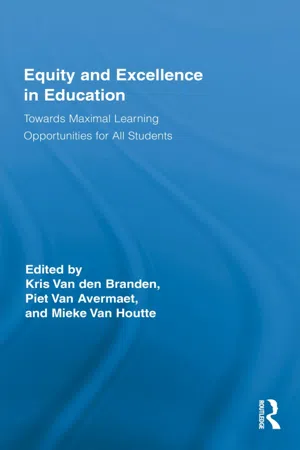
eBook - ePub
Equity and Excellence in Education
Towards Maximal Learning Opportunities for All Students
- 286 pages
- English
- ePUB (mobile friendly)
- Available on iOS & Android
eBook - ePub
Equity and Excellence in Education
Towards Maximal Learning Opportunities for All Students
About this book
Information
1 Promoting Equity and Excellence in Education
An Overview
Piet Van Avermaet, Mieke Van Houtte, and Kris Van den Branden
INTRODUCTION
In different parts of the world, equity and excellence in education is a major issue of concern. Spurred by national studies of school effectiveness and international comparative studies on young students’ development of key skills (such as reading comprehension skills, mathematical and science competencies), educational policies in many countries have tried to combine a concern for equity in education (providing high-quality education and learning opportunities for students of different backgrounds) with a striving for excellence (stimulating outstanding performance and the development of specialist skills). This volume aims to compile a wide range of research-based contributions, providing a state of the art of what we know about this topic today. One of the key questions the various contributions in this volume aim to answer is whether the pursuit of educational excellence is fully compatible with the aim of organizing an equitable educational system.
In this introduction, we will set the scene, by providing the reader with historical background on research about equity and excellence in education and presenting an overview of the ways in which the key concepts related to this issue have been approached and made operational in policy documents and research studies. In doing so, we aim to give the reader a clear picture of the scope and contents of the various chapters in this volume: Rather than offering a summary of the different chapters in a separate section, we have chosen to integrate our references to the chapters of the book into our outline of the major theme of this book. We will conclude this chapter with a range of recommendations that aim to inspire educational policy makers who are dedicated to stimulating equity and excellence and researchers to carry out quantitative and qualitative studies into this intricate matter. Our recommendations will be based largely on the contributions of the different authors who wrote a chapter in this book.
SITUATING EQUITY AND EXCELLENCE IN EDUCATION
On December 10, 1948, the General Assembly of the United Nations adopted and proclaimed the Universal Declaration of Human Rights. Article 26 of this declaration focuses on individuals’ right to education:
Article 26
- Everyone has the right to education. Education shall be free, at least in the elementary and fundamental stages. Elementary education shall be compulsory. Technical and professional education shall be made generally available and higher education shall be equally accessible to all on the basis of merit.
- Education shall be directed to the full development of the human personality and to the strengthening of respect for human rights and fundamental freedoms. It shall promote understanding, tolerance and friendship among all nations, racial or religious groups, and shall further the activities of the United Nations for the maintenance of peace.
- Parents have a prior right to choose the kind of education that shall be given to their children.
The previously mentioned headings 1 and 3 refer to each individual’s right to have free access to education in the elementary and fundamental stages and for parents to choose the kind of education that their children will follow. Around the time it was issued, the UN document gave expression to an unprecedented educational ambition that had been taken up in the preceding years by many countries in the world. For many centuries before, access to education had been the exclusive right of particular (privileged) groups of children, while other groups such as girls, minorities, and the children of laborers had been systematically excluded from the educational system. In numerous policy documents that have been issued at a national and international scale since then, universal access to education has been connected with the battle against poverty, discrimination, sickness, economic and social strife, discrimination, and racism. Access to education (at the very least to primary education) is now generally believed to raise an individual’s chances to build a good life, fi nd a suitable job, move upward on the social ladder, and be well-prepared for modern-day globalized information and communication society. By providing chances to everybody to learn to read and write, process information, and develop key skills in science, mathematics, and complex problem-solving, education is believed to function as a springboard for human beings, irrespective of how wealthy, educated, or powerful their parents are. By strengthening students’ respect for human rights and fundamental freedoms, and by promoting understanding, tolerance, and friendship, education is believed to contribute to a better and more peaceful world. But does education really work for all? Can education cater to the learning needs of all students, regardless of the mother tongue they speak and the socioeconomic environment in which they have grown up? Has the massification of education led to full democratization as far as the acquisition of knowledge and skills are concerned? What have been the consequences of opening up education to all individuals and all layers of society in terms of (a) the ultimate level of attainment that students reach, and (b) the differences between individual students and student groups in academic achievement? To what extent is the ambition to create powerful education for all and offering all students, irrespective of their background, maximal chances to develop a broad range of competencies truly compatible with the ambition to allow certain students (or student groups) the opportunity to acquire excellence in a limited range of competencies?
FROM EQUAL ACCESS TO EQUAL OUTPUT AND EQUAL OPPORTUNITIES
The consolidation of equal access to education for all in the post-war period, which was accompanied by a public discourse emphasizing the emancipation of the whole population, has given rise to a rich vein of social and educational research. From the 1960s onward, research reports started showing that ensuring a mere right of access to education for all did not automatically result in the enhancement of social and racial equality. A long series of studies (e.g., Coleman et al., 1966, and Lucas, 2001, for the United States; Garnier & Hout, 1976, for France; Kerckhoff, 1975, and Willis, 1977, for the United Kingdom; Pelleriaux, 2001, and Tan, 1998, for Belgium) have persistently shown that socially disadvantaged groups of pupils, who had been denied access to education in earlier ages, are still granted access to the academic strands of secondary education, to higher education, and to highly achieving, prestigious schools to a far lesser extent than the children of highly educated parents.
This mechanism appears to be strongly linked with inequity at the level of educational output: Socially disadvantaged groups of pupils show systematically lower levels of performance in key disciplines in compulsory education, lower degrees of success in higher education, and lower results in terms of final degree. They have been shown to develop key skills of elementary education (such as a basic academic proficiency in the main medium of instruction and basic mathematical skills) to a considerably lesser extent than the children of parents who were highly successful in education themselves. Forty years after the publication of the Coleman report (Coleman et al., 1966), Gamoran and Long (2006) concluded that (a) schools in the United States are still highly segregated along racial and ethnic lines, and (b) that there are still major achievement gaps between Black and White pupils and between pupils of low and high socioeconomic status (SES). In many other countries alike, pupils coming from a socially advantaged background still have the best chances to be successful in education, whereas pupils from a socially disadvantaged background run a serious risk of not, or insufficiently, developing the competencies that are necessary to succeed in the academic strands of secondary education and in higher education and to succeed and further develop in life after compulsory schooling.
In the Coleman report (Coleman et al., 1966), the inequities in terms of access and academic output were linked with the notion of equal opportunity, which was defi ned in terms of the consequences of schooling for individuals with equal backgrounds and abilities.
In this definition, equality of educational opportunity is equality of results, given the same individual input. (see page).
By controlling for family background, studies into equality of educational opportunity investigate which particular school and schooling conditions influence achievement. So, by controlling for individual inputs, these studies assess equality of results among students with similar backgrounds.
The notion of equality of educational opportunity may even be taken one step further, referring to the equality of results for pupils with differing backgrounds:
In this defi nition, equality of educational opportunity is equality of results given different individual inputs. The most striking example of inequality here would be children from households in which a language other than English, such as Spanish or Navaho, is spoken. Other examples would be low-achieving children from homes in which there is a poverty of verbal expression or an absence of experiences which lead to conceptual facilities. (Coleman et al., 1966, see page)
According to some, this would correspond to the ideal of a truly meritocratic society: the idea that everyone, irrespective of class, race or gender, should have an equal chance to perform well in school and ultimately to obtain the higher rewarded positions in society (Gewirtz & Cribb, 2009). Whether they do or not then primarily depends upon the students’ effort, persistence, and initiative (variables that the students themselves can influence) rather than on static background variables such as gender, the socioeconomic status of their parents, their mother tongue, or their cultural or religious background. At fi rst sight, such an educational system would provide greater opportunities for able and hard-working children from lowerstatus families to move up, while at the same time requiring children from higher-status families to prove themselves in school if they want to maintain their benefits (and thus for education to break down the intergenerational reproduction of social divide) (Brint, 2006).
However, to ascertain whether an educational system lives up to this ideal (if, at least, this should be considered an ideal situation), researchers would need to defi ne fi rst what kind of output the system should produce: What competencies should these hard-working students develop, and what measures would be used to assess the degree of success and the quantity/ quality of educational output?
DEFINING OUTPUT
The initial objectives of mass schooling mainly focused on the development of basic skills such as literacy and calculation skills, supporting morality, and creating loyal citizens (Brint, 2006). Today, in every industrialized society, schools assume a central position in the process of sorting and allocating people to appropriate jobs (Brint, 2006; Parsons, 1959). Obtaining high educational degrees has become a crucial condition for people to find good jobs in society; one of the major goals of mass education is to award credentials that will help people to find work and to increase the number of high-skilled workers modern-day economies appear to be in demand of. Educational credentials have come to play the stratifying role that family resources and family reputation once played: Educational attainment is regarded as a more important determinant of an individual’s chances of building up a good life than family background (Brint, 2006). Conversely, the economic needs of today’s society strongly dictate what attainment goals will be crucial in the educational curriculum. A fine example in this respect is provided by the Lisbon Strategy of the European Union, aiming to make the EU “the most competitive and dynamic knowledge-based economy in the world capable of sustainable economic growth with more and better jobs and greater social cohesion.” Raising the quality of education is regarded as one of the essential strategies in this respect. The benchmarks to be achieved by 2020 are the following:
- At least 95% of children between the age of 4 and the age for starting compulsory primary education should participate in early childhood education.
- The share of 15-year-olds with insufficient abilities in reading, mathematics, and science should be less than 15%.
- The share of early leavers from education and training should be less than 10%.
- The share of 30- to 34-year-olds with tertiary educational attainment should be at least 40%.
- An average of at least 15 % of adults (age group 25–64) should participate in lifelong learning.
The example shows that educational systems, on the one hand, have to make sure that virtually every child participates in education from a very early age on and develops core abilities by the age of 15 (“reading, mathematics, and science”), while at the same time a high percentage of the population should acquire excellence in specialist areas (as denoted by the aspired high levels of participation in tertiary education). In this way, the almost mythic fear that governmental policies aiming to enhance equity in education threaten to undermine the overall quality level of the educational system, and the chances of the happy few to obtain levels of excellence in particular, has been countered during the past 15 years—at least in policy documents—with an aspiration to obtain excellence for the many, rather than for the happy few.
The Power of Tests
In quite a number of countries around the world, this ambition has given rise to educational policies that involve a tighter governmental grip on quality control, systematic procedures of standard setting, a range of measures allowing for (or stimulating) competition between schools, and the introduction of high-stakes testing. “Accountability” has become the new buzzword in educational policy making: Using the results of standardized tests as the ultimate benchmark and making school results public, governments aim to monitor the overall level of excellence of the public school system by rewarding well-performing schools and sanctioning failure in low-performing schools (Anagnostopoulos, 2005; Au, 2008; Linn, 2000). In a similar vein, governments (and the media) pay considerable attention to the results of international comparisons of students’ achievement (e.g., the Programme for International Student Assessment [PISA] of the Organisation for Economic Co-operation and Development [OECD]). In higher education this evolution is accompanied by a process of international quality assurance and accreditation.
The Problem with Tests
Over the past decades, however, high-stakes, standardized tests (and the accountability logic they are embedded in) have met with fierce criticism. Among others, concerns have been raised about their potentially negative impact on equity in education. For one, because high-stakes tests typically involve the assessment of cognitive skills that are relatively easy to measure and score, they may privilege particular groups of students who are more talented or who have had better chances to develop these particular competencies, either at school or outside (for instance, by being intensively supported by their highly educated parents to score well on the tests) (Au, 2008; Linn, 2000). In addition, the use of standardized tes...
Table of contents
- Cover Page
- Title Page
- Copyright Page
- Equity and Excellence in Education
- Routledge Research in Education
- Figures
- Tables
- 1 Promoting Equity and Excellence in Education
- 2 Measuring Excellence and Equity in Education
- 3 School Competition, Institutional Differentiation, and the Quality and Equity of Education Systems
- 4 So where’s the Teacher in School Effects Research?
- 5 A Feminist Analysis of Gender and Educational Achievement
- 6 Teachers’ Adaptations to Ethnic Minority Students in Belgium and England
- 7 Early Childhood Education and Care
- 8 Bilingualism for Equity and Excellence in Minority Education
- 9 Finnish Basic Education
- 10 Literacy for All
- 11 Caring Mothers and Teachers, Not Acting White, and Religiosity
- 12 Full Service and Extended Schools
- Contributors
Trusted by 375,005 students
Access to over 1.5 million titles for a fair monthly price.
Study more efficiently using our study tools.
Frequently asked questions
Yes, you can cancel anytime from the Subscription tab in your account settings on the Perlego website. Your subscription will stay active until the end of your current billing period. Learn how to cancel your subscription
No, books cannot be downloaded as external files, such as PDFs, for use outside of Perlego. However, you can download books within the Perlego app for offline reading on mobile or tablet. Learn how to download books offline
Perlego offers two plans: Essential and Complete
- Essential is ideal for learners and professionals who enjoy exploring a wide range of subjects. Access the Essential Library with 800,000+ trusted titles and best-sellers across business, personal growth, and the humanities. Includes unlimited reading time and Standard Read Aloud voice.
- Complete: Perfect for advanced learners and researchers needing full, unrestricted access. Unlock 1.5M+ books across hundreds of subjects, including academic and specialized titles. The Complete Plan also includes advanced features like Premium Read Aloud and Research Assistant.
We are an online textbook subscription service, where you can get access to an entire online library for less than the price of a single book per month. With over 1.5 million books across 990+ topics, we’ve got you covered! Learn about our mission
Look out for the read-aloud symbol on your next book to see if you can listen to it. The read-aloud tool reads text aloud for you, highlighting the text as it is being read. You can pause it, speed it up and slow it down. Learn more about Read Aloud
Yes! You can use the Perlego app on both iOS and Android devices to read anytime, anywhere — even offline. Perfect for commutes or when you’re on the go.
Please note we cannot support devices running on iOS 13 and Android 7 or earlier. Learn more about using the app
Please note we cannot support devices running on iOS 13 and Android 7 or earlier. Learn more about using the app
Yes, you can access Equity and Excellence in Education by Kris Van den Branden, Piet Van Avermaet, Mieke Van Houtte, Kris Van den Branden,Piet Van Avermaet,Mieke Van Houtte in PDF and/or ePUB format, as well as other popular books in Education & Comparative Education. We have over 1.5 million books available in our catalogue for you to explore.