Rethinking Rape Law provides a comprehensive and critical analysis of contemporary rape laws, across a range of jurisdictions. In a context in which there has been considerable legal reform of sexual offences, Rethinking Rape Law engages with developments spanning national, regional and international frameworks. It is only when we fully understand the differences between the law of rape in times of war and in times of peace, between common law and continental jurisdictions, between societies in transition and societies long inured to feminist activism, that we are able to understand and evaluate current practices, with a view to change and a better future for victims of sexual crimes. Written by leading authors from across the world, this is the first authoritative text on rape law that crosses jurisdictions, examines its conceptual and theoretical foundations, and sets the law in its policy context. It is destined to become the primary source for scholarly work and debate on sexual offences laws.
eBook - ePub
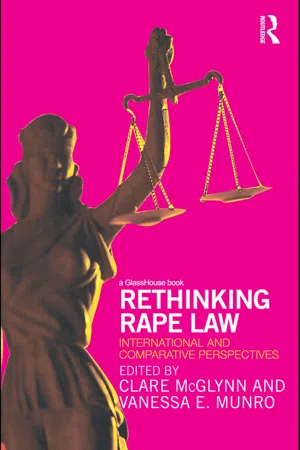
Rethinking Rape Law
International and Comparative Perspectives
- 368 pages
- English
- ePUB (mobile friendly)
- Available on iOS & Android
eBook - ePub
Rethinking Rape Law
International and Comparative Perspectives
About this book
Information
Publisher
Routledge-CavendishYear
2010Print ISBN
9780415610667
9780415550277
Edition
1eBook ISBN
9781136974786
Part I
Conceptual and theoretical engagements
Chapter 1
From consent to coercion
Evaluating international and domestic frameworks for the criminalization of rape
Vanessa E. Munro
The decision of the International Criminal Tribunal for Rwanda (ICTR) in the case of Prosecutor v Akayesu (ICTR-96-4-T, Judgment 2 September 1998) has been heralded by many as signalling a new, and improved, approach to defining the offence of rape (at least, although not necessarily solely, for the purposes of international criminal law). The background to the Akayesu judgment is discussed in detail in subsequent chapters (see, in particular, the discussion by Cole and Buss in this collection). For current purposes suffice it to say that, in its judgment, the ICTR sought to ensure that the fundamentally aggressive nature of the act of rape should not be eclipsed by a mechanical obsession with what needs to be done (e.g. penetration) with which body parts. Thus, a ‘conceptual’ rather than ‘cataloguing’ approach was adopted, emphasizing that rape represents a violation of personal dignity, which can be used to intimidate, degrade, humiliate, discriminate, punish, control or destroy a person. Rape was defined as a ‘physical invasion of a sexual nature, committed under circumstances which are coercive’ (paras 597–8), although it was noted that, for it to constitute a crime against humanity, the rape(s) must have been committed as part of a systematic/widespread attack on a civilian population and grounded in national, ethnic, political, racial or religious discrimination.
This conceptualization of rape as paradigmatically involving sexual invasion under coercive circumstances has received an uneven reception in subsequent international criminal cases. In Prosecutor v Kunarac, Kovac and Vukovic (case no. IT-96-23-T & IT-96-23/1-T, Judgment 22 February 2001), the International Criminal Tribunal for the former Yugoslavia (ICTY) reinserted the reliance upon a consent threshold that had been deliberately omitted in Akayesu. Here, rape was defined as requiring proof of a lack of consent, albeit that it was emphasized that the issue of voluntariness would need to be assessed in the context of the surrounding circumstances, with due attention being paid to the fact that coercion need not be limited to a narrow focus upon force or the threat of force. Acknowledging that in most cases charged as war crimes or crimes against humanity, the prevailing circumstances will indeed give rise to coercion (and thus to a lack of ‘true’ consent), the ICTY nonetheless sought to preserve the definitional significance of consent, or more specifically non-consent, to the offence of rape.
While any suggestion that this created a competing and contradictory authority has been formally disputed by the ICTR (Prosecutor v Muhimana (case no. ICTR-95-1B-T, Judgment 28 April 2005) and Prosecutor v Gacumbitsi (case no. ICTR-2001-64-A, Judgment 7 July 2006)), the ideological compatibility of the coercive circumstances approach in Akayesu and the consent-based approach in Kunarac have been questioned by several commentators, many of whom have insisted that the former represents the more progressive, and more accurate, framework for responding to (wartime) rape.
With Ines Peterson, Wolfgang Schomburg – an Appeals Chamber judge at both the ICTR and ICTY – has insisted that ‘the peculiar characteristics of crimes of sexual violence under international law militate in favour of shifting the focus away from consent as an element of the crime’ (2007: 139). Acknowledging that the familiarity of domestic criminal law responses to rape, the vast majority of which retain a consent threshold, may make transposing the same model into the international context seem prima facie appropriate, Alison Cole makes a similar argument, emphasizing that ‘in this national context, there is no attack against an entire population’ and ‘the issue is typically the interactions between two individual people who are treated in law as equally autonomous individuals’ (2008: 75). While this may make a definitional focus upon (non-)consent more appropriate in the national context, Schomburg and Peterson suggest that ‘the general assumption of equal autonomy … cannot indiscriminately be transferred to the level of international criminal law’ (2007: 126), and Cole insists that the ‘need to reflect the imbalance in interpersonal relations that exist in wartime’ and the fact that in ‘a context of armed conflict, the victims … by definition are under a non-consensual attack’ renders this domestic approach problematic in the international criminal arena (2008: 75).
Meanwhile, Catharine MacKinnon has gone further, insisting that the approach initiated in Akayesu is not only to be preferred at the international level, in responding to wartime rape, but should also provide a template to be adopted at the domestic level. MacKinnon traces the origins of a conflict strategy of instrumentalizing sexual violence as a tactic of genocide to patriarchal peacetime structures within which women are marked as inferior, conspicuous and vulnerable. In this context, she seeks – without conflating the two phenomena – to emphasize the continuum which unites genocidal rape and sexual violations that occur on the domestic scale, outwith conflict zones, and between individual acquaintances or intimates (2006a: 225). Having done so, MacKinnon laments the retreat from the coercive circumstances approach of Akayesu in subsequent ICTY jurisprudence, highlighting the extent to which the return to non-consent in Kunarac ignores the contextual and collective dimensions of rape, focusing, she argues, upon an atomistic, one-at-a-time model of sexual negotiation that is ill-fitting in circumstances of both war and peace, since it ignores the foundational patterns of gender inequality that frame the parameters within which (hetero)sexual agency is exercised.
The Akayesu approach has, as MacKinnon advocates, now been incorporated in several national jurisdictions, including both California and Illinois, where gender violence for civil purposes is defined to include ‘a physical instruction or physical invasion of a sexual nature under coercive conditions’ (MacKinnon 2006b: 956). This chapter seeks to evaluate the merits and demerits of this turn from consent to coercion. Exploring the transferability of this model from international contexts marked by war and genocide to national contexts in which the profoundly mundane nature of sexual violence against women has been emphasized, it argues that abandoning consent risks practical obstacles to prosecution, as well as doctrinal contortions (and, indeed, distortions). It suggests that while there are clear merits to a focus upon coercion, this should be seen to supplement rather than supplant our reliance upon consent in domestic rape laws. Indeed, it illustrates that many of the apparent advantages of coercion over consent-based frameworks are attributable to a tendency amongst commentators to contrast a minimalist conception of consent against a rich conception of coercion, which underestimates the potential for a more contextual understanding of agency and autonomy within the confines of existing consent regimes.
FROM COERCION TO CONSENT, AND BACK AGAIN?
Historically, the tendency to conceive of female chastity/fidelity in terms of financial or (male) status value, together with a palpable unease at the prospect of women’s false rape allegations (e.g. Hale 1736 (reprinted 1971); for recent commentary, see Rumney 2006), led to the creation of laws in many national jurisdictions which defined the offence of rape to require the use of physical force to overpower the victim’s resistance. While, over time, these force-based accounts were often expanded to accommodate, for example, the coercive effect of threats of physical force upon the victim, they continued to expect that a female victim would resist unwanted sexual contact with utmost vigour, and retained a trigger for criminalization which lay in the forceful actions of the assailant, rather than in the ‘wantedness’ or otherwise of the encounter from the victim’s perspective.
While in some jurisdictions, such as Scotland and certain US states, the retreat from such narrow forced-based accounts has been a relatively recent phenomenon (see, further, Cowan and Dripps in this collection), in many other jurisdictions – including, for example, England and Wales (see McGlynn in this collection) – the law has long since converted (at least at the level of formal doctrine) to a response to rape that is grounded in the existence of a lack of victim consent. Within this genre of approach, and particularly with the passage of time and consecutive efforts at substantive and evidential law reform, there have been significant points of divergence – for example, in relation to the conceptualization of consent as a state of mind or a performative act, to the need for positive dissent to be communicated, and to the level of knowledge/concern about the victim’s lack of consent that the defendant must exhibit in order to be criminally liable.
Campaigns to reform force-based rape laws have often held out such consent-based frameworks as providing a more progressive and responsive alternative. But these too have generated significant difficulties and concerns. Although non-consent is a required element in many crimes, critics have pointed out that, in rape law, this threshold is operationalized in a context of profound suspicion of female sexuality (Naffine 1994). It is argued that using consent to distinguish instances of (socially prized and personally endorsed) intimacy from instances of sexual violation has encouraged a disproportionate focus upon the will and behaviour of the complainant rather than upon the conduct and intentions of the perpetrator. While force and resistance are no longer definitional requirements of the offence, they continue to be seen as evidentially highly significant, and their absence in many experiences of rape ensures that a large share of the sexual violence perpetrated upon women is never brought to the attention of, or is summarily dismissed by, domestic criminal justice systems (for England and Wales, see Kelly et al. 2005; Munro and Kelly 2009). In addition, there is substantial evidence that a woman who exhibits other non-conforming behaviour, for example, by drinking alcohol, dressing provocatively, or initiating intimacy, will often be deemed – by defendants, criminal justice officials and jurors – to have sent out signals of sexual interest which cannot easily be revoked when subsequently relied upon by a male perpetrator (for England and Wales, see Home Office 2009; Temkin and Krahé 2008; Brown et al. 2007; Finch and Munro 2007).
In addition, it has been emphasized that while they assert a foundation that is grounded in freedom, capacity and choice, consent-based models often fail to adequately interrogate these concepts, and in so doing fail to acknowledge their profound malleability (e.g. Temkin and Ashworth 2004; Finch and Munro 2006). The deference afforded to the conventional (and highly abstract) conception of consent in rape laws disguises the extent to which men and women do not operate in, choose from, or communicate on the basis of an equal and mutually respectful terrain. On the contrary, it is argued, social stereotypes about ‘appropriate’ gendered behaviour, as well as material considerations and inter personal/structural power differentials, inform women’s subjectivities, activities, choices and assessments of the scope for refusal. In a patriarchal world in which women experience systematic disempowerment and inequality, critics have cautioned that women’s tokens of heterosexual interest, acquiescence or even initiative may be as much a mechanism for survival as an expression of legitimate choice (see MacKinnon 1987, 1989). And yet, as MacKinnon emphasizes, consent-based criminal thresholds have tended to pay scant regard to this complexity: ‘when the law of rape finds consent to sex, it does not look to see if the parties were social equals in any sense, nor does it require mutuality or positive choice in sex, far less simultaneity of desire’ (2005: 243).
These, and other, concerns have led some commentators to argue for a reformulation of rape laws, proposing either to relegate non-consent from being a constitutive element to being solely of defensive relevance or to establish a differentiated ‘familial’ system within which a substantive definitional content will describe the harm in its absence (e.g. rape by coercion, rape by force, drug-assisted rape, etc.) (e.g. Tadros 2006). The shift in Akayesu away from reliance upon consent, and towards a definition of rape grounded in the existence of a physical invasion of a sexual nature in coercive circumstances, in many ways represents a concrete attempt at such a reformulation in the international context.
Yet, there are reasons to be sceptical of these so-called alternative models. For one thing, it has been argued that, in the context of rape, some concept of consent is necessary to allow people to act, and be respected as, moral agents who police the boundaries of their own personal intimacy by inviting as well as denying sexual access (Gardner and Shute 2000: 207–8). One may respond to this assertion, as Victor Tadros has done, by insisting that ‘even if the concept of consent is central to the most appropriate theoretical investigation into the scope of the law of rape’, its excessive and inherent ambiguity mean that it is simply not useful in the delineation of the law itself (2006: 518). But this begs crucial questions, in particular about the wisdom of generating conceptual frameworks for law reform that are consciously detached from – and arguably at odds with – the wrong that occasions their development. At a more practical level, moreover, it is far from clear that reforms which purport to abandon the consent threshold at the level of doctrine can succeed in avoiding its reinsertion in trial proceedings. Research by Regina Graycar and Jenny Morgan (2002) has illustrated the extent to which legal reforms that formally relegate consent to the status of a defence in rape have failed to prevent disputes about its presence from arising in the courtroom, and have done little to prevent dubious claims about ‘proper’ female socio-sexual behaviour from informing b...
Table of contents
- Contents
- Contributors
- Foreword
- Acknowledgements
- Rethinking Rape Law: an introduction
- Part I Conceptual and theoretical engagements
- Part II International and regional perspectives
- Part III National perspectives
- Part IV New agendas and directions
- Index
Trusted by 375,005 students
Access to over 1.5 million titles for a fair monthly price.
Study more efficiently using our study tools.
Frequently asked questions
Yes, you can cancel anytime from the Subscription tab in your account settings on the Perlego website. Your subscription will stay active until the end of your current billing period. Learn how to cancel your subscription
No, books cannot be downloaded as external files, such as PDFs, for use outside of Perlego. However, you can download books within the Perlego app for offline reading on mobile or tablet. Learn how to download books offline
Perlego offers two plans: Essential and Complete
- Essential is ideal for learners and professionals who enjoy exploring a wide range of subjects. Access the Essential Library with 800,000+ trusted titles and best-sellers across business, personal growth, and the humanities. Includes unlimited reading time and Standard Read Aloud voice.
- Complete: Perfect for advanced learners and researchers needing full, unrestricted access. Unlock 1.5M+ books across hundreds of subjects, including academic and specialized titles. The Complete Plan also includes advanced features like Premium Read Aloud and Research Assistant.
We are an online textbook subscription service, where you can get access to an entire online library for less than the price of a single book per month. With over 1.5 million books across 990+ topics, we’ve got you covered! Learn about our mission
Look out for the read-aloud symbol on your next book to see if you can listen to it. The read-aloud tool reads text aloud for you, highlighting the text as it is being read. You can pause it, speed it up and slow it down. Learn more about Read Aloud
Yes! You can use the Perlego app on both iOS and Android devices to read anytime, anywhere — even offline. Perfect for commutes or when you’re on the go.
Please note we cannot support devices running on iOS 13 and Android 7 or earlier. Learn more about using the app
Please note we cannot support devices running on iOS 13 and Android 7 or earlier. Learn more about using the app
Yes, you can access Rethinking Rape Law by Clare McGlynn, Vanessa E. Munro, Clare McGlynn,Vanessa E. Munro in PDF and/or ePUB format, as well as other popular books in Law & Comparative Law. We have over 1.5 million books available in our catalogue for you to explore.