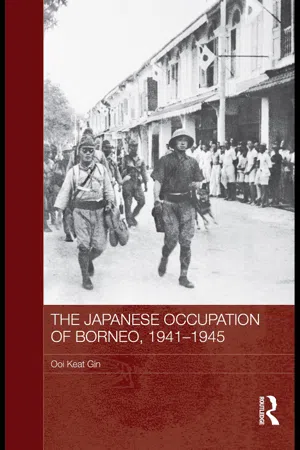
The Japanese occupation of both British Borneo – Brunei, Sarawak and North Borneo – and Dutch Borneo in 1941 to 1945 is a much understudied subject. Of particular interest is the occupation of Dutch Borneo, governed by the Imperial Japanese Navy that had long-term plans for 'permanent possession'. This book surveys Borneo under Western colonialism, examines pre-war Japanese interests in Borneo, and analyses the Japanese military invasion and occupation. It goes on to consider the nature of Japanese rule in Borneo, contrasting the different regimes of the Imperial Japanese Army, which ruled the north, and the Navy. A wide range of issues are discussed, including the incorporation of the economy in the Greater East Asia Co-prosperity Sphere and the effects of this on Borneo's economy. The book also covers issues such as the relationship with the various indigenous inhabitants, with Islam and the Muslim community, and the Chinese, as well as topics of acculturation and propaganda, and major uprisings and mass executions. It examines the impact of the wartime conditions and policies on the local multiethnic peoples and their responses, providing an invaluable contribution to the greater understanding of the significance of the wartime Japanese occupation in the historical development of Borneo.
- 200 pages
- English
- ePUB (mobile friendly)
- Available on iOS & Android
eBook - ePub
The Japanese Occupation of Borneo, 1941-45
About this book
1 Introduction
Borneo,1 the world’s third largest island (after Greenland and Papua New Guinea), straddles the equator, which slices the island’s 754,000 square kilometre (290,000 square miles) area into two almost equal halves. Geographically, the island, strategically located in a central position in archipelagic Southeast Asia, was (and still is) off the world’s major trade route. The Straits of Melacca prevented Borneo taking a role as a major player in the region. Historically Borneo had been the bridesmaid to more dominant territories. Java to the south and Sumatra and the Malay Peninsula to the southwest had greatly impacted on Southeast Asia’s past developments while Borneo, despite its size, stood on the sidelines. More than anything it was the physical environment that ensured that Borneo took a backseat in most fields of endeavour – urbanization, modernization, telecommunications, transportation, and others.
Environmental setting
Shaped like ‘a barking dog on its hind legs gazing attentively eastwards,’ Borneo possesses a rugged terrain where a mountain range extends like a backbone from the ‘dog’s head’ (northeast) running down the ‘dog’s back’, to end in the centre of the canine’s body. Land over 900 metres emanates from the northeast to run almost in a north–south direction to the heartland of the island. The highest point, at 4,093 metres, is reached at Mount Kinabalu in the heart of Sabah, which is reputedly the highest peak in Southeast Asia.
Some 200 million years ago, a continental core of rock formed a highland area surrounded by volcanic activity. This older core, essentially an exposed part of the Sunda shield, was gradually worn away, depositing sedimentary rocks to the north-west and south-east. These sediments were subsequently compressed and folded, creating an arc of younger rocks around a central continental core which stretched across the south-central part of the island. [Mount] Kinabalu represents an igneous mass intruded into the sedimentary rocks of the Crocker Range some 10 million years ago. A 2-mile square summit area of the mountain experienced direct glaciations during the Quaternary [c. 2 million years ago]. The lowering of sea-levels during the Quaternary led to considerable fluvial down-cutting and the deposition of large amounts of alluvium in many coastal areas as sea-levels were adjusted.2
Mineral resources such as gold, diamonds, iron, and tin deposits are present in the ‘continental core’ and the metamorphosed margins of this core, the auriferous areas of southwest Sarawak and West Kalimantan. The younger sedimentary rocks are equal or even more important; coal and hydrocarbon deposits are found inland as well as offshore in Sarawak, Brunei, and East and South Kalimantan.
From the mountainous centre of the island flows a network of rivers. The Mahakam (980 kilometres) heads eastwards to the Straits of Makassar while the Kayan drains into the Sulawesi (Celebes) Sea, the mighty Kapuas (1,143 kilometres) meanders westwards towards the Karimata Straits, the Barito (890 kilometres) and Kahayan (600 kilometres) make their way southwards to the Java Sea, and the Rejang (760 kilometres) flows northwestwards to the South China Sea. Between the mountainous interior and the swampy coastal areas (mangrove, nipah and sago palm), the rivers are a lifeline for many parts of the island. Besides the fatally obstructive rapids in the upper reaches of most of the rivers that hamper travellers, the rapid rise and fall in the water level as a result of torrential tropical downpours creates massive and destructive flooding in the downstream areas where most riverine settlements are situated.
Annual rainfall of between 2,500 millimeters and 3,000 millimeters is typical of the equatorial climate that envelopes the entire island. Precipitation increases inland and at higher altitudes. The rainy season is between October and March, when the northeast monsoon is prevalent. The landas (wet season) occurs in November, December and January, when coastal travel in small native crafts is discouraged owing to the choppy seas and strong winds. Nonetheless Borneo is typhoon-free. When the dry southwest monsoon blows during the months from May to September, there is less rainfall; the driest months, which are more pronounced inland, are July, August and September. Day temperatures can reach 37° C on the coast but are much cooler inland and upland. Hygrometer readings of more than 80 per cent relative humidity make it unwelcomingly uncomfortable. However, highland areas (over 700 metres) tend to be more agreeable and pleasant.
Heavy downpours and high humidity hasten considerably the decaying and decomposition process. Despite the luxuriant appearance of Borneo’s immense rainforest the high precipitation leaches the red lateritic soil of nutrients.
Borneo possesses three distinct ecological zones: the coastal and estuarine periphery; the river valleys; and the forested uplands of the interior that impacted on the history and human geography of the island.3 Despite the absence of good natural harbours and the presence of swamps, the coastal peripheries were convenient sites for trading settlements, which developed over time to become major urban centres; notably Bandar Seri Begawan, Kota Kinabalu, Samarinda, Banjarmasin, Pontianak, Kuching and Sibu. Many of these towns are sited on the estuarine area of the rivers: Samarinda on the Mahakam, Banjarmasin on the Barito, Pontianak on the Kapuas and Sibu on the Rejang. The river valleys of alluvial flood plains and gentle hills offer opportunities for farming and settlement. Along the banks or at the confluences of the rivers settlements were established and economic activity promoted. Tropical rainforest with an astonishing diversity of flora and fauna throws a green canopy over the hilly and mountainous interior. Shifting cultivation and gathering of forest produce are the preoccupation of nomadic groups inhabiting the interior zone. But on intermontane plateaux and tablelands such as in the Kelabit Highlands of northeast Sarawak, there are picturesque irrigated and terraced wet-rice fields that ably sustain settled communities in these remote and isolated interior uplands.
The human factor
Malaysia’s Sabah and Sarawak collectively are home to no less than 70 ethnic communities.4 Brunei’s ethnic composition is less diverse but still culturally colourful.5 Kalimantan’s human ecology is equally diverse as its neighbouring territories. Some generalization in classification is useful to present a sensible ethnographic picture of the inhabitants of Borneo. The Muslim Malays and the non-Muslim Dayaks is a useful division of Bornean society. The third category is of non-indigenous communities; those that migrated centuries ago and others that arrived in recent decades or years.
The ethnic term ‘Malay’ is at best a tricky category. However, one of the distinct characteristics of Malay-ness is being a Muslim, meaning one who embraces the Islamic religion. Other defining attributes of being Malay are the language and certain unique customary practices. In the Bornean context Malays are further defined by their places of origin: Brunei Malays, Sarawak Malays, Banjar Malays, Kapuas Malays, Bulungan Malays and others. There are also the non-indigenous Muslims, mainly with trading and mercantile backgrounds from neighbouring regions such as Malay Peninsula, Sumatra, Java, Madura and Sulawesi, who have migrated and settled in Borneo’s coastal belt. Intermarriage with locals gradually dissociated the immigrant Muslim from their original homeland, although some maintained their identity and cultural norms. Malays predominantly settled in clusters of kampung (villages). Wet-rice cultivation, sea and river fishing, smallholding of commercial crops (rubber, coconut, fruit), and small-scale trading activities sustained a generally subsistence and spartan existence.
The term ‘Dayak’ means ‘person’ or ‘inland person,’ the latter because most of the communities settled in the interior, upriver, forested upland areas. Non-Muslim Dayaks are a heterogeneous group that are culturally diverse as well as numerically significant.
. . . to simplify this complex reality we can make some generalizations in order to sort Dayaks into broader categories . . . Two categories based essentially on ecological criteria are hunters-gatherers and settled agriculturalists. Some of the settled agriculturalists can then be divided by sociological criteria into those which have stratified social orders comprising two or more named social classes or strata, and societies which are more egalitarian in organization, although they do acknowledge the importance of acquiring prestige or status. The settled agriculturalists can also be differentiated according to language and various cultural traits into smaller sub-groupings.6
The intention here is not to give a detailed portrait of the various categories of Bornean indigenes.7 Instead the spatial distribution of Muslim Malays and the non-Muslim Dayaks (Map 1.1) should suffice.
Immigrant Asian peoples, notably Chinese, and Indians, from mainland China and the South Asian sub-continent respectively, are two minority groups in Borneo. Early Chinese immigrants to West Kalimantan were gold miners with self-governing mining settlements. Trading communities were established in most townships throughout Borneo; to a large extent before the Pacific War (1941–1945) the Chinese monopolized the commercial life of both coastal and inland settlements. The Chinese were also involved in commercial agriculture. Small pockets of both Indian Hindu and Indian Muslim communities are found in most Bornean towns. Cloth and spices are the mainstay of most Indian businesses. Arabs from West Asia who initially arrived as traders intermarried into Malay Muslim communities and settled as a small trading class. Overall the Chinese are the most significant minority community in present-day Borneo.

Map 1.1 Indigenous ethnic groups of Borneo
Source: After Victor T. King, The Peoples of Borneo (Oxford: Blackwell, 1993), p. 39.
Contemporary Borneo
Borneo today is physically carved into four territories and politically into three nation states. The upper northwest part of the island forms the state of Sabah (before 1963, British North Borneo) while its lower portion is Sarawak; both Sabah and Sarawak are two component states of the Federation of Malaysia. The independent, sovereign Malay Muslim Kingdom of Negara Brunei Darulssalam perches comfortably between Sabah to the northeast and Sarawak to the southwest. The remainder, the larger portion of the island – southeast, south, and west – is Kalimantan, one of the many states of the Republic of Indonesia. Administratively Kalimantan is partitioned into four provinces, clockwise from Kalimantan Timur (Kaltim) (East Kalimantan), Kalimantan Selatan (Kalsel) (South Kalimantan), Kalimantan Tengah (Kalteng) (Central Kalimantan) and Kalimantan Barat (Kalbar) (West Kalimantan). Table 1.1 illustrates the contemporary political and administrative configuration of the island.
Pre-colonial Borneo
Archaeological finds point to continuous human habitation at the Niah Caves on the northeast of the island stretching from 40,000 to 2,000 years.8 Santubong on the southwest coast was once the site of an ancient seaport and an iron-smelting centre (c. sixth or seventh century CE).9 During the Hindu-Buddhist period (first to thirteenth centuries CE) there were numerous Indianized polities on Borneo. The Martapura Kingdom (predecessor of Kutai) located at present-day Muara Kaman on the confluence of the lower Mahakam River and the Kedang Kepala River on the southeast of the island appeared to be the earliest formal polity.10 Artifacts including Pallawan script (c. 400 CE) and stone sculptures emphasized the strong Indian cultural influence. Vijayapura, supposedly on Brunei Bay, the precursor to Brunei (whence the name Borneo originated), was the Borneo Srivijaya.11 It was apparent that by the close of the first millennium Borneo’s coastal settlements had trading relations with the surrounding territories as well as ties with the Indian sub-continent and China. Jungle products (bird’s nests, bezoar stones, resins like benzoin and dammar, aloeswood or gaharu, camphor) from the island’s interior and sea produce (trepang or sea cucumber, shark’s fins) were prized exotic and/ or medicinal commodities particularly in the China market. By the seventh century CE Borneo was drawn into China’s tribute system. Envoys from the coastal kingdoms of Borneo’s northwest brought tribute to the dragon throne; such tribute-bearing missions were nothing more than facades for trade transactions between non-Chinese territories and the Middle Kingdom (China).
Table 1.1 Contemporary Borneo political and administrative configurations
Regional powers such as Buddhist Srivijaya (seventh to ninth/tenth centuries CE), Hindu Kediri (twelfth to thirteenth centuries CE), Hindu Majapahit (1293–c. 1520s), the Malay Muslim Melaka (1400–1511), and Muslim Banten (1526–1687) had each exerted their political and socio-cultural influence over the coastal polities of Borneo. Coastal Bornean kingdoms such as Brunei on the northeast, Kutai on the southeast, and Banjarmasin on the south all possessed Hindu-Buddhist roots. For instance, the Javanese chronicle Negarakertagama recorded that Kutai and Banjarmasin were vassals of Majapahit. Brunei had close trading as well as religious (Islam) links with Melaka. By the early decades of the sixteenth century these Bornean kingdoms embraced Islam and their rulers adopted the title ‘sultan’, hence the Sultanates of Brunei, Kutai and Banjarmasin.
Melaka’s fall to the Portuguese in 1511 had to some extent brought a boon to Brunei when Muslim traders from India and the region deliberately shifted their commercial activities to this Malay Muslim sultanate. Banjarmasin also experienced an increase in trade when Chinese merchants preferred this southern Bornean port to Portuguese Melaka. This increased commercial prosperity resulted in Banjarmasin shifting from upstream to the Barito Delta during the mid-sixteenth century. Kutai, a vassal of the more dominant Banjarmasin, prospered in the sixteenth and seventeenth centuries, trading in jungle products sourced from the Upper Mahakam. Bugis from southern Sulawesi (Celebes) had long trading ties with Kutai and the east coast; the eighteenth century saw substantial Bugis settlements on Borneo’s eastern periphery.12 Over on the west coast, 1772 was the emergence of the coastal trading centre of Pontianak on the Kapuas River. Syarif Abdurrahm...
Table of contents
- Cover Page
- Title Page
- Copyright Page
- Illustrations
- Currencies
- Preface
- Abbreviations
- Military Abbreviations
- 1. Introduction
- 2. Pre-War Borneo
- 3. On the Road to War
- 4. The Japanese Invasion and Occupation of Borneo
- 5. The Partition of Borneo
- 6. Kita Boruneo
- 7. Minami Boruneo
- 8. Atrocities, Opposition and Response
- 9. Between Generals and Admirals
- 10. End of an Era
- Concluding Remarks
- Glossary
- Notes
- References
Frequently asked questions
Yes, you can cancel anytime from the Subscription tab in your account settings on the Perlego website. Your subscription will stay active until the end of your current billing period. Learn how to cancel your subscription
No, books cannot be downloaded as external files, such as PDFs, for use outside of Perlego. However, you can download books within the Perlego app for offline reading on mobile or tablet. Learn how to download books offline
Perlego offers two plans: Essential and Complete
- Essential is ideal for learners and professionals who enjoy exploring a wide range of subjects. Access the Essential Library with 800,000+ trusted titles and best-sellers across business, personal growth, and the humanities. Includes unlimited reading time and Standard Read Aloud voice.
- Complete: Perfect for advanced learners and researchers needing full, unrestricted access. Unlock 1.5M+ books across hundreds of subjects, including academic and specialized titles. The Complete Plan also includes advanced features like Premium Read Aloud and Research Assistant.
We are an online textbook subscription service, where you can get access to an entire online library for less than the price of a single book per month. With over 1.5 million books across 990+ topics, we’ve got you covered! Learn about our mission
Look out for the read-aloud symbol on your next book to see if you can listen to it. The read-aloud tool reads text aloud for you, highlighting the text as it is being read. You can pause it, speed it up and slow it down. Learn more about Read Aloud
Yes! You can use the Perlego app on both iOS and Android devices to read anytime, anywhere — even offline. Perfect for commutes or when you’re on the go.
Please note we cannot support devices running on iOS 13 and Android 7 or earlier. Learn more about using the app
Please note we cannot support devices running on iOS 13 and Android 7 or earlier. Learn more about using the app
Yes, you can access The Japanese Occupation of Borneo, 1941-45 by Ooi Keat Gin in PDF and/or ePUB format, as well as other popular books in History & Asian History. We have over 1.5 million books available in our catalogue for you to explore.