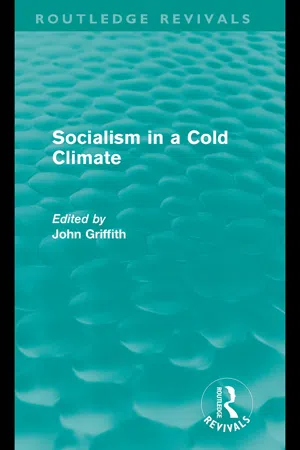
First published in 1983, this important and stimulating book is a thoughtful contribution to the debate about the first steps that needed to be taken to build a socialist society in the 1980s. It covers topics as diverse as concepts of equality and fairness, sexual discrimination, economic policy, health and urban policy, pensions, poverty and the economics of the welfare state, defence and internationalism.
- 230 pages
- English
- ePUB (mobile friendly)
- Available on iOS & Android
eBook - ePub
Socialism in a Cold Climate
About this book
Information
1
Introduction
John Griffith
Thatcherism in 1979 seemed very like the standard Conservative product: tax cuts, promises of a review of the social services to eliminate extravagance and wastage, law and order, curbs on trade unions, reduction in Government intervention and in subsidies—down with nationalisation, up with free enterprise. These were the slogans believed to be election winners in those constituencies where winning and losing mattered. Then, after victory, very large hand-outs followed to those with the highest incomes, while VAT increases cancelled out the tax reliefs at the lower levels.
It was to be expected that standard Conservatism, like too much standard Labourism, would then sit back, contemplate the real world and see, from day to day, what might be done to move some way towards the fulfilment of some election pledges. No need to be over-literal; a week’s a long time; circumstances alter cases; the business of government is a private affair; the Civil Service pulling back Ministers to that central consensus; no cause for drastic action; hope for the best and accommodate to the worst.
But Thatcherism departed from the standard and, to a very considerable extent, despite the protests from right, left and centre, persisted in its aim of seeking to improve the competitiveness of British industry by deflating the economy, creating huge unemployment, weakening the trade unions and forcing small firms into bankruptcy.
Today we are witness to an unusual phenomenon in British politics: a Government which not only has no positive social policies but takes pride in having none. We have no idea how it is planned that major state responsibilities in housing, roads, land use, education, health and welfare services will develop over the next few years because the Government has no plans, except in a few instances to transfer some of those responsibilities to private ownership. Ministers for the social services stand like figureheads at the prows of the becalmed ships of their Departments, saying and doing very little except considering how further financial cuts may be imposed. No attempt is being made to consider how the social well-being of the nation may be improved.
All this was not achieved without help from elsewhere. But Thatcherism has no wish to excuse the consequences of its own policies by blaming the world recession. On the contrary, it wishes to claim the credit for everything except unemployment. So there is much wringing of hands in public about the jobless, while in private the policies which deprive people of work, over and above those attributable to external causes, continue to be directly and deliberately pursued.
Governments like to publicise some economic aim which is both easy to understand and almost certainly attainable. Wilson used the balance of payments and then the voluntary control of wages. For Thatcher the trick was initially to pursue policies that boosted the rate of inflation and then to justify public-expenditure cuts over the years by the need to reduce that rate, all of this, and more, being subsumed under ‘monetarism’.
But these are means not ends. And the end is to collapse the economy.
In this sense, Thatcherism has been a highly interventionist type of Conservatism. In addition, partly by legislation but much more by changing the political, ideological and economic climate, it has contained trade unionism and greatly reduced the standard of living of the poor by keeping percentage wage increases far below the level of inflation, holding down supplementary benefit payments and weakening the social services.
One of the five ‘tasks’ which the Conservative party set itself in its 1979 Election Manifesto was ‘to support family life, by helping people to become home-owners, raising the standard of their children’s education and concentrating welfare services on the effective support of the old, the sick, the disabled and those who are in real need’. The transparent ambiguities of that last phrase are not a sufficient defence to the charge that this statement was dishonest. Reducing the level of the social services was an inevitable, intended and central part of the economic and financial strategy.
For these reasons, appeals to Thatcherism to indulge in modifications of its policy, to effect even a modest U-turn, mistake the nature of that policy. Governments have hitherto sought to manage the economy. Thatcherism seeks to change it. Thatcherism seeks not to help industry but to create the harsh economic conditions in which industry will be forced to make the changes necessary to keep itself alive.
This is most obvious when we consider what will happen if the Conservative Party is returned to power at the next general election. Mrs Thatcher has said many times that she needs a second term. But there is no suggestion that in that second term, continuing until nearly the end of the 1980s, there will be any change in policy. Indeed, the promise is for more of the same. There is no suggestion that, having put the country on a sounder footing (as the Conservatives would claim), Government will seek through positive action to reduce unemployment, to restore the social services, to improve the conditions of the poor. Thatcherism is unable to offer any alleviation. All those policies which socialists must insist on—an increase in industrial activity, the reduction of unemployment, the improvement of social services—are bound to militate against the strategy of Thatcherism.
The more Western capitalism changes, the more it remains the same. Its considerable successes over the last 200 years have always been accompanied by its consequent calamities. In economic terms, profit-seeking in the short term has resulted in unwillingness and inability to plan for the future and in collapse. In political terms, the need to centralise power and to resist democratic developments in industry has resulted in monopoly and in authoritarian structures. In social terms, its operation has, because of all these other factors, resulted in widespread unemployment which, from time to time, has gone out of control and helped to accelerate the periodic collapses. But until now Governments in this country and in other Western democracies have considered it a part of their function to give positive support to those industries they wished to nurture. This is not the approach of Thatcherism, despite its total commitment to private capitalism.
The politics of self-destruction which Thatcherism has pursued means that the devil takes the hindmost. It is a drastic and radical policy and has one strongly religious tenet: that out of the funeral pyre of industry a phoenix will arise. It is obvious that this cannot be assured. This is why it is proper to describe the politics of the last four years as the Thatcher experiment. It is the beginning of a policy, in every sense highly individualist, that in its own terms might work. British industry might be thus rejuvenated. Or the policy might be catastrophic. Purification by fire always carries its own obvious dangers. The freshly feathered eagle, in its red and gold plumage, may not rise from the ashes.
For socialists Thatcherism is not a possible way of proceeding. The price paid in human suffering is already far too high and will greatly increase. But, even more, the political philosophy that believes the welfare of the mass of the population will be promoted by the profit motive of private enterprise, financed by private investment and supported by a cheap labour force, is rejected by socialism. Thatcher’s way, socialists believe, must depend on exploitation, on greed, and that is what Thatcherites meant when, in the Conservative Manifesto of 1979, they spoke of working ‘with the grain’ of human nature. Socialists believe that this mistakes and debases human motives. They believe that representative democracy can, through its control of the principal means of production, so organise the economy that it works designedly for the general good. They believe that the power of private capital to employ and to dispose of labour, to make investment decisions affecting the livelihood of tens of thousands of workpeople, to make political decisions of the utmost significance, must be brought under public scrutiny and, where necessary, transferred to public management. Collapsing the economy, creating unemployment, cutting social services is not the way to recovery for the mass of the people.
Thatcherism will leave two appalling legacies for the next Labour Government. One will be a crippled industrial base; the other will be a severely damaged welfare state. Never since 1945 will there have been so extensive a need for reconstruction. But the problems will, in one respect, be more severe than those created by six years of war. In 1945 Labour had some remedies to hand. Nationalisation of basic industries, the creation of a national health service, the replacement of the poor law, the establishment of social welfare, the relief of poverty, all these presented themselves as opportunities in a world in which it was possible to make things new.
Tomorrow will not be the same. The Labour Administrations of the 1960s and the 1970s provided very few fresh insights into the way socialism should develop in the 1980s and 1990s. The old Labourism will not do. The problems are different; the future is more dangerous; the structures of national and international society have changed.
The socialist solutions to the problems faced by a post-Thatcherite Britain will not be those of the previous years. We believe that Thatcherism will have greatly damaged the productive strength of the country, antagonised large sections of the working population and weakened the social services. In January 1980 I suggested to colleagues of mine at the London School of Economics and Political Science who were Labour supporters that we might put forward some analyses, propose some ways in which the task of reconstruction might be begun. Over the next months we met each week during term and discussed each other’s draft chapters. Final drafts were produced during the summer of 1982. This is not a handbook for immediate revolution; nor does it assume that the remedies will be quick or easy. No attempt has been made to cover the whole field of government policy. Each contributor has written on his or her own subject, and, not surprisingly, none of us agrees with all that the others have written.
This book of essays is meant as a contribution to the considerable debate within the Labour movement about the first steps to be taken to begin to build a socialist society in the cold climate of the second half of the 1980s.
2
A New Start for Labour
Howard Glennerster
At various points in their history political parties must examine their fundamental assumptions. Surely this is such a time for the Labour Party and its social policies. Their intellectual origins were varied but not particularly socialist. They have been undermined by practical experience, by wide-ranging attacks not only from the far right but also from the Marxist left and by self-doubt about the achievements of the welfare state by erstwhile supporters. To renew its momentum, the Party must develop an alternative social as well as economic strategy (Meacher, 1982), having honestly faced these criticisms. The essence of such a new strategy should lie in an extended interpretation of the ideal of full citizenship in modern Britain, building upon and extending institutions like the National Health Service, which in themselves embodied initially a deeper conception of what it meant to be a British citizen.
How has the world changed since the foundations for Labour’s social policies were laid in 1945?
Keynesianism and full employment
In the 1920s and 1930s Labour relied on a mystical belief that something called socialism would solve the unemployment problem, but it had no practical substance (Skidelsky, 1967). Hence Keynesian theory came to fill a theoretical vacuum, to be embraced as the final justification for a mixed economy. This is best illustrated in the 1944 full employment White Paper (Cmd 6527), which the postwar Labour Government took as one of its articles of faith. It formed the premise for Crosland’s The Future of Socialism (1956). Rereading that book, one is amazed by the confidence of the first section. Indeed, most of the later chapters depended on this logical foundation. The problem of unemployment was permanently solved; Britain’s growth rate was high and assured; and inflation was barely mentioned until the end of the book, where the problem is seen entirely as one of demand management and the stimulation of an adequate supply of savings: ‘It simply means that under normal peacetime conditions, progress and efficiency require, amongst other things, the avoidance of periodic crises of serious excess demand (though it may be that a continuing mild inflation is inseparable from full employment)’ (Crosland, 1956, p. 401).
It was precisely this misjudgement that lay at the root of the problem that successive Labour Governments faced. It was a Labour Government, after 1966, that began the process of trading higher levels of unemployment for lower levels of inflation. In some ways it is surprising that this ‘crisis of Keynesianism’ should have taken so long to become obvious (Crouch et al., 1979). The problems posed by organised labour and large-scale employers in a fully employed economy were clearly appreciated not only by Keynes himself in How to Pay for the War? (1940) and Beveridge (1944), who advocated permanent wages and price controls after the war, but also by socialists such as Barbara Wooton (1954).
The presumption of growth
A presumption of the inevitability of growth and of its benefits became an integral part of Labour’s social policy in the 1960s. Just as in the 1920s and 1930s the Labour Party had no real policy for full employment, so in the 1960s and 1970s it had no real basis for its belief that it could affect the growth rate. There was virtually no economic analysis to explain Britain’s relatively poor economic performance, although this dated back to the late nineteenth century, if not before (see chapter 4).
Universality and redistribution
Just as Keynes had filled the vacuum in Labour’s economic policy in the 1930s, so Beveridge supplied coherence for many of Labour’s disparate social policy objectives. The Labour movement came only gradually to accept the principle of social insurance. It was born, after all, out of Liberal and Bismarckian parentage and was extended by a Conservative Government. Beveridge went to great pains to point out that his proposals were designed not to promote redistribution between the classes but to provide a means of redistributing income through the life cycle, to give minimum, adequate support in periods of misfortune and interrupted earnings. The social welfare schemes of the interwar period were selective in scope. Many were received only by sections of the manual classes and lower-income groups. Other services (like secondary education), from which the middle classes did benefit, carried charges. Labour’s postwar legislation was frequently all-embracing or universal. All employees were members of the National Insurance scheme. All citizens could use the National Health Service. All children were to have secondary education. The legislation embodied what T.H. Marshall (1963) was to call a third level or dimension in citizenship. From the time of Magna Carta onwards the British people had won certain civil rights—freedom from arbitrary arrest, free speech and equality before the law—at least in theory. In the nineteenth and twentieth centuries they won another element in British citizenship—one person one vote. But the Second World War and its aftermath were to add a third dimension: ‘the right to a modicum of economic welfare and security, to share to the full in the social heritage and to live the life of a civilised being according to the standards prevailing in society’ (Marshall, 1963, p. 72).
The practice fell short of the ideal. Benefits were never enough to ensure the universal right to such a standard of living, but since the Second World War the commitment to a high standard of public services has become the one really distinguishing feature of Labour policy. Indeed...
Table of contents
- Contents
- 1 Introduction
- 2 A New Start for Labour
- 3 The Commitment to Equality
- 4 Economic Alternatives for Labour, 1984–9
- 5 Privatisation and the Social Services
- 6 Income Maintenance
- 7 Conceptualising Equality for Women
- 8 Industrial Relations
- 9 A Politics of Location
- 10 Race and Immigration
- 11 Nationalism and Internationalism: a Critique of Economic and Defence Policies
- 12 Provision and Choice in Housing
- Index
Trusted by 375,005 students
Access to over 1.5 million titles for a fair monthly price.
Study more efficiently using our study tools.
Frequently asked questions
Yes, you can cancel anytime from the Subscription tab in your account settings on the Perlego website. Your subscription will stay active until the end of your current billing period. Learn how to cancel your subscription
No, books cannot be downloaded as external files, such as PDFs, for use outside of Perlego. However, you can download books within the Perlego app for offline reading on mobile or tablet. Learn how to download books offline
Perlego offers two plans: Essential and Complete
- Essential is ideal for learners and professionals who enjoy exploring a wide range of subjects. Access the Essential Library with 800,000+ trusted titles and best-sellers across business, personal growth, and the humanities. Includes unlimited reading time and Standard Read Aloud voice.
- Complete: Perfect for advanced learners and researchers needing full, unrestricted access. Unlock 1.5M+ books across hundreds of subjects, including academic and specialized titles. The Complete Plan also includes advanced features like Premium Read Aloud and Research Assistant.
We are an online textbook subscription service, where you can get access to an entire online library for less than the price of a single book per month. With over 1.5 million books across 990+ topics, we’ve got you covered! Learn about our mission
Look out for the read-aloud symbol on your next book to see if you can listen to it. The read-aloud tool reads text aloud for you, highlighting the text as it is being read. You can pause it, speed it up and slow it down. Learn more about Read Aloud
Yes! You can use the Perlego app on both iOS and Android devices to read anytime, anywhere — even offline. Perfect for commutes or when you’re on the go.
Please note we cannot support devices running on iOS 13 and Android 7 or earlier. Learn more about using the app
Please note we cannot support devices running on iOS 13 and Android 7 or earlier. Learn more about using the app
Yes, you can access Socialism in a Cold Climate by John Griffith in PDF and/or ePUB format, as well as other popular books in Politics & International Relations & Politics. We have over 1.5 million books available in our catalogue for you to explore.