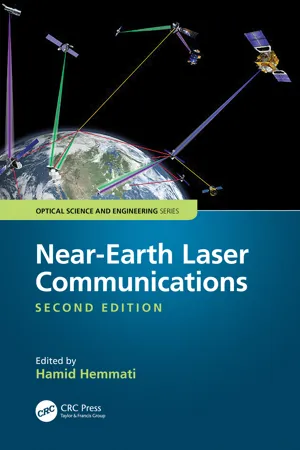
This reference provides an overview of near-Earth laser communication theory developments including component and subsystem technologies, fundamental limitations, and approaches to reach those limits. It covers basic concepts and state-of-the-art technologies, emphasizing device technology, implementation techniques, and system trades. The authors discuss hardware technologies and their applications, and also explore ongoing research activities and those planned for the near future. This new edition includes major to minor revisions with technology updates on nearly all chapters.
- 454 pages
- English
- ePUB (mobile friendly)
- Available on iOS & Android
eBook - ePub
Near-Earth Laser Communications, Second Edition
About this book
Information
1
Near-Earth Laser Communications
Contents
- 1.1 Introduction
- 1.1.1 Why Laser Communications?
- 1.1.2 Why Not Laser Communications?
- 1.1.3 Laser Communications Maturity
- 1.1.4 Use Cases
- 1.2 Subsystem Technologies
- 1.2.1 Design Drivers
- 1.2.2 Spatial Acquisition, Tracking, and Laser Beam Pointing and Stabilization
- 1.2.3 Robust Flight Optomechanical Assembly (OMA)
- 1.2.4 Ground Telescope
- 1.2.5 Optomechanical Assembly for Ground Transceiver
- 1.2.6 Signal Reception
- 1.2.7 Modulation and Coding
- 1.2.8 Flight Laser Transmitter
- 1.3 Atmospheric Channel
- 1.3.1 Atmospheric Background Light
- 1.3.2 Atmospheric Attenuation
- 1.3.3 Atmospheric Turbulence/Scintillation
- 1.3.4 Mitigation of Atmospheric Effects
- 1.3.5 Aperture Averaging Effects
- 1.3.6 Downlink Adaptive Optics
- 1.3.7 Encoding, Decoding, and Protocols
- 1.3.8 Multi-Beam Uplink
- 1.3.9 Uplink Adaptive Optics
- 1.4 Lasercom Applications
- 1.4.1 Point-to-Multipoint Links
- 1.4.2 Networks and Multiple Access Links
- 1.4.3 Improved Navigation and Ranging
- 1.4.4 Multifunctional Transceivers
- 1.4.5 Retro-Modulator Links
- 1.5 Technology Validations
- 1.5.1 Recent Validations
- 1.5.1.1 Lasercom Demonstrations from LEO, GEO, and the Moon
- 1.6 Future Directions, Demonstrations, and Operational Systems
- 1.6.1 Inter-Satellites Links
- 1.6.2 Component Technologies
- 1.7 Evolving Non-Optical Technologies
- 1.8 Conclusion
- References
- 1.5.1 Recent Validations
1.1 Introduction
Today, the fiberoptics technology is managing much of the terrestrial access and backbone networks at tens of tera-bit-per-second (Tbps) collective capacity [1]. However, due to steep cost or geological obstacles, fiberoptic networks have been impractical in certain rural and isolated areas. Mobile networking is another application where wired communications is not applicable [2]. Telecommunications via satellites and high-altitude platforms (HAPs) may bridge this gap and in particular deliver backhaul service coverage to sparsely populated areas.
Link reliability and availability aside, current communications capacity via airborne and spaceborne platforms now constitutes only a small fraction of those provided by the fiberoptics networks. However, such platforms equipped with a multitude of Earth-observing sensors or broadband communications systems are experiencing an exponential growth in telecom data volumes.
Conventional air and space platforms use radio the frequency (RF), microwave (MW), and millimeter-wave (MMW) spectrum for communications. Geosynchronous orbit (GEO) satellites deliver the bulk of these links [3]. By 2022, the ViSat-3 GEO satellites with a total capacity of >1 Tbps per satellite is expected to establish the highest throughput satellite (HTS). Downlinking of hundreds of beams each operating at 1 to 2 Gbps and with capacity demand dependent beam-hopping capability to activate and deactivate the beams makes this sizeable link capacity possible [4]. In early 2020s, several constellations of LEO satellite are also planning to create multi-Tbps collective capacity in space [5–7]. Owing to the huge growth forecasted in the volume of information linked globally, entirely new approaches for data communications are required for future spacecraft. RF and MMW satellite telecom technology are hindered by the available spectrum bandwidth limitations and regulations. Their system technologies are now pushing the state-of-the-art limits. MMW links at slightly higher frequencies are promising limited relief to these obstacles [8].
The laser (optical) communications (lasercom) technology with currently unregulated spectrum and with multi-THz of telecom bandwidth can potentially augment the conventional RF/MW/MMW communications technology with orders of magnitude capacity enhancement [9]. As an example, uplink to GEO satellite at rates of hundreds of Gbps to multi-Tbps beamed from spatially diverse ground stations would majorly enhance the current capacity limits. Inter-satellite crosslinks at the rate of tens of Gbps would also enable large capacity LEO satellite constellations with much fewer numbers of ground-based gateway stations [10]. Relative to RF/MW communications, for nearly the same flight mass and input power, the lasercom technology provides tens of dB link margin enhancement. The additional margin may be traded for substantial increase in data-rate or significant reductions in aperture (telescope) diameter, weight, and power-consumption. Since the year 2000, a number of highly successful lasercom demonstrations from airplane, the Earth orbit and the Moon have reaffirmed that this technology is ready for operational use.
This chapter provides a high-level overview of the status of near-Earth laser communications technology developments and future research opportunities. Subsequent chapters describe each subsystem in greater detail. By near-Earth we mean links with airborne, Earth orbiting, and the lunar platforms. A number of publications describe excellent performances of recent lasercom demonstrations, follow-up technology development efforts, and lasercom theoretical treatments [11–12]. Here, we emphasize critical requirements and design drivers, the status of current subsystem technologies, and pathways to achieve the immense potential of laser communications. This chapter summarizes state of the art in subsystem hardware technologies, underlying principles and its technology trends.
1.1.1 Why Laser Communications?
- Lower link losses due to lower beam divergenceDominated by the laws of diffraction, the width of the high frequency (short wavelength) optical/laser communications beams are three to four orders of magnitude narrower than the (lower frequency) RF communications beams. Consequently, the transmitted signal can be delivered to the intended receiver in a less lossy manner. The resulting benefits include data-rate delivery comparable to that of fiberoptics communications, reduced SWaP (size, weight, and power consumption), and precision navigation, tracking, and ranging that could be conducted along with the telecom function [13]. Examples of benefits include frequency reuse, i.e., using the same wavelength for multiple links, improved channel security, reduced mass, reduced power consumption, reduced size, ability to track and communicate with the sun within the field of view, multifunctionality with other electro-optic instruments, and precision ranging [14].
- Abundant unregulated spectrumUnlike RF communication systems with restricted spectrum usage, optical links are not subject to frequency regulation. This is an attractive prospect for high-bandwidth applications. Frequency reuse represents an additional advantage, made possible due to the small divergence angle of the communications laser beam.
- Leverages advancements in fiberoptics industryLasercom links efficiently leverage the huge and continuous investment that has gone into the fiberoptics industry to support the huge demand posed by the exponential growth of the Internet globally.
- Benefits tactical applicationsRelative to RF systems, lasercom systems are difficult to intercept and jam.
1.1.2 Why Not Laser Communications?
Despite a multitude of...
Table of contents
- Cover
- Half Title
- Series Page
- Title Page
- Copyright Page
- Contents
- Preface
- Contributors
- Editor Biography
- Chapter 1 Near-Earth Laser Communications
- Chapter 2 Systems Engineering and Design Drivers
- Chapter 3 Pointing, Acquisition, and Tracking
- Chapter 4 Laser Transmitters: Coherent and Direct Detection
- Chapter 5 Flight Optomechanical Assembly
- Chapter 6 Coding and Modulation for Free-Space Optical Communications
- Chapter 7 Photodetectors and Receiver Architectures
- Chapter 8 Atmospheric Channel
- Chapter 9 Optical Ground Station: Requirements and Design, Bidirectional Link Model and Performance
- Chapter 10 Reliability and Flight Qualification
- Chapter 11 Optical Satellite Networking: The Concept of a Global Satellite Optical Transport Network
- Chapter 12 Future Directions
- Index
Trusted by 375,005 students
Access to over 1.5 million titles for a fair monthly price.
Study more efficiently using our study tools.
Frequently asked questions
Yes, you can cancel anytime from the Subscription tab in your account settings on the Perlego website. Your subscription will stay active until the end of your current billing period. Learn how to cancel your subscription
No, books cannot be downloaded as external files, such as PDFs, for use outside of Perlego. However, you can download books within the Perlego app for offline reading on mobile or tablet. Learn how to download books offline
Perlego offers two plans: Essential and Complete
- Essential is ideal for learners and professionals who enjoy exploring a wide range of subjects. Access the Essential Library with 800,000+ trusted titles and best-sellers across business, personal growth, and the humanities. Includes unlimited reading time and Standard Read Aloud voice.
- Complete: Perfect for advanced learners and researchers needing full, unrestricted access. Unlock 1.5M+ books across hundreds of subjects, including academic and specialized titles. The Complete Plan also includes advanced features like Premium Read Aloud and Research Assistant.
We are an online textbook subscription service, where you can get access to an entire online library for less than the price of a single book per month. With over 1.5 million books across 990+ topics, we’ve got you covered! Learn about our mission
Look out for the read-aloud symbol on your next book to see if you can listen to it. The read-aloud tool reads text aloud for you, highlighting the text as it is being read. You can pause it, speed it up and slow it down. Learn more about Read Aloud
Yes! You can use the Perlego app on both iOS and Android devices to read anytime, anywhere — even offline. Perfect for commutes or when you’re on the go.
Please note we cannot support devices running on iOS 13 and Android 7 or earlier. Learn more about using the app
Please note we cannot support devices running on iOS 13 and Android 7 or earlier. Learn more about using the app
Yes, you can access Near-Earth Laser Communications, Second Edition by Hamid Hemmati in PDF and/or ePUB format, as well as other popular books in Tecnología e ingeniería & Óptica y luz. We have over 1.5 million books available in our catalogue for you to explore.