eBook - ePub
Water Contamination and Health
Integration of Exposure Assessment, Toxicology, and Risk Assessment
- 544 pages
- English
- ePUB (mobile friendly)
- Available on iOS & Android
eBook - ePub
Water Contamination and Health
Integration of Exposure Assessment, Toxicology, and Risk Assessment
About this book
This volume examines every potential means of exposure to water contaminants, provides in-depth discussions on toxicology, and explains up-to-date techniques for evaluating human health risk. It develops a methodology for assessing the cumulative absorbed dose of contaminants through all routes of exposure, including ingestion, inhalation and dermal. Federal and state efforts to monitor and treat water are examined.
Information
WATER CONTAMINANTS: MONITORING, TREATMENT, AND HEALTH IMPACT
1
A Retrospective on Drinking Water
Charles O. Abernathy
U.S. Environmental Protection Agency, Washington, D.C.
I. Introduction
Water is essential for all organisms; it comprises 60–95% of the weight of living cells (1), and losses through various metabolic and excretory processes must be balanced by an adequate intake. However, water may contain substances, whether natural or anthropogenic, that can affect the quality and existence of life.
It is important to distinguish between pure water and safe water. Pure water may be defined as water that is free of extraneous substances (2), whether harmless or not, and, from a practical standpoint, impossible to produce. On the other hand, safe water is water that is not likely to cause undesirable or adverse effects (2), although it may contain various contaminants. The crux is embodied in the definition of “safe.” In the regulatory sense, safe means that, although the “purified” water may contain some contaminants, the risks imposed by those contaminants are of an acceptable nature. For example, chlorination is used extensively to disinfect water in the United States. This process introduces trihalomethanes (THM) into the finished product, however, and THM pose potential health risks (3). As expected, differences of opinion exist about the “safety” or “acceptable nature” of contaminants in drinking and surface water, and there is considerable public awareness of this problem, as evidenced by recent articles in the New York Times (4), Washington Post (5), and U.S. News and World Report (6).
It is also informative to consider the business aspects of water purification. The production of potable water in the United States is a very large industry. Moeller (7) estimates that it costs $5 billion/year to operate the 60,000 water treatment facilities and that these plants have required a capital investment of approximately $250 billion. These facilities produce 40–50 billion gallons/day (approximately 180 gallons per capita). Over one-half is used in the home, and nearly one-third is consumed by industry. The rest is used by public services or lost in the distribution process (Figure 1). In 1985, approximately 60% of the 36,500 million gallons of water withdrawn per day in the United States came from surface water; the remainder was from groundwater sources (8).
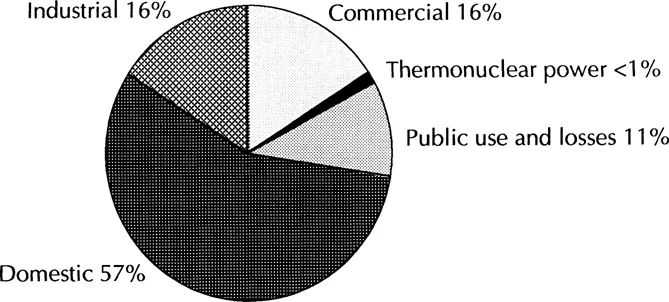
Figure 1 Percentage use by various sectors of municipally treated water in the United States in 1985. (From Reference 8.)
The objectives of this chapter are to provide a brief history of water use and purification, to give a few examples of the types of adverse effects associated with water contaminants, to mention some risk assessment methods, and briefly to consider drinking water regulations. Details of risk assessment methodology for specific end points or for various exposure routes are covered in subsequent chapters.
II. History
Since many writings have been lost, our knowledge of the early history of drinking water treatment is stochastic in nature (Table 1). The following is a brief overview; those wishing a more detailed history are referred to Baker (9).
Date | Comment |
|---|---|
2000 BCE, India | Exposure to sunlight, boiling, and filtration through charcoal or sand |
1500 to 1300 BCE, Egypt | Use of wick siphons |
600 BCE, Persia | Cyrus the Great took boiled water for his troops |
400 to 200 BCE, Greece | Boiled and filtered water through cloth and porous vessels |
97 CE, Rome | Frontius was first water engineer |
Eighth century | Geber used distillation to purify water |
Eleventh century | Avicenna recommended boiling to purify water while traveling |
Fifteenth century | Venice had filter-cisterns |
1675 | Walcott given the first water purification patent (distillation) |
1804 | Gibb used filtration to provide purified water to Paisley, Scotland |
1806 | Happey... |
Table of contents
- Cover
- Half Title
- Series Page
- Title Page
- Copyright Page
- Preface
- Table of Contents
- Contributors
- Water Contaminants: Monitoring, Treatment, and Health Impact
- Exposure Assessment of Water Contaminants: Specific Dosimetry on Radon and Chloroform
- Methodology Development in Exposure Assessment and Dose Estimates
- Human Health Risk Assessment and Water Contaminants
- Epidemiological Evaluation of Water Contaminants and Toxicological End Points
- Index
Trusted by 375,005 students
Access to over 1.5 million titles for a fair monthly price.
Study more efficiently using our study tools.
Frequently asked questions
Yes, you can cancel anytime from the Subscription tab in your account settings on the Perlego website. Your subscription will stay active until the end of your current billing period. Learn how to cancel your subscription
No, books cannot be downloaded as external files, such as PDFs, for use outside of Perlego. However, you can download books within the Perlego app for offline reading on mobile or tablet. Learn how to download books offline
Perlego offers two plans: Essential and Complete
- Essential is ideal for learners and professionals who enjoy exploring a wide range of subjects. Access the Essential Library with 800,000+ trusted titles and best-sellers across business, personal growth, and the humanities. Includes unlimited reading time and Standard Read Aloud voice.
- Complete: Perfect for advanced learners and researchers needing full, unrestricted access. Unlock 1.5M+ books across hundreds of subjects, including academic and specialized titles. The Complete Plan also includes advanced features like Premium Read Aloud and Research Assistant.
We are an online textbook subscription service, where you can get access to an entire online library for less than the price of a single book per month. With over 1.5 million books across 990+ topics, we’ve got you covered! Learn about our mission
Look out for the read-aloud symbol on your next book to see if you can listen to it. The read-aloud tool reads text aloud for you, highlighting the text as it is being read. You can pause it, speed it up and slow it down. Learn more about Read Aloud
Yes! You can use the Perlego app on both iOS and Android devices to read anytime, anywhere — even offline. Perfect for commutes or when you’re on the go.
Please note we cannot support devices running on iOS 13 and Android 7 or earlier. Learn more about using the app
Please note we cannot support devices running on iOS 13 and Android 7 or earlier. Learn more about using the app
Yes, you can access Water Contamination and Health by Rhoda G.M. Wang in PDF and/or ePUB format, as well as other popular books in Physical Sciences & Public Health, Administration & Care. We have over 1.5 million books available in our catalogue for you to explore.