- 216 pages
- English
- ePUB (mobile friendly)
- Available on iOS & Android
eBook - ePub
Integrated Tse-tse Fly Control
About this book
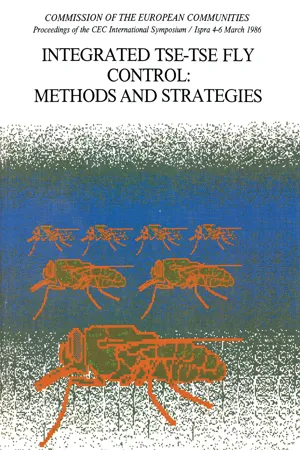
This book discusses methods which might appropriately be employed under various circumstances. It is concerned with control of insect pests and tse-tse flies, and considers prospects for integrated control of the African trypanosomiases, in which vector control is envisaged as playing a key role.
Information
Session 1
The safety and efficaciousness of chemical control
Is resistance developing in tsetse flies? Susceptibility to two chlorinated hydrocarbon insecticides in sprayed and unsprayed populations of Glossina pallidipes in Kenya
Summary
An investigation into the possible development of insecticide resistance in tsetse flies was carried out by comparing the susceptibility to topical applications of endosulfan and dieldrin between two populations of Glossina pallidipes Austen in Kenya; one from the Lambwe Valley, where there has been a long history of spraying operations, and the other from Nkruman which has never been sprayed. Dosage-mortality regression lines and LD data showed that wild-caught, non-teneral males and females from Lambwe were significantly more tolerant of both insecticides than their counterparts from Nkruman, with the exception of males dosed with dieldrin. The differences were insufficiently great, however, to be incontestable evidence for the development of resistance in the Lambwe strain, although there were no obvious sources of variability between strains adequate to account for the differences in susceptibility.
Introduction
Given the genetic potential, which seems to be a feature of all natural populations, the development of insecticide resistance is primarily a matter of sufficient selection pressure over a sufficient period. Selection pressure is applied through the frequency of application and the dosage of insecticides, and is conditioned by population density and distribution, reproductive capacity and movement capability of the insect. Prom a consideration of some of these factors as they apply to tsetse flies Burnett (9) concluded that resistance might develop but only very rarely. The continuing high levels of kill obtained in control operations would appear to bear this out, and where there have been failures in eradication attempts, these have mostly been accounted for by re-invasion and/or the survival of residual populations resulting from enhanced tolerance of insecticide by pregnant females (1, for review). The fact remains, however, that no resistance studies have ever been carried out, presumably because there has been no compelling reason to suspect it.
The subject has not been altogether neglected, nevertheless. In the process of insecticide toxicity trials and studies aimed at providing practical guidelines on dosages and formulations (1, for review), a body of comparative susceptibility data has been acquired which could serve as base-line information for resistance studies. More recently, an investigation by computer simulation predicted that there were circumstances in which high frequencies of resistant genes could be attained in tsetse populations subjected to fairly typical spraying regimes (18). Biochemical studies have also shown that tsetse can metabolise DDT (18) and the dieldrin analogue. HEOM (4), by reductive dechlorination into less toxic forms, indicating a potential for resistance in two insecticides commonly used for tsetse control.
Insofar as insecticidal pressure and population isolation are concerned in promoting resistance, the influence of these factors has been expressed, perhaps more intensely than elsewhere, on a population of Glossina pallidipes Austen inhabitating the Lambwe Valley in western Kenya. This population was therefore considered to be a prime candidate for an investigation of possible development of resistance, and the justification for this is enlarged upon in the following description of the history of spraying operations and other relevant factors. An additional justification was the suspicion of control workers that one of the insecticides being used in the Lambwe Valley, namely dieldrin, was giving less than the desired effect, though a number of other factors could also be responsible.
As tsetse fly-belts go, the G. pallidipes infestation in the Lambwe Valley is small in area (approx. 300 km2) and isolated (the nearest other infestation being 70 km away), but in parts contains one of the densest fly populations ever recorded (2). Whereas livestock trypanosomiases have always been present, Rhodesian sleeping sickness also became endemic in the area in the early 1960’s, and from 1968 to the present, various measures, mainly insecticidal, have been carried out, initially to contain the diseases and later to eliminate them through vector eradication. During the late sixties and early seventies tsetse control was aimed at confining the fly to its principal habitat of thicket within the Lambwe Valley Game Reserve in the southern half of the valley, by clearance of lowland thicket in adjacent settlement areas and ground spraying in the form of a series of four monthly applications of residual dieldrin (Dieldrex 15T 1.8% e.c.) to thickets on hillsides flanking the valley. Also in the period 1968-1971 a series of five aerial spray trials, employing first helicopters then fixed-wing aircraft, were conducted in the valley thicket (17, 2). This thicket consists of fairly discrete large blocks, and each was either blanked sprayed or strip sprayed on one occasion or another with residual deposits of dieldrin invert emulsion, at dosages which varied between 54 and 200 g a. i./ha. Post-spray monitoring recorded reductions in the G. pallidipes population of 95-99.9%, which were maintained for six to eight months afterwards.
Soon after the completion of the aerial spray trials the indications were that the tsetse population was rapidly recovering (3). Because the disease had been rendered quiescent, however, tsetse control measures were sporadic thereafter, and aimed at preventing re-infestation of scrub and thicket in settlement areas, chiefly by ground applications of residual dieldrin. These measures seem to have been discontinued altogether in the late seventies.
A resurgence of the disease occurred in 1980. In response, the authorities, in 1981, undertook to eradicate the fly from the whole valley and adjacent hillsides, by a programme of sequential aerial applications of endosulfan aerosol spray, supplemented by ground application of dieldrin 1.8% e.c. and limited bush clearance in areas of difficult terrain for aircraft. Despite nine aerial sprays at 12-day intervals of relatively heavy dosages of insecticide (19-38 g a.i./ha.), eradication was not achieved, but the population was reduced by over 99.9% by the end of operations in May, 1981. A model of spray effectiveness suggested, however, that this final reduction was the cumulative effect of only about a 90% kill per spray application, and that several thousand flies possibly remained after spraying. Post-spray monitoring later showed that the population in...
Table of contents
- Cover
- Half Title
- Title Page
- Copyright Page
- Foreword
- Table of Contents
- Opening session
- Session 1. The safety and efficaciousness of chemical control
- Session 2. Biological, biotechnical and other control methods
- Session 3. Present and future programmes of international and national organizations
- Session 4. General aspects on Glossina
- Closing session
- List of participants
- List of authors
Trusted by 375,005 students
Access to over 1.5 million titles for a fair monthly price.
Study more efficiently using our study tools.
Frequently asked questions
Yes, you can cancel anytime from the Subscription tab in your account settings on the Perlego website. Your subscription will stay active until the end of your current billing period. Learn how to cancel your subscription
No, books cannot be downloaded as external files, such as PDFs, for use outside of Perlego. However, you can download books within the Perlego app for offline reading on mobile or tablet. Learn how to download books offline
Perlego offers two plans: Essential and Complete
- Essential is ideal for learners and professionals who enjoy exploring a wide range of subjects. Access the Essential Library with 800,000+ trusted titles and best-sellers across business, personal growth, and the humanities. Includes unlimited reading time and Standard Read Aloud voice.
- Complete: Perfect for advanced learners and researchers needing full, unrestricted access. Unlock 1.5M+ books across hundreds of subjects, including academic and specialized titles. The Complete Plan also includes advanced features like Premium Read Aloud and Research Assistant.
We are an online textbook subscription service, where you can get access to an entire online library for less than the price of a single book per month. With over 1.5 million books across 990+ topics, we’ve got you covered! Learn about our mission
Look out for the read-aloud symbol on your next book to see if you can listen to it. The read-aloud tool reads text aloud for you, highlighting the text as it is being read. You can pause it, speed it up and slow it down. Learn more about Read Aloud
Yes! You can use the Perlego app on both iOS and Android devices to read anytime, anywhere — even offline. Perfect for commutes or when you’re on the go.
Please note we cannot support devices running on iOS 13 and Android 7 or earlier. Learn more about using the app
Please note we cannot support devices running on iOS 13 and Android 7 or earlier. Learn more about using the app
Yes, you can access Integrated Tse-tse Fly Control by R. Cavalloro in PDF and/or ePUB format, as well as other popular books in Technology & Engineering & African History. We have over 1.5 million books available in our catalogue for you to explore.