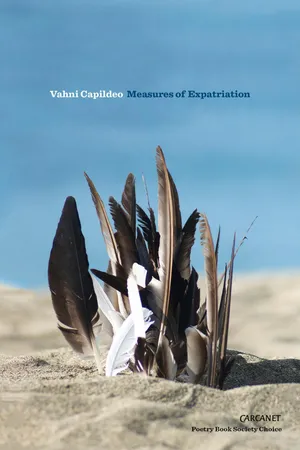
In Measures of Expatriation Vahni Capildeo's poems and prose-poems speak of the complex alienation of the expatriate, and address wider issues around identity in contemporary Western society. Born in Trinidad and resident in the UK, Capildeo rejects the easy depiction of a person as a neat, coherent whole - 'pure is a strange word' - embracing instead a pointilliste self, one grounded in complexity. In these texts sense and syntax are disrupted; languages rub and intersect; dream sequences, love poems, polylogues and borrowed words build into a precarious self-assemblage. 'Cliché', she writes, 'is spitting into the sea', and in this book poetry is still a place where words and names, with their power to bewitch and subjugate, may be disrupted, reclaimed. The politics of the body, and cultures of sexual objectification, gender inequality and casual racism, are the borders across which Capildeo homes, seeking the modest luxury of being 'looked at as if one is neutral ground'. In the end it is language itself, the determination to speak, to which the poet finds she belongs: 'Language is my home, I say; not one particular language.' Measures of Expatriation is in the vanguard of literature arising from the aftermath of Empire, with a fearless and natural complexity.
- 128 pages
- English
- ePUB (mobile friendly)
- Available on iOS & Android
eBook - ePub
Measures of Expatriation
About this book
Winner of the Forward Prize for Best Collection and Shortlisted for the T.S. Eliot Prize (2016).
Information
Measures of Expatriation — IV
Kassandra #memoryandtrauma #livingilionstyle
for Judy Raymond
Terribly terribly sorry (not) it’s hard relating to this one: you know, the dead wench in another country, gifted but an attention-seeker? Your camera strikes from afar. Like snakes licking out K.’s ears, men of power seem caught up with her. More Twitter than other girls round her. Your camera strikes. K.’s screwing up her eyes in a boat – speaking for the sisterhood, but from that kind of family? Why listen? She’s privilege. Complication. Must be spoilt. K.’s voice flares victim to her high-explosive hair; her thoughts dismissable; cuntly, if you’re a man; peripheral.
Take sixty seconds to re-read each of the lines above.
That took ten minutes: half as long as my death by stoning.
Athena, grey-eyed, justicer,
they’ve brought me back
as if each stone
broken for their roads
and the rare earths
mined for their devices
vocalized my far-flung blood,
but I have questions
for you, law-giver, spoiler;
also, plans to find
which women you move
in these greater days
of privilege and complication.
Holding on to you
was the safe zone
but the hero entered
held and raped me
in your precincts, justicer.
Why’d you let him do it? Why did you wait to strike him down? Was it, in a way I do not understand, due process?
Does the burden of proof still fall on me, in modern courts? As people encouraged by helpful foreigners to cross a minefield may smile, stretchered, blinded or their legs blown off, so each of my memories, a living and willing witness, gets up to walk to you, to tell my story, but doesn’t make it. His camera strikes from afar. If you want it to add up, why give me the gift of prophecy? I split, spill truth like marrow from bones, gleaming on stone-strewn ground.
The Book of Dreams / Livre de Cauchemars
for JanaLee Cherneski
I
The women were helpful. The smart cut of their suiting would be elegance in England. In this country it meant that they did not work for themselves. They would be slashed and draped if they were independent. Their suiting bespoke an important, insecure job.
The helpful women were to one side of me wherever we went: the semi-open corridors along the side of concrete quadrangles; the raw rooms with class-length chipboard trestle tables; the half-built, much-used places still to be crossed, topsoil red-orange from sand mixed into sea-reclaimed, or de-agriculturalized, earth.
Something was wanted. I trusted there were good intentions.
Through grilled walls the semi-pleased students were to be seen: standing; sitting; a bewilderment of orderliness and familial pride.
Something was wanted. I would be agreeable.
We were sitting down, with a few more of the women. How good some of what they said they did was!
What did they stand for? I did not want to agree to something.
A ringbound notebook was given to me. A notebook as large as a music book was given to me. A large notebook with a laminated cover was given to me. A shiny green notebook was given to me, recalling the carapace of an insect seldom seen these days.
Inside were rough photocopies, cut-and-paste jobs, blurry, some photocopied from typescripts bad in the original. Verse extracts featured, with space beside and in between the stanzas.
Was that extract Tennyson? Here I could not recognize Tennyson. Were his lines so complex and so long, or had they undergone development in the process of copying?
The women’s looks were anxious. The women’s mouths scraped an expression. The women’s focus was as neat as thimbles.
I would live in the barracks. I would update the verse. I would make it relevant. I would employ dialects. Then I would use the verse as a basis of teaching. There were lambsfuls of students to be taught.
II
The land was flat and round. A river, as if it would have been blue anyway, reflected the sky. It was hard to discern it as river. It ran in loops. There was no way of crossing directly to where we were going. Nor was the destination in view. The distance was amethyst mist. People zigzagged for miles ahead. This had the appearance of leisure.
The people might be struggling across the tussocked mud of the vast, but they did not have to crowd.
The national power grid had gone out. It was said that water reserves would be hit next. That was why we had been put on the move. The town across from us had a considerable water reservoir.
Walking towards it, as yet we could see nothing. People did not know about the water. They were supposed to know about the electricity. Those of us who knew about both should help to keep people moving, without saying. There was no alarm.
Nice ladies expected to go home soon. They sauntered like daytime, greying hair deliberate in its yellowing, orange linen skirts ethically traded, blue flowered dresses having cost a pound and a crown. They brandished folk chic baskets, having taken few things. They chatted through strong teeth.
I would not normally have been on a walk with such nice ladies. They would go to church where they lived. They would book into the restaurants where I lived. They had children, with related activities out of town, requiring the car. Now they were most concerned that school might be disrupted. Assessment tests had been scheduled.
Their children must not lose pace.
Losing pace, place, face, without children, having nothing to join, I walked without saying: aspirins, spectacles, flour, there will be none of these things. The factories, and the mills of God, alike will stop grinding.
None of these things entered their vision.
Fine, lagging, sauntering.
I tried to maintain a sense of direction.
In the distance was water. At our backs, the town, on which darkness had fallen. Day persisted, eggshell and semiprecious. I could not see with whom, but we had to keep up.
III
Night in another place. Again the having to keep walking. I know this road. It runs south to the next town, which over a thousand years ago was the greater, and accessed by river. I stick to the western side of this road. It is a broken way, not meant for pedestrians. The pavements give way to grass verges that dip into the straggle of nothing. They are in the dark but in daylight diffuse anyhow, returning to hedgerow and hostility at the least opportunity: sports grounds, a parking lot, lower middle-class terraced housing latterly subdivided if not subsidized for the less poor, fish and chip...
Table of contents
- Cover
- Title
- Contents
- I
- II
- III
- IV
- V
- VI
- VII
- Acknowledgements
- Copyright
Trusted by 375,005 students
Access to over 1.5 million titles for a fair monthly price.
Study more efficiently using our study tools.
Frequently asked questions
Yes, you can cancel anytime from the Subscription tab in your account settings on the Perlego website. Your subscription will stay active until the end of your current billing period. Learn how to cancel your subscription
No, books cannot be downloaded as external files, such as PDFs, for use outside of Perlego. However, you can download books within the Perlego app for offline reading on mobile or tablet. Learn how to download books offline
Perlego offers two plans: Essential and Complete
- Essential is ideal for learners and professionals who enjoy exploring a wide range of subjects. Access the Essential Library with 800,000+ trusted titles and best-sellers across business, personal growth, and the humanities. Includes unlimited reading time and Standard Read Aloud voice.
- Complete: Perfect for advanced learners and researchers needing full, unrestricted access. Unlock 1.5M+ books across hundreds of subjects, including academic and specialized titles. The Complete Plan also includes advanced features like Premium Read Aloud and Research Assistant.
We are an online textbook subscription service, where you can get access to an entire online library for less than the price of a single book per month. With over 1.5 million books across 990+ topics, we’ve got you covered! Learn about our mission
Look out for the read-aloud symbol on your next book to see if you can listen to it. The read-aloud tool reads text aloud for you, highlighting the text as it is being read. You can pause it, speed it up and slow it down. Learn more about Read Aloud
Yes! You can use the Perlego app on both iOS and Android devices to read anytime, anywhere — even offline. Perfect for commutes or when you’re on the go.
Please note we cannot support devices running on iOS 13 and Android 7 or earlier. Learn more about using the app
Please note we cannot support devices running on iOS 13 and Android 7 or earlier. Learn more about using the app
Yes, you can access Measures of Expatriation by Vahni Capildeo in PDF and/or ePUB format, as well as other popular books in Literature & Poetry. We have over 1.5 million books available in our catalogue for you to explore.