In this seminal, founding work of political anthropology, Pierre Clastres takes on some of the most abiding and essential questions of human civilization: What is power? What is society? How, among all the possible modes of political organization, did we come to choose the monolithic State model and its accompanying regimes of coercion? As Clastres shows, other and different regimes do indeed exist, and they existed long before ours — regimes in which power, though it manifests itself everywhere, is nonetheless noncoercive.
In such societies, political culture, and cultural practices generally, are not only not submissive to the State model, but they actively avert it, rendering impossible the very conditions in which coercive power and the State could arise. How then could our own "societies of the State" ever have arisen from these rich and complex stateless societies, and why?
Clastres brilliantly and imaginatively addresses these questions, meditating on the peculiar shape and dynamics of so-called "primitive societies," and especially on the discourses with which "civilized" (i.e., political, economic, literate) peoples have not ceased to reduce and contain them. He refutes outright the idea that the State is the ultimate and logical density of all societies. On the contrary, Clastres develops a whole alternate and always affirmative political technology based on values such as leisure, prestige, and generosity.
Through individual essays he explores and deftly situates the anarchistic political and social roles of storytelling, homosexuality, jokes, ruinous gift-giving, and the torturous ritual marking of the body, placing them within an economy of power and desire very different from our own, one whose most fundamental goal is to celebrate life while rendering the rise of despotic power impossible. Though power itself is shown to be inseparable from the richest and most complex forms of social life, the State is seen as a specific but grotesque aberration peculiar only to certain societies, not least of which is our own.
Not for sale in the U.K. and British Commonwealth, South Africa, Burma, Jordan, and Iraq.
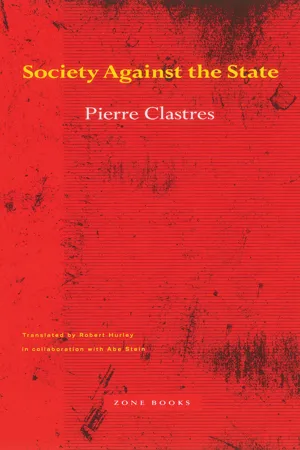
eBook - ePub
Society Against the State
Essays in Political Anthropology
- 224 pages
- English
- ePUB (mobile friendly)
- Available on iOS & Android
eBook - ePub
Society Against the State
Essays in Political Anthropology
About this book
Information
Topic
PhilosophieSubtopic
Philosophie politiqueIndependence and Exogamy1
The strongly marked contrast between the cultures of the Andean high plateaus and the cultures of the Tropical Forest, etched in the narratives and reports of sixteenth- and seventeenth-century missionaries, soldiers, and explorers, was subsequently exaggerated: there gradually formed the popular imagery of a pre-Columbian America delivered over to savagery, except for the Andean region where the Incas had assured the triumph of civilization.
These simplistic notions – naive in appearance only, for they were in complete accord with the objectives of white colonization – crystallized in a tradition whose weight was felt heavily by Americanist ethnology in its infancy. Faithful to its calling, this ethnology selected and discussed problems in scientific terms. Nevertheless, it allowed an unmistakable persistence of traditional thought patterns to show in its solutions, a state of mind which, unknown to the authors, partly determined their research perspectives. What indicates this state of mind? First, a certainty: primitives are generally incapable of achieving good sociological models; next, a method that caricatures the most conspicuous traits of the cultures studied.
The Inca empire, for example, impressed the early chroniclers in essence by its strong centralization of power and a mode of economic organization then unknown. Now, these aspects of Inca society were transformed by modern ethnology into totalitarianism in R. Karsten,2 or into socialism in L. Baudin.3 But a less ethnocentric scrutiny of the source material induces us to correct these all-too modern images of a society which was, in spite of everything, archaic; and in a recent work, Alfred Metraux4 has pointed up the existence of centrifugal forces in Tahuantinsuyu which the Cuzco clans did not think of resisting.
As for the Forest peoples, they were not classed as anachronistic cultures; on the contrary, in close parallel to the tendency to expand the “Western” features of the Inca empire, the sociological structures of the Forest societies were presented as all the more primitive, more flimsy, less capable of dynamism, strictly limited to small units. This no doubt explains the tendency to stress the fragmented, “separatist”5 appearance of the non-Andean communities, together with the inevitable correlate: a quasi-permanent state of war. Thus, the Forest as a cultural habitat is presented as an assortment of micro-societies each more or less resembling the others, but all at the same time hostile to one another. It is quite certain that if, like Baudin, one thinks of the Guarani Indian as an individual “whose mentality is that of a child,”6 one cannot hope to find “adult” types of social organization. This sensitivity to the atomism of Indian societies is also noticeable in Koch-Grunberg and Kirchhoff – for example, in their often excessive use of the term “tribe” to denote any community, a practice that leads them to the surprising notion of tribal exogamy applied to the Tucano tribes of the Uaupes-Caqueta region.7
There is no question here of taking the opposite view, attempting somehow to bring the tribes of the Tropical Forest into line with the cultures of the Andes. And yet it does seem that the most common picture of the societies in question is not always accurate; and if, as Murdock writes, “The warlikeness and atomism of simple societies have been grossly exaggerated,”8 the same is certainly true of South America. Hence we are called upon to re-examine the ethnographic material and re-evaluate the sociopolitical units of the Tropical Forest, with regard to both their nature and their interrelations.
The ethnographic information is largely contained in the monumental Handbook of South American Indians,9 Volume III being devoted to the Forest cultures. This cultural region comprises a very large body of tribes, many of which belong to the three major linguistic stocks: Tupi, Carib, Arawak. All these peoples can be grouped in a common category: although subject to local variations, their ecology conforms to the same model. The Forest societies’ mode of subsistence is basically agricultural, involving an agriculture limited to gardening to be sure, but one whose product in almost every case is at least as substantial as that of hunting, fishing, and gathering. Futhermore, the plants cultivated are fairly constantly the same, with similar production techniques and work routines. Hence, in this instance, the ecology furnishes a very valuable basis for classification, and one is confronted with a group of societies offering, from this standpoint, a real homogeneity. It is not surprising, therefore, to find that the uniformity at the level of the “infrastructure” is ascribed to the level of the “superstructures” as well – the level, that is, of the types of social and political organization. Thus, the most widespread sociological model in the area under consideration seems to be, if we are to believe the general documentation, that of the “extended family.” This is the unit moreover, that constitutes the politically autonomous community, sheltered by the great communal house or maloca; it holds true for the tribes inhabiting the Guianas – those of the Jurua-Purus region, the Witoto, the Peba, the Jivaro, the numerous Tupi tribes, and so on. The demographic size of these households may vary from 40-odd to several hundred persons, although the optimal mean appears to be situated between one and two hundred persons per maloca. There are notable exceptions to the rule: the large Apiaca, Guarani, and Tupinamba villages, which brought together up to a thousand individuals.
But this raises a twofold series of problems. The first difficulty has to do with the nature of the socio-political units of the Tropical Forest. Their sociological characterization as communities constituted by an extended family does not tally with their mean demographic size. In fact, Lowie holds to Kirchhoff’s definition of this type of social organization:10 it refers to a group consisting of a man, his wife – or wives if he is polygynous, his sons and their wives if the postmarital residence is patrilocal, his unmarried daughters, and the children of his sons. If the rule of residence is matrilocal, a man is surrounded by his daughters and their husbands, his unmarried sons, and the children of his daughters. Both types of extended family exist in the Forest habitat, the second being less common than the first and clearly predominating only in the Guianas and the Jurua-Purus region. The difficulty comes from the fact that an extended family, defined strictu sensu, could not attain the usual size of the Forest communities, that is, around a hundred persons. An extended family actually includes only three generations of relatives connected in direct line; and what is more, as Kirchhoff makes clear,11 a process of segmentation subjects the extended family to a perpetual transformation that prevents it from going beyond a certain population level. Consequently, it is not possible for the socio-political units of the Forest to be made up of a single extended family and at the same time to group together a hundred persons or more. It must be admitted, therefore, if the contradiction is to be eliminated, that either the figures put forward are inexact or else an error was committed in identifying the type of social organization. And as it is surely easier to be mistaken about the “dimensions” of a society than about its nature, it is the latter that needs to be examined.
The Indian community of the Forest is described, as we have seen, as a self-contained unit with political independence as one of its essential characteristics. Thus there would be throughout this immense area a multitude of settlements, each existing for itself, the relations between them very often mutually antagonistic, that is, warlike. And it is at this point that the second difficulty emerges. For, besides the fact that generally primitive societies are wrongly condemned to a fragmentation thought to reveal a “primitiveness” that would appear in the political domain alone, the ethnological status of the Indian peoples of the Tropical Forest exhibits an additional peculiarity: if these peoples are in fact grouped within a distinct cultural unit, it is to the precise extent that they are different from the other non-Andean peoples, that is the so-called marginals and submarginals.12 The latter are culturally defined by the nearly general and complete absence of agriculture. Hence, they consist of nomadic groups of hunters, fishermen, and gatherers: Fuegians, Patagonians, Guayaki, and the like. It is evident that these peoples can exist only in small groups scattered over vast territories. But this vital need to scatter no longer plagues the Forest people since, as sedentary growers, they are able, so it seems, to bring into play sociological models very different from those of their less favored marginal neighbors. Is it not strange to see a nomadic type of social organization and an ecology of food growers coexist in one and the same general group, especially as the growers’ capabilities for transport and travel by river navigation would allow them to intensify “external” relations? Is it really possible for the benefits – enormous in some respects – of agriculture and sedentary life to vanish in such a manner? That ecologically marginal peoples might be capable of inventing highly refined sociological models offers no impossibility: the Bororo of central Brazil, with their clan organization cut across by a double system of moieties, or the Guaycuru of the Chaco, with their hierarchy of castes, are cases in point. But the converse, whereby agricultural peoples would be organized according to marginal schemes, is harder to imagine. Hence the question arises of knowing whether the political isolation of each community is a feature that is relevant to the ethnology of the Tropical Forest.
But what is wanted first is to explain the nature of these communties. That this nature is in fact problematical seems to be clearly indicated by the terminological ambiguity found repeatedly throughout the Handbook. If, in Volume III, Lowie calls the most prevalent socio-political unit of the area an “extended family,” Stewart, in Volume V, calls it a “lineage,” thus suggesting the inadequacy of the term proposed by Lowie. But while the units in question are too “populous” to be made up of a single extended family, it does not appear that we are in the presence of lineages in the strict sense either, i.e., groups with unilineal descent. In South America, and particularly in the Tropical Forest area, bilateral descent actually seems to predominate. The possession of more varied and complete genealogies would perhaps enable us to ascertain whether it is a matter of several instances of unilineal organization. But the material currently available does not permit us to assign this latter type of organization to any but a small number of Forest societies: peoples of the Para region (the Mundurucu and the Maué) or of the Uaupes-Caqueta (the Cubeo, the Tucano, and so forth).
Nor, obviously, is it a matter of kindreds: the postmarital residence, which is never neolocal, serves to determine the composition of the units, from the mere fact that with each generation, and supposing that the sex ratio is statistically in equilibrium, one half of the siblings (either the brothers where residence is matrilocal, or the sisters where it is patrilocal) leave the community of origin and go to live in the spouse’s community. In a sense then, the rules of marriage assign the group an effective unilineality, even if it is not culturally recognized by the group’s members, since the latter happen to be consanguineous relatives in matrilineal or patrilineal descent, depending on the rule of residence adopted. No doubt that is what decided Stewart to identify the sociological units of the Forest as lineages. It is appropriate, however, to note that if the notion of the extended family falls short, failing to account for a large part of the concrete reality of these groups, the notion of lineage, for its part, imputes to them a certain number of features they obviously do not possess. For a true lineage implies a descent that is articulated according to a unilineal mode, while here it is bilateral in the majority of cases; and, most important, the fact of belonging to the unilineal type of grouping is independent of the place of residence. Hence, in order for the communities of the Tropical Forest to be the equivalent of lineages, all their members, including those whom marriage has removed from the maloca in which they were born, would have to continue to be a part of the respective communities, on the same footing with the others. That is, the postmarital residence would not change their social status.
Now the units in question are primarily residential, and a change of residence indeed seems to entail a change of membership, or at least a break in the status held prior to marriage. What is involved here is a classic problem of ethnology: that of the relationship between a rule of residence and a mode of descent. In point of fact, it is evident that a patrilocal rule of residence, for example, is of a sort to strongly favor the establishment of a patrilineal mode of descent, which is to say, a lineal structure with a harmonic regime. But no ineluctable mechanism is at work in this, there is no categorical imperative to go from the rule of residence to that of filiation; there is simply a possibility depending largely on the concrete historical circumstances, a strong possibility to be sure, but still insufficient to allow for a close identification of the groups, since the determination of membership cannot be made “free” of the rule of residence.
If, therefore, it cannot be a matter of true lineages, that must not be allowed to mask the very real activity – one that perhaps has not received enough attention – of a twofold dynamic process which, although permanently interrupted by the Conquest, appears to have been gradually transforming the Tropical Forest communities precisely into lineages. The first component of this ...
Table of contents
- Cover Page
- Title Page
- Copyright Page
- Contents
- Copernicus and the Savages
- Exchange and Power: Philosophy of the Indian Chieftainship
- Independence and Exogamy
- Elements of Amerindian Demography
- The Bow and the Basket
- What Makes Indians Laugh
- The Duty to Speak
- Prophets in the Jungle
- Of the One Without the Many
- Of Torture in Primitive Societies
- Society Against the State
- About the Author
Trusted by 375,005 students
Access to over 1.5 million titles for a fair monthly price.
Study more efficiently using our study tools.
Frequently asked questions
Yes, you can cancel anytime from the Subscription tab in your account settings on the Perlego website. Your subscription will stay active until the end of your current billing period. Learn how to cancel your subscription
No, books cannot be downloaded as external files, such as PDFs, for use outside of Perlego. However, you can download books within the Perlego app for offline reading on mobile or tablet. Learn how to download books offline
Perlego offers two plans: Essential and Complete
- Essential is ideal for learners and professionals who enjoy exploring a wide range of subjects. Access the Essential Library with 800,000+ trusted titles and best-sellers across business, personal growth, and the humanities. Includes unlimited reading time and Standard Read Aloud voice.
- Complete: Perfect for advanced learners and researchers needing full, unrestricted access. Unlock 1.5M+ books across hundreds of subjects, including academic and specialized titles. The Complete Plan also includes advanced features like Premium Read Aloud and Research Assistant.
We are an online textbook subscription service, where you can get access to an entire online library for less than the price of a single book per month. With over 1.5 million books across 990+ topics, we’ve got you covered! Learn about our mission
Look out for the read-aloud symbol on your next book to see if you can listen to it. The read-aloud tool reads text aloud for you, highlighting the text as it is being read. You can pause it, speed it up and slow it down. Learn more about Read Aloud
Yes! You can use the Perlego app on both iOS and Android devices to read anytime, anywhere — even offline. Perfect for commutes or when you’re on the go.
Please note we cannot support devices running on iOS 13 and Android 7 or earlier. Learn more about using the app
Please note we cannot support devices running on iOS 13 and Android 7 or earlier. Learn more about using the app
Yes, you can access Society Against the State by Pierre Clastres, Robert Hurley, Abe Stein, Robert Hurley,Abe Stein in PDF and/or ePUB format, as well as other popular books in Philosophie & Philosophie politique. We have over 1.5 million books available in our catalogue for you to explore.