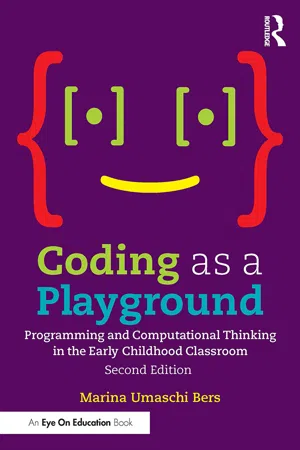
Coding as a Playground, Second Edition focuses on how young children (aged 7 and under) can engage in computational thinking and be taught to become computer programmers, a process that can increase both their cognitive and social-emotional skills. Learn how coding can engage children as producers—and not merely consumers—of technology in a playful way. You will come away from this groundbreaking work with an understanding of how coding promotes developmentally appropriate experiences such as problem-solving, imagination, cognitive challenges, social interactions, motor skills development, emotional exploration, and making different choices. Featuring all-new case studies, vignettes, and projects, as well as an expanded focus on teaching coding as a new literacy, this second edition helps you learn how to integrate coding into different curricular areas to promote literacy, math, science, engineering, and the arts through a project-based approach and a positive attitude to learning.
eBook - ePub
Coding as a Playground
Programming and Computational Thinking in the Early Childhood Classroom
- 230 pages
- English
- ePUB (mobile friendly)
- Available on iOS & Android
eBook - ePub
Coding as a Playground
Programming and Computational Thinking in the Early Childhood Classroom
About this book
Information
Topic
EducationSubtopic
Classroom ManagementPart
I
Coding as Playground
1 | In the Beginning There Was Language |
In 1969, a young woman named Cynthia Solomon and MIT professor Seymour Papert went to the Muzzey Jr. High School in Lexington, MA, a Boston suburb, to teach students how to program. At the time, “programming” was a strange word and very few people knew what it meant. Although the students were learning programming, there was no computer to be found in the classroom. The computer was a few miles away at the Bolt, Beranek and Newman (BBN) research lab, and the classroom had teletypes, which resembled big typing machines. The information was sent over to a big computer, a PDP-1, one of the first modern commercial computers, back at BBN. This was a dedicated LOGO time-shared system. Users saved and retrieved their work sitting at teletype terminals. Although expensive and huge, the PDP-1 had computing power equivalent to a 1996 pocket organizer and a little less memory, and it used punched paper tape as its primary storage medium. In its basic form, the PDP-1 sold for $120,000 (roughly equivalent to $950,000 today) (Hafner & Lyon, 1996).
Despite all of this, children were invited to use it, to become programmers. Solomon (in a personal e-mail) describes how the children “made up hilarious sentence generators and became proficient users of their own math quizzes.” This was the beginning of the first programming language for children, LOGO. Led by Seymour Papert at MIT and Wally Feurzeig and Dan Bobrow at BBN, over time, many people contributed and developed different prototypes of this child-friendly version of the LISP programming language. The home for this work was the MIT Artificial Intelligence (AI) Lab, then co-directed by Seymour Papert and Marvin Minsky. Thus, it is not surprising that LISP is considered by some to be the favored programming language for AI. By 1969, the LOGO group at MIT had been formed, with Papert as its director. As new versions of LOGO were developed, researchers would go to schools to teach and observe what happened in the classroom. Inspired by the Piagetian tradition of using clinical observations of children to learn about cognition, they documented their observations in several dozen LOGO memos later published by MIT (MIT LOGO Memos, 1971–1981; Piaget, 1964).
“By the 1970–71 school year we had a floor turtle and a display turtle,” recalls Solomon in her wiki (Solomon, 2010). While the floor turtle had to be attached to a terminal and children shared it, the display turtle was designed to let users at four different terminals alternately take control of the turtle. By then, LOGO, the first programming language specifically designed for children, included a way to write stories, a way to draw with a programmable object (i.e., the turtle), a way to have the programmable object explore the environment, and a way to make and play music. As early as 1970, the first programming language for children provided tools for creative expression, and not only for problem-solving.
Because Seymour Papert was trained as a mathematician, he could see the potential for LOGO to help children to understand mathematical ideas by playing with them. He also realized the value of the two different interfaces: the screen-based turtle and the floor-based turtle. The floor turtle would, decades later, evolve into the LEGO® MINDSTORMS® robotics concept through a partnership between the LEGO company and MIT. The onscreen turtle became available through different venues, both commercially and free (i.e., Terrapin Logo, Turtle Logo, Kinderlogo). Geometry and LOGO were a natural match. The children could program the turtle to do anything that they wanted. Instructions were given to the turtle to move about in space, and the turtle dragged a pen to draw a trail. Such drawings gave birth to turtle geometry (see Figure 1.1). The turtle could draw squares, rectangles, and circles of all sizes, inviting children to explore the concept of angles. Through coding, mathematics became playful and expressive. Back in those early days, Seymour and his colleagues already wanted children to learn how to code so that they could become creators.

Figure 1.1 This example of “turtle geometry” was created using Terrapin Logo using the following code: repeat 44 [fd 77 lt 17 repeat 17 [fd 66 rt 49]]. This nested code loop translates as, “Repeat 44 times the following: [forward 77, repeat 17 times the following: [forward 66 right turn 49]].”
“Forward 60, right 90.” How many times does this procedure need to be repeated to draw a square? And how should it be adapted to draw a rectangle? While exploring these questions, children would solve multiple problems. However, LOGO engaged children in creating beautiful shapes, not calculating angles. They needed math to make a project of their choice. They learned to see math as a useful, creative tool.
The story of LOGO is also the story of how, for those early researchers devoted to bringing the power of computation to education, programming was associated with children’s ability to make something they cared about. They provided tools that offered multiple paths for expression: drawing, storytelling, games, and music. Programming was at the service of expression. Back then, researchers would have flinched at the idea of only associating coding with STEM (science, technology, engineering, and math). Those disciplines provide important skill sets and knowledge, but programming takes the young coder beyond: it provides a tool for personal, communicative expression.
Constructionism
Back in the late ‘90s, when I was a doctoral student working with Seymour Papert at the MIT Media Lab, the joke was that Seymour did not come in the LOGO box. What we meant was that although we were bringing LOGO and its full expressive potential to schools, many teachers tended to use LOGO in traditional, instructionist ways. Creativity and personal expression were left out. Our internal joke hid our wish to have Seymour come inside the LOGO box, so that when we needed to convince teachers to let their students freely explore and to create a project of their choice, he would come out and help us with his charming personality.
We spent hours sharing his theory, philosophy, and pedagogical approach with as many teachers as we could find. Seymour did not come in the LOGO box, but Constructionism, the framework he developed, came in a book, Mindstorms: Children, Computers and Powerful Ideas (Papert, 1980). This wonderful book summarizes Papert’s approach to how children can become better learners and thinkers through coding. LOGO was carefully designed so that young children could create their own personally meaningful projects. However, a top-down curriculum and an instructionist pedagogy could turn LOGO into a completely different tool in classrooms where teachers did not understand the principles of Constructionism. Although LOGO was designed as a playground, it could easily become a playpen. Seymour’s choice of this word, Constructionism, to name his pedagogical and philosophical approach is a play on Piaget’s Constructivism (Ackermann, 2001; Papert & Harel, 1991). Seymour had worked with Jean Piaget in Switzerland and, amongst many things, he learned the importance of learning by doing.
While Piaget’s theory explains how knowledge is constructed in our heads through a process of accommodation and assimilation, Papert pays particular attention to the role of computationally rich constructions in the world, as a support for those in the head. Papert’s Constructionism asserts that computers are powerful educational technologies when used as tools for creating projects that people truly care about. Programming is a vehicle for creation, either on a screen or in the physical world, as shown by the early work on LOGO with both turtle interfaces. Papert’s Constructionism believes that independent learning and discovery happen best when children can make, create, program, and design their own “objects to think with” in a playful manner (Bers, 2008). Computational objects can help us to think about powerful computational ideas, such as sequencing, abstraction, and modularity, but they also provide an opportunity to communicate our own voices. Coding, then, becomes both a vehicle for new forms of thinking and expression of the resulting thoughts. Chapters 7 and 8 will look at this and explore the powerful ideas of computer science that coding reveals.
Constructionism is my intellectual home. It is from there that I write this book. I apply what is useful to early childhood education and I extend it with my own theoretical framework, which I call Positive Technological Development (PTD). Chapter 10 will expand on this.
Seymour Papert refused to give a definition of Constructionism. In 1991, he wrote, “It would be particularly oxymoronic to convey the idea of constructionism through a definition since, after all, constructionism boils down to demanding that everything be understood by being constructed” (Papert & Harel, 1991). Respecting his wish, in my past writings I have always avoided providing a definition (e.g., Bers, 2017); however, I have presented four basic principles of Constructionism that have served early childhood education well (Bers, 2008):
- Learning by designing personally meaningful projects to share in the community;
- Using concrete objects to build and explore the world;
- Identifying powerful ideas from the domain of study;
- Engaging in self-reflection as part of the learning process.
These principles are consistent with the general agreement in early childhood education about the efficacy of “learning by doing” and engaging in “project-based learning” (Diffily & Sassman, 2002; Krajcik & Blumenfeld, 2006). Constructionism extends these approaches to also engage children in “learning by designing” and “learning by programming.” From a Constructionist perspective, there is a continuum of learning opportunities that spans from blocks to robots (Bers, 2008). For example, while wooden blocks can help children explore size and shape, robots allow exploration of digital concepts, such as sensors. Nowadays, these are found in most “smart objects” around us, from water dispensers to elevator doors. The early childhood curriculum is supposed to focus on children’s experiences in the world, and smart objects like these are a growing presence in our world.
When children are provided tools to learn about these “smart objects” by making them, fixing them, or playing with them through educational robotics, they not only become producers of their own projects, but they also explore disciplinary realms of knowledge, such as coding and engineering, as well as the nature of knowledge itself. They “think about thinking.” They become epistemologists, just like Piaget who was deeply interested in the nature of knowledge, and just like Papert, who named his research group at the MIT Media Lab “Epistemology and Learning.”
In Memoriam
Seymour Papert was a South African mathematician who worked with Jean Piaget in Geneva and then moved to Boston and became the co-director of the AI Lab at MIT. He was one of the founding pioneers of the MIT Media Lab. After he died in July 2016, Gary Stager wrote a beautiful obituary for Nature: “Few academics of Papert’s stature have spent as much time as he did working in real schools. He delighted in the theories, ingenuity and playfulness of children. Tinkering or programming with them was the cause of many missed meetings” (Stager, 2016). I recall those missed meetings with frustration. I was an eager student trying to make sense of many questions.
Seymour loved questions but he did not have enough hours in the day to explore them all. By the time I met him, Seymour was already a prominent figure and embarked on frequent trips. So, escorting him to the airport was a wonderful and rare opportunity to have his undivided attention. He was always travelling, so such meetings became frequent. I remember discussing my questions in the back of a taxi or an airport coffee shop while he was waiting for his next plane. I also remember having to interrupt a thought-provoking discussion because his flight was leaving.
Seymour was a man of ideas. I believe he fell in love with computer programming because of its potential to bring about new ideas, both at the personal and societal level. Ideas can change the world, and Seymour wanted to change the world. However, in order to make abstract ideas concrete, we need a way to express them. Seymour understood that programming languages can serve as tools for expression. The next chapter will explore this concept.
References
Ackermann, E. (2001). Piaget’s Constructivism, Papert’s Constructionism: What’s the difference? Future of Learning Group Publication, 5(3), 438.
Bers, M. U. (2008). Blocks to robots: Learning with technology in the early childhood classroom. New York, NY: Teachers College Press.
Bers, M. U. (2017). The Seymour test: Powerful ideas in early childhood education. International Journal of Child-Computer Interaction. doi:10.1016/j.ijcci.2017.06.004.
Diffily, D., & Sassman, C. (2002). Project based learning with young children. Westport, CT: Heinemann, Greenwood Publishing Group, Inc.
Hafner, K., & Lyon, M. (1996). Where wizards stay up late: The origins of the Internet (1st Touchstone ed.). New York, NY: Simon and Schuster.
Krajcik, J. S., & Blumenfeld, P. (2006). Project based learning. In R. K. Sawyer (Ed.), Cambridge handbook of the learning sciences (pp. 317–333). New York, NY: Cambridge University Press.
MIT LOGO Memos. (1971–1981). Memo collection. Retrieved from www.sonoma.edu/users/l/luvisi/logo/logo.memos.html
Papert, S (1980) Mindstorms: Children, Computers and Powerful Ideas, NY: Basic Books.
Papert, S., & Harel, I. (1991). Situating constructionism. Constructionism, 36(2), 1–11.
Piaget, J. (1964). Cognitive development in children: Piaget, development and learning. Journa...
Table of contents
- Cover
- Half Title
- Series Page
- Title Page
- Copyright Page
- Table of Contents
- Meet the Author
- Acknowledgments
- Introduction
- PART I: CODING AS PLAYGROUND
- PART II: CODING AS LITERACY
- PART III: COMPUTATIONAL THINKING
- PART IV: NEW LANGUAGES FOR YOUNG CHILDREN
- Conclusion
Trusted by 375,005 students
Access to over 1.5 million titles for a fair monthly price.
Study more efficiently using our study tools.
Frequently asked questions
Yes, you can cancel anytime from the Subscription tab in your account settings on the Perlego website. Your subscription will stay active until the end of your current billing period. Learn how to cancel your subscription
No, books cannot be downloaded as external files, such as PDFs, for use outside of Perlego. However, you can download books within the Perlego app for offline reading on mobile or tablet. Learn how to download books offline
Perlego offers two plans: Essential and Complete
- Essential is ideal for learners and professionals who enjoy exploring a wide range of subjects. Access the Essential Library with 800,000+ trusted titles and best-sellers across business, personal growth, and the humanities. Includes unlimited reading time and Standard Read Aloud voice.
- Complete: Perfect for advanced learners and researchers needing full, unrestricted access. Unlock 1.5M+ books across hundreds of subjects, including academic and specialized titles. The Complete Plan also includes advanced features like Premium Read Aloud and Research Assistant.
We are an online textbook subscription service, where you can get access to an entire online library for less than the price of a single book per month. With over 1.5 million books across 990+ topics, we’ve got you covered! Learn about our mission
Look out for the read-aloud symbol on your next book to see if you can listen to it. The read-aloud tool reads text aloud for you, highlighting the text as it is being read. You can pause it, speed it up and slow it down. Learn more about Read Aloud
Yes! You can use the Perlego app on both iOS and Android devices to read anytime, anywhere — even offline. Perfect for commutes or when you’re on the go.
Please note we cannot support devices running on iOS 13 and Android 7 or earlier. Learn more about using the app
Please note we cannot support devices running on iOS 13 and Android 7 or earlier. Learn more about using the app
Yes, you can access Coding as a Playground by Marina Umaschi Bers in PDF and/or ePUB format, as well as other popular books in Education & Classroom Management. We have over 1.5 million books available in our catalogue for you to explore.