'This book offers an excellent guide for all those committed to the provision of high quality field teaching and assessment in the human services. The international line-up of top contributors confirms the widespread importance now given to field education.'
Professor David Howe, University of East Anglia
'This is an impressive collection of wisdom, reflections and practical advice. It is comprehensive and clearly written. The various authors address issues which are pertinent to field education globally.'
Joan Orme, University of Southampton
How do students learn from fieldwork experiences? How can supervisors assist students doing fieldwork?
Fieldwork in the Human Services is a practical guide for educators and managers involved in supervising field education. Drawing on the experience of academics, clinicians and educators from Australia, New Zealand, Canada and the UK, this collection explores how to make the most of the fieldwork experience.
With learning as the central theme, contributors examine the practical application of a range of learning theories and models of supervision. Management issues are also considered, as are working with cultural difference and legal and ethical aspects.
Fieldwork in the Human Services will be welcomed by anyone involved in field education in social work, health, community work, education, welfare and related fields.
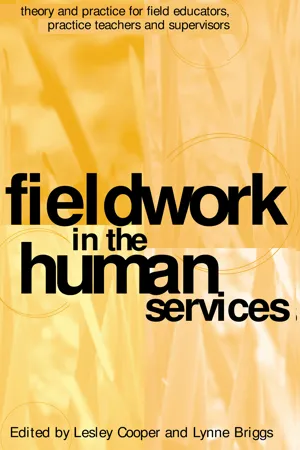
eBook - ePub
Fieldwork in the Human Services
Theory and practice for field educators, practice teachers and supervisors
- 288 pages
- English
- ePUB (mobile friendly)
- Available on iOS & Android
eBook - ePub
Fieldwork in the Human Services
Theory and practice for field educators, practice teachers and supervisors
About this book
Information
SECTION 1 TEACHING, LEARNING AND ASSESSMENT IN THE FIELD
1 Overview of teaching, learning and assessment in the field
Lesley Cooper and Lynne Briggs
The human services field involves learning in, and from, the real-life work of communities, agencies, practitioners and clients. It is a special form of learning that allows students to learn experientially, under the guidance and supervision of experienced practitioners in the context of specific requirements of training institutions, agencies and the professions. While the organisation of this activity involves a large number of stakeholders, including students, academic staff, practitioners and clients, the student is the key person and learning is the core task.
Learning from real-life experiences provides a range of major challenges for all those involved in this important educational activity—students, practitioners, academic staff and those field coordinators who operate on the boundary between the training institution and the agency in which the learning occurs. This book is written for field educators—practitioners who, on a day-to-day basis, are responsible for students and their learning. The chapters are organised for the purposes of assisting them in their role as educators. This introduction, however, provides a conceptual orientation to the learner, the context of learning and learning from experience, based on the work of David Boud and David Walker (Boud and Walker 1990, Walker and Boud 1994).
Four key themes are addressed, emphasising the importance of:
- the learner;
- the context for learning;
- the learning experience;
- appropriate management and organisation of fieldwork.
Although the learner and learning are at the heart of fieldwork, the last theme is crucial, as learning cannot take place without it.
THE LEARNER
The learner is the most important person in the human services field. Students come to their fieldwork experiences with an extensive range of prior social and cult ural experiences that impact on what they learn and how they approach the task of learning. These experiences may be conscious, but often they are hidden. Part of learning is assisting students to understand the impact of these prior experiences through developing self-awareness during the supervision process.
There is an increasing diversity among students attending university. In recent years, the profile of university students has changed. More women are attending; there is an increase in mature-age students; many are from non-English speaking backgrounds; and there is an increasing number of indigenous students. Language skills vary enormously. Mature-age students may come to university lacking confidence in their ability to study and cope with academic or practical learning. Younger students may be confident about their intellectual ability but lack the life experiences needed to engage with clients in the human services. Indigenous students struggle with agency values and beliefs that differ from their cultural orientation.
Learning new skills, practices and tasks arouses strong emotions as students struggle in an unfamiliar environment with clients and educators who may be different from themselves. Where students are required to work across cultures, anxiety about learning or feelings of oppression may become acute. All students, irrespective of their experiences or cultural backgrounds, come to their first field placement with some trepidation, anxiety and excitement about this new learning challenge.
Although early learning experiences are significant in terms of the way students approach fieldwork learning, the students’ social, emotional and intellectual development is also important. Believing that students have attained all milestones of cognitive and emotional development if they have reached adulthood is a false assumption. Entering university heralds a time when students are required to process large amounts of information and knowledge. The beginning of fieldwork brings the realisation that learning practice is more than the application of classroom theory. Learners are required to adapt all their cognitive skills to issues of professional practice. They soon discover that there is no right or wrong answer, but instead a plethora of approaches, all of which are acceptable.
In addition to these prior personal, social and cultural experiences, students have particular intentions and goals with regard to field learning. Some students see fieldwork as an opportunity to decide if this career is the right one for them. Others’ unique life experiences give them the desire to help people, just as they have been helped. A few with a well-defined view of social justice and injustice have a political commitment to change the world for the better. Although some students may be explicit about their intent, Boud and Walker (1990) note that students may have little conscious intent or commitment to being in an agency. Whatever their reason for doing fieldwork, each student will approach the learning tasks in a different manner.
CONTEXT FOR LEARNING
Learning in the field involves learning from experience and making the most of that experience. It occurs off-campus in a wide variety of workplaces. Classroom learning comprising lectures and tutorials has a degree of uniformity, predictability and transparency. The same claim cannot be made for off-campus field learning. This is complicated, challenging and puzzling. Field learning may not be a totally structured and carefully executed activity orchestrated by the agency, field educator and student. It can be uneven, unpredictable and often surprising.
Boud and Walker (1990) refer to the importance of the learning milieu—the physical environment of the agency where the learning takes place. They emphasise the interaction between the learner and the specific field learning environment. As well as being a physical environment, the milieu encompasses the social, cultural, interpersonal, economic, legal and political context. It incorporates ‘the formal requirements, the culture, procedures, practices and standards of particular institutions and societies, the immediate goals and expectations of any facilitator, as well as the personal characteristics of any individuals who are part of it’ (1990: 65). The cultures, procedures and formal requirements of the training institution and the agency form an integral part of this complex milieu.
While Boud and Walker were primarily interested in the interaction between the learner and the milieu, field educators acknowledge the impact of social, political and economic events on the availability of fieldwork, the quality of learning and opportunities for students. In the current political and organisational climate, educators and practitioners must contend with rapid change and the associated organisational turmoil. These turbulent settings become the classroom (or context) for student learning. Immersion in this environment potentially provides a first-hand appreciation of the vigour, intensity and impact of change. Despite these opportunities, it also creates problems both for those responsible for the organisation and management of student learning and for students. There may be insufficient field placements that allow appropriate learning. Field educators may be busy with additional work and unintentionally neglect the learner and their needs. A high turnover of field educators may result in large numbers of inexperienced field educators. Some novice students may not receive an adequate orientation, being given too little work, while those with prior experiences may be simply used as an extra pair of hands, thus receiving little educational or administrative support.
LEARNING FROM EXPERIENCE
Field learning occurs through and from workplace experiences, but involves more than just students learning from these experiences. Learning is enhanced when it is treated as a conscious, reflective process and when students have control over that process. Boud and Walker (1990) aimed to achieve this with their framework for le arning from experience, which was intended to raise educators’ and students’ awareness of the complexity of learning by making the components of learning as explicit as possible.
This book has a similar objective. It aims to make explicit three key concepts: the complementary concepts of teaching and learning, together with assessment. It also intends to illustrate how student learning in the field reaches beyond achieving specified learning outcomes to include an appreciation of difference, culture, self, complexity of practice, milieu and practice relationships.
Teaching consists of the actions, strategies and behaviours that make student learning possible. Learning means a change in an individual as a result of experiences. Learning from experience is the primary goal of field learning. This book shows that there are many teaching, learning and assessment theories and practices that support such experiential learning.
The learning experience begins with the first contact between students and their agency field educator. This first encounter is generally a structured event involving orientation combined with a process of contracting learning activities and assessment, and can give a positive or negative flavour to the whole fieldwork experience. Field educators play an important role in how students approach the task of field learning. It is assumed that educators appreciate the variety of learning theories and their consequential teaching strategies, and will use these in a positive manner. The process of learning from experience in human services fieldwork occurs during ‘supervision’—structured conversations between the student or students and their field educator. Thus the field educator– student relationship is vitally important.
Assessment is a central feature of fieldwork. Teaching and learning are not achievable unless assessment is taken seriously and considered as a key element of learning. Assessment can be an ongoing process. It can occur informally during the structured supervisory conversation, or more formally through an ‘event’—an evaluative conference when students are given direct feedback about their performance. As many educators can attest, assessment of student performance can be one of the most difficult and conflict-ridden areas of professional education. A negative or badly managed student assessment can have wide-ranging consequences for the student, agency and training institution. A principled assessment approach that takes account of complexities can facilitate and enhance learning in fieldwork and minimise disruptive consequences.
MANAGEMENT AND ORGANISATION OF LEARNING
Although this introduction is written from a learner’s perspective, the book is written for field educators. Fieldwork has an educational focus and requires careful management and organisation. This is an important task for all educators, as efficient management is necessary to enable learners and field educators to maximise learning opportunities. Management begins with the preparation of students on campus; is supported by field learning and concurrent integration seminars; and is completed with final assessments and the debriefing of students.
Field educators have a number of specific managerial, legal, ethical and educational responsibilities. They are responsible for the overall management of the student learning process, beginning with planning for learning, orientation to the agency, arranging the learning contract and being involved in the mid- and end-of-fieldwork assessments. They also provide constant administrative oversight of the student’s work th...
Table of contents
- Cover
- Title Page
- Dedication
- Contents
- Tables and figures
- Contributors
- Preface
- Section 1 Teaching, learning and assessment in the field
- Section 2 The responsibilities of fieldwork management
- Section 3 Practical suggestions
- References
- Index
Trusted by 375,005 students
Access to over 1.5 million titles for a fair monthly price.
Study more efficiently using our study tools.
Frequently asked questions
Yes, you can cancel anytime from the Subscription tab in your account settings on the Perlego website. Your subscription will stay active until the end of your current billing period. Learn how to cancel your subscription
No, books cannot be downloaded as external files, such as PDFs, for use outside of Perlego. However, you can download books within the Perlego app for offline reading on mobile or tablet. Learn how to download books offline
Perlego offers two plans: Essential and Complete
- Essential is ideal for learners and professionals who enjoy exploring a wide range of subjects. Access the Essential Library with 800,000+ trusted titles and best-sellers across business, personal growth, and the humanities. Includes unlimited reading time and Standard Read Aloud voice.
- Complete: Perfect for advanced learners and researchers needing full, unrestricted access. Unlock 1.5M+ books across hundreds of subjects, including academic and specialized titles. The Complete Plan also includes advanced features like Premium Read Aloud and Research Assistant.
We are an online textbook subscription service, where you can get access to an entire online library for less than the price of a single book per month. With over 1.5 million books across 990+ topics, we’ve got you covered! Learn about our mission
Look out for the read-aloud symbol on your next book to see if you can listen to it. The read-aloud tool reads text aloud for you, highlighting the text as it is being read. You can pause it, speed it up and slow it down. Learn more about Read Aloud
Yes! You can use the Perlego app on both iOS and Android devices to read anytime, anywhere — even offline. Perfect for commutes or when you’re on the go.
Please note we cannot support devices running on iOS 13 and Android 7 or earlier. Learn more about using the app
Please note we cannot support devices running on iOS 13 and Android 7 or earlier. Learn more about using the app
Yes, you can access Fieldwork in the Human Services by Lynne Briggs,Lesley Cooper in PDF and/or ePUB format, as well as other popular books in Pedagogía & Formación del profesorado. We have over 1.5 million books available in our catalogue for you to explore.