Life can be a struggle for some families and support from skilled human service workers can make a real difference.
Collaborative Family Work offers practical strategies for working with families, always emphasising the importance of collaboration in assisting them in developing strategies to learn new skills and improve their lives. Chris Trotter explains how to identify strengths, assist families in setting goals, articulate strategies for change and develop methods of ongoing evaluation.
He offers a systematic overview of family work models and theories, from long-term therapeutic and narrative approaches to short-term solution-focused and mediation models. His evidence-based model for family work draws on extensive field research and observation with experienced professionals.
Collaborative Family Work is a valuable reference for professionals seeking to enhance their professional skills, and an essential text for students in the human services.
'Chris Trotter addresses the ''how'' of practice in a field that is often stronger on general principles than it is on practical detail.' - Dr Chris Beckett, University of East Anglia, UK
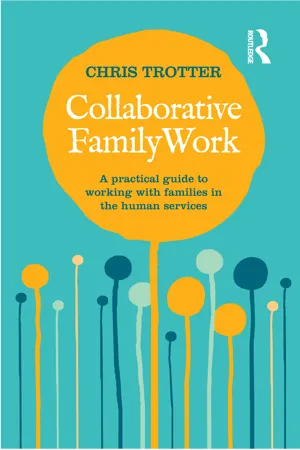
eBook - ePub
Collaborative Family Work
A practical guide to working with families in the human services
- 248 pages
- English
- ePUB (mobile friendly)
- Available on iOS & Android
eBook - ePub
Collaborative Family Work
A practical guide to working with families in the human services
About this book
Information
1 Introduction: Why Collaborative Family Work?
Sylvia works as a youth justice worker. She supervises young people who are placed on probation. Steve is 14 years old, and is one of her clients. He is on probation for stealing cars. He also has a problem with sniffing glue. Sylvia has worked with Steve for three months since he was placed on probation and has come to know him well. He has a long history of stealing cars and is due to return to court next week to face charges for another offence. He has a very poor record of school attendance and is pretty much illiterate. He has no real friends and most of his acquaintances are also school truants.
He lives with his father, Mario, his father's partner, Maria, and her two children, Emily, 14, and Jane, 11. Steve's mother died when he was 4 years old. He likes his father's partner but feels that she favours her own two children. Steve and his father don't get on well They rarely talk to each other and Steve feels that his father does not like him. Sylvia has interviewed Mario on several occasions and she feels that his rejecting and authoritarian attitude to Steve is an important factor in Steve's behaviour. In fact, it is her view that one of the reasons why Steve steals cars is to get his father's attention. On several occasions after police have visited the house, Mario has told Steve to get out of the house and not come back. This has been followed by Steve getting into further trouble. On one occasion after he was told to leave, Steve broke into a house with some other young people and stole money and food.
Sylvia feels that Mario cares about Steve but does not know how to deal with his behaviour—harsh discipline is the only way he knows. Mario has acknowledged to Sylvia that it isn't working, but says that he can think of no other way of handling the situation. Steve talks about his father as if he is in awe of him. He talks about his father's work as a supervisor in an engineering shop that repairs ambulances. The ambulances must be maintained in perfect condition and only top-class mechanics can work in this field. He also talks about the times his father took him to the football, to the beach and so on.
Sylvia feels that she has done about as much as she can for this family. She has talked to Steve at length and she has talked to Mario and tried to persuade him to be more positive with Steve, and (to try) to let him know that he cares about him. She has even talked to Maria and asked her to encourage Mario to be more positive towards Steve. She feels that if she could get the relevant family members together—maybe Steve, Mario and Maria, or even just Steve and Mario—she could work through the issues more effectively. However, she feels
that she does not have the skills or the confidence to work together with the family members to address the issues they are facing.
The aim of this book is to help professional workers like Sylvia to develop the skills and confidence to do this.
Andrea is a foster care worker. Sophia is 12 and has been in kinship foster care with her aunt, Stephanie, and Stephanie's partner, Huang, for three years. Sophia had been in several foster care placements before this; she had been happy with Stephanie and Huang until everything started to go downhill a few months ago. Stephanie rang Andrea, saying that things had deteriorated so much that they could no longer continue to foster Sophia. Her temper tantrums made them scared and they felt it was only a matter of time before she turned violent. They were also worried that their other two children were beginning to dislike Sophia. Andrea was very disappointed with the foster parents' attitude, mostly because it would be so difficult to place Sophia with another family. Sophia's mother was not an option—while she had some contact with Sophia, she continued to struggle with a mental illness and was not in a position to have her daughter with her. Earlier attempts to place Sophia with other relatives had failed.
Andrea understood the reluctance of the foster parents to keep Sophia with them; however, she could see that a move at this stage was not in Sophia's best interests, and she was worried that she would ultimately end up homeless. Andrea attempted to do some mediation with the three of them. She even tried involving Naomi, Stephanie's 16-year-old daughter. However, this did not seem to help and Andrea felt that she did not really know how to tackle working with the family group.
In both of these situations, the professional worker feels that working with the family group maybe the best way to deal with the issues facing the family and the worker. However, in each case, even though the workers have professional qualifications, they do not feel equipped to work with the family group through a series of family counselling sessions. This book aims to help them do this. It aims to help social workers, welfare workers, psychologists, school counsellors and others in the human services to work through a series of family sessions with client families.
This chapter introduces the Collaborative Family Work model, discusses the aims of the book and clarifies the terminology relating to family work, family therapy, family counselling and family mediation. It identifies situations where human service workers work with families, and discusses some of the benefits and difficulties of working with the family group rather than, or as well as, working with family members individually. It also discusses situations where family work may not be appropriate—for example, with families who are experiencing domestic violence or child sexual abuse.
Why Collaborative Family Work?
There have been many books published on working with families. There are general books on family therapy and there are books on specific forms of family therapy—including psychodynamic, structural, experiential and behavioural models. There are books on narrative and solution-focused family work and books on problem-solving with families. So why is there a need for another book on working with families?
There is a need for Collaborative Family Work because there are few if any other books like it. It differs from other books on working with families because it focuses on families in the social services and criminal justice systems, many of whom are involuntary clients. It presents a model that has been developed for use with young offenders and their families, with families in the child protection system, with young people who are homeless, with families of children referred to school welfare staff, with family members with learning disability or acquired brain injury, and with family members with drug and alcohol addictions. It has been developed and used with families experiencing poverty and with families from many different backgrounds, including Australian Indigenous families.
This is a practical book that provides the tools for professional workers in the social services or youth justice systems to work through a series of sessions with family members. Many family therapy models require years of training for practitioners to develop expertise. However, research and experience with the model presented in this book suggest that professional workers can successfully apply the model by following the steps as they are outlined in this book. Similarly, students in social work, welfare, psychology, counselling or other human services courses can develop expertise in working with family groups by using this book as a basis.
A particular strength of the Collaborative Family Work model is that it is readily understood by clients who may not be well educated or particularly articulate. Family members can understand and follow the steps in the model during sessions with their workers, and they can use the steps in the model to solve problems for themselves. It teaches skills that family members can use outside of family work sessions.
The model is presented in user-friendly language that aims to he as straightforward as possible. Nevertheless, the application of the model requires skill and contains complexities that may not be apparent on the first reading. Experience has shown that while professional workers in the social services can work successfully with the model with minimal training or experience, over time they learn to operate with increasing degrees of expertise. In other words, the model can readily be understood by workers and clients and inexperienced workers can work successfully with the model; however, with experience workers can become more expert and more successful in its application.
There are a number of commercial family work models available for use by professional workers. Some of these involve a process of training and certification. The model presented in this book does not require such a process. This is not to say that training and ongoing supervision will not enhance the skills of those offering Collaborative Family Work. In fact, when organisations have implemented the model, it has been most successful when initial and ongoing training has been offered followed by professional supervision or debriefing after each family work session. However, it is acknowledged that many professional workers work with families on a regular or an irregular basis, and often do not have the opportunity to access specific training or debriefing. Those workers can benefit from the knowledge offered in this book. By following the steps presented, they can successfully undertake work with family groups. They can use the expertise that they have developed in working with individuals and apply that expertise to work with families.
Collaborative Family Work is an evidence-based model. There are, of course, many books on work with families that are evidence-based. Like them, this book operates from a paradigm that focuses primarily on practices that are supported by research findings and consistent with established theories. I have addressed the issues surrounding evidence-based practice in earlier books (Trotter 2004, 2006), and it is acknowledged that there are arguments for and against evidence-based practice. Nevertheless, this book is firml rooted in the evidence-based paradigm. At the same time, it acknowledges the importance of critical and reflective practice, as discussed in Chapter 2.
Family work, family therapy, family counselling and family mediation
This book is about working with families who have problems. It is about how a professional human services worker can undertake a series of family sessions with a family with a view to assisting them with their problems. It presents a problem-solving model for working with families. While the term 'family work' is used throughout this book, many of the skills that can be learnt from the book might also be described as family therapy, mediation or counselling skills.
Family therapy generally refers to long-term interventions with specifically trained family therapists. The formal definitions of family therapy tend to be general. The UK Association for Family Therapy and Systemic Practice suggests that:
Family Therapists help family members find constructive ways to help each other. They work in ways that acknowledge the contexts of people's families and other relationships, sharing and respecting individuals different perspectives, beliefs, views and stories, and exploring possible ways forward. (<www.familytherapy.org.uk>)
The Association acknowledges that family therapists may have varying qualifications, some with little or no formal training (Stratton 2005). Family therapy may take place in one session or over several years.
The term 'family counselling' is sometimes used to describe work done with families following divorce and separation, and is often offered through the legal system when there are issues relating to the care of children. One defintion includes:
Family counselling is defined as a process in which a family counsellor helps one or more people to deal with personal or interpersonal issues relating to marriage, separation or divorce, including issues relating to the care of children. (Attorney-General's Department 2007: 2)
Family mediation is also often described in a legal context. The Legal Services Commission of South Australia (2011) refers to mediation as a 'form of dispute resolution where an impartial third party helps communication and negotiations between the parties, but does not decide the dispute.' In other words, family mediation tries to reach agreement between people—often between separating couples—about issues which they cannot agree on.
The Collaborative Family Work model for working with families presented in this book is more in line with definitions of family therapy. Some professional workers who make use of the Collaborative Family Work model describe themselves as family therapists. However, as discussed earlier, many who use the model are not specialist family therapists but workers in child protection, juvenile justice, schools or family-supportagencies who use elements of family therapy in their work. The term 'family work' is used in this book because it is a more low-key term than 'family therapy', it is less associated with illness or dysfunction, and it is more readily accepted by the clients with whom it is most often used.
What is a family?
Families can be defined in many ways. Gill Barnes (1984:10) refers to the traditional view of family as 'the primary social group into which individuals are born and upon which they initially depend for nurture'. Faith Robertson Elliot (1986: 4) suggests that family is widely seen as a 'group based on marriage and biological parenthood, as sharing a common residence and as united by ties of affection', but then refers to the complexities of defining families. More recent publications have defined families more in terms of a system. Herbert and Irene Goldenberg (2008: 1) suggest that each family may be considered a 'natural sustained social system with properties all its own—one that has attained a set of rules, is replete with assigned and ascribed roles for its members, has an organised power structure, has developed intricate and overt forms of communication'.
Other texts have discussed definitions of families in more detail and it is not necessary to dwell on detailed definitions for the purposes of this book. Suffice to say that families come in many forms, and definitions may vary between cultures. For example, American and British people tend to focus on nuclear families, whereas Afro-American and Australian Aboriginal families are more focused on a wider network of relatives and community members.
This book adopts a broad definition of families. Families may include members who have no blood relationship with other members—for example, in cases of adoption or foster care; they may include members who have no legal relationship with other members—for example, cohabiting couples; and they may include same-sex partners. Some people who live in close relationships may not constitute families from a traditional viewpoint; however, they may share many of the characteristics of families—for example, a young person who lives with the family of a friend, an ex-prisoner who is provided with accommodation by a family following release from prison, a congregrate care facility where 'house parents' care for the children, two friends who have lived together for many years or a small group of disabled people who live together and support each other. These people share some, if not all, of the characteristics referred to by Herbert and Irene Goldenberg (2008).
Rather than struggle with definitions of family, in this book we are more concerned with whether or not a family work intervention might be appropriate. Family interventions may be suitable for any situation where 'two or more people have a close or important personal interaction'—this becomes the definition of family for the purposes of this book.
For example, it maybe appropriate to use the skills and practices offered in this book with groups who may not traditionally be described as families. Let us take the example of a young person who, following his release from prison, finds accommodation with a couple who have volunteered to support ex-prisoners through a prisoner support service. The young person's parole officer feels that the accommodation is helpful, has a stabilising effect on the young person and has helped to keep him away from his criminal mates. After a period of time, difficulties develop in the relationship between the young person and the couple, and the accommodation arrangement looks like it may break down. In this situation, it may be appropriate for the parole officer, or another professional worker, to work with those involved to resolve their differences. The skills of working with families developed in this book are relevant to this process.
Do family interventions work?
This book is based on the assumption that working with families leads to good outcomes for family members. These may include reduced offending, reduced child abuse, reduced drug use, reduced homelessnessor truancy, or improved fami...
Table of contents
- Cover
- Half Title
- Title Page
- Copyright Page
- Contents
- Figures
- Acknowledgements
- 1 Introduction: Why Collaborative Family Work?
- 2 Family work models and theories
- 3 The Collaborative Family Work model
- 4 Preparing families for family work and developing ground rules
- 5 Identifying issues to work on and focusing on strengths
- 6 Deciding what to work on first and setting goals
- 7 Problem exploration and developing strategies
- 8 Reviewing and concluding the family work sessions
- References
- Index
Trusted by 375,005 students
Access to over 1.5 million titles for a fair monthly price.
Study more efficiently using our study tools.
Frequently asked questions
Yes, you can cancel anytime from the Subscription tab in your account settings on the Perlego website. Your subscription will stay active until the end of your current billing period. Learn how to cancel your subscription
No, books cannot be downloaded as external files, such as PDFs, for use outside of Perlego. However, you can download books within the Perlego app for offline reading on mobile or tablet. Learn how to download books offline
Perlego offers two plans: Essential and Complete
- Essential is ideal for learners and professionals who enjoy exploring a wide range of subjects. Access the Essential Library with 800,000+ trusted titles and best-sellers across business, personal growth, and the humanities. Includes unlimited reading time and Standard Read Aloud voice.
- Complete: Perfect for advanced learners and researchers needing full, unrestricted access. Unlock 1.5M+ books across hundreds of subjects, including academic and specialized titles. The Complete Plan also includes advanced features like Premium Read Aloud and Research Assistant.
We are an online textbook subscription service, where you can get access to an entire online library for less than the price of a single book per month. With over 1.5 million books across 990+ topics, we’ve got you covered! Learn about our mission
Look out for the read-aloud symbol on your next book to see if you can listen to it. The read-aloud tool reads text aloud for you, highlighting the text as it is being read. You can pause it, speed it up and slow it down. Learn more about Read Aloud
Yes! You can use the Perlego app on both iOS and Android devices to read anytime, anywhere — even offline. Perfect for commutes or when you’re on the go.
Please note we cannot support devices running on iOS 13 and Android 7 or earlier. Learn more about using the app
Please note we cannot support devices running on iOS 13 and Android 7 or earlier. Learn more about using the app
Yes, you can access Collaborative Family Work by Chris Trotter in PDF and/or ePUB format, as well as other popular books in Sciences sociales & Prestation de soins de santé. We have over 1.5 million books available in our catalogue for you to explore.