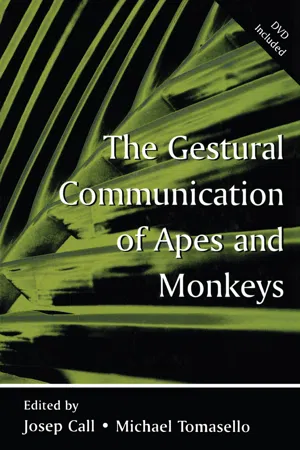
The Gestural Communication of Apes and Monkeys is an intriguing compilation of naturalistic and experimental research conducted over the course of 20 years on gestural communication in primates, as well as a comparison to what is known about the vocal communication of nonhuman primates. The editors also make systematic comparisons to the gestural communication of prelinguistic and just-linguistic human children. An enlightening exploration unfolds into what may represent the starting point for the evolution of human communication and language.
This especially significant read is organized into nine chapters that discuss:
*the gestural repertoire of chimpanzees;
*gestures in orangutans, subadult gorillas, and siamangs;
*gestural communication in Barbary macaques; and
*a comparison of the gestures of apes and monkeys.
This book will appeal to psychologists, anthropologists, and linguists interested in the evolutionary origins of language and/or gestures, as well as to all primatologists. A CD insert offers video of gestures for each of the species.
- 264 pages
- English
- ePUB (mobile friendly)
- Available on iOS & Android
eBook - ePub
The Gestural Communication of Apes and Monkeys
About this book
Trusted by 375,005 students
Access to over 1.5 million titles for a fair monthly price.
Study more efficiently using our study tools.
Information
Topic
PsicologiaCHAPTER 1
Introduction: Intentional Communication in Nonhuman Primates
Michael Tomasello
Josep Call
Max Planck Institute for Evolutionary Anthropology
Organisms seek information to help them make adaptive behavioral decisions. Some of that information comes from the behavior of conspecifics. For example, if a small youngster sees a large adult approaching food, she knows that there is no use contesting it. In this context, some organisms have evolved physical characteristics and/or behavior patterns that influence what others perceive and do in ways that accrue to their advantage. For example, many animals have developed ways of making themselves look bigger—puffing out parts of their bodies, raising their hair, and so forth—such that others are less likely to oppose them in contests of various kinds.
Physical characteristics and behavior patterns that have evolved to influence what other organisms perceive and do, especially conspecifics, are typically referred to by ethologists and behavioral ecologists as communicative signals. Since the arguments of Dawkins and Krebs (1978), the focus has been on the extent to which such signals are deceptive versus honest. Dawkins and Krebs argued that because only signals that favor the signaling individual could evolve, most signals provide others with misinformation (deceptive information) that gives the signaling individual an advantage it would not have had without the signal. On the other hand, often in the context of sexual selection, other theorists have argued that it is useful for an individual to advertise some advantage it has to potential mating partners or other potential interactants. Because ‘cheap’ signals are easy for individuals not possessing this advantage to fake, organisms have evolved a number of ‘honest’ signals that are so costly to produce that they cannot be faked; for example, only extremely strong and healthy male peacocks can afford to have huge tails because these represent a large handicap both energetically and in fleeing predators (Zahavi, 1997).
The kind of signals that are the topic of these debates are those that have been phylogentically ritualized under specific selection pressures (Tinbergen, 1951). But some social behaviors that would also seem to qualify as communicative signals have not arisen from evolutionary processes directly, but rather have been created and/or learned by individuals during their individual lifetimes. The most striking example is the many communicative signals and symbols that make up the 6,000+ different human languages of the world. Of course, although the ability to create these signals and symbols has evolved biologically, the signals themselves—for example, the greeting “Hello!” used by some but not all humans—would not seem to be subject to evolutionary pressures directly (even if greeting itself, as a general social function, somehow is). We may thus say that these signals have been ontogenetically ritualized, as individuals have in one way or another created or learned them during their own lifetimes—perhaps for more transitory functions. These signals quite often serve to regulate social interactions among individuals in ways that are mutually beneficial to both signaler and recipient alike.
The communicative signaling of the various species of nonhuman primates is a complex mix of phylogentically and ontogenetically ritualized signals used in many different social contexts. And indeed, many individual signals themselves arise from a confluence of different processes. For example, the alarm calls of some monkey species are made even by individuals raised in complete social isolation, suggesting that they have been crafted by evolution. However, knowing precisely when to use these signals, and how to respond to them when they are produced by others, appear to involve significant learning processes during ontogeny (Seyfarth & Cheney, 2003). There are also some signals in the gestural modality that seem to have been invented and used by only a single individual (Goodall, 1986). The important point in the current context is that communicative signals that involve a significant degree of learning require the signaler to make informed decisions about when and perhaps how to use them. That is, using communicative signals flexibly and appropriately requires learning and complex cognitive processes (Tomasello & Call, 1997).
In this book, we focus on the gestural communication of the four great ape species, along with that of one species of small ape and one species of cercopithecine monkey. The actual behavioral form of some of these gestural signals is at least partially phylogentically ritualized, whereas others would seem to be ontogenetically created and/or learned. In all cases, however, our focus is on gestural signals—no matter their source as behavioral forms—over which the signaler has significant behavioral control. In other words, the signals we are interested in are not signals that are invariably elicited by particular external or internal stimuli, but rather they are signals that the individual chooses to produce, or not to produce, in particular situations for particular social goals. Although the term sometimes creates confusion, we know of no better way to designate these strategically used signals than with the term intentional communication.
In this introductory chapter, we provide a brief review of what is known about primate vocal and gestural communication, with particular focus on those aspects that involve individual decision making and cognition. We also set the stage for our six case studies of primate gestural communication—involving chimpanzees, gorillas, orangutans, bonobos, siamangs, and Barbary macaques—by outlining the major theoretical and methodological issues involved.
PRIMATE VOCAL COMMUNICATION
By far the greatest amount of research has been done on primate vocal, as opposed to gestural, communication. Primates vocalize to one another in various contexts such as avoiding predators, defending against aggressors, traveling as a group, and discovering food. For the most part, all of the individuals of a given species use the same vocal signals, and no new vocal signals are invented individually. However, there is some flexibility in the precise manner in which a given call is produced. For example, rhesus monkey “coo” calls are acoustically more similar within than between matrilines (Hauser, 1992), and chimpanzees (and some other species) display population-specific “dialects” in some vocal signals (Mitani, Hasegawa, Gros-Louis, Marler, & Byrne, 1992). But experimental studies have suggested that such flexibility is severely limited (see Hammerschmidt & Fischer, in press). Thus, Owren, Dieter, Seyfarth, and Cheney (1992) found only minor modifications in the calls of two cross-fostered macaque species, and the modifications that were found mostly involved changes in the frequency of calls already in the animals’ repertoires.
Unlike call morphology, call usage seems to have a bit more flexibility, although learning may still play a highly constrained role to particular emotionally-charged situations. Thus, in most cases, calls are used in adultlike contexts from early in ontogeny, but then there is a learning phase in which more adultlike usage is fine tuned (see Snowdon, in press). For example, infant vervet monkeys often make mistakes by giving an eagle alarm call to various moving things in the sky, and they produce intergroup calls whenever they are distressed. Only later do they confine these to adultlike contexts (Seyfarth & Cheney, 1997). Tamarins that heard (and observed) a conspecific alarm calling after tasting peppered tuna fish, which the listeners themselves had not tasted, subsequently reduced the consumption of that food item even after the pepper had been removed (Snowdon & Boe, 2003). An especially important type of flexibility concerns audience effects, in which an individual uses its vocal signals differently depending on the social communicative situation. For example, some tamarins produce food calls when discovering food, but rates depend on whether or not other group mates are present (Caine, Addington, & Windfelder, 1995); male chimpanzees pant hoot more frequently in traveling contexts when their alliance partners are nearby (Mitani & Nishida, 1993); and vervet monkey females adjust the rate of alarm calling depending on whether their own offspring are present, whereas males call more often when females are present (Cheney & Seyfarth, 1985). On the other hand, in an experimental study, macaque females who saw a predator approaching their offspring in another location did not attempt to alert ignorant offspring more often than knowledgeable ones (Cheney & Seyfarth, 1990). This suggests that audience effects in primate vocal communication may not involve callers assessing the knowledge of recipients but only noting their presence or absence in the situation.
Undoubtedly, primates display most flexibility in the way they perceive and understand vocal signals. The classic case for context-sensitive comprehension is vervet monkey alarm calls in which individuals respond to acoustically distinct calls with particular types of antipredator responses even in the absence of the predator (Seyfarth & Cheney, 1990; Seyfarth, Cheney, & Marler, 1980). Convincing evidence that recipients are indeed responding to the meaning (reference) of such calls, and not to such things as their emotional intensity or the like, come from experiments in which individuals habituated to some call show dishabituation only when the meaning (referent) of calling is changed (e.g., Cheney & Seyfarth, 1988; Zuberbühler, Cheney, & Seyfarth, 1999). Interestingly, there are no convincing observations of such ‘referential vocal signals’ in any ape species, the closest possibility being the way chimpanzees adjust calling rate for food grunts used in the context of sharable and unsharable foods (Crockford, Herbinger, Vigilant, & Boesch, 2004; Hauser, Teixidor, Field, & Flaherty, 1993). In general, it may be said that the learning skills used in call comprehension show almost unlimited flexibility because a number of primate species can learn to effectively use the calls of other species, including some nonprimate species (Hauser, 1988; Zuberbühler, 2000).
Overall, then, nonhuman primates seem to have only limited control over their vocalizations—very little in terms of call morphology and a bit more in the case of call usage, including some adjustments for audience presence or absence. Current evidence suggests that nonhuman primates possess most flexibility in call comprehension, with some species even comprehending the calls of other species, which almost certainly requires learning.
PRIMATE GESTURAL COMMUNICATION
Primates also routinely communicate using manual and body gestures (see definition later), mainly in close-range social contexts such as play, grooming, nursing, and during sexual and agonistic encounters. These are in general less evolutionarily urgent functions than those signaled by acts of vocal communication, but nevertheless many of them are fairly involuntary facial expressions, body autonomic responses (e.g., piloerection), and the like. But an important subset of these seem intentional, in the sense of individual control. That is, unlike the case of vocal signals, there is good evidence that individuals of some primate species—most of the research is with great apes—invent new gestural signals as needed. Goodall (1986), for example, reported much variability in the gestures used by individual chimpanzees, including even a number of idiosyncratic gestures used by single individuals only, that could not have been either genetically determined or socially learned. Common gestures used by one or another ape species include such things as “arm raise,” “wrist offer,” “head-bob,” “chest beat,” “touch side,” “ground slap,” and “poke at.”
Apes most likely acquire many of their gestural signals via a process of ontogenetic ritualization (Tomasello, 1996). In ontogenetic ritualization, two organisms essentially shape one another’s behavior in repeated instances of a social interaction. The general form of this type of learning is:
• Individual A performs behavior X (not a communicative signal);
• Individual B consistently reacts by doing Y;
• Subsequently B anticipates A’s performance of X, on the basis of its initial step, by performing Y; and
• Subsequently, A anticipates B’s anticipation and produces the initial step in a ritualized form (waiting for a response) in order to elicit Y.
The main point is that a behavior that was not at first a communicative signal becomes one by virtue of the anticipations of the interactants over time. There is no evidence that any primate species acquires most of its gestural signals by means of imitative learning (Tomasello & Call, 1997). Indeed, de Waal and Johanovitz (1993) looked at the reconciliation gestures of juvenile rhesus and stumptail macaques who were co-housed for a period of 5 months and found that the nature of the gestures and displays for reconciliation remained unchanged for both species (even though the frequency of occurrence of some other behaviors did change).
With regard to flexibility of use, Tomasello and colleagues (1994, 1997) found that many chimpanzee gestures were used in multiple contexts, sometimes across widely divergent behavioral domains. Also, sometimes different gestures were used in the same context interchangeably toward the same end—and individuals sometimes performed these in rapid succession in the same context (e.g., initiating play first with a poke at followed by an arm raise). The gestural signals of many monkey species have not been studied much; however, those that have been studied do not appear to have this same degree of flexibility, but rather they are tied to particular communicative situations more in the manner of their vocal signals (Maestripieri, 1999). For what it is worth, in some studies both monkeys and apes have been observed learning to use some gestures to outwit competitors (e.g., Mitchell & Anderson, 1997; Woodruff & Premack, 1979). Although it is still unclear what level of psychological processes support those cases of “tactical deception,” they at least indicate that individuals can display a gesture outside its ordinary context of use (Whiten & Byrne, 1988).
In terms of audience effects, Tomasello and colleagues (1994, 1997) found that chimpanzee juveniles only give a visual signal to solicit play (e.g., arm raise) when the recipient is already oriented appropriately, but they use their most insistent attention getter, a physical poke at, most often when the recipient is socially engaged with others. Tanner and Byrne (1993) reported that a female gorilla repeatedly used her hands to hide her playface from a potential partner, indicating some flexible control of the otherwise involuntary grimace—as well as a possible understanding of the role of visual attention in the process of gestural com...
Table of contents
- Cover
- Half Title
- Title Page
- Copyright Page
- Table of Contents
- Preface
- 1 Introduction: Intentional Communication in Nonhuman Primates
- 2 The Gestural Repertoire of Chimpanzees (Pan troglodytes)
- 3 Gestures in Subadult Bonobos (Pan paniscus)
- 4 Gestures in Orangutans (Pongo pygmaeus)
- 5 Gestures in Subadult Gorillas (Gorilla gorilla)
- 6 Gestures in Siamangs (Symphalangus syndactylus)
- 7 Gestural Communication in Barbary Macaques (Macaca sylvanus): An Overview
- 8 Comparing the Gestures of Apes and Monkeys
- 9 Ape Gestures and the Origins of Language
- Author Index
- Subject Index
Frequently asked questions
Yes, you can cancel anytime from the Subscription tab in your account settings on the Perlego website. Your subscription will stay active until the end of your current billing period. Learn how to cancel your subscription
No, books cannot be downloaded as external files, such as PDFs, for use outside of Perlego. However, you can download books within the Perlego app for offline reading on mobile or tablet. Learn how to download books offline
Perlego offers two plans: Essential and Complete
- Essential is ideal for learners and professionals who enjoy exploring a wide range of subjects. Access the Essential Library with 800,000+ trusted titles and best-sellers across business, personal growth, and the humanities. Includes unlimited reading time and Standard Read Aloud voice.
- Complete: Perfect for advanced learners and researchers needing full, unrestricted access. Unlock 1.5M+ books across hundreds of subjects, including academic and specialized titles. The Complete Plan also includes advanced features like Premium Read Aloud and Research Assistant.
We are an online textbook subscription service, where you can get access to an entire online library for less than the price of a single book per month. With over 1.5 million books across 990+ topics, we’ve got you covered! Learn about our mission
Look out for the read-aloud symbol on your next book to see if you can listen to it. The read-aloud tool reads text aloud for you, highlighting the text as it is being read. You can pause it, speed it up and slow it down. Learn more about Read Aloud
Yes! You can use the Perlego app on both iOS and Android devices to read anytime, anywhere — even offline. Perfect for commutes or when you’re on the go.
Please note we cannot support devices running on iOS 13 and Android 7 or earlier. Learn more about using the app
Please note we cannot support devices running on iOS 13 and Android 7 or earlier. Learn more about using the app
Yes, you can access The Gestural Communication of Apes and Monkeys by Josep Call,Michael Tomasello in PDF and/or ePUB format, as well as other popular books in Psicologia & Psicologia cognitiva e cognizione. We have over 1.5 million books available in our catalogue for you to explore.