Stressing the use of several software packages based on simplex method variations, this text teaches linear programming's four phases through actual practice. It shows how to decide whether LP models should be applied, set up appropriate models, use software to solve them, and examine solutions to a
1 Introduction to Systems of Linear Equations (Linear Systems) and Related Properties of Matrices
The topics presented in this introductory chapter are used to formulate and analyze models for a wide variety of practical problems in subsequent chapters. If you have been exposed to systems of linear equations and matrix operations, you may wish merely to skim this chapter to pick up the notation and then proceed to Chapter 2, where linear programming is introduced. In this chapter we discuss solving linear systems by row reduction, matrix operations, rank, and linear independence. Two examples are used to motivate definitions and illustrate concepts.
1.1 Linear Systems
The discussion of linear systems begins with Example 1.1.
Example 1.1. Solve the linear system
2 x1 + 3 x2 = 3
−x1 + 2 x2 = 4.
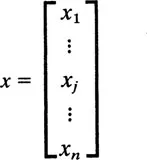
Solve means to find all two-dimensional vectors
that satisfy both equations (1) and (2); here x is a pair x1, x2 of numbers written in column form. Except for the names x1 and x2 of the variables (unknowns), all the information that we need to solve the system is given by the parameters of the system; the parameters of the system are the coefficients of the variables and the numbers on the right-hand side of the equations. For Example 1.1, all of this information is contained in the augmented matrix
which is composed of the coefficient matrix
followed by the right-hand-side vector
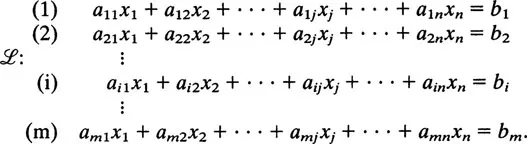
. Examples 1.1 and 1.2 below illustrate how to solve the general m × n linear system:
Solving this linear system means finding all n-dimensional column vectors
that satisfy the equations (1), (2),…, (m). The ai,j’s and bi’s are (specific) numbers called parameters of the system. Again, except for the names x1, x2, …, xn o...
Table of contents
Cover
Half Title
Series Page
Title Page
Copyright Page
Dedication
Preface
Table of Contents
Original Half Title
Chapter 1. Introduction to Systems of Linear Equations (Linear Systems) and Related Properties of Matrices
Chapter 2. Introduction to Linear Programming
Chapter 3. Elementary Properties of the Feasible Set for an LP
Chapter 4. Introduction to the Simplex Method
Chapter 5. Topics in LP and Extensions
Chapter 6. Duality
Chapter 7. Quadratic Programming
Chapter 8. Minimizing a Quadratic Function
Chapter 9. Network Algorithms
Appendix 1. Forms of LPs
Appendix 2. Solutions Supplement for Chapter 2
Appendix 3. Solutions Supplement for Chapter 5
Reading List
Index
Trusted by 375,005 students
Access to over 1.5 million titles for a fair monthly price.
Study more efficiently using our study tools.
Frequently asked questions
Yes, you can cancel anytime from the Subscription tab in your account settings on the Perlego website. Your subscription will stay active until the end of your current billing period. Learn how to cancel your subscription
No, books cannot be downloaded as external files, such as PDFs, for use outside of Perlego. However, you can download books within the Perlego app for offline reading on mobile or tablet. Learn how to download books offline
Perlego offers two plans: Essential and Complete
Essential is ideal for learners and professionals who enjoy exploring a wide range of subjects. Access the Essential Library with 800,000+ trusted titles and best-sellers across business, personal growth, and the humanities. Includes unlimited reading time and Standard Read Aloud voice.
Complete: Perfect for advanced learners and researchers needing full, unrestricted access. Unlock 1.5M+ books across hundreds of subjects, including academic and specialized titles. The Complete Plan also includes advanced features like Premium Read Aloud and Research Assistant.
Both plans are available with monthly, semester, or annual billing cycles.
We are an online textbook subscription service, where you can get access to an entire online library for less than the price of a single book per month. With over 1.5 million books across 990+ topics, we’ve got you covered! Learn about our mission
Look out for the read-aloud symbol on your next book to see if you can listen to it. The read-aloud tool reads text aloud for you, highlighting the text as it is being read. You can pause it, speed it up and slow it down. Learn more about Read Aloud
Yes! You can use the Perlego app on both iOS and Android devices to read anytime, anywhere — even offline. Perfect for commutes or when you’re on the go. Please note we cannot support devices running on iOS 13 and Android 7 or earlier. Learn more about using the app
Yes, you can access Introduction to Linear Programming by Richard Darst in PDF and/or ePUB format, as well as other popular books in Mathematics & Computer Science General. We have over 1.5 million books available in our catalogue for you to explore.