eBook - ePub
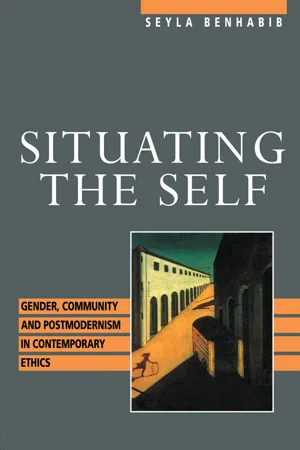
Situating the Self
Gender, Community, and Postmodernism in Contemporary Ethics
- 276 pages
- English
- ePUB (mobile friendly)
- Available on iOS & Android
eBook - ePub
About this book
This book is an attempt to defend the tradition of universalism in the face of a triple-pronged critique by engaging with the claims of feminism, communitarianism, and postmodernism and by learning from them. It situates reason and the moral self more decisively in contexts of gender and community.
Information
PART I
Modernity, Morality and Ethical Life
1
In the Shadow of Aristotle and Hegel
Communicative Ethics and Current Controversies in Practical Philosophy
In their Introduction to Revisions: Changing Perspectives in Moral Philosophy, Stanley Hauerwas and Alasdair MacIntyre write:
This is not the first time that ethics has been fashionable. And history suggests that in those periods when a social order becomes uneasy and even alarmed about the weakening of its moral bonds and the poverty of its moral inheritance and turns for aid to the moral philosopher and theologian, it may not find these disciplines flourishing in such a way as to be able to make available the kind of moral reflection and theory which the culture actually needs. Indeed on occasion it may be that the very causes which have led to the impoverishment of moral experience and the weakening of moral bonds will also themselves have contributed to the formation of a kind of moral theology and philosophy which are unable to provide the needed resources.1
If this statement can be viewed as a fairly accurate indication of the Zeitgeist concerning ethical theory today, then this certainly does not bode well for yet another program of ethical universalism and formalism in the Kantian tradition. Such ethical formalism is considered a part of the Enlightenment project of rationalism and of the political project of liberalism, and it is argued that precisely these intellectual and political legacies are an aspect, if not the main cause, of the contemporary crisis. If communicative or discourse ethics is to be at all credible, it must be able to meet the kind of challenges posed by MacIntyre and Hauerwas.
Communicative or discourse ethics, as formulated by Karl-Otto Apel and Jürgen Habermas over the last two decades, is informed both by the Anglo-American and Continental traditions of thought and is witness to a provocative interaction between them. This project has been influenced by the work of such moral philosophers as Kurt Baier, Alan Gewirth, H. M. Hare, Marcus Singer and Stephen Toulmin on moral reasoning and universalizability in ethics.2 Above all, it is in John Rawls’s neo-Kantian constructivism and Lawrence Kohlberg’s cognitive-developmental moral theory that Apel and Habermas have found the most kindred projects of moral philosophy in the Anglo-American world.3
The central insight of communicative or discourse ethics derives from modern theories of autonomy and of the social contract, as articulated by John Locke, Jean-Jacques Rousseau, and in particular by Immanuel Kant. Only those norms and normative institutional arrangements are valid, it is claimed, which individuals can or would freely consent to as a result of engaging in certain argumentative practices. Apel maintains that such argumentative practices can be described as “an ideal community of communication” (die ideale Kommunikationsgemeinschaft), while Habermas calls them “practical discourses.” Both agree that such practices are the only plausible procedure in the light of which we can think of the Kantian principle of “universalizability” in ethics today. Instead of asking what an individual moral agent could or would will, without self-contradiction, to be a universal maxim for all, one asks: what norms or institutions would the members of an ideal or real communication community agree to as representing their common interests after engaging in a special kind of argumentation or conversation? The procedural model of an argumentative praxis replaces the silent thought-experiment enjoined by the Kantian universalizability test.
In this chapter I would like to acknowledge the challenge posed to communicative ethics from a standpoint which I will roughly describe as “neo-Aristotelian” and “neo-Hegelian.” Since Aristotle’s criticism of Plato’s theory of the good and of the ideal state in his Nicomachean Ethics and Politics,4 and since Hegel’s critique of Kantian ethics in his various writings,5 formalist and universalist ethical theories have been continuously challenged in the name of some concrete historical-ethical community or, in Hegelian language, of some Sittlichkeit. In fact, Apel and Habermas admit that one cannot ignore the lessons of Hegel’s critique of Kantian morality.6 Whether they have successfully integrated these lessons into communicative ethics is worth examining more closely.
A word of terminological clarification at the outset. In recent discussions “neo-Aristotelianism” has been used to refer to three, not always clearly distinguished, strands of social analysis and philosophical argumentation. Particularly in the German context, this term has been identified with a neoconservative social diagnosis of the problems of late-capitalist societies.7 Such societies are viewed as suffering from a loss of moral and almost civilizational orientation, caused by excessive individualism, libertarianism, and the general temerity of liberalism when faced with the task of establishing fundamental values. Neither capitalist economic and societal modernization, nor technological changes are seen as basic causes of the current crisis; instead political liberalism and moral pluralism are regarded as the chief causes of this situation. From Robert Spaemann to Allan Bloom, this position has found vigorous exponents today.
The term “neo-Aristotelian” is also frequently used to designate the position of thinkers like Alasdair MacIntyre, Michael Sandel, Charles Taylor and Michael Walzer, who lament the decline of moral and political communities in contemporary societies.8 But unlike the neoconservatives, the “communitarian” neo-Aristotelians are critical of contemporary capitalism and technology. The recovery of “community” need not only or even necessarily mean the recovery of some fundamentalist value scheme; rather communities can be reconstituted by the reassertion of democratic control over the runaway megastructures of modern capital and technology. The communitarians share with neoconservatives the belief that the formalist, ahistorical and individualistic legacies of Enlightenment thinking have been historically implicated in developments which have led to the decline of community as a way of life. Particularly today, they argue, this Enlightenment legacy so constricts our imagination and impoverishes our moral vocabulary that we cannot even conceptualize solutions to the current crises of welfare-state type democracies which would transcend the “rights-entitlement-distributive justice” trinity of political liberalism.
Finally, “neo-Aristotelianism” refers to a hermeneutical philosophical ethics, taking as its starting point the Aristotelian understanding of phronesis. Hans-Georg Gadamer was the first to turn to Aristotle’s model of phronesis as a form of contextually embedded and situationally sensitive judgment of particulars.9 Gadamer so powerfully synthesized Aristotle’s ethical theory and Hegel’s critique of Kant that after his work the two strands of argumentation became almost indistinguishable. From Aristotle’s critique of Plato, Gadamer extricated the model of a situationally sensitive practical reason, always functioning against the background of the shared ethical understanding of a community.10 From Hegel’s critique of Kant, Gadamer borrowed the insight that all formalism presupposes a context that it abstracts from and that there is no formal ethics which does not have some material presuppositions concerning the self and social institutions.11 Just as there can be no understanding which is not situated in some historical context, so there can be no “moral standpoint” which would not be dependent upon a shared ethos, be it that of the modern state. The Kantian moral point of view is only intelligible in light of the revolutions of modernity and the establishment of freedom as a principle of the modern world.
These three strands of a neoconservative social diagnosis, a politics of community and a philosophical ethics of a historically informed practical reason form the core elements of the contemporary neo-Aristotelian position. This chapter will deal with neo-Aristotelianism not as a social diagnosis or as a political philosophy but primarily as philosophical ethics. The political and social implications of neo-Aristotelian and communitarian positions will be discussed in the following chapter.
Let me now formulate a series of objections to communicative ethics. Some version of these has been voiced by thinkers inspired by Aristotle and Hegel against Kantian-type ethical theories at some point or another. My goal is to show that these objections have not succeeded in delivering a coup de grace (a blow of mercy) to a dialogically reformulated universalist ethical theory. A serious exchange between such a universalist ethical theory, which presupposes neither the methodological individualism nor the ahistoricism of traditional Kantian ethics, and a hermeneutically inspired neo-Aristotelianism can lead us to see that some traditional oppositions and exclusions in moral philosophy are no longer convincing. Such oppositions as between universalism and historicity, between an ethics of principle and one of contextual judgment, or as between ethical cognition and moral motivation, within the confines of which much recent discussion has run, are no longer compelling. Just as it is not the case that there can be no historically informed ethical universalism, it is equally not the case that all neo-Aristotelianism must defend a conservative theory of communal ethics. In this chapter I will be concerned to indicate how such false oppositions can be transformed into a more fruitful set of contentions between two types of ethical theorizing which have marked the western philosophical tradition since its beginnings in Socrates’ challenge to the Sophists and his condemnation to death by the city of Athens.
1 Skepticism toward the Principle of Universalizability. Is it at best Inconsistent and at worst Empty?
Hegel had criticized the Kantian formula, “Act only on that maxim through which you can at the same time will that it should become a universal law,” on numerous occasions as being inconsistent at best and empty at worst.12 Hegel argued that the test alone whether or not a maxim could be universalized could not determine its moral rightness. As he pointed out in his early essay on Natural Law, whether or not I should return deposits entrusted to me is answered in the affirmative by Kant with the argument that it would be self-contradictory to will that deposists should not exist. The young Hegel answers that there is no contradiction in willing a situation in which deposits and property do not exist, unless of course we make some other assumptions about human needs, scarce resources, distributive justice and the like. Out of the pure form of the moral law alone, no concrete maxims of action can follow and if they do, it is because other unidentified premises have been smuggled into the argument.13
In view of this Hegelian critique, which influences discussions of Kantian ethics even today,14 the response of Kantian moral theorists has been twofold: first, some have accepted Hegel’s critique that the formal procedure of universalizability can yield no determinate test of the rightness of maxims; they admit that one must presuppose some minimally shared conception of human goods and desires as goals of action, and must test principles of action against this background. This line of response has weakened the Kantian distinction between autonomy and heteronomy by accepting that the goals of action may be dictated by contingent features of human nature rather than by the dictates of pure practical reason alone. John Rawls’s list of “basic goods,” which rational agents are supposed to want whatever else they also want, is the best example of the introduction of material assumptions about human desires into the universalizability argument. The test of universalizability is not about whether we want these goods but rather about the moral principles guiding their eventual distribution.15 Other Kantian moral philosophers, and most notably among them Onora O’Neill and Alan Gewirth, have refused to jettison the pure Kantian program, and have attempted to expand the principle of the non-contradiction of maxims by looking more closely at the formal features of rational action. O’Neill, for example, distinguishes between “conceptual inconsistency” and “volitional inconsistency” in order to differentiate among types of incoherence in action.16 “The non-universalized maxim,” she writes, “embodies a conceptual contradiction only if it aims at achieving mutually incompatible objectives and so cannot under any circumstances be acted on with success.”17 Volitional inconsistency, by contrast, occurs when a rational agent violates what O’Neill names “principles of rational intending.”18 Applying universalizability to maxims of action both to test their conceptual consistency and their volitional consistency avoids, so argues O’Neill, “the dismal choice between triviality and implausible rigorism.”19 In a similar vein, Alan Gewirth expands on the idea of the “rational conditions of action” in order to derive from them nontrivial and intersubjectively binding maxims of moral action.20
Both strategies have problems. In the first case, by allowing material presuppositions about human nature and desires into the picture, one runs the risk of weakening the distinction between Kantian and other types of utilitarian or Aristotelian moral theories. The result is a certain eclecticism in the structure of the theory. The second position runs a different danger: by focussing exclusively on the conditions of rational intending or acting, as O’Neill and Gewirth do, one can lose sight of the question of intersubjective moral validity. After all, the Kantian principle of universalizability was formulated in order to generate morally binding maxims of action which all can recognize. As Alasdair MacIntyre shows in his sharp critique of Gewirth, from the premise that I as a rational agent require certain conditions of action to be fulfilled, it can never follow that you have an obligation not to hinder me from enjoying these conditions.21 The grounds for this obligation are left unclear; but it is precisely such grounds that the universalizability requirement was intended to produce. Put in terms which are those of Apel and Habermas, the analysis of the rational structure of action for a single agent produces an egological moral theory which cannot justify inter-subjective moral validity. Instead of asking what I as a single rational moral agent can intend or will to be a universal maxim for all without contradiction, the communicative ethicist asks: what principles of action can we all recognize or agree to a...
Table of contents
- Cover
- Half Title
- Dedication Page
- Title Page
- Copyright Page
- Contents
- Acknowledgments
- Introduction Communicative Ethics and the Claims of Gender, Community and Postmodernism
- PART I Modernity, Morality and Ethical Life
- PART II Autonomy, Feminism and Postmodernism
- Index
Trusted by 375,005 students
Access to over 1.5 million titles for a fair monthly price.
Study more efficiently using our study tools.
Frequently asked questions
Yes, you can cancel anytime from the Subscription tab in your account settings on the Perlego website. Your subscription will stay active until the end of your current billing period. Learn how to cancel your subscription
No, books cannot be downloaded as external files, such as PDFs, for use outside of Perlego. However, you can download books within the Perlego app for offline reading on mobile or tablet. Learn how to download books offline
Perlego offers two plans: Essential and Complete
- Essential is ideal for learners and professionals who enjoy exploring a wide range of subjects. Access the Essential Library with 800,000+ trusted titles and best-sellers across business, personal growth, and the humanities. Includes unlimited reading time and Standard Read Aloud voice.
- Complete: Perfect for advanced learners and researchers needing full, unrestricted access. Unlock 1.5M+ books across hundreds of subjects, including academic and specialized titles. The Complete Plan also includes advanced features like Premium Read Aloud and Research Assistant.
We are an online textbook subscription service, where you can get access to an entire online library for less than the price of a single book per month. With over 1.5 million books across 990+ topics, we’ve got you covered! Learn about our mission
Look out for the read-aloud symbol on your next book to see if you can listen to it. The read-aloud tool reads text aloud for you, highlighting the text as it is being read. You can pause it, speed it up and slow it down. Learn more about Read Aloud
Yes! You can use the Perlego app on both iOS and Android devices to read anytime, anywhere — even offline. Perfect for commutes or when you’re on the go.
Please note we cannot support devices running on iOS 13 and Android 7 or earlier. Learn more about using the app
Please note we cannot support devices running on iOS 13 and Android 7 or earlier. Learn more about using the app
Yes, you can access Situating the Self by Seyla Benhabib in PDF and/or ePUB format, as well as other popular books in Philosophy & Critical Theory. We have over 1.5 million books available in our catalogue for you to explore.