- 152 pages
- English
- ePUB (mobile friendly)
- Available on iOS & Android
eBook - ePub
About this book
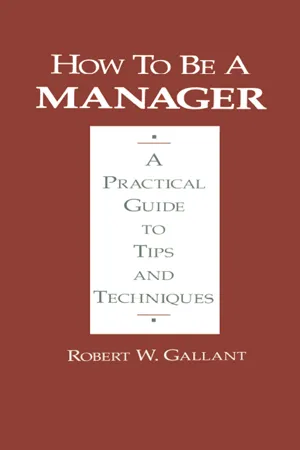
How to be a Manager: A Practical Guide to Tips and Techniques is a useful book designed to show you how to develop your managerial understanding and skills at whatever job level you presently hold. Written by an experienced top-level manager, this fast-paced guide teaches you how to excel at your current position while preparing to move into higher management responsibilities.
The book is organized so that each of the 18 chapters can be read and used for specific management tasks. However, each chapter builds on the understanding of overall management concepts so that by the end of the book, a broad array of management principles has been presented. The "what and why" of management principles is interwoven with techniques and specific examples of typical managerial problems. Recommendations for further reading are also incorporated so that this book can serve as the foundation for every professional's library of management lore. Whether ground-breaking entrepreneur or commercial manager directing 300 salesmen spread across the country, this book will show you the way to successful management.
Trusted by 375,005 students
Access to over 1.5 million titles for a fair monthly price.
Study more efficiently using our study tools.
Chapter 1
TIME BANKING
(The First Step Toward Becoming A Manager)
Dear Bob:
All through college, I dreamed of becoming a manager. When I went to work, my goal was to be a manager. I’ve been out of college 3 years now, working in a manufacturing plant for a large chemical company. Some of the work is very stimulating engineering, but so much of my time is consumed working on routine activities like weekly production reports, or repairing something that breaks down. The problems and routine jobs keep me so busy, I don’t have a chance to demonstrate my ability to be a manager. I’m not getting any management experience.
I don’t mind working extra hours to achieve my goals, and I expect to spend time building a foundation, but I feel bogged down. I need help. You made it to the management level. What should I do?
Chuck
Dear Chuck:
If it is any consolation, many engineers struggle with the same concern you have. I certainly did. You are wise to consider early in your career the question of how to become a manager. Being a topnotch engineer all your career can be exciting and rewarding both professionally and financially. However, managers usually enjoy added prestige, more independence, and higher salaries than someone who stays predominantly an engineer. The manager is in the know early on major company decisions and helps shape those decisions. Being a manager has many advantages.
But reaching the management ranks is a difficult task. Only one out of ten engineers will make it to a significant management level, and only one out of a hundred will attain an upper management position. The competition is stiff and there are no easy routes. At times, you will have to deal with the disappointment of not receiving a promotion that you felt was rightly yours. Because even in the best managed companies, some promotions go to the person who was in the right place at the right time, or had worked for the right person, or duped management into believing they had accomplished much more than was actually true. You may sometimes work for a poor supervisor who slows up your advancement All of these may influence the level of management that you obtain. But the biggest influence on your future is your own performance, both individually and as a supervisor of others. Let’s talk about how to enhance that performance so that you are one of those one in ten or one in a hundred that attains the management level and excels at it.
It’s very important to understand the difference between engineering and management. The discipline we learned in engineering courses makes us seek exact answers. The same equations give the same answers as long as we use the same bases. The time frame to know if we are right or wrong on a decision is reasonably short, usually less than three years. Mistakes are made in steel and concrete that can be corrected with dollars. In many cases, the decision and the implementation are in our hands.
In contrast, a manager’s bases are more nebulous, the results less predictable, and the decisions often sail into uncharted waters. Mistakes are measured in flesh and blood, because management decisions invariably affect people. Measuring success or failure may require five years or more. The easy decisions are made at levels below you. Most of your decisions will require painful compromise between complex alternatives. Furthermore, the success of those decisions will depend, not on your performance, but on the performance of others. For a prime fact of management is that you must delegate to others the authority and the responsibility to make many of the decisions and to implement all of them.
If you like stress, you have come to the right place. I say this in a positive sense, because a good manager utilizes the stress that goes with the job. Stress can be a catalyst that fires a person up in the same way that a great athlete draws on the rush of adrenalin to break a record or score the impossible winning goal.
Having said all this, let me say unequivocally, based on my own personal experience, being a manager is absolutely exhilarating, challenging, and rewarding. I thoroughly enjoyed and thrived as an engineer, but being a manager surpasses anything I ever did.
So how do you personally lay the foundation for climbing the management ladder?
First, your present assignment offers fertile ground to develop management skills. The skills that are essential ingredients of being a good manager also make you a better engineer. The fundamental keys to building and demonstrating your management capabilities can be honed and used right where you are.
Rather than starting on management philosophy, let me first talk about Time Banking, because Time Banking is one of the single most important techniques that you develop, whether you remain an engineer or reach the management ranks. Time Banking is to your job what a savings account is to your financial well being. Financially, a savings account earns dividends for us. It provides a reservoir that we can dip into for emergencies, or even on a planned basis to allow purchasing something at the right time for the right price. It gives us flexibility in our finances. A savings account is the cornerstone for our financial future, allowing us to be more adventuresome with our other funds.
Time Banking serves exactly the same purpose in our job. In its simplest terms, Time Banking means spending time today to save time in the future. For example, you have a relatively routine weekly report that requires about 3 hours to gather and calculate the data. With it due on Friday, you compile the data off the instrument and operator sheets on Thursday, do the necessary calculations, write up a summary, propose the next action needed, and give it to the secretary Friday morning.
Next week, stay over an extra 6 hours and format a program on the computer that does the calculations and prints out a finished format when you input the data. You then add the necessary comments and the report is ready for final typing. That effort cuts your time to 2 hours a week. You have saved 1 hour per week by expending 6 hours now. So your payout time is six weeks. That is a quick return on your investment, in economic jargon. In fact, properly formatted, the report may also eliminate routine work by your secretary. Good managers work very hard at reducing the workload on everyone.
Next, you spend that saved 1 hour per week teaching the lab technicians how to measure, record, and input the data. You develop a report format that allows them to eliminate their present lab data sheet and use just this new report sheet. That’s practicing another important management technique — delegating responsibility to the lowest appropriate level and providing the training so that they do it well. You are now down to 1 hour per week on this report. That one hour is spent analyzing the data and writing the summary; plus doing “quality control,” i.e., checking out some of the input data personally. Another characteristic of a good manager is regularly inspecting the bases to be certain the input is right, and that the training was adequate.
You have now banked 2 hours a week to do other time banking tasks. Note that what you eliminated was the repetitious, non-engineering, non-supervisory portion of the task but retained and enforced the management aspects (analysis, decisionmaking, delegation, and inspection). You now use that 2 hours for other Time Banking tasks. If an unexpected problem requires immediate attention, the report is still completed on time because your involvement is less than 1 hour.
An even more important use of Time Banking is tackling recurring problems. For example, a pump on the storage tank occasionally vapor locks, doubling the loading time for the railroad cars. There is no obvious reason. Getting it working properly takes four hours of your time, plus the loading man’s time, and sometimes a shipment is delayed a day.
Let’s assume that by spending 18 hours of your time digging through all the data, running tests on the pump, etc., you determine the cause. You spend another 10 hours installing the proper instrumentation to eliminate the problem. It took 28 hours of your time to solve a problem that costs you 8 hours a month, plus significant hours of your loading person’s time. On your basis alone, you have a 4-month payout. Additionally, you’ve reduced the workload on other people in your group. More importantly, you have eliminated a problem that when it occurs demands your time right now, and may sometime cause a serious situation.
Most important of all, you have just practiced one of the most critical rules of being a good manager. A good manager does not tolerate problems. Not even small problems! Small problems ignored have a terrible tendency for some day dealing serious consequences: injuries to people, ruined equipment, missed shipments to customers, poor morale among your employees.
I still remember the day in my production plant when a perennial tiny leak at a pump seal became a small fire which burned out the wiring to a minor instrument which messed up an important controller which upset a very large reactor system which caused a massive runaway reaction that culminated in a heart-stopping rupture disc failure that damaged trays in a giant stripping tower and wrecked a large compressor. The result was a 7-day shutdown and a half million dollar repair bill. All of us knew about that perennial nuisance but none of us made it go away; until it caused a big problem and then all of us jumped in and solved it. Bhopal is the most famous minor problem which escalated into a catastrophe of gigantic proportions.
In production plants, we often apply quick fixes to problems to keep the plant running. It’s like taking aspirin for a fever. The aspirin temporarily reduces the fever but it does nothing to eliminate the infection. Having been a plant superintendent, I know that using aspirin on a problem is often a necessary short-term solution. I used a lot of aspirin. However, it is never an appropriate substitute for solving the problem. Do what must be done at the time, but then find the source of the problem and cure it. Cure it once and forever! Small problems drain your time and your energy. Eventually some of them grow into malignant tumors that require performing drastic surgery or, even worse, killing the patient. So store this in your memory banks. Good managers do not tolerate problems!
Time Banking has three key objectives:
1. Reduce repetitious, time-consuming tasks.
2. Solve and eliminate recurring problems.
3. Free your time for more productive, creative responsibilities.
Time Banking is so obvious, it is surprising how underused it is. The most common excuse is, “I don’t have time. I’m buried already with work.” The truth about Time Banking is the same as for saving money. You really don’t have any to save because it is all being consumed by the daily requirements. Fortunately, unlike money, you have access to extra quantities of time. You can work at night, you can come in to work on weekends, you can even skip lunch. If it sounds like I’m suggesting being a workaholic, quite the contrary. Working 60 hours a week is a poor substitute for not practicing Time Banking.
The person who doesn’t practice Time Banking is like a tennis playing friend of mine who lamented when he turned age 50, “My brain still tells me where I need to be on the tennis court, but my feet get me there a fraction of a second too late.” If you want to be a manager, your brain and your feet need to get you there in the right place at the right time. Time Banking is a way to make that happen. Time Banking is what makes you the person about whom the manager comments, “Chuck always seems to be one step ahead of the problems and has the time to do the extra jobs.”
Time Banking allows you to accomplish more in fewer hours. It also lets you choose your priorities rather than being forced to delay other important tasks for lack of time. That’s very important because a manager is always short of time. Developing the Time Banking technique now is probably essential to receiving the opportunity to be a manager, and is absolutely essential to performing well when you become a manager.
Successful Time Banking also enables you to carry out another important step in reaching the management level: taking on extra responsibility. Most jobs start off inside a box, with relatively well defined responsibilities and tasks. The management-savvy engineer quickly begins expanding that box by mastering the regular job, building up a Time Banking account, then cashing in some of the dividends to “buy” extra responsibilities. Pick tasks that make the department operate better or unload time from your supervisor. Properly chosen tasks broaden your insight and experience. As a manufacturing plant engineer, make a trip with the marketing man to see a customer. Understanding the customer needs might enable you to improve your product quality and service. It will certainly earn you some high marks from the marketing people. Time spent with a marketing person will give you new insight into a very important part of your company’s activities. All of these factors may pay big dividends in the future.
If you and another plant are arguing every month over the metered quantity of steam or raw materials coming into the plant, take on the assignment of working out a solution with the other department. Volunteer to head up the department safety committee. Even offer to write the report on long term capital spending needs (I know — ugghh! Nobody volunteers to write a report.) But you will volunteer and spend the time to do those jobs well.
The point is, reach outside that arbitrary box and learn what else is going on. Get exposure to other people’s ideas and techniques. Find out what they are thinking and why they do things a particular way. Learn how to negotiate with people to resolve differences. Make yourself the person the manager thinks of when there is a significant project that needs a strong person to handle it.
Cleaning out the dull, energy-sapping jobs, and eliminating time-consuming problems in your regular job gives you the time to handle your assigned responsibilities, deal with unexpected emergencies, and still reach out for other opportunities.
Okay, we can agree that Time Banking is a great idea. But how do you start?
First, do a diagnosis of how your time is spent now. Don’t be too specific. Break it down into about ten jobs and the time each one requires per week. Second, list the nonrecurring time consumers that have happened in the past 2 months. Third, list the five most bothersome recurring problems or tasks that you have. Fourth, select six items from those lists as candidates for Time Banking resolution. Beside each one record your estimate as to how much time it would take you to eliminate or significantly reduce the present time burden.
Resolve that you will accomplish at least one of these within the next 30 days. Then make it happen! Don’t let anything keep you from spending the time necessary. Work nights and weekends, or come in early each morning. Incidentally, coming in an hour early each morning for a month can accomplish wonders. It is 23 hours that seems to come out of nowhere. Actually it comes out of the hours you sleep b...
Table of contents
- Cover
- Title Page
- Copyright Page
- Preface
- The Author
- Table of Contents
- Chapter 1 Time Banking
- Chapter 2 Management Techniques
- Chapter 3 Customer Satisfaction and Competitive Edge
- Chapter 4 People Development
- Chapter 5 Average Performers
- Chapter 6 Discipline
- Chapter 7 Presentations
- Chapter 8 Handling Authority
- Chapter 9 Risk Versus Reward
- Chapter 10 When Things Go Wrong
- Chapter 11 Dealing With Change
- Chapter 12 Dealing With Stagnation
- Chapter 13 Making Training Work
- Chapter 14 The Winning Edge in Negotiations
- Chapter 15 Strategic Future Vision
- Chapter 16 Integrity
- Chapter 17 The Ethics of Management
- Chapter 18 Summing it Up
Frequently asked questions
Yes, you can cancel anytime from the Subscription tab in your account settings on the Perlego website. Your subscription will stay active until the end of your current billing period. Learn how to cancel your subscription
No, books cannot be downloaded as external files, such as PDFs, for use outside of Perlego. However, you can download books within the Perlego app for offline reading on mobile or tablet. Learn how to download books offline
Perlego offers two plans: Essential and Complete
- Essential is ideal for learners and professionals who enjoy exploring a wide range of subjects. Access the Essential Library with 800,000+ trusted titles and best-sellers across business, personal growth, and the humanities. Includes unlimited reading time and Standard Read Aloud voice.
- Complete: Perfect for advanced learners and researchers needing full, unrestricted access. Unlock 1.5M+ books across hundreds of subjects, including academic and specialized titles. The Complete Plan also includes advanced features like Premium Read Aloud and Research Assistant.
We are an online textbook subscription service, where you can get access to an entire online library for less than the price of a single book per month. With over 1.5 million books across 990+ topics, we’ve got you covered! Learn about our mission
Look out for the read-aloud symbol on your next book to see if you can listen to it. The read-aloud tool reads text aloud for you, highlighting the text as it is being read. You can pause it, speed it up and slow it down. Learn more about Read Aloud
Yes! You can use the Perlego app on both iOS and Android devices to read anytime, anywhere — even offline. Perfect for commutes or when you’re on the go.
Please note we cannot support devices running on iOS 13 and Android 7 or earlier. Learn more about using the app
Please note we cannot support devices running on iOS 13 and Android 7 or earlier. Learn more about using the app
Yes, you can access How to be a Manager by Robert W. Gallant in PDF and/or ePUB format, as well as other popular books in Business & Human Resource Management. We have over 1.5 million books available in our catalogue for you to explore.