eBook - ePub
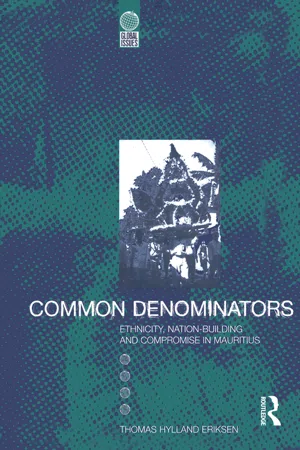
Common Denominators
Ethnicity, Nation-Building and Compromise in Mauritius
- 224 pages
- English
- ePUB (mobile friendly)
- Available on iOS & Android
eBook - ePub
About this book
This book seeks to enhance comparative understandings of ethnicity, to refine theories of nationalism, and to contribute to ongoing debates on multiculturalism, identity politics and creolization. Mauritius, an Indian Ocean island-state with a population of about one million, provides a fascinating focus for this comprehensive study of social identity and political culture. Fifteen languages are officially spoken on the island, and four world religions are represented, as well as a high number of ethnic groups. The author argues that the social importance of ethnicity depends not only on political and economic circumstances, but also on kinship organization, and shows how ethnicity is expressed through the idioms of language and religion. However, it is also shown how ethnic identity may be superseded by other forms of belongingness and politics in the contemporary age. Nationhood, gender, class and individualism are all examined for the role they play in social organization and the formation of collective identity. Multiethnic and peaceful, the pace of social change in Mauritius has been rapid throughout the 1980s and 1990s. The ways in which Mauritians negotiate the relationship between ethnic, national and other identities in forging a surprisingly stable and democratic society, and the peculiar tensions which arise in the interface between the ethnic and the non-ethnic, ought to be familiar to anyone concerned with the future of multiethnic societies.
Information
CHAPTER ONE
Introduction
Commenting obliquely but accurately on the genre of biography, Virginia Woolf lets the protagonist of her novel Orlando (1928) assume an enormous and seemingly unrealistic variety of social roles and identities, right down to the point of changing gender. Yet, the narrator says towards the end of the book, she has written only a small fraction of the possible biographies that could be written about Orlando; in other words, persons have many more dimensions than a single book might reveal.
The people of Mauritius, it is tempting to say, collectively exploit a fair proportion of Orlando’s vast role repertoire. Mauritius, a polyethnic island-state in the south-western Indian Ocean, has for historical reasons an ethnically very diverse population of about one million, four major religions, a large but uncertain number of languages, and no indigenous population. Widely considered an economic miracle by the 1990s, Mauritius is also a stable multi-party democracy that has gone through several peaceful changes of government since independence in 1968. Mauritius has, since its independence, consistently failed to fulfil the predictions of gloomy prophets. The island, regarded by its colonial administrators as hopelessly overpopulated, ethnically divided and overdependent on sugar mono-culture (Meade et al. 1961), is currently prospering, and its population seems to cope efficiently with problems formerly perceived as insurmountable. In one of the few scholarly books on Mauritius written by foreigners, the anthropologist Burton Benedict ends with a prophetic statement: ‘The ethnic divisions of Mauritius are changing. They are no longer mere categories but are becoming corporate groups. The danger of communal conflict increases’ (Benedict 1965:67). His argument, which seemed reasonable at the time of its proposal, was not immediately proved wrong, and the first half of the syllogism was correct; but within less than a decade it was clear that Mauritians had chosen another, less destructive, direction, at least for the time being.
Leaving for fieldwork in Mauritius for the first time in early 1986, I had jokingly told my friends that I expected to find a society where postmodern relativism was as deeply ingrained as the faith in technological progress had been in Europe in the 1950s. Instead, it would turn out that I encountered a very wide range of perfectly solid and confident personal identities, often based on qualitatively different premisses; some of them were justified with reference to ethnic identity, while others were not. The local approach to identification was puzzling and seemed eclectic; even the basic ethnic classification drew on varying kinds of criteria.
- Port-Louis. A first approach to the diversity of Mauritius might be spatial. Beginning in the centre of the capital Port-Louis, the only truly ethnically segregated town in the island, a visitor quickly encounters the Jummah mosque, an imposing white monster of massive stone fringed with beggars, brutally planted in the midst of busy Chinatown; its self-assertive presence a majestic interruption to the strings of small colourful Chinese shops sprouting from the mosque in four directions. The mosque bears testimony to the stability and collective prosperity of the Muslim community in Mauritius. Although three times as numerous, the Hindus have nothing nearly as prestigious.
An ethnically segregated city, damp and aromatic Port-Louis retains the ambience of a busy colonial centre of administration and commerce, domestic and international. A few blocks from the Jummah Mosque is the city market, embalmed in a pungent smell of saltfish – a rancid reminder of Mauritius’ past as a slave society. An increasing part of the bustling market, still dominated by trade in basic foodstuffs, is gradually being taken over by vendors of generic tourist curios; tee-shirts, souvenir cups and saucers and flags, as well as globalised local specialities such as tortoise shells and sharks’ teeth. Clustered along a palm-fringed boulevard ending at the docks are many of the administrative and commercial nexuses of Mauritius: to the left, one finds the Parliament and the Queen Victoria monument; across the street is the Anglo-Mauritius House, where insurance companies and shipping firms are located – and which for many years contained the only European-style outdoor café in Port-Louis, patronised by foreigners and the upper middle class. Further down along the avenue are several government ministries, the General Post Office and one of the city’s bus stations, and at the upper extreme is the Bank of Mauritius, which was for years the only Mauritian building more than six storeys tall.
Starting from Cassis in the west and moving towards Roche-Bois in the east, several distinctively ethnic neighbourhoods can be identified in Port-Louis. All the major ethnic categories of Mauritius except the Franco-Mauritians are represented in one or several distinct neighbourhoods. (Rich Franco-Mauritians fled Port-Louis for the cooler climate in the interior during a malaria epidemic in the 1880s.) The western extreme of the capital is dominated by respectable working-class and lower-middle-class Creoles; in Bell Village, this area merges into an ethnically mixed area, which again merges into an upper-middle-class Hindu neighbourhood near the ominously named Champ de Mars, where horse-racing is a weekly Sunday attraction for thousands of male Mauritians of all communities and classes. Beyond the stadium there is a growing squatter settlement, which is ethnically composed of Hindus, Creoles and Tamils. A few blocks below the Champ de Mars, the commercial centre of the city begins and exhaust fumes take over from the scents of garden flowers. To the immediate east of the city centre lies Chinatown, which in turn merges into the Muslim neighbourhood of Plaine Verte, beyond which is the largely Creole quarter Abercrombie. The north-eastern frontier of Port-Louis is Roche-Bois, a largely Creole and Rodriguan area which rose to national fame during the 1970s because of its militant dockers.
- Plaines Wilhems. Approaching the urban centres of Mauritius from the airport near the small south-eastern town of Mahébourg, one passes through immense canefields and the large estate village of Rose-Belle before going uphill to the dark green tea estates surrounding Curepipe. Although only some three hundred metres above sea level, Curepipe has a distinctly cooler and rainier climate than Port-Louis; these microclimatic variations provide an apt analogy to the seemingly great cultural variations of the island. Curepipe and adjacent Floréal were the towns to which the white upper class of Mauritius moved in the 1880s; they still possess a strong ambience of old-world aristocratic Europe. Some of the poshest shops and finest restaurants of Mauritius are found in the Curepipe area, as are most of the embassies and high commissions, as well as the most imposing colonial dwellings, with large, well-kept grounds surrounding them. The miniature Eiffel Tower in the courtyard of one of the French restaurants in Curepipe accurately signifies the positioning of the town in the collective consciousness of Mauritius.
Moving down the Plaines Wilhems from Curepipe, lush and affluent Floréal merges almost imperceptibly into the dusty twin towns of Vacoas-Phoenix, which in turn give way to Quatre-Bornes, Rose-Hill (pronounced Rozille, French V) and Beau-Bassin; initially three clearly distinguishable towns, they are now virtually continuous. From Beau-Bassin, the Route Royale goes steeply downhill through Coromandel, a new industrial estate reminding the visitor that manufacturing has replaced sugar as the main earner of foreign currency during the 1990s, and eventually reaches hot and humid Port-Louis.
Apart from Curepipe-Floréal and Port-Louis, Mauritian towns are similar in their spatial layout. They are centred around two axes; the main road and the bus station (which was formerly the railway station). Most of the buildings date from the early postwar years; most are single-storeyed, and many are poorly maintained. Although consumerism may not yet have reached European levels in currently booming Mauritius, the number of shops and other commercial establishments in Mauritian towns is impressive and bears testimony to the island’s initial raison-d’être as a transit port. Most of the shop signs are written in French, although the traffic signs are in English.
Initially, it may seem a stupendous task to try to make sense of social categories and cultural patterns in a society that is simultaneously a member of La Francophonie and of The New Commonwealth; where fifteen languages may be spoken, according to official statistics; where the currency is the rupee, whose name is usually pronounced in a vaguely French-sounding language (but the banknotes have text in English, Hindi and Tamil); where people can possess names like Françoise Yaw Tang Mootoosamy; and where the second-in-charge of the Catholic Church turns out to be a man named Amedée Nagapen. The pages that follow, fuelled by human concerns and social science theory as well as by the pedestrian nitty-gritty of ethnographic research, are an attempt to make sense of this apparent chaos.
- Compromise through encounters. This introductory chapter apart, the rest of the chapters can be divided into two’s. Chapters 2 and 3introduce the empirical field and the analytical issues, Chapter 2 concentrating on introducing Mauritius, and Chapter 3 delving into conceptual and methodological questions. Chapters 4 and 5 show the ways in which ethnicity is reproduced in Mauritius, giving particular attention to the relationship between instrumental and symbolic aspects. Chapters 6 and 7 present non-ethnic forms of alignment and identity, while the last two chapters discuss the dilemmas faced by democratic multiethnic societies. This book is chiefly a study of compromise, avoidance, merging horizons and collective identification in complex modern society. Its empirical focus is Mauritius, and the material has largely been collected and analysed through anthropological methods;1 but it is my hope that the book may have a lesson to teach us all – about the need to reconcile opposing interests, the importance of acknowledging both the existence of strong collective identifications and individual rights, and the sheer complexity of personal identification. It seeks to identify the fields and arenas where compromise is necessary, as well as those fields where either indifference or similarity are the only viable options. Writing this book has been a labour of love, as Mauritius, the site of my first ethnographic fieldwork, remains a society I feel strongly attached to. This sentimental attachment may occasionally interfere with academic pretensions, particularly in the concluding chapter; but as a compensation I offer sincerity and engagement.
In other words, this book is unabashedly (and unfashionably) normatively slanted. It must therefore be said that the reader looking for simple formulaic solutions to the challenges of multiculturalism in the New World, to the issue of social exclusion of ethnic minorities in the rich countries of the Old World, or for that matter solutions to ethnic competition and downright ethnic warfare in other countries, will have to go elsewhere, although these issues are also dealt with intermittently by way of comparison. What this study offers is essentially a thorough understanding of the political culture in Mauritius – one of the few stable democracies in the postcolonial world – and a demonstration of the ways in which Mauritians come to terms with their insistently multiethnic social environment.
If the normative orientation is unfashionable, central parts of the theoretical framework are no less so – quite undeservedly in my opinion. In the analysis, I draw extensively on the methods and concepts advocated by the Manchester School of urban anthropology, a group of researchers studying social change in Zambia from the 1940s to the 1960s. This body of work, pioneering in the study of ethnicity (or ‘tribalism’, as it was called at the time), can today be read as exceptional case studies in how new shared meaning can be developed through interaction between people of discrete cultural origins (see Chap. 3). There is, I hasten to add, a male bias, particularly in the ethnographic description, but also in the analysis of this book. Mauritius is a male-dominated society, and I am a male anthropologist. Complementary analyses, showing important dimensions that I have missed because of these shortcomings, are naturally necessary for a fuller picture. Although fieldwork in Mauritius was carried out in 1986 and in 1991–2, the ethnographic present is used throughout the book except when the temporal setting makes a difference.
Before moving on, it should finally be stated that this book is not primarily intended as a study of ethnicity and nationalism,2 although the forms of identification analysed most carefully are, for obvious empirical reasons, ethnic and national ones. Its compass is both wider and narrower: it tries to identify the forms of compromise necessary for every complex society to function – compromises in political arenas and in the arena of married life, compromises between ethnic groups, between genders and between classes, between modernists and traditionalists, between Hindus and Christians, and between ethnic and non-ethnic forms of identification. Ethnicity and nation-building are central preoccupations for Mauritians, who frequently experience tensions between the two dimensions; but from this it does not follow that interethnic compromise is the key to peace and prosperity in every society. Other compromises may be more important, depending on the society in question and its internal contradictions.
Of course, when compromise fails, conflict ensues; and certain forms of conflict can sometimes be both necessary and desirable. In choosing to focus, in most of the book, on the integrative processes in Mauritian society rather than discussing the possibilities of future violent conflict, I have been loyal to the current spirit of Mauritian society itself. The focus is deliberate. In the early 1990s, I was temporarily employed as a researcher at the International Peace Research Institute (PRIO), analysing compromise, common denominators and peace in multiethnic societies. Eventually it transpired that I was the only person at PRIO carrying out research on peace. All the other peace researchers were studying conflict, in most cases ‘death on a large scale’, to quote PRIO’s current Director, Dr Dan Smith. Rather than showing what doesn’t work, this book shows what works and why.
Notes
1. Some of the ethnographic micro details have been tampered with; notably, some of the individuals presented have been compounded from several actual individuals. Mauritius is a small society, and some of my informants might not appreciate being identified.
2. For critical overviews of the anthropological literature on ethnicity and nationalism, the reader may consult Eriksen (1993b) and Banks (1996).
CHAPTER TWO
Mauritius Past and Present
Historical Junctures
Mauritius, a former British colony (1810–1968) and before that French (1710–1810), has been an independent state since March 1968 and a republic within the New Commonwealth since March 1992. Located just within the Tropic of Capricorn in the south-western Indian Ocean, roughly eight hundred kilometres east of Madagascar, the state comprises the islands of Mauritius and Rodrigues as well as a handful of small to tiny islands to the north, the latter often referred to as the ‘outer islands’. Mauritius belongs, together with Rodrigues and neighbouring La Réunion, to the isolated Mascarenes archipelago, named after the Portuguese explorer Pedro de Mascarenha. When speaking of Mauritius in the following, I refer to the island proper unless otherwise stated. Mauritius is by far the largest island in the state, covering 1,850 of its total of 2,074 square kilometres; and of the 1.2 million inhabitants of the state, 96 per cent live on the main island.
Mauritius was unpopulated when discovered by Portuguese explorers in the latter half of the sixteenth century. This makes it one of the last inhabitable territories on Earth to be discovered and settled, seven hundred years after the permanent colonisation of barren Iceland by Norse sailors, and well over a thousand years after the Polynesian expansion had come to include remote Hawaii and Easter Island. The island may have been known to Arab sailors in medieval times, but the Austronesian speakers who became Madagascar’s aboriginal population around AD 500 seem to have bypassed Mauritius, like the many tradesmen active in the Indian Ocean for centuries before European colonialism. The nearly constant southeastern wind is doubtless part of the explanation for its remaining unknown for so long.
Despite its pleasant climate and fertile volcanic soil, the Portuguese never seriously attempted to colonise the island; the Dutch did a few decades later, however, and named it after their Prince Maurits van Nassau in 1598. Sixty years later the Dutch, after infamously exterminating the do...
Table of contents
- Cover
- Half Title
- Series Page
- Title Page
- Copyright Page
- Contents
- Preface
- Chapter One Introduction
- Chapter Two Mauritius Past and Present
- Chapter Three Fields and Levels of Mauritian Society
- Chapter Four Dimensions of Ethnicity
- Chapter Five Contested Symbols: Language and Religion
- Chapter Six Cross-Cutting Ties: The Non-Ethnic
- Chapter Seven Mauritian Nationhoods
- Chapter Eight The Mauritian Dilemma
- Chapter Nine Conclusions and Prospects
- Bibliography
- Index
Trusted by 375,005 students
Access to over 1.5 million titles for a fair monthly price.
Study more efficiently using our study tools.
Frequently asked questions
Yes, you can cancel anytime from the Subscription tab in your account settings on the Perlego website. Your subscription will stay active until the end of your current billing period. Learn how to cancel your subscription
No, books cannot be downloaded as external files, such as PDFs, for use outside of Perlego. However, you can download books within the Perlego app for offline reading on mobile or tablet. Learn how to download books offline
Perlego offers two plans: Essential and Complete
- Essential is ideal for learners and professionals who enjoy exploring a wide range of subjects. Access the Essential Library with 800,000+ trusted titles and best-sellers across business, personal growth, and the humanities. Includes unlimited reading time and Standard Read Aloud voice.
- Complete: Perfect for advanced learners and researchers needing full, unrestricted access. Unlock 1.5M+ books across hundreds of subjects, including academic and specialized titles. The Complete Plan also includes advanced features like Premium Read Aloud and Research Assistant.
We are an online textbook subscription service, where you can get access to an entire online library for less than the price of a single book per month. With over 1.5 million books across 990+ topics, we’ve got you covered! Learn about our mission
Look out for the read-aloud symbol on your next book to see if you can listen to it. The read-aloud tool reads text aloud for you, highlighting the text as it is being read. You can pause it, speed it up and slow it down. Learn more about Read Aloud
Yes! You can use the Perlego app on both iOS and Android devices to read anytime, anywhere — even offline. Perfect for commutes or when you’re on the go.
Please note we cannot support devices running on iOS 13 and Android 7 or earlier. Learn more about using the app
Please note we cannot support devices running on iOS 13 and Android 7 or earlier. Learn more about using the app
Yes, you can access Common Denominators by Thomas Hylland Eriksen in PDF and/or ePUB format, as well as other popular books in Social Sciences & Nationalism & Patriotism. We have over 1.5 million books available in our catalogue for you to explore.