This practice-orientated book explores the nature of leadership in higher education during three key stages of the leadership cycle: becoming, being, and leaving leadership.
Providing perspectives on leadership from a range of professional sectors, this book presents considered views on contemporary and future leadership practices in higher education from a global network of contributors. Included within each chapter are prominent questions designed to engage the reader to think about their own leadership experiences to date and leadership development needs. Key points covered include:
the complexities of leadership in higher education in a changing world
discussion of internally resourced leadership development frameworks and programmes currently used across the sector
leading complex education systems
perspectives on leadership from a range of professional sectors such as corporate, military, elite sport, and public, that can be used to improve the quality of higher education leadership
case studies of academics' leadership practices that provide readers with authentic personal insights into discipline-specific leadership experiences from around the world.
Full of practical examples of personal leadership experiences which can be used to help inform readers' leadership aspirations, development, and legacy planning, this is the ideal read for anyone interested in understanding their identity and practice as a leader in higher education.
Trusted by 375,005 students
Access to over 1.5 million titles for a fair monthly price.
Realities of leadership in higher education in a changing world
Chapter 1
Defining leadership in HE
Stephen Newton
What is ‘leadership?’ Does leadership in higher education (HE) differ from leadership in other fields? What impact do local cultural norms have on the exercise of leadership? In other words, what are the impacts of context and culture on the practice of leadership? How does leadership adjust to changes in the structure and economics of HE that are of increasing scale and rapidity?
In this chapter, we seek to address some of these questions (culture and context are covered in Chapter 4) and to highlight the impact of change in a sector that had, for many years, remained relatively stable in terms of structures and business model.
The HE business model began to change significantly in the UK with the move from grant-funded tuition (where many students could attend university at no cost to themselves) to the current tuition fee and student loan regime. That, arguably, altered fundamentally the relationship between students and universities, with students beginning to see themselves as customers rather than supplicants, and universities and other higher education institutions (HEIs) having to operate as commercial businesses needing to recruit customers from a finite pool.
For the purposes of this book, we take the term ‘higher education’ to include not only universities but also colleges of further education – those institutions that focus on technical or vocational subjects. In the past, in the UK, these might have been referred to as ‘polytechnics’, although all of the former polytechnics now have university status. In the US, the equivalent would be community colleges; similarly, the TAFEs in Australia.
What do we mean by ‘leadership’?
There is no single answer to this question and indeed there can be confusion between the theory and practice of leadership in different contexts, between the various approaches or styles of leading in any given context, and the characteristics that may define a ‘good’ leader. We explore such issues throughout the book, focusing on practical, actionable ideas rather than theory.
My own definition of leadership is:
Getting things done through others, by creating a common purpose where all concerned believe that the goals can credibly be achieved and that they, individually, have the wherewithal to do so in the context of a shared culture, marked by mutual professional and personal respect.
That is somewhat complex, but in my experience, leadership is rarely simple. Key elements to consider are:
‘Through others’ – in other words good leaders generate willing followership.
‘Common purpose’ – effort of the whole group is focused on agreed outcomes and there is a greater likelihood of mutual support in achieving that purpose.
‘Believe that goals can be achieved’ and ‘they have the wherewithal to do so’. These concepts are self-explanatory and critical to gaining buy-in to exert what has been called ‘discretionary effort’ over and above routine requirements.
‘Shared culture’ and ‘mutual respect’. This pair of concepts is especially relevant in the military. It can also occur in corporates and professional firms. In the military, these attributes come together to enable individuals to trust others with their personal safety and ‘look after my back’. They do not necessarily extend to liking each other, as such, although that may be the case. Both concepts remain relevant in HE (and indeed in the professions and corporates). However, the stakes are lower and therefore the intensity with which they are fostered may also be lower.
Leadership occurs in a variety of contexts. Conceptually, leadership is similar, whether in HE, the professions, or the military. The routine practice of leadership differs, however. In the HE world, it can encompass:
thought leadership (developing new areas of specialised research)
executive leadership (roles such as vice chancellor or head of department)
leadership in teaching or supervision (at undergraduate or postgraduate level)
team leadership (in research programmes for example)
management roles.
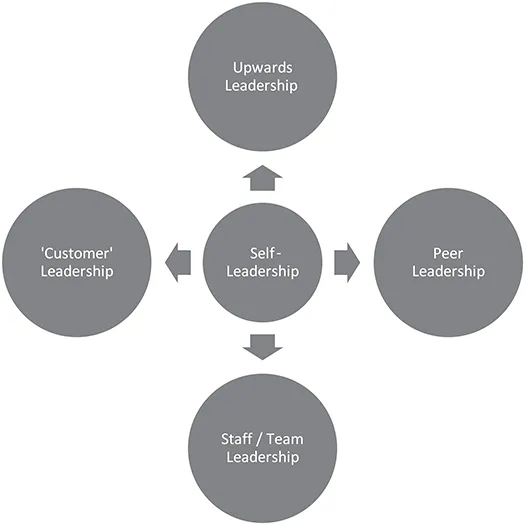
In each of these categories, leadership can be seen in several dimensions; for example, see Figure 1.1 (Newton, 2012).
Figure 1.1 A model to visualise the dimensions of leadership
Variants of this model appear to work effectively on both sides of the Atlantic, in both corporate and professional firms and in the military. In most cases, the model appears to work particularly well in the context of more senior roles, where at least an element of politics is likely to be involved; hence the increased importance of upwards leadership (see below) and stakeholder mapping/management.
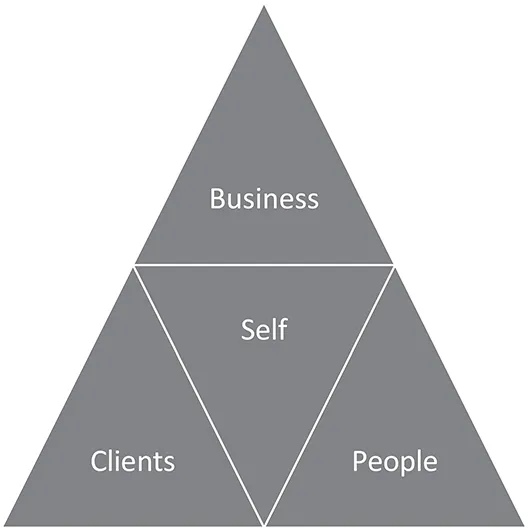
A variant of this model, developed for professional firms, was put forward in the book Professional Services Leadership Handbook by Clark, Kent, Beddow, and Furner (2017) (Figure 1.2). Aimed at managing or senior partners, this model seeks to visualise the need to balance business imperatives with those of the firm’s people and clients. At the centre of this triangle, which exists in a state of dynamic tension, sits the values and behaviours of the firm’s senior leader (shown as ‘Self’).
Figure 1.2 A leadership model for professional firms – a question of balance
Self-leadership
In both models, self-leadership is the first consideration. This is about your own values and behaviours, your psychometric preferences and your personal ‘style’ or characteristics. It is also about your personal boundaries – things you will do, or will refuse to do, regardless of the difficulties you encounter as a result. In other words, self-leadership encompasses the concepts of integrity and authenticity. We explore these ideas in greater detail below.
Questions to consider
What factors define your success as a leader?
How will your success be judged, (a) by you yourself, (b) by your team, and (c) by other stakeholders?
If these measures differ substantially, how best can you bridge the gaps?
One cannot change significantly ‘who you are’ simply because of taking on a leadership role. All you can be is yourself (as Oscar Wilde remarked, ‘Everybody else is already taken’), and experience indicates that it would be a mistake to try to present a new face to the world. To do so tends to damage perceived credibility, without which leadership success becomes immeasurably harder.
Upwards leadership
Upwards leadership (Figure 1.1) comes second. This is about managing expectations of your boss and your boss’s boss. In other words, you need to create relationships two levels up, across the range of stakeholders that impact your role. You need to manage those relationships openly and actively so that no surprises occur for anyone.
Key questions to ask in this context (and we mean ask explicitly, not implicitly) include:
How will you judge my success?
What factors will you measure in assessing my success and how will you measure them?
On what basis is your own success measured?
How can I best ensure your success? (Alternatively, ‘What actions can I take to ensure your success?’, which is more robust and results oriented.)
What is my span of decision?
The first two questions are relatively common topics for discussion when one enters a new role. They are essentially context setting and they set up future conversations around goals and evaluation of performance. It is usually helpful to record the answers so that there is no room for doubt.
The second pair of questions can serve to place you in a different position in the eyes of your boss and boss’s boss. Very few others will have asked them such questions. The effect is to emphasise your commitment to teamworking and collaboration, and your support for these individuals. Do not ask these questions lightly: you may be expected, by implication, to deliver against the answers you receive, unless you make it clear that you cannot or will not do so.
Question to consider
What specific results must you deliver in order to be recognised as successful in your leadership/management role?
The last of these questions is critical to the way in which you are able to carry out your role. Many people interpret it as a reference only to budget authorisation. However, this is only one aspect of your span of decision. More important in determining your leadership success will be to understand your authority to give instructions versus your need to exercise influence. In most cases, influence is both greatly to be preferred as a leadership style and will usually be what is required in HE leadership situations. Occasionally, an instruction becomes necessary, especially on those occasions where you experience deliberate blocking behaviour by colleagues.
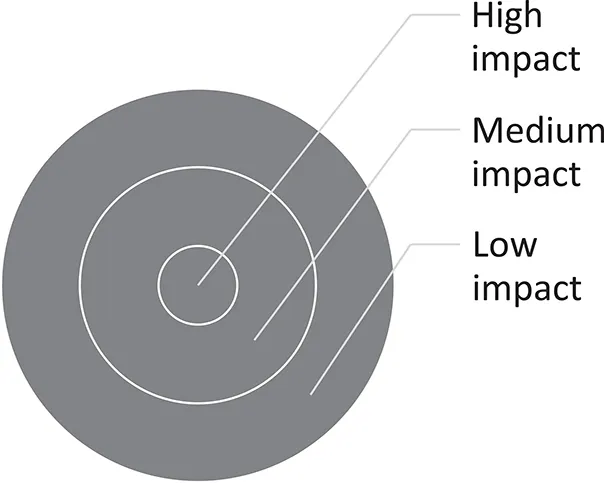
In all dimensions of this leadership model, but especially in upwards and peer leadership, it is helpful to map your stakeholders so that you can understand the various layers and complexities of relationships and competing interests more easily. We offer an approach to do this in Figure 1.3.
Figure 1.3 An approach to stakeholder mapping
Customer and peer leadership
These two can be considered together in that both require the careful use of influence. That can best be achieved by first taking a genuine interest in the relevant individuals and gathering information about what drives them personally and (where practicable) at a psychological level.
This, of course, needs to be linked to their commercial/academic/career interests (‘business interests’ for this purpose). The key is conversation, usually one-to-one. You can direct the conversation by asking well-thought-through, pre-planned questions to elicit the information you need and at the same time establish rapport. This is the basic ‘like and trust’ that is essential to any successful personal, business, professional, or academic relationship. Once you have mapped their business interests and personal drivers, it becomes far easier to present your ideas in a manner that resonates with that person.
Useful questions in this context include:
What results must you achieve in order to be recognised as successful in your current role?
What do you feel are the most important factors that drive your success in your current role? How do you measure them?
What issues or factors cause you friction in achieving the results that define your success?
What do you most enjoy about your current role?
What made you take on this role?
What do you see yourself doing next?
What do you feel will be your greatest contribution in your current role?
Peer leadership is relatively easy to define. In the HE context, it refers essentially to fellow academics and/or those in management or technical support roles. It could also include external suppliers (for example of technology) who provide critical infrastructure that is necessary for research purposes and other institutions with which HE institutions (HEIs) partner to deliver some learning outcomes – such as NHS hospitals in which medical students train.
The idea of ‘customers’ may be unfamiliar to many in HE. As most HEIs become increasingly commercial in their focus, students have come to see themselves as customers who seek a variety of results, which might include:
a good degree leading to well-rewarded employment that justifies the cost of gaining their degree
intellectual stimulation and enhanced interest in their subject, which may translate into lifelong engagement with it
positive engagement with them b...
Table of contents
Cover
Half Title
Title Page
Copyright Page
Table of Contents
Editors
Contributors
Foreword
Introduction
PART 1: Realities of leadership in higher education in a changing world
PART 2A: Leadership insights: from within the sector
PART 2B: Leadership insights: from outside the sector
PART 3: Stories of leadership in higher education
In conclusion
Index
Frequently asked questions
Yes, you can cancel anytime from the Subscription tab in your account settings on the Perlego website. Your subscription will stay active until the end of your current billing period. Learn how to cancel your subscription
No, books cannot be downloaded as external files, such as PDFs, for use outside of Perlego. However, you can download books within the Perlego app for offline reading on mobile or tablet. Learn how to download books offline
Perlego offers two plans: Essential and Complete
Essential is ideal for learners and professionals who enjoy exploring a wide range of subjects. Access the Essential Library with 800,000+ trusted titles and best-sellers across business, personal growth, and the humanities. Includes unlimited reading time and Standard Read Aloud voice.
Complete: Perfect for advanced learners and researchers needing full, unrestricted access. Unlock 1.5M+ books across hundreds of subjects, including academic and specialized titles. The Complete Plan also includes advanced features like Premium Read Aloud and Research Assistant.
Both plans are available with monthly, semester, or annual billing cycles.
We are an online textbook subscription service, where you can get access to an entire online library for less than the price of a single book per month. With over 1.5 million books across 990+ topics, we’ve got you covered! Learn about our mission
Look out for the read-aloud symbol on your next book to see if you can listen to it. The read-aloud tool reads text aloud for you, highlighting the text as it is being read. You can pause it, speed it up and slow it down. Learn more about Read Aloud
Yes! You can use the Perlego app on both iOS and Android devices to read anytime, anywhere — even offline. Perfect for commutes or when you’re on the go. Please note we cannot support devices running on iOS 13 and Android 7 or earlier. Learn more about using the app
Yes, you can access The Practice of Leadership in Higher Education by Kendall Jarrett, Stephen Newton, Kendall Jarrett,Stephen Newton, Stephen Newton, Kendall Jarrett in PDF and/or ePUB format, as well as other popular books in Didattica & Didattica generale. We have over 1.5 million books available in our catalogue for you to explore.