Building off the highly successful The Cyborg Handbook, this new collection of essays, interviews, and creative pieces brings together a set of compelling personal accounts about what it means to live as a cyborg in the twenty-first century.
Human integration with complex technologies goes back to clothes, cooking, and language, but has accelerated incredibly in the last few centuries, with interest spreading among scientists, coders, people with sophisticated implants, theorists, and artists. This collection includes some of the most articulate of these voices from over 25 countries, including Donna Haraway, Stelarc, Natasha Vita-More, Steve Mann, Amber Case, Michael Chorost, Moon Ribas, Kevin Warwick, Sandy Stone, Dion Farquhar, Angeliki Malakasioti, Elif Ayiter, Heesang Lee, Angel Gordo, and others. Addressing topics including race, gender, sexuality, class, conflict, capitalism, climate change, disability and beyond, this collection also explores the differences between robots, androids, cyborgs, hybrids, post-, trans-, and techno-humans, offering readers a critical vocabulary for understanding and discussing the cyborgification of culture and everyday life.
Compelling, interdisciplinary, and international, the book is a perfect primer for students, researchers, and teachers of cyberculture, media and cultural theory, and science fiction studies, as well as anyone interested in the intersections between human and machine.
Trusted by 375,005 students
Access to over 1 million titles for a fair monthly price.
Why Priveillance Is More Important to Our Cyborg Future Than Privacy
Steve Mann
I’ve been a professor for over 20 years, during which time my students and I founded many successful companies on the principles of “HuMachine Intelligence” (H.I.) (Minsky, Kurzweil, and Mann 2013), i.e. cyborg technologies, including human-in-the-loop A.I.
Cyborg technology is probably the single most important advancement to human civilization, but it is being threatened by a new kind of surveillance that calls itself “privacy”. This newspeak “privacy” is perhaps the single largest threat to not just cyborg technology, but to democracy itself.
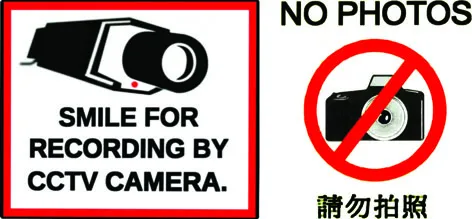
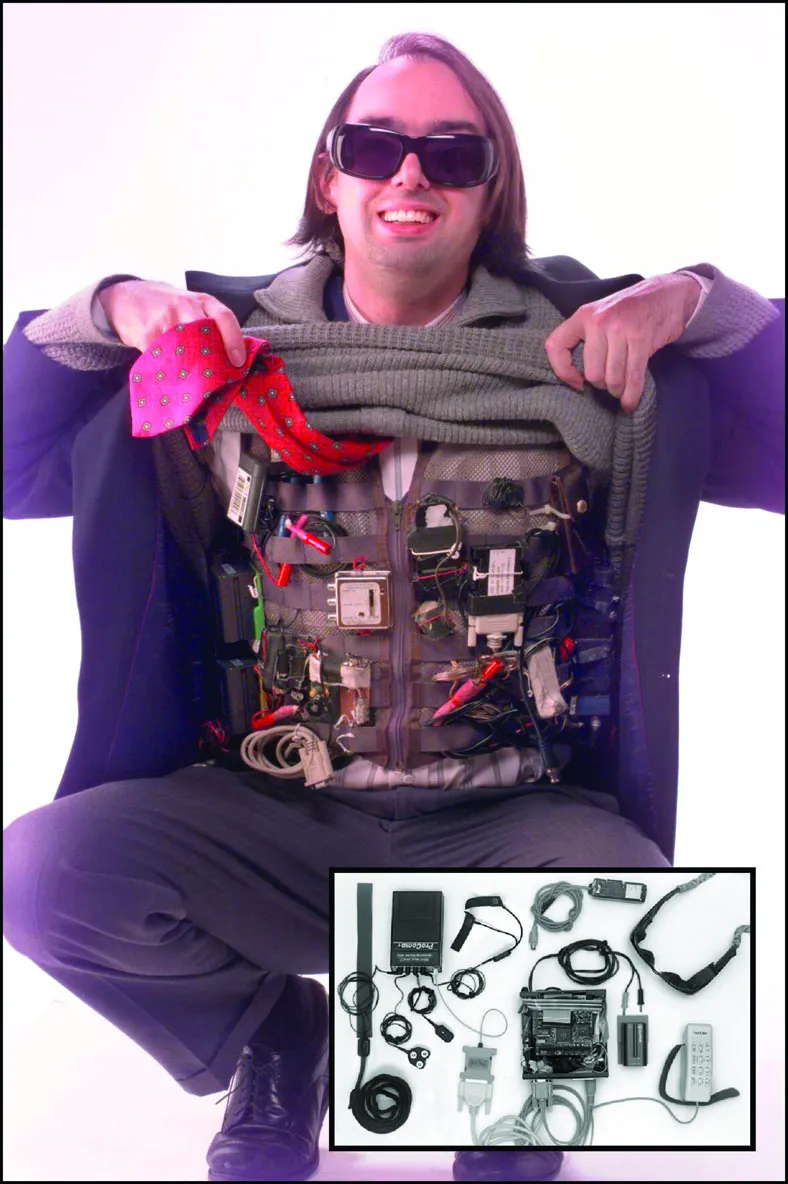
Figure 1.1Smile!
A Childhood Exploring
My current work in wearable computers and related areas can be traced directly to my childhood fascinations. In the 1960s my parents and grandparents taught me how to make things, and how to invent new things like underwater musical instruments. They taught me how to measure things in inches, feet, hands, hand spans, finger breadths, cubits, and “Steves” (units of my own height). These ancient Egyptian, Mesopotamian, Hebrew, Greek, and Roman units of measure, combined with daily Bible readings, left me with the idea that the human body itself could and should be used as an existential sort of ruler with which to more deeply understand and measure the world. One palm (i.e. 3 inches) equals four digits (4 “fingers”), so a finger is 3/4 of an inch. Three palms equals one hand span, and two hand spans equals one cubit, and two cubits equals one yard.
These units were not very accurate, especially considering that I had not grown up to adult size yet, but I certainly developed a high degree of proficiency in working with fractions (e.g. a 3/8 drill is half the size of a 3/4 drill, etc.) and doing arithmetic in my head: 12 inches equals one foot, so there are 4 palms in a foot, and three hands in a foot, so a palm is 3/4 of a hand. While not as accurate as measuring the world in millimeters or angstroms, it gave me a more fundamental understanding of the existential nature of the world, and of my place in it.
My father would sometimes call one of his associates at work, and be told “He’s smelling cloth and will call you back when he’s done.” When I asked my dad what “smelling cloth” meant, he said that means measuring cloth, which is done by holding the cloth to your nose, and then pulling it along your nose until your arm is fully outstretched, and then grabbing it again where your nose is and pulling it out again, while counting the number of times you do this in succession. The distance from the nose to the end of the outstretched arm is called a “yard”, and cloth is sold by the yard. A yard is 2 cubits or 3 feet or 4 hand spans or 9 hands or 12 palms or 36 inches or 48 fingers.
I liked the way these ancient units of measurement were designed around carefully chosen numbers that worked easily for mental arithmetic. This taught me about highly composite numbers (numbers with lots of divisors) which are: 1, 2, 4, 6, 12, 24, 36, 48, 60, 120, 180, 240, 360, and so on. That’s why there are 60 seconds (not 10 or 100) in every minute, and 60 minutes in every hour. That’s also why there are 360 degrees (not 100 or 1000) in a circle. It meant that mathematics was a part of my own body. This meant that mathematics felt as if it was a part of me, and I became naturally adept at math since the age of 3 or 4.
My father worked at Cambridge Clothes (Coppley, Noyes & Randall Ltd.), a men’s clothing manufacturer founded in 1883. This meant that I had lots of cloth to “smell”, and I sometimes tried to make my own clothes. My grandmother taught me how to knit and sew, and I became quite proficient at making clothes, and also at making things out of cloth.
My father’s childhood hobby was building radios. Back in the days of large console and table radios, he built one of the first pocket radios, a radio you could wear. The French word “portable” comes from the Latin word “portare” “to carry”. The French word “porter” means “to wear”, “carry”, or “bear”.
Unsurprisingly, I also developed a childhood obsession with things like radios that were wearable, and began to experiment with making cloth out of wires, and sewing wire into clothes. My mother was rather upset when she found me trying to run fine wire through the sewing machine, but my grandmother had an older and more rugged “Singer” sewing machine that made experimentation a bit easier.
My grandfather taught me how to weld, and while looking at the world through the welding glass, darkly, I had a vision of how people could see better using machines. I envisioned a wearable television station using cameras to sense the world and redisplay it so that I could see perfectly while welding, without exposing my eyes directly to the bright light. It was this childhood vision that inspired me to later invent HDR (High Dynamic Range) imaging now used in billions of smartphones (http://wearcam.org/hdr.htm).
My childhood fascination with television led me to begin collecting old television sets that people were throwing in the garbage. When I was about 8 years old, I was taking apart TV sets and fixing them, and soon people in the neighborhood came to me with TV sets to fix, and I ended up starting my own radio and TV repair business. I also wanted to see the otherwise invisible television signals, so I devised a way to convert some old television receivers into oscilloscopes. It took a while to get this right, and the first one I made overheated. My father got me an old broken RCA Cathode Ray Oscillograph that was being thrown away. The time base (sweep) was broken so it could not plot or draw graphs as a function of time. But there was a dot on the screen that could only move up-and-down (not left-to-right).
I wanted to see the invisible radio wave from a police radar gun, so I pushed the oscillograph from left-to-right on my workbench, while it was connected to the Doppler radar signal. The oscillograph was housed in a large steel cabinet, so it produced a strong radar return, and as I moved it from left-to-right, I could see the radio wave on the screen very clearly as a function of the position of the oscillograph’s metal housing.
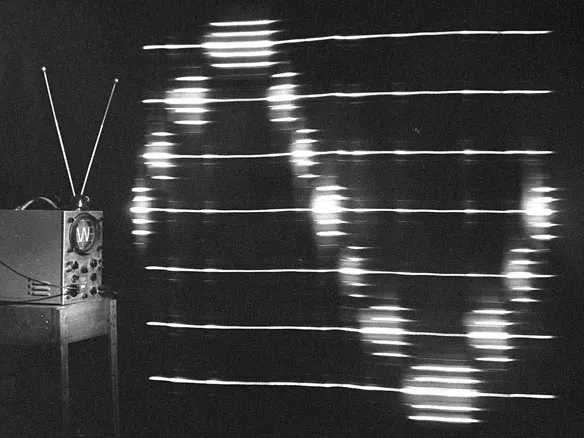
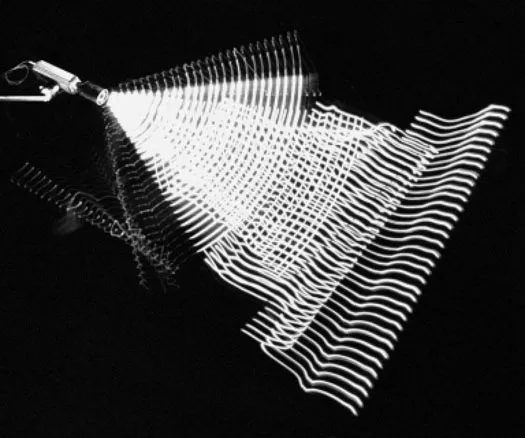
I had discovered something I thought was quite important. I could see (and photograph) radio waves in such a way that they were aligned perfectly in space (rather than merely in time, as on a normal oscilloscope). I called this invention the Sequential Wave Imprinting Machine (S.W.I.M.) because it sequentially imprints radio waves on the eye or on film, giving rise to a “real reality” in which one could see what is really present all around us, but otherwise invisible. So it is a phenomenological augmented reality machine.
I soon replaced the heavy oscilloscope SWIM with a row of light bulbs on a stick with an antenna or microphone that I could wave through the air to see and photograph radio waves and sound waves.
Figure 1.2SWIMwaves
I also discovered I could use the SWIM for video feedback to see, and photograph a surveillance camera’s ability to see. I called this Metavision (which later became the name of a company I co-founded with one of my PhD students, Raymond Lo).
A meta-conversation is a conversation about conversations. A meta argument is an argument about arguments. Metadata is data about data. Likewise, Metavision is the vision of vision, i.e. seeing sight (such as seeing a camera’s ability to see, and recording a camera’s ability to record), and more generally, sensing sensors and sensing their capacity to sense (Mann 2018).
Figure 1.3Metavision
Back in the 1970s, I was particularly fascinated by the relationship between the workings of the body and its relationship to its surroundings. I built many different kinds of sensors to explore what was happening inside my body in relation to what was happening around it. Using miniature cathode-ray tubes that were originally designed as camera viewfinders, I made a wearable oscillograph so I could see my cardiac (heart) waveform, as well as my brainwaves for biofeedback while exercising. I called this “Quantigraphic Self-Sensing” because the wearable oscillograph allowed me to quantify, graphically, various physiological phenomena.
I also had a childhood dream about a device that was a radio, television, telephone, music player, health monitor, camera, and computer all in the same device, which I built various prototypes of, to varying degrees.
All these youthful projects were about extending my ability to experience, to know, the world. I continued with this work during my undergraduate schooling and after that I was accepted to MIT (the Massachusetts Institute of Technology) and brought these inventions there to found the MIT Media Lab’s wearable computing project, as its first member. See my website, http://wearcam.org/nn.htm for more details.
While at MIT, a number of companies became interested in my inventions and I was flown back and forth between MIT and Silicon Valley, California, where I spent quite a bit of time “inventing the future” as they used to call it. In 1996 I presented my “body of work” to the people at WiReD magazine, and WiReD’s Kevin Kelly took a keen interest in my Quantigraphic Self-Sensing invention, and he began to write about the “Quantified Self” as a social movement.
Figure 1.4Steven Mann
About 10 years later, my students James Fung (now with Google) and Chris Aimone, and I, along with others, founded a company on the main floor of my principal residence, which quickly expanded to take up most of the building, before moving to a larger space. We raised $28,800,000 to make the Muse, a product now sold in Best Buy stores all across North America and on Amazon.com, known as “The King of Wearables” (BetaKit), the “#1 in wearables” (PC Retail), and “the holy grail for mindfulness” (Taylor 2018).
Today there are many of us, so-called “cyborgs”, who use technology to improve our lives. It can even be argued that most of us are cyborgs of a sort, i.e. most of us have used human-made technologies to improve our lives. I am not interested in empowering others to watch me, but the technologies don’t just “look” in one direction. Self-awareness technologies depend on the same science and engineering that enables surveillance, after all.
“Privacy” is Surveillance
There has been a recent trend to install surveillance cameras in locker rooms where people change clothes and are naked. Officials doing so used to be forced to resign and were even imprisoned. But in 2007 the “Privacy Commissioner” in the Canadian province of Alberta, ruled that the Talisman Centre in Calgary can continue to use locker-room video cameras as long as only staff or police can view the recordings (Fraser 2007). The Westside Recreation Centre, also in Calgary, defends its use of locker room cameras as long as the images are kept “secure” (Frakes 2016). This shows how “security” itself can become another form of surveillance (Mann 2014).
What we see here is a new definition of “privacy” in which it is okay for police and staff and other officials to watch people, as long as the people are protected from being watched by each other. Social media companies have created a similar kind of “privacy” in which they offer governments and businesses (for a fee) the ability to spy on people, while protecting individual users from spying on each other.
In olden times, when we went away on vacation, we might leave our house keys with neighbors and ask them to check up on our house now and again, to make sure the pipes are not freezing and bursting, or to keep a lookout for burglars. Now we might install surveillance cameras and rely on an alarm company or the police.
Anyone who’s tried to photograph a police officer, or who’s even merely tried to wear a camera-based seeing aid in the presence of a police officer, will be able to tell you how violent and law-breaking the police can get when being watched through any form of technological prosthesis.
In my own experience, I’ve been physically assaulted by police officers as well as security guards, simply because I have been wearing a computerized seeing aid, not even recording anything. The reason that they broke the law to attack me was, allegedly, that they were trying to protect the privacy of other people, although I suspect that they were law breaking for selfish reasons, perhaps to evade accountability, or to maintain their monopoly on sight. We now live in a world of ever-increasing one-sided surveillance combined with an ever-increasing degree of secrecy.
There are many different veillances: surveillance (oversight), sousveillance (undersight), and dataveillance. But surveillance is unique in that it is the veillance of authority, i.e. the veillance with...
Table of contents
Cover
Half Title
Title Page
Copyright Page
Dedication
Table of Contents
Acknowledgements
“You are a Cyborg; Deal with it!”: The Overdetermination of Cyborgization
Part 1 Being a Cyborg Is My Job
Part 2 Being a Cyborg for My Health
Part 3 Imagining Myself Cyborg
Part 4 Performing My Cyborgness
Part 5 Thinking Myself a Cyborg
Illustrations
Index
Frequently asked questions
Yes, you can cancel anytime from the Subscription tab in your account settings on the Perlego website. Your subscription will stay active until the end of your current billing period. Learn how to cancel your subscription
No, books cannot be downloaded as external files, such as PDFs, for use outside of Perlego. However, you can download books within the Perlego app for offline reading on mobile or tablet. Learn how to download books offline
Perlego offers two plans: Essential and Complete
Essential is ideal for learners and professionals who enjoy exploring a wide range of subjects. Access the Essential Library with 800,000+ trusted titles and best-sellers across business, personal growth, and the humanities. Includes unlimited reading time and Standard Read Aloud voice.
Complete: Perfect for advanced learners and researchers needing full, unrestricted access. Unlock 1.4M+ books across hundreds of subjects, including academic and specialized titles. The Complete Plan also includes advanced features like Premium Read Aloud and Research Assistant.
Both plans are available with monthly, semester, or annual billing cycles.
We are an online textbook subscription service, where you can get access to an entire online library for less than the price of a single book per month. With over 1 million books across 990+ topics, we’ve got you covered! Learn about our mission
Look out for the read-aloud symbol on your next book to see if you can listen to it. The read-aloud tool reads text aloud for you, highlighting the text as it is being read. You can pause it, speed it up and slow it down. Learn more about Read Aloud
Yes! You can use the Perlego app on both iOS and Android devices to read anytime, anywhere — even offline. Perfect for commutes or when you’re on the go. Please note we cannot support devices running on iOS 13 and Android 7 or earlier. Learn more about using the app
Yes, you can access Modified: Living as a Cyborg by Chris Hables Gray, Heidi Figueroa-Sarriera, Steven Mentor, Chris Hables Gray,Heidi Figueroa-Sarriera,Steven Mentor in PDF and/or ePUB format, as well as other popular books in Social Sciences & Computer Science General. We have over one million books available in our catalogue for you to explore.